





Global businesses are no longer facing isolated disruptions. Instead, they are operating with a constant churn of change. Tariffs may be the issue of the moment, but they are only one signal in a wider pattern. External forces are increasingly influencing internal decisions, and many organizations are still not equipped to respond effectively. These forces are increasingly driving companies to respond differently, quickly and effectively.
This is a moment for leadership to take a broader view and build resilience for the future.

Why strategy stalls before it starts
It’s difficult to plan and make decisions without clarity. And in the current tariff environment, there’s not much clarity and no single solution. The pressure is coming from all sides: policy shifts, supply disruptions, cost volatility and operational constraints. Many organizations are trying to respond but find themselves blocked by structural breakdowns that prevent fast, confident decision-making.
The following challenges make it nearly impossible to respond strategically, even when the need for action is clear. They can slow down decisions, create conflicting priorities and leave companies exposed just when they need to move together.
Real-world tariff challenges: industry snapshots
Food & beverage
A food and beverage company relies heavily on apple juice concentrate, which is sourced from China and difficult to procure outside that region. With new tariffs in play, they explore alternatives in Mexico and Brazil, only to face capacity limitations and new cost concerns. Reformulating recipes introduces manufacturing and R&D complexity, which sourcing shifts raise tax and compliance implications tied to long-standing low-tax jurisdictions.
Apparel
A clothing brand manages a fully outsourced global production model, from stitching and assembly to tagging and packaging. With no owned operations, the company has limited visibility into subcontractors or material origins. Tariff exposure is difficult to trace and model and fragmentation across the value chain slows down the ability to respond with confidence.
Chemicals
A high-margin chemicals company sources most raw materials from China, exposing itself to concentrated risk. Current performance remains strong, but leadership lacks a diversification plan and clear execution path. The company’s profitability masks a deeper vulnerability. If trade conditions change quickly, they are not set up to respond without disruption.
Auto manufacturing
A US-based automaker assembles vehicles domestically, but key parts move through Mexico multiple times. The most significant tariff exposure lies in tier 2 and 3 suppliers, where visibility is low. This multi-border movement creates cost layering and compliance challenges while upstream disruptions quietly drive pricing pressure downstream.
Planning across time horizons
Disruption resilience requires a coordinated set of actions mapped across time. Some decisions should happen immediately. Others require preparation, staging or long-term shifts in strategy and structure.
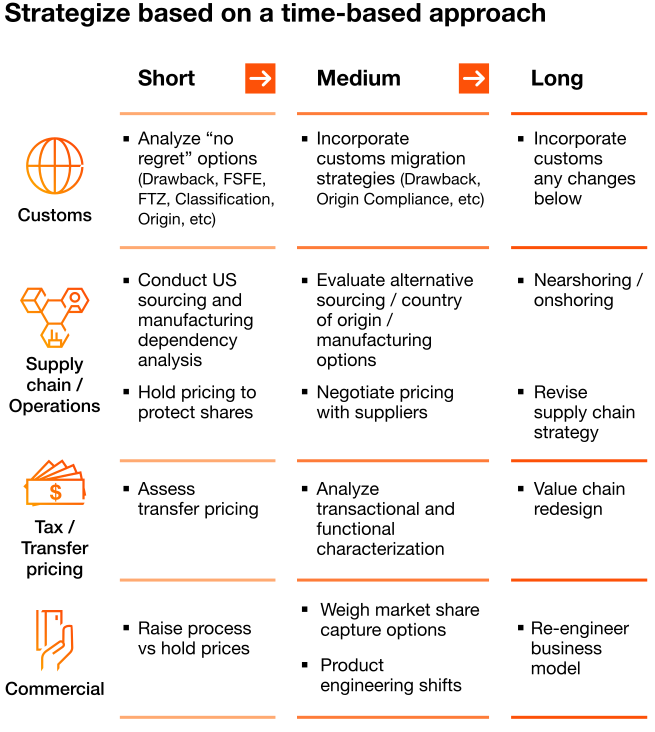
Tariffs are a clear example of this. They demand quick tactical moves, like supplier negotiations or cost modeling. But they also raise questions that play out over months or years, including tax planning, operating model design and commercial positioning. The table below outlines how organizations can structure their short-, medium- and long-term responses to tariff-related challenges across customs, supply chain, tax and commercial strategy. This isn’t a linear roadmap. It’s a repeatable decision framework. The goal isn’t just to respond once, but to keep planning as conditions evolve.
Questions to ask yourself to identify your current gaps
Responding to tariffs and other disruption takes more than data or instincts. It requires the ability to connect insights to coordinated action. You’re probably feeling the pressure to act but still lack the systems and structures to do so confidently. Our May Pulse Survey found that while many companies are cutting costs and renegotiating with suppliers in response to the tariff situation, fewer have built scenario planning and cross-functional capabilities that translate into strategy. The following questions can prompt deeper reflection about what’s missing, what’s misaligned and what might need to change.
Start with the future, then work back
The questions companies are facing today about tariffs, costs, supply risk and structure aren’t just short-term challenges. They’re signals that it’s time to reimagine how the business makes decisions. That means letting go of reactive planning cycles and fragmented tools and instead asking: what should our decision environment look like in a world where uncertainty is constant?
Confident, resilient organizations start with a vision of their future state. One where cross-functional data is connected, scenario planning is continuous and teams are equipped to act together in real time. Then they work backward, identifying the systems, inputs and cultural shifts needed to get there. This isn’t just about navigating the current moment. It’s about building a capability that lasts and helps the organization move from disruption-prone to future-ready.
Model uncertainty in real time
Chart your next move
See how leaders are adapting to policy and supply shifts