






{{item.videoDuration}}
{{item.title}}
{{item.text}}

{{item.videoDuration}}
{{item.text}}
Across industries, the accelerating pace of technology change is often placing sustained pressure on data and engineering teams. Platform modernization programs and the push to make data usable for AI and analytics are adding work faster than teams can absorb it, increasing the demand on technical teams whose headcount remains largely fixed. The result is a widening gap between what the business should deliver, and the capacity to deliver it.
AI coding assistants speak directly to this constraint, helping teams write code faster and accelerate delivery. For organizations in regulated industries such as healthcare and financial services, however, adopting these tools is rarely straightforward. The source code, data schemas, and surrounding context that makes AI coding assistants powerful are often sensitive, and most AI coding tools are not built with the residency, privacy, and governance requirements these organizations require. As a result, many of the teams that stand to benefit most from AI-assisted development are among the slowest to adopt it. For technology leaders, the question is no longer whether to adopt these tools. It is how to do so without compromising the controls that keep data secure.
PwC set out to address this question with a large healthcare payer by bringing Claude Code, Anthropic's agentic coding tool, into the organization's existing AWS environment. Through this implementation, Claude Code runs entirely within the organization's security perimeter on Amazon SageMaker Studio and Amazon Bedrock. In an initial pilot, the implementation of this tool helped the cloud data engineering team reduce the time spent on routine pipeline changes by ~75%, and saved several hours of effort on exploratory development work. The AI-generated output remained subject to the team's existing peer-review process, while also preserving established security controls and configurations.
In this post, we walk through the implementation approach and how it works inside an AWS environment, describe how the team applied it across two data engineering use cases in a focused pilot, and identify the challenges to plan for when performing similar implementations.
Faced with this challenge, most organizations land on one of two responses. The first is to prohibit external AI coding tools. While this helps safeguard data and keeps security strong, the underlying capacity problem does not go away. Teams are still faced with the same backlog of work, increased demand, and reliance on patterns and ways of working that were not designed to handle the scale and capacity that the industry is demanding.
The second is to enable the use and adoption of external AI coding tools, but without a clearly defined governance model. While an optimistic solution, this path tends to surface risk and issues only after they have been materialized, and can leave businesses exposed and vulnerable.
Both of these responses treat security and speed as a tradeoff, when in reality, they do not need to be. The constraint is not whether an AI coding assistant can be trusted with sensitive work, but rather if the environment and controls around it can guarantee that sensitive work is secure from day one. This is not a decision of policy, but rather a question of system design and architecture; one that PwC set out to answer with Claude Code on AWS.
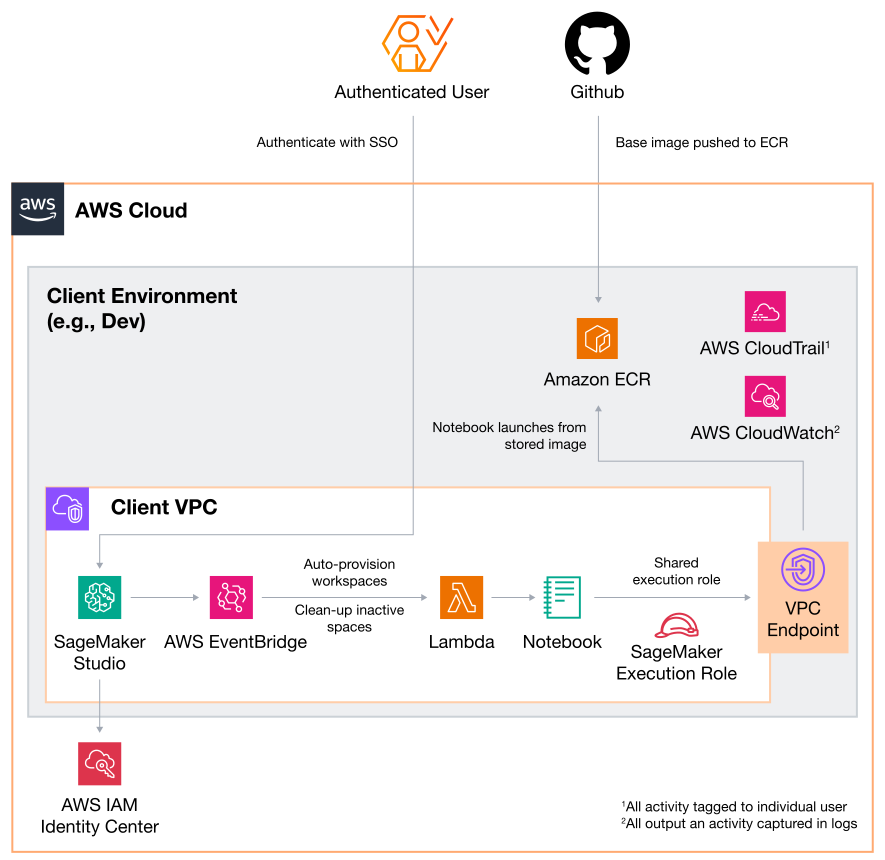
The solution helps address the capacity and governance problem through three components: where the tool runs, how team knowledge gets applied, and how adoption is rolled out.
Environment
Claude Code runs inside the client's AWS account. Amazon Bedrock provides model access and Amazon SageMaker Studio provides the development environment. There is no public internet path, and outbound access is restricted to an allowlist of approved tools and MCP servers. Developers authenticate through the organization's existing SSO and AWS IAM Identity Center, with no direct AWS console access required. Because the tool operates entirely inside the client’s existing perimeter, code, prompts, and outputs do not leave the already secure environment.
Codified team knowledge
Team knowledge, ways of working, and domain-specific process rules are codified into reusable skills instead of remaining tribal knowledge. Activities such as classifying sensitive fields, structuring configuration files, and applying team-specific naming and formatting conventions are written once as a skill, rather than existing only as unwritten context that different developers apply inconsistently or incorrectly. This turns practices that previously depended on informal, person-specific knowledge into a standard that is applied the same way each time, by any developer, automatically.
Pilot-first rollout
Our team began with a focused pilot instead of skipping ahead to a broad rollout. A small group of developers used the tool on real production work, covering both a repeated, monotonous task and an exploratory development one. Pilot results were verified before tool access was expanded to the broader development team. This gave the organization a way to assess the security model and the productivity results against actual outcomes before committing to scale.
This use case involved onboarding new source tables into the data pipeline, a task that team members perform dozens of times each year. This effort involves the same series of steps each time: writing table configuration entries, applying rules for masking sensitive fields, and checking the result against the target schema. This kind of work enabled us to demonstrate where Claude Code adds value on tasks that are repeated often and follow an established pattern. To facilitate this workflow, the team built a series of reusable skills and modules:
In this instance, Claude Code took the effort of onboarding a batch of ten new source tables from roughly 12 hours of manual effort down to under 3, while producing output consistent with that of developer's manual efforts. As with the output from the pilot, each generated skill, configuration, and piece of output was reviewed by humans, treating it with the same level of scrutiny as any other change committed to the codebase. This use case demonstrated significantly high value in removing the time and inconsistency that comes with re-applying the same rules by hand, turning a task that used to depend on careful manual repetition into one where a developer's time is spent reviewing and confirming decisions rather than producing them from scratch.
This use case involved reconstructing how a legacy system was built across scattered files and stored procedures. This kind of work enabled us to demonstrate where Claude Code can add a different type of value than automating repeatable tasks. Rather than following a fixed pattern, the tool read across a codebase, traced dependencies between files, and surfaced relevant context that could otherwise take a developer hours to piece together manually.
In this instance, Claude Code helped a senior level developer remove several hours of discovery effort by mapping how existing schemas and procedures were structured, and saved additional hours through the assistance in writing stored procedures, stage DDLs, and overall debugging. This work was held to the same review standard as the rest of the pilot. The value here was less about speed on a known task and more about helping developers compress the time it takes to understand a new system or hunt for unfamiliar code, turning a slow, manual process into one where a developer can move quickly into making changes with confidence.
The following lessons reflect our learnings from the broad experience enabling Claude Code for the client, and should be considered when approaching future Claude Code enablement work:
The capacity gap facing data and engineering teams will likely not go away on its own, and AI coding assistants like Claude Code offer a way to help close this gap. Organizations today know it is not a matter of if they should leverage these tools, but how. They require an environment that can assure them security and control from day one.
By running Claude Code inside their own AWS environments, organizations can adopt AI-assisted development within the security and governance controls they already have in place. PwC and AWS worked together to bring this approach to life for a large healthcare payer, and the results have shown that security and speed do not have to be a tradeoff when using these tools. Organizations facing similar demand and capacity constraints should look to their own AWS environments to enable AI-assisted development, rather than relying on external tools that sit outside controls.
{{item.text}}
{{item.text}}


