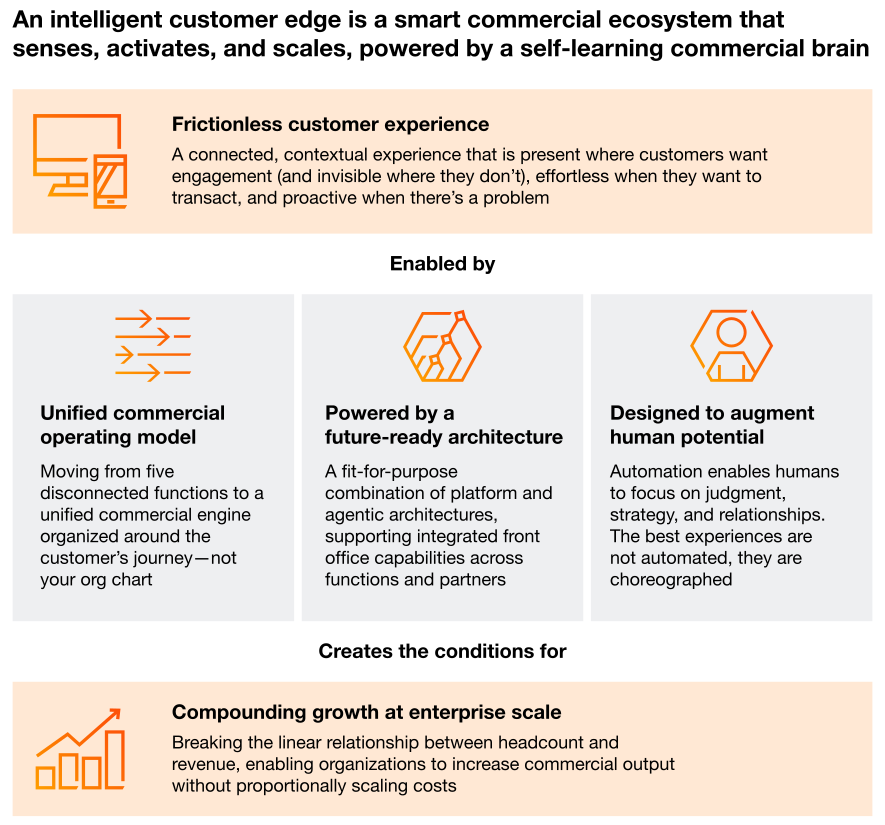



Connect customer-facing functions through one commercial operating model, shared intelligence, and clear accountability.

Build an intelligent customer edge:
PwC's approach to the agentic front office

hero image

For organizations navigating customer experience transformation, commercial transformation, and the rise of AI-mediated buying, the question is no longer whether AI can help. It is whether the front office is designed to act as one coordinated engine, powered by a centralized “commercial brain”, and led by one accountable leader.

This shift is often called the agentic front office: the move from siloed, human-gated functions to a connected system where AI agents and humans work together across the customer lifecycle. PwC's point of view on this shift is the intelligent customer edge—a model for growth, margin protection, and customer value built not by layering AI copilots onto existing functions, but by redesigning how customer-facing operations coordinate decisions, actions, and accountability end to end.


Why front office transformation matters now

Traditional growth levers are producing diminishing returns while leadership teams continue to face pressure to deliver profitable growth. 30% of CEOs report confidence in organic revenue growth over the next twelve months (PwC's 29th Global CEO Survey). The familiar commercial playbook is no longer sufficient.

Human-intensive commercial models are often too slow, too manual, and too fragmented to support the speed and precision the market now demands. As noted by Gartner in a survey, “56% of CFOs rank achieving enterprise-wide cost optimization targets in their top five, while 51% of respondents rank improving financial forecast accuracy and quality in their top five.” In the human-centric commercial model at many companies, sales, marketing, and service functions consume nearly 30% of revenue in operating costs, on average.

Customers increasingly use AI to research, compare, qualify, and narrow choices before a human interaction ever begins. AI-influenced commerce is already a measurable force in retail: according to Salesforce, AI-influenced commerce drove 20% of all online purchases during Cyber Week 2025 alone, generating $67 billion in sales. Your commercial systems must engage intelligently not just with human buyers, but with the AI agents acting on their behalf.

AI deployed at the task level can improve efficiency, but it rarely fixes the structural disconnects between marketing, sales, commerce, service, and pricing. Organizations capturing compounding value are those that have redesigned their commercial architecture around agentic capabilities.

When front-office functions operate independently, the customer experiences the org chart rather than the brand, and the business loses value across the seams. PwC's 2026 AI Performance Study found that just 20% of companies capture 74% of all AI-driven value. AI leaders are roughly twice as likely as other companies to apply AI across the value chain, while most organizations still concentrate AI in a handful of disconnected use cases. Customer experience transformation and commercial transformation are now the same agenda.


What is an intelligent customer edge?

An intelligent customer edge builds every customer-facing function into a single, intelligent system. It’s a new commercial ecosystem that uses agentic AI to connect marketing, sales, commerce, service, and pricing into one intelligent, self-optimizing system.

Rather than improving each function in isolation, it redesigns how the front office works around connected customer moments, shared intelligence, and coordinated action.

In practical terms, that means:

  • One commercial operating model instead of disconnected functions
  • One intelligence layer instead of fragmented data and signals
  • One coordinated system of human and AI execution across the customer lifecycle
  • One leader accountable for growth, customer value, service continuity, and the quality of the end-to-end experience

This is the next evolution of front office transformation with agentic AI.

Business outcomes of creating an intelligent customer edge

Better growth coordination

Create tighter alignment across awareness, conversion, service, renewal, and expansion. A unified commercial engine ensures that each customer moment builds on previous interactions, reducing friction and accelerating revenue growth.

Stronger margin discipline

Reduce leakage across pricing, handoffs, approvals, and fulfillment. When one leader owns the whole experience, there are fewer seams where value escapes. Pricing discipline, contract management, and margin protection improve systematically.

Better customer continuity

Create a more connected, contextual experience across the full lifecycle. Customers experience one brand and one relationship. Service interactions inform sales opportunities. Pricing reflects customer value. Every moment strengthens the relationship.


Where are you on the maturity curve?

“My departments don't talk to each other — and neither do my systems.”

  • Customer experience: Fragmented customer experience across every touchpoint.
  • Operating model: Functional silos with separate scorecards and leadership.
  • Business processes: Manual, human-gated steps at every stage.
  • Data & technology: Siloed systems with no unified customer view.
  • AI role: Absent or experimental.
  • Human role: Task execution and data entry.

“My teams are more efficient — but we're still running in separate lanes.”

  • Customer experience: Better CX within functions but broken at every handoff.
  • Operating model: Efficient silos with emerging cross-functional visibility.
  • Business processes: Automated within functions, manual handoffs between them.
  • Data & technology: Unified within functions; some cross-functional visibility.
  • AI role: Functional copilot assisting individual tasks.
  • Human role: Supervise execution and manage exceptions.

“My functions are starting to work as a system — agents are handing off to each other.”

  • Customer experience: Journeys connect across functions with persistent context.
  • Operating model: Integrated workflows with shifting roles from execution to oversight.
  • Business processes: Agents trigger and hand off to each other across boundaries.
  • Data & technology: Shared cross-functional data foundation; early "commercial brain".
  • AI role: Cross-functional orchestrator coordinating workflows.
  • Human role: Manage exceptions and strategic decisions.

“My commercial engine senses, decides, and acts — my people focus on what only humans can do.”

  • Customer experience: A single, continuous commercial relationship.
  • Operating model: Unified operating model organized around customer moments.
  • Business processes: Autonomous end-to-end execution within governed guardrails.
  • Data & technology: Full “commercial brain” — self-enriching and API-accessible.
  • AI role: Autonomous commercial system with compounding intelligence.
  • Human role: Strategic oversight, judgment, and relationship stewardship.

Who should lead the new commercial ecosystem?

The title will vary by organization. The mandate should not. Many companies still manage the customer through separate functions:

  • Marketing owns awareness
  • Sales owns pipeline
  • Commerce owns transactions
  • Service owns issues
  • Pricing owns discipline

But customers do not experience the org chart. They experience one brand, one relationship, and one sequence of moments.

In an agentic world, where AI can sense signals, coordinate actions, and trigger workflows across the front office in real time, this fragmentation becomes a liability. If no one owns the whole system, no one owns the leakage between its parts.

The end-to-end customer and commercial experience should have one accountable owner and one coordinated operating model.


Frequently asked questions

The agentic front office is a commercial operating model that uses agentic AI to connect marketing, sales, commerce, service, and pricing into one intelligent, self-optimizing system. PwC calls this model the intelligent customer edge: not a collection of AI tools layered onto existing functions, but a redesign of how customer-facing operations coordinate decisions, actions, and accountability across the customer lifecycle.

Agentic AI transforms the front office by improving how customer-facing functions work together, not just how individual tasks get done. It helps the organization sense, decide, and act as one commercial engine—with AI agents handling execution and humans focused on judgment, strategy, and relationship-building.

Outcomes can include revenue uplift, cost reduction, margin protection, productivity gains, and stronger customer experience outcomes.

The "commercial brain" is the intelligence layer that connects proprietary data, customer interactions, and AI agents to continuously improve decisions and actions.

Most agentic AI use cases improve tasks within one function. The agentic front office redesigns the full commercial operating model across functions.

Start by aligning ownership of the commercial engine, unifying the data and knowledge foundation, and identifying a small set of self-funding micro-journeys.


Contact us

Ian Kahn

Principal, US and Global Customer and Commercial Excellence Platform Leader, PwC US

Pete Choo

Principal, Customer & Commercial Excellence, PwC US

Jose Linares

Principal, Customer and Commercial Excellence, PwC US

Follow us

Required fields are marked with an asterisk(*)

Your personal information will be handled in accordance with our Privacy Statement. You can update your communication preferences at any time by clicking the unsubscribe link in a PwC email or by submitting a request as outlined in our Privacy Statement.

Hide