






Turning AI ambition into end-to-end reinvention

PwC’s 2026 Digital Trends in Operations Survey

An employee scanning warehouse products
  • Insight
  • 14 minute read
  • April 23, 2026
89%

of operations leaders say their tech investments haven’t fully delivered the expected results

87%

say poor data quality has impacted their organization’s ability to achieve value for digital initiatives

94%

say their organization is likely to shift toward a more horizontal, networked operational structure

There’s a gap between optimism and execution when it comes to technology investments, AI achievements, and measurable innovation in company operations. In our 2026 Digital Trends in Operations Survey of 767 operations and supply chain leaders at US companies, 85% say they’re ahead of most competitors in digital transformation, yet 89% say their tech investments haven’t fully delivered the expected results.

Other key issues are posing challenges to reinventing operations.

  • More than four-fifths (83%) of respondents say AI agents and automation will accelerate the breakdown of traditional functional silos. But only 27% have fully embedded an AI strategy across business units, and just 37% are comfortable assigning AI agents to execute full end-to-end processes in operations.
  • While data foundations are stronger, only 30% report significant improvement in data quality and reliability, and 87% say poor data quality has hampered their progress in achieving value for digital initiatives.
  • Nearly all intend to reorganize their operations, but while 94% of those with siloed or partially integrated operating structures expect to shift toward a more horizontal, networked model, only 41% of companies operate that way today.

While these challenges are real and widespread, a few companies seem to be cracking the code. A deeper dive into survey data reveals a handful of leaders who say their companies have fully embedded AI, modernized data foundations, and redesigned operating models in tandem—and are outperforming peers, sometimes dramatically.

This reinforces a mandate for organizations that are falling short. Competitive advantage won’t come from isolated pilots or incremental upgrades but by moving from fragmented progress to bold, integrated reinvention.  

Survey chart

Develop integrated digital muscle to deliver more value

At many companies, attention to AI remains short-sighted. While digitizing operations should be done hand in hand with business strategy, many survey respondents report an approach of addressing issues in isolation instead of working across the enterprise.

Not surprisingly, 72% rank automating operations as a top 3 AI investment focus. Other critical actions aren’t nearly as much a priority. Only 30% rank scalability of solutions and end-to-end capabilities among the top 3 outcomes when evaluating ROI from digital investments, and just 24% rank reducing enterprise complexity as a top 3 factor influencing their build versus buy decisions when investing in digital operations or supply chain technologies.

These numbers contribute to a concerning finding that continues to come up in our annual surveys. Similar to last year, 89% of respondents give at least one reason why tech investments haven’t fully delivered the expected results, and a substantial majority cite two or three reasons. Integration complexity tops the list, followed by data issues and user adoption challenges. This confirms what we see among many clients: Connecting systems, platforms, and data remains a big obstacle to realizing digital value in operations.  

Done right, however, AI could—and should—be an equalizer. An overwhelming majority agree or strongly agree that emerging AI and cloud technologies allow organizations at any level of digital maturity to leapfrog industry leaders (91%), and that affordable cloud- and AI-enabled data tools help smaller firms reach parity with digital leaders (93%). This should set off alarms at larger, established companies. Traditional advantages such as scale or infrastructure may no longer safeguard them from newer, nimbler digitally enabled competitors, as just throwing money at technology without committing to innovation won’t cut it.

Make your move: Shift the narrative from technology and capabilities in isolation to integration, and prioritize scalable capabilities over point solutions. Instead of a “nice to have,” make integration simplicity a board-level KPI. If you can’t connect AI across workflows, you're just accumulating complexity, not innovating or transforming.

Building operational value without perfect data

The foundation for leveraging data in operations and supply chains is improving but remains a work in progress for many. Only about half (51%) of all respondents say their companies establish a clean, structured data foundation before scaling digital initiatives, while 60% tell us that poor data quality has had some impact on achieving value for those initiatives.

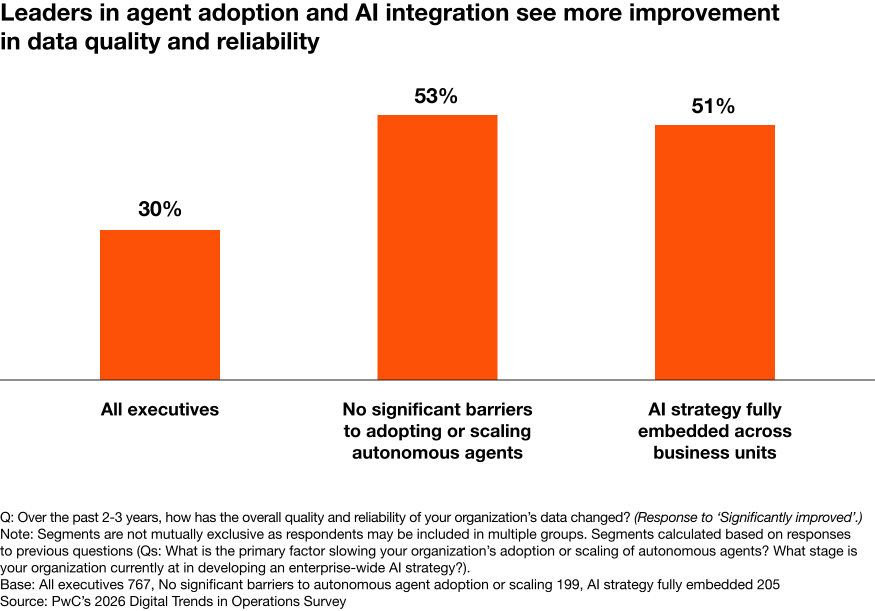
These issues come as most say the quality and reliability of their data has improved over the past two to three years. But 58% say improvement is only slight, and only 30% say it’s significant. The latter number was higher for certain respondents, however, including more than half of those reporting no significant adoption barriers to adopting or scaling autonomous agents, as well as those who say AI is fully embedded across business units. 

Survey chart

The survey also raises questions about the need for pristine data. Most respondents agree that actionable data is more important than comprehensive data (89%) and that they’ve become comfortable making decisions even when data isn’t perfect (84%). In addition, 73% agree that data doesn’t need to be perfect to drive value.

These numbers highlight a common paradox. Many leaders say data doesn’t have to be perfect to launch digital initiatives, yet many also acknowledge that poor data can undermine outcomes. Some are threading that needle and finding success by improving data quality in a targeted manner, iteratively alongside transformation.

Make your move: Bad data is often used as an excuse, but AI can help bridge the gap, especially through agents that can reason like humans and make faster decisions using available data. Determine an approach that enables transformation while encouraging experimentation, pairing AI with disciplined governance, and iterative cleansing. Competitive advantage comes from working with data you have today and improving it continuously, not waiting for perfection.  

Different chains, different digital playbooks

Our survey also illuminates something we see often. Digital initiatives—and their impact—vary by industry, sometimes greatly. That makes sense considering the fundamental differences in operations. Product- and asset-intensive businesses typically compete through supply chains that move materials and goods. Service-intensive businesses compete through service chains that orchestrate people, processes, and digital delivery across the front, middle, and back office.

Each demands a different playbook that addresses nuances in risk patterns, transformation blockers, and levers for performance. Service chain respondents, for instance, are more likely to report that no significant factors are slowing adoption or scaling of autonomous agents, while a higher percentage of supply chain respondents say they lack the necessary skills or talent. In addition, service chain respondents are more likely to say their companies have integrated digital capabilities end to end.

Survey chart

These differences illustrate how pairing sector‑specific knowledge with digital transformation efforts is critical. In manufacturing, operational automation may refer to physical processes, while in service industries it may refer to digital workflows such as claims processing or risk assessment.

Rethinking operating models in the AI era

“Silo” has become a four-letter word for operations at many companies, and dismantling them is a driver for many digital initiatives. More than four-fifths (83%) of survey respondents say AI and automation will accelerate the breakdown of traditional functional silos. But our survey also found multiple barriers to achieving a horizontal, networked organizational model.

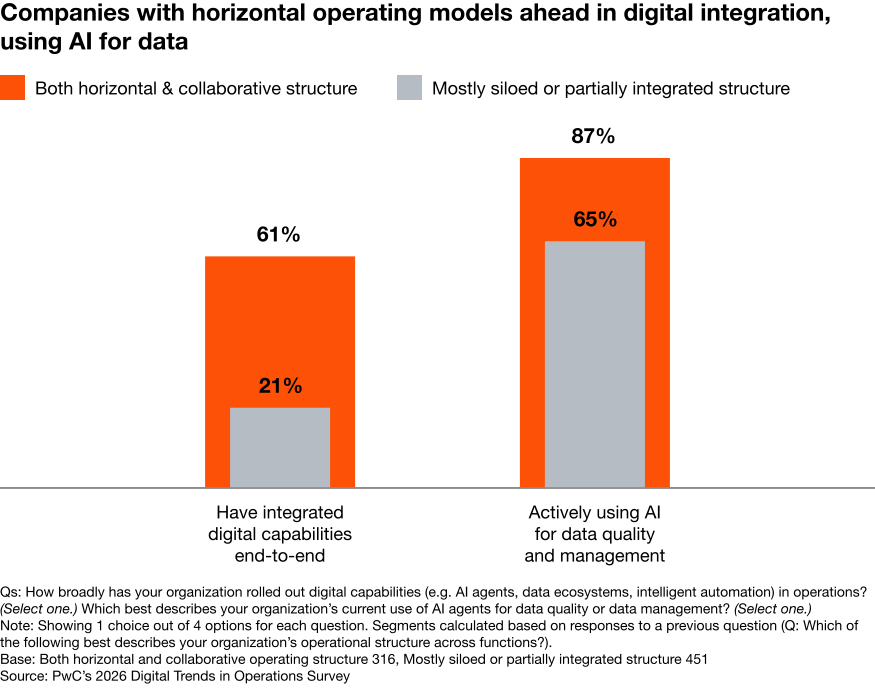
These hurdles may explain why only 41% of all respondents say their companies operate with collaborative, horizontal structures today. That can make a big difference in the success of digital investments. Among those companies with horizontal models, performance gains in speed, accuracy, visibility, and collaboration are significantly higher.

Survey chart

Make your move: AI can drive new operating structures whether your organization intentionally designs them or not. Reassess and reinvent your operating model in parallel with AI deployment, and incentivize cross-functional outcomes, not silo performance. Upskilling for tech-enabled, higher-value roles is no longer optional, as collaboration between humans and machines won’t emerge organically.

Leading the pack in redefining operational performance

Among the 767 operations and supply chain leaders we surveyed, a rare cohort may be rewriting the performance curve. Just 4% report success in four key areas: AI fully embedded enterprise-wide, no significant barriers to scaling autonomous agents, a collaborative and horizontal operating structure, and technology investments that are fully delivering expected results.

What’s their secret? Among the many ways these companies leading others: 

  • They connect tech across segments: 87% of leaders say their companies have integrated digital capabilities end to end, enabling technologies to operate across workflows of internal teams, suppliers, and customers rather than inside functional silos. 

  • They’re seeing enterprise impact from tech initiatives: 73% have achieved broad organizational impact from digital investments. 

  • They dig in on innovation: 74% deploy AI-native or agentic platforms in R&D. 

  • They don’t shortchange metrics: 83% measure both operations and financial impact of recent digital investments. 

  • They’ve boosted data hygiene: 63% say the overall quality and reliability of their data has significantly improved in the past two to three years. 

Survey chart

Unlike many organizations that are still early in their AI maturity journey, these companies aren’t experimenting at the edges. They’re integrating at the core. By aligning AI, data, and operating model transformation into an enterprise-wide mandate, they convert digital ambition into measurable, scalable advantage while others endure fragmented progress. 

Survey insights by industry 

In consumer markets, the distance between a trend and a sold-out shelf is shrinking—and our survey suggests that sector leaders know it. Three-fourths (75%) of respondents from consumer markets (CM) companies rank automating operations among their top 3 AI investment priorities, while 74% cite enhancing decision-making.

Those aren’t abstract goals. With 65% of CM companies already deploying AI agents both in demand planning and forecasting and in sourcing and procurement, the industry is targeting functions that determine if the right product is in the right place at the right time. This means improving demand planning accuracy reliability amid volatile signals while enhancing sourcing and procurement through more visible spend and efficient materials management.

That reach is expanding fast. Thirty-five percent of CM respondents say they’ve integrated digital capabilities end to end, while 64% say automation has increased their reliance on real-time data for decision-making and 62% report it has created new hybrid human-machine workflows. Together, these shifts can enable faster, more precise cost and service decisions, better management of channel complexity through exception-based human input, and improved scalability—ultimately allowing companies to meet demand and deliver products before moments pass.

Achieving agility isn't easy. Fifty-nine percent say integration complexity is the top reason technology investments haven’t fully delivered expected results, and 47% cite user adoption. As automation advances, defining human roles becomes harder, increasing pressure to adapt to shifting consumer behavior and agentic commerce. Success often requires building more deliberately—strong data foundations, reimagined workflows, and tighter human-system integration—and becoming as fluid internally as the market demands externally.  


59%

of consumer markets leaders cite integration complexity as their top reason technology investments haven’t fully delivered expected results, the highest of any sector surveyed.

As digital transformation continues to reshape global operations, energy companies report growing confidence in their digital capabilities but still see gaps in key areas. While nearly all energy respondents (97%) say they’re implementing an enterprise-wide AI strategy, only 30% report that AI is fully embedded across business units. For now, AI-enabled tools are increasingly applied to core supply chain activities, including planning and forecasting (66%) and sourcing and procurement (64%).

Energy leaders also are placing strong emphasis on measuring the impact of digital investments. Almost all energy respondents (98%) say their organizations formally measure the business impact of these investments, but significant barriers to value realization remain. Integration complexity (52%) and data issues (51%) are the most common reasons digital initiatives fall short of expectations, and 37% say poor data quality has prevented them from achieving expected value.

External pressures are shaping operational priorities as well. Regulatory and policy volatility most often affects resilience and business continuity (56%) and also impacts trade compliance (47%), ranking among the top three areas. Meanwhile, automation is reshaping the energy operations workforce, increasing reliance on real-time data for decision-making (69%) and shifting employees toward higher-value analytical roles (66%).  


88%

of energy respondents say they’re ahead of most competitors in digital transformation

For many banks, capital markets businesses, and asset and wealth management firms, the tech conversation has shifted from experimentation to execution, with increased pressure to scale AI investments, redesign business models, and deliver measurable outcomes quickly. This comes as the lines between traditional financial services (FS) businesses blur, creating more competition.

In this environment, digital initiatives at FS companies are outpacing other industries in key areas, our survey found. Among FS respondents, 80%—highest among all industries surveyed—say their company is either scaling AI implementation enterprise-wide or has fully embedded AI across business units. In addition, 54% say their company has integrated digital capabilities end-to-end in operations—also highest among sectors by far.

These efforts may be paying dividends. Among industries, 44% of FS respondents say no significant factors are slowing adoption of scaling of autonomous agents. Only one other industry tops 30%, and FS leads the way in reporting that their investments in operations technology have delivered the expected results. FS executives also report the highest instance of having a collaborative and horizontal operational structure (54%), as well as being very likely to shift toward such a structure in the next two or three years (79%).  


80%

of financial services operations leaders say their company is either scaling AI implementation enterprise-wide or has fully embedded AI across business units.

Once slow to adopt the use of AI agents compared to other industries, the health services sector is rapidly gaining confidence in AI. Currently, 93% of health services operations and supply chain leaders agree or strongly agree that AI agents and automation will accelerate the breakdown of traditional functional silos, compared to 83% of industry leaders overall. Moreover, 65% are comfortable assigning AI agents to prioritize and route work across teams and systems, breaking down silos in complex supply chains and speeding issue resolution in claims and customer workflows.

Additionally, 58% are comfortable assigning AI to execute operational decisions using predefined rules and real-time data, while 53% strongly agree that the benefits of autonomous AI agents outweigh operational security risks.

AI is enhancing accuracy, tracking, and processing speed for smoother operations such as order fulfillment and shipment tracking. Over half of health services executives report increased processing speed (53%) and improved decision quality and consistency (57%) thanks to AI-assisted workflows.

Looking ahead, healthcare’s digital transformation is embracing AI not just for technology’s sake but to redefine care to be smarter, faster and more human-centered.


53%

of health services operations leaders strongly agree that the benefits of autonomous AI agents outweigh the risks they pose to operational security versus 38% of all survey respondents

Industrial products (IP) companies are continuing to digitize operations, but our survey suggests the frontier is enterprise scale. Nine in ten IP leaders (90%) say their organizations are implementing an enterprise-wide AI strategy, yet only 20% say that strategy is fully embedded across business units. This suggests that many companies may be early in their AI journey.

Value capture remains uneven. Only 27% say recent digital investments have achieved broad impact across the organization, and 89% cite at least one reason why investments haven’t fully delivered expected results—most often integration complexity (55%) and user adoption challenges (51%). In many cases, the hurdle isn’t demonstrating value in specific use cases but integrating solutions and driving adoption to help unlock enterprise-wide impact.

IP operations leaders appear to be closing the scale gap by pairing technology with work redesign. Automation is already reshaping how work gets done, with 65% reporting new hybrid “human + machine” workflows, a practical lever for modernization while adoption ramps up. A little more than half (54%) cite that AI-assisted workflows have increased processing speed to date, reinforcing that scale is being achieved by embedding digital into day-to-day execution.  


65%

of industrial products operations leaders say automation has created new hybrid “human + machine” workflows

In contrast to the caution we’ve historically seen at many carriers, life and P&C respondents indicate strong belief in the benefits of digital transformation, as well as confidence in the overall progress of their own transformations. Most (88%) agree that AI and cloud-based technologies have leveled the playing field by enabling organizations at any stage of digital maturity to leapfrog industry leaders. The same percentage agree that affordable cloud-based and AI-enabled data tools allow smaller firms to reach parity with digital leaders. This suggests that an industry which has traditionally viewed operational change as an incremental process now recognizes how evolving technologies can facilitate rapid transformation.

Moreover, belying common perceptions, many carriers don’t view themselves as technological laggards. Four out of five (80%) say they’re ahead of most competitors when it comes to digital transformation. That said, this response—while very upbeat—is tied for the lowest among the eight industries surveyed. Overall, there’s growing confidence among insurers that digital transformation can pay off, though with a healthy acknowledgement there’s plenty of room for improvement.  


80%

of insurance operations leaders say they’re ahead of most competitors in digital transformation.

Pharmaceutical supply chains are complex. They’re subject to global trade challenges, geopolitical tensions, and fluctuating drug pricing. More than half (59%) of pharma and life sciences (PLS) leaders rank supply chain logistics among the top three business areas most impacted by regulatory and policy volatility. Still, AI is emerging as a transformative force within the industry, modernizing workflows and decision-making processes. Most (72%) PLS operations and supply chain leaders—compared to 53% across industries—say that AI automation is driving a growing reliance on real-time data for decision-making. Further, 73% of PLS executives versus 50% of all respondents report that automation is shifting employees into analytical and supervisory roles, moving focus from routine tasks to high-value analysis and leadership.

Confidence in AI’s capabilities among PLS executives is growing. Fifty-seven percent are comfortable assigning AI agents to detect anomalies and trigger corrective actions, crucial for early interception of supply disruptions or quality problems. Moreover, 68% are comfortable with AI applying probability-based analytics to prioritize work, enhancing demand planning and risk assessment.

Looking ahead, 56% foresee AI reshaping operating models to emphasize capability-based roles like orchestration and governance. Far from merely adapting, PLS companies are accelerating digital innovation powered by adaptive, AI-generated operating systems that can redefine the future of the pharmaceutical supply chain.


73%

of pharma and life sciences executives say automation has shifted employees into higher-value analytical or supervisory roles

Among operations and supply chain leaders at technology and telecommunications companies, the focus has shifted from insight to impact: Can AI at scale help deliver measurable financial results? While 94% of tech and telecom survey respondents say their companies have implemented AI, including 40% who are scaling it enterprise-wide, only 21% say this strategy is fully embedded across business units. This suggests AI is not yet consistently integrated into daily operations or delivering sustained improvements in cost, service, or productivity. For most, AI remains concentrated in pilots rather than running core processes.

Tech and telecom leaders are tightening execution while redesigning how work gets done. Automation is the first lever, with half (51%) citing reduced reliance on offshoring—reflecting increased use of automation and “digital workers”—as one way it is reshaping operations. This shift is helping stabilize operations, reduce manual effort, and manage demand volatility, especially as memory shortages and advanced-node capacity constraints pressure hardware supply chains. At the same time, companies are shifting to platform-based operating models. Tech and telecom lead key industries, with 89% launching external digital capabilities like AI agents, data ecosystems, and intelligent automation. Of these, 29% are extending these capabilities to suppliers and partners to improve planning, allocation, and coordination across constrained supply networks.

Early results are positive. Fifty-eight percent say recent digital investments have delivered impact in multiple areas, including financial or strategic outcomes. But execution remains uneven. Data quality and access are the biggest barriers to ROI, followed by integration with legacy systems and user adoption. While 34% are comfortable letting AI agents run end-to-end processes, 33% say scaling them is slowed by skills shortages.


89%

of tech and telecom operations leaders say they’re rolling out digital capabilities for external use across supplier, partner, and customer interactions

The time to act was yesterday

… but the next best time is now. While only a small group of companies are currently achieving significant enterprise impact, nearly all are in some stage of their digital operations journey. Here’s how you can start moving from experimentation to scaled transformation.

  • Rethink how you measure value to reflect enterprise impact. Using only cost or only operational metrics understates AI’s true value. Connect both financial and operational metrics to strategic priorities such as growth, resilience, and customer experience—moving toward integrated performance management and more disciplined capital allocation.

  • Design an operating model that enables experimentation with control. Establish clear guardrails for model usage, data access, and risk management while enabling cross-functional teams to test and scale AI use cases quickly. Define decision rights, accountability, and oversight upfront so experimentation can drive value without creating fragmentation.

  • Unite segments by combining industry expertise and customer insight. Unlocking AI value requires connecting knowledge across the enterprise. Bring together domain experts from supply chain, operations, customer functions, and data teams to help solve specific problems end to end processes. This helps ground AI solutions in real operational context and customer outcomes, not just technical capability.

  • Orchestrate systems, data, and AI as one. Stop treating integration as a backend IT problem and elevate it to a core business priority. Join leading companies by redesigning your architecture around end-to-end workflows and connecting AI, data, and core systems through integration layers and platforms.

  • Shift from AI pilots to enterprise activation. Pilot programs and point solutions rarely scale impact. Identify a few enterprise-critical processes where AI can be embedded across decision points and commit to scaling with clear ownership and funding—turning AI from experimentation into a performance driver.

  • Practice progress-over-perfection with data discipline. You can move forward without perfect data, but you should have a structured approach to improving it. Launch priority AI use cases using available data while deploying AI-enabled data governance, cleansing, and enrichment in parallel. Treat data improvement as an ongoing capability embedded in transformation, not a prerequisite that delays it.

  • Pressure-test your ecosystem for disruption. Constantly assess the impacts—and opportunities—from tech, economic, geopolitical and other disruption, including your potential to build capabilities internally that reduce reliance on external platforms. Evolve your scenario planning to identify where to build, collaborate, or invest to take advantage of emerging opportunities and stay ahead of emerging threats. 

The gap between ambition and execution in operations remains wide and can be difficult for many companies to bridge. Those businesses that integrate AI, data, and operating model transformation—simultaneously and decisively—won't just improve operational performance. They can redefine it.

Explore the 2026 survey data

Access our interactive dashboard, filter by industry and more.

About the survey

PwC’s 2026 Digital Trends in Operations Survey surveyed 767 operations executives and supply chain officers in January and February 2026. Respondents in the online survey included C-suite executives, upper management, directors, and managers of organizations based in the US with annual revenues of $100 million or more. Respondents either have sole responsibility for business decisions on operations and supply chain or procurement operations or share influence with others regarding those decisions. Sectors surveyed include consumer markets (13%); energy, utilities, and resources (16%); financial services (5%); health industries (11%); industrial products (18%); insurance (5%); pharmaceuticals and life sciences (11%); and technology and telecommunications (16%).

Follow us