{{item.videoDuration}}
{{item.title}}
{{item.text}}

{{item.videoDuration}}
{{item.text}}
The next industrial revolution is unfolding around us. AI, automation, and robotics are converging across industries, powered by accelerated compute. But while compute is becoming more efficient per task, access to frontier GPUs remains hobbled. For hyperscalers especially, this constraint is already shaping infrastructure strategy, capital commitments and the pace of innovation. For other organizations, it’s an early signal of a future where compute choices become business choices. We’re seeing a shift from GPU allocation as a technical decision—based on capacity and queue priority—to a strategic one. Where should industrial, energy, mobility, and consumer-facing companies deploy compute to drive the greatest economic and operational impact?
We’re seeing major shifts in how industries operate and compete. PwC’s Global Industrial Manufacturing Sector Outlook points to the scale of this inflection point. Nearly all industrial and energy leaders—93%—believe the next industrial revolution is already underway. Over the next several years, reliance on advanced technologies is expected to more than double, while both adoption and automation accelerate sharply.
The same compute that powers digital twins in factories and robotics in warehouses is also driving AI agents in commerce, autonomous digital assistants, and real-time decision systems. Retail alone has seen a 1,200% surge in traffic from AI tools in just six months.
Compute is no longer sector-specific. It’s become a common foundation across industrial systems, consumer platforms, energy grids, and mobility networks.
Accelerated compute supports training, inference, simulation, and autonomy. Historically, these categories fit neatly into different functions or industries. Today, they’re intertwined—and that changes how leaders should allocate them.
Compute now goes beyond optimizing individual processes to help run whole systems. The leading edge of this shift is already visible. The top 20% of manufacturers—what we describe as “future-fit”—are ahead in advanced technology adoption across design and production, with nearly double the automation of their peers. The advantage isn’t coming from owning more machines but from orchestrating AI, automation, and data across ecosystems.
Consumer AI, industrial systems, and critical infrastructure are all legitimate priorities. All are accelerating. All are drawing from the same constrained pool of compute.
A unit of compute used to increase consumer engagement can deliver measurable returns. But that same unit of compute, applied to industrial systems or critical infrastructure, might improve factory yield, stabilize an energy grid, or strengthen supply chain resilience.
It’s a strategic trade-off that most organizations make by default rather than by design. Leaders should look for compute allocation where one investment strengthens multiple systems at once.
At Nvidia’s GTC, the direction of travel was made clear. Hyperscalers are now deeply embedded in AI infrastructure, accounting for a significant share of demand and shaping how compute is deployed. The concept of AI factories reflects this evolution—moving from general-purpose compute to highly specialized environments designed for training and running AI systems at scale.
Model providers and hyperscalers are experiencing first constrained access, longer planning horizons, and greater dependence on energy, data center capacity and ecosystem relationships. And this is likely to become a broader enterprise reality as AI adoption scales.
At the same time, new entrants are emerging to build and operate AI infrastructure, while enterprises are making larger, longer-term commitments to secure access. Despite this expansion, constraints persist. Scaling AI now depends on full infrastructure systems, not chips alone. Gains in efficiency are being reinvested into larger models and new applications, particularly in physical AI.
Access to compute is increasingly shaped by capital, contracts, infrastructure strategy, and ecosystem relationships. It’s not evenly distributed, and that means prioritization isn’t optional. In many ways, compute allocation is starting to resemble capital allocation.
There’s also a deeper structural reality. The ownership of the means of production still matters. Technology expands what’s possible, but it doesn’t instantly expand industrial capacity. The organizations that control infrastructure like materials, fabs, energy, and data centers continue to shape what gets built and who gets access.
Compute is becoming a form of economic currency. Control over chips, infrastructure, and the systems running on them is increasingly determining where value accrues.
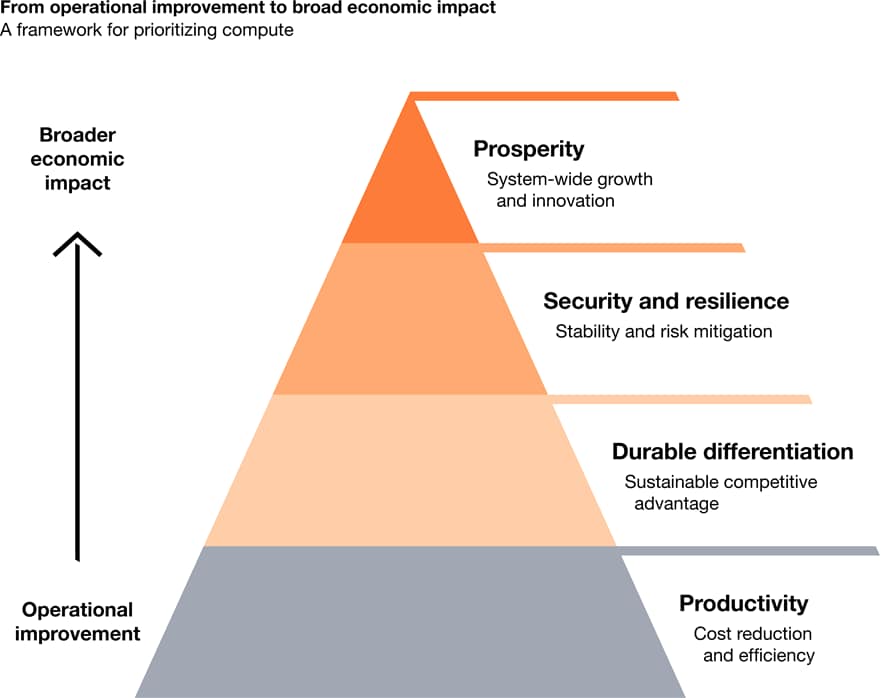
When compute was abundant, the question was simply whether a workload could run. When it’s constrained, the question becomes whether it should. A useful way to approach this is to think in terms of four layers, moving from operational improvement to broader economic impact.
Not every workload belongs at the top. The hierarchy exists precisely because trade-offs are unavoidable—and because the organizations that understand the difference will likely allocate more effectively than those that don't.
Organizations should draw a clearer line between strategic and discretionary compute.
Not every workload requires access to the frontier GPUs used to train and run the most demanding AI models. Some workloads can run effectively on less advanced infrastructure. Others may duplicate existing capabilities or lack a clear connection to meaningful outcomes.
The key question is whether the workload drives outcomes that scale.
Leaders can pressure-test decisions by asking a few questions. Does this use of compute expand output or productivity beyond the enterprise? Does it strengthen resilience in interconnected systems? Does it build an advantage that lasts? Does it deliver measurable improvements in how the business operates?
The more dimensions a workload touches, the stronger its case becomes.
We’re no longer allocating compute within silos. We’re allocating it across converging industrial, energy, mobility, and consumer ecosystems. And compute sits at the center of that convergence.
The demand signals are coming from everywhere at once. Those who move forward effectively won’t simply follow demand. They’ll direct compute toward areas where it creates broader benefits over time—where one investment strengthens multiple systems, and where gains extend beyond a single function or use case. That means workloads like proof-of-concept projects without a scaling path, redundant model training, or low-impact personalization may need to wait.
Compute is becoming a core resource in the next economy. The constraints now visible among AI foundation builders are an early signal for the broader market. How compute is prioritized may shape what gets built, what scales, and who leads.
{{item.text}}
{{item.text}}