






{{item.videoDuration}}
{{item.title}}
{{item.text}}

{{item.videoDuration}}
{{item.text}}

Tokenized deposits, stablecoins, and deposit tokens look identical on a screen. They represent three fundamentally different answers to the same question, and three very different business models.
Walk into any trading floor or treasury meeting in 2026 and someone is pitching "programmable money." The term is doing real work to sell the technology, yet it obscures a more important question: when that token moves, where does the liability go? That single question determines who earns the spread, who carries the credit risk, and which institutions will find themselves disintermediated in three years before they realize they’ve made a choice.
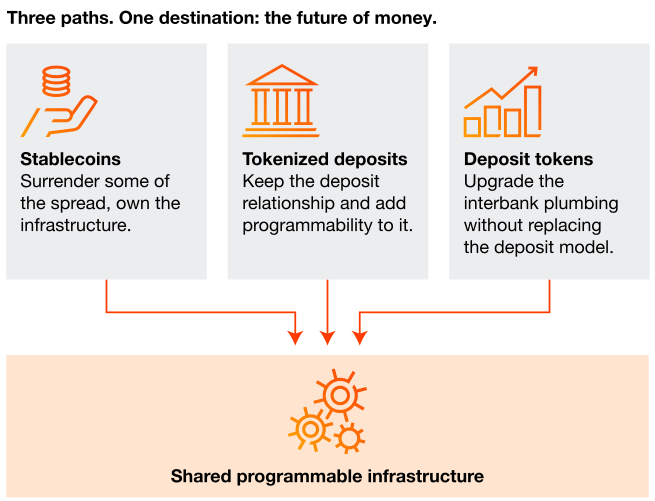
Stablecoins are bearer instruments issued against a reserve of cash and short-dated assets like Treasuries. Typically, they are not issued by a bank, but by dedicated issuers or by payment companies and fintechs operating under an increasingly defined licensing regime. USDC and USDT are canonical examples. The holder has a claim on the issuer, not on a bank deposit. They settle 24/7 on public blockchains, with no gatekeeper deciding who can participate.
Their economic model is straightforward and worth understanding clearly: the holder gets a stable dollar, and the issuer holds the reserves and earns the yield. It behaves less like a bank deposit and more like handing your cash to someone who puts it in a money market fund and pockets the return while you use the receipt as currency. Banks entering this space are strategically deciding to shift the revenue opportunity from deposit yield on their balance sheet to earning on the stablecoin activity (e.g. transaction volume, custody, FX conversion, and the services built on top of the rail). And with the GENIUS Act now settling who can issue them and on what terms, the window for positioning is closing.
Tokenized deposits are exactly what the name says: a commercial bank deposit, represented as a token on a ledger that the issuing bank (or a consortium) controls. Unlike stablecoins, tokenized deposits are non-bearer instruments. Because the bank maintains the ledger and only onboarded customers can interact with the token (at the bank’s discretion), the bank always knows who owns what. The liability stays on the bank's balance sheet. It remains FDIC-insured and inside the existing monetary system in which the Fed creates money and banks create deposits.
The design intent is explicit: preserve the deposit relationship and add programmability and 24/7 movement without turning the deposit into a bearer asset. For a bank, this is the most defensive of the three formats and the one with the most to lose if executed as a product rather than a platform.
Deposit tokens are the hybrid the industry is still arguing about. They are tokenized bank liabilities designed to move across institutions, a shared-network instrument rather than a single-bank one. Numerous offerings are currently being built or piloted, each with a different answer to the hardest question: how do you let a token leave Bank A and arrive at Bank B without turning it into a bearer instrument along the way? These offerings vary significantly: some destroy the token at Bank A and recreate it at Bank B, some settle through central bank payment infrastructure, and some route through a permissioned network where participating banks share a clearing layer.
Deposit tokens are currently the most nascent of the three wrappers, attempting to combine stablecoin-like interoperability with deposit-like liability. This is a bet on the two-tier monetary system staying intact, and on the bank industry’s ability to agree on shared infrastructure before someone else builds it for them.
Whatever instrument a bank issues or accepts, there are changes to the global money movement landscape in motion. Three things are likely to happen:
Understanding the difference between a tokenized deposit, a stablecoin and a deposit token is the entry fee, not the strategy. Banks that spend the next 12 months debating which tokenized dollar to issue, and stop there, will have optimized the wrong variable. The format you choose determines your regulatory posture and your liability structure, but it does not determine whether you win the next generation of corporate treasury relationships. That will be decided by what you build around it: the settlement rails, the collateral mobility, the intraday liquidity infrastructure, and the treasury services that make programmable money useful to a CFO rather than just interesting to a technologist. Thus, the more consequential question is architectural, and it starts with understanding why moving money today is still so expensive.
Today, most financial transactions cross multiple systems. Securities move in one environment. Cash moves in another. Reconciliation sits in the middle. Even when both sides are ultimately electronic, settlement remains a sequence of coordinated updates across separate ledgers, institutions, and operating hours. The result is idle cash, trapped liquidity, settlement risk, operational friction, and billions of dollars spent every year proving that one system agrees with another.
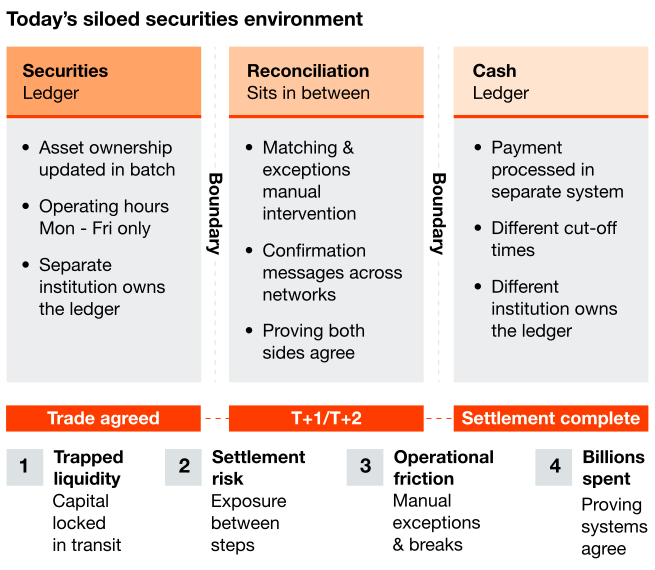
Bringing money onchain changes the architecture. Once both the asset and cash leg exist on common programmable infrastructure, settlement can become atomic rather than sequential. Ownership of both the asset and cash transfers at the same moment. There is no funding gap, daylight exposure, or waiting period between delivery and payment. The transaction is either completed in full or not completed at all. That capability is more important than the specific wrapper carrying the money.
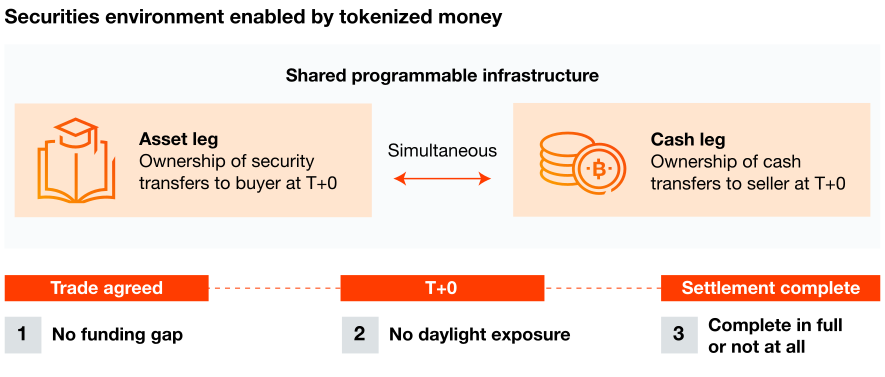
Stablecoins, tokenized deposits, and deposit tokens are all attempting to solve the same underlying challenge: how to bring trusted forms of value onto programmable infrastructure. The long-term winners will not be determined solely by which form of tokenized money achieves the largest circulation. They will be determined by which forms of money can participate most effectively in an ecosystem where assets, collateral, liquidity, and payments operate as interconnected components of a single network.
The implications extend well beyond faster payments. Atomic settlement enables real-time collateral mobility, programmable liquidity management, intraday financing, automated treasury operations, and new market structures that are difficult or nearly impossible to support in today's fragmented infrastructure. Tokenized securities, money market funds, private assets, deposits, and cash equivalents become composable building blocks rather than isolated products connected through intermediaries and batch processes.
This is why the future debate should be less about tokenized cash and more about the next evolution of financial infrastructure. The question is no longer whether dollars can exist as tokens. The question is whether the industry can create the settlement rails, interoperability standards, identity frameworks, and regulatory models necessary for money and assets to operate together onchain. Until trusted forms of money move natively across those environments, the broader promise of onchain finance remains constrained. Once they do, the conversation shifts from modernizing payments to redesigning financial services.
Banks likely have the most to defend and the most to gain. Tokenized deposits are the only form of tokenized money that keeps the bank in the middle of the client relationship, the NIM, and the regulatory perimeter. The banks that treat this solely as a payments modernization project will lose share to the ones that treat it as a business imperative. The real prize is 24/7 corporate liquidity, programmable treasury services, and a credible answer to corporate clients asking why their digital asset wallet settles faster than their operating account. The GENIUS Act does not kill bank-issued money; it forces banks to show up with something competitive.
Fintechs and payment companies are the biggest near-term beneficiaries of stablecoins. Cross-border payroll, merchant settlement, and stored-value wallets all get meaningfully better when the rails are USDC or a regulated equivalent. The strategic risk is picking the wrong wrapper: a fintech that builds its treasury around a single stablecoin issuer has just taken on a concentration risk that regulators, auditors, and enterprise customers will increasingly ask about.
Asset managers are already past the proof-of-concept stage on tokenized money market funds, BUIDL, BENJI, USTB and USYC are live products with real AUM. The more interesting question is what the cash leg looks like in a tokenized securities market. A tokenized MMF that can be posted as collateral, redeemed atomically, and moved between counterparties without a T+1 wait is a structurally better product than its non-tokenized counterpart. The firms that solve the cash-leg interoperability problem, meaning which forms of tokenized money their fund can accept and pay out in, will set the distribution standard.
Corporate treasurers are the quiet center of gravity in all of this. They do not care about the wrapper. They care about four questions: can I move money on weekends, can I earn yield on idle cash without taking duration risk, can I automate intercompany and supplier payments, and is my auditor going to sign off? The bank, fintech, or asset manager that answers yes to all four wins the treasury relationship, and treasury relationships are sticky in a way that consumer payments are not.
This is not a technology debate. It is a conflict over which institutions get to be in the middle of the next generation of money movement. Stablecoin issuers are arguing the bank disintermediation case. Banks are arguing the systemic stability case. Deposit token proponents are arguing that the two-tier system can be upgraded without being replaced. All three are partially right, which is why all three will exist and why the institutions that refuse to pick a posture will find the posture picked for them by their clients.
The GENIUS Act has substantially reduced banks’ ability to treat this as a future problem. By the end of this year, corporate clients will be asking which tokenized instruments their bank issues, accepts, and integrates into treasury services. The wrapper question cannot be deferred, but it also cannot be the entirety of the strategy.
The wrapper is not the destination but rather the access point. The institutions that focus exclusively on issuing tokenized money may win distribution. The institutions that help build the infrastructure allowing money, assets, collateral, and liquidity to move together onchain will likely win the market by shaping the next generation of financial services. The architecture is the real business.
Digital assets are transforming businesses. Let’s plan your next move.
Industry convergence is real and it’s changing the flow of capital and the status quo, requiring a fresh strategic view.
{{item.text}}
{{item.text}}


