






{{item.videoDuration}}
{{item.title}}
{{item.text}}

{{item.videoDuration}}
{{item.text}}

Imagine it’s almost 8 p.m., and a family of four is piling into their car after a long weekday. Everyone is tired and hungry, so they head to the nearest restaurant. The kids order kids’ meals. Dad goes with a chicken sandwich and fries. And Mom, who’s about seven months into a GLP-1 regimen, orders a protein bowl heavy on vegetables and grilled chicken.
It's a small moment, but the kind that plays out across America every night. It also offers a glimpse into the future of consumer spending amid the rise of GLP-1 adoption, as purchasing decisions are increasingly influenced by at least one family member’s health goals, nutrition priorities, and changing definitions of value. Multiply this family’s decision across millions of households, and it’s clear the impact extends far beyond dinner.
For the past 50 years or so, much of the U.S. consumer economy was built around the idea of more. More volume. More impulse purchases. More calories. But now, along with the rise of GLP-1s comes consumers who want less of some things, as they make different choices around a new physical, emotional, and metabolic identity.
As of May 2026, roughly one in five U.S. households (21%) includes a current GLP-1 user, up from 9% in January 2025, based on PwC analysis of data from Numerator. Adoption is broad: flat across income levels, nearly equal between men and women, and led by Gen X with usage spanning every generation that has purchasing power. And that consumer base is only growing.
According to the 2026 PwC GLP-1 Usage & Attitudes Survey of 3,000+ current, lapsed, and considering users, 54% of users surveyed in 2026 have been on GLP-1s for more than a year, up from 38% in 2024. And 37% of current users are now taking GLP-1s for weight loss alone, up from 24% in 2024.
For millions of Americans, GLP-1 use is reshaping how they eat, shop, move, socialize, and see themselves, with ripple effects showing up across industries. Part of the reason why one class of medications can touch so many industries is that GLP-1s often catalyze a holistic health journey, and the consumer builds an ecosystem around it. The data points to a lifestyle shift with lasting implications.
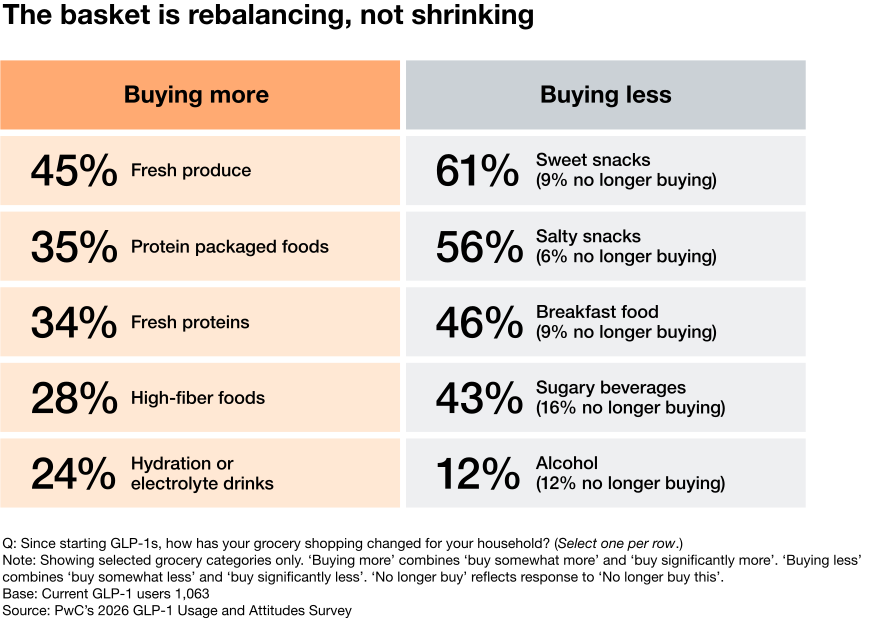
The GLP-1 effect on grocery and CPG: While 61% of current users say they’re buying fewer sweet treats, and 56% say the same about salty snacks, fresh produce and protein are taking their place: 44% are buying more fresh produce, 35% more packaged protein, and 34% more fresh protein. The biggest casualties are sugary drinks and alcohol, while adjacent categories are riding the wave: Greek yogurt is up 6.8%, jerky 7.9%, nutrition bars 3.4%, and energy drinks 7.0%. With these increases in protein and fiber, it’s less about strictly cutting things out and more about rebalancing. For brands watching volume collapse in core indulgence categories, mini sizes and portion-controlled premium formats could be a margin-protection play to test.
61% of current GLP-1 users say they’re buying fewer sweet treats, and 56% say the same about salty snacks.
The GLP-1 effect on apparel shopping: 73% of current users report a meaningful change in clothing size, and 26% say they’re spending more on clothing overall. Already, apparel is one of the most directionally positive spend stories correlated to GLP-1 drug use, with overall apparel spend up 9.9% among GLP-1 users after 6 to 8 months of being on the drug. As people start to feel different in their bodies, they often start dressing differently and treating themselves to higher-quality, more expensive brands. Spending on women's jeans is up 66.1%, swimwear 31.1%, dresses 22.1%, and jewelry 36.4%.
At the same time, GLP-1 users are also dropping sizes faster than they're committing to new wardrobes, often because they don't know where they'll land in three months. That hesitation is a headwind and an opening. Shifting size distributions can complicate merchandise planning, demand forecasting, and size curve assumptions. Buyers can no longer assume last season's size mix will match next season's demand. But the brands that pull ahead will make it easier to shop during the transition, not just after it. Think flexible fits, generous exchange and alteration policies, styling support, and loyalty programs that reward customers for coming back as their size changes.
73% of current users report a meaningful change in clothing size, and 26% say they’re spending more on clothing overall.
The GLP-1 effect on fitness: The survey points to a clear shift in how GLP-1 users are moving. Cardio is the most active category for current users: 36% have increased their frequency of walking, running, cycling, and swimming, versus 16% who reduced it, and 15% are using wearables to manage their health on the medication. Group fitness, by contrast, is a category under pressure: 14% of current users have decreased their frequency of classes, while only 11% have increased it. Strength training is also where the data gets interesting: 21% of current users have increased it, 17% have decreased it, and 41% have never done it at all. That’s the growth opportunity. If gyms, boutique studios, connected fitness platforms, and even apparel brands can guide first-time strength trainers through programs built around personalization and muscle preservation, not just weight loss, they may be well positioned to reach a new group of users actively looking for help.
What GLP-1 users want from restaurants and food brands: Spending on quick-service restaurants (QSR) is down 8.7% per GLP-1 household after 6 to 8 months, with pizza down 22.2%, chicken down 11.6%, coffee/bakery down 8.0%, burgers down 6.4%, and sandwich/delis down 4.5%. According to our survey, half of current and lapsed users say restaurants haven't caught up, and they know exactly what they want. Thirty-five percent are asking for smaller portions at proportionally lower prices, and 32% want half-portions or split plates without the upcharge.
GLP-1s reduce food noise, that constant background negotiation with the next snack, drink, or impulse food purchase. That noise powered decades of growth in packaged food, sugary beverages, and QSR. With food noise reduced, so are the triggers that the modern consumer economy was built to monetize. For QSR and casual dining operators, now could be the time to rethink portion tiers and pricing, so smaller options sit naturally alongside full-size ones. Operators can also lean into more protein-forward options and greater transparency around ingredients and micronutrients that GLP-1 users are seeking. The brands that move first stand to win loyalty from a segment that's actively telling operators what it wants, and noticing who isn't listening.
35% of current GLP-1 users are asking for smaller portions at proportionally lower prices—and 32% want half-portions or split plates without the upcharge.
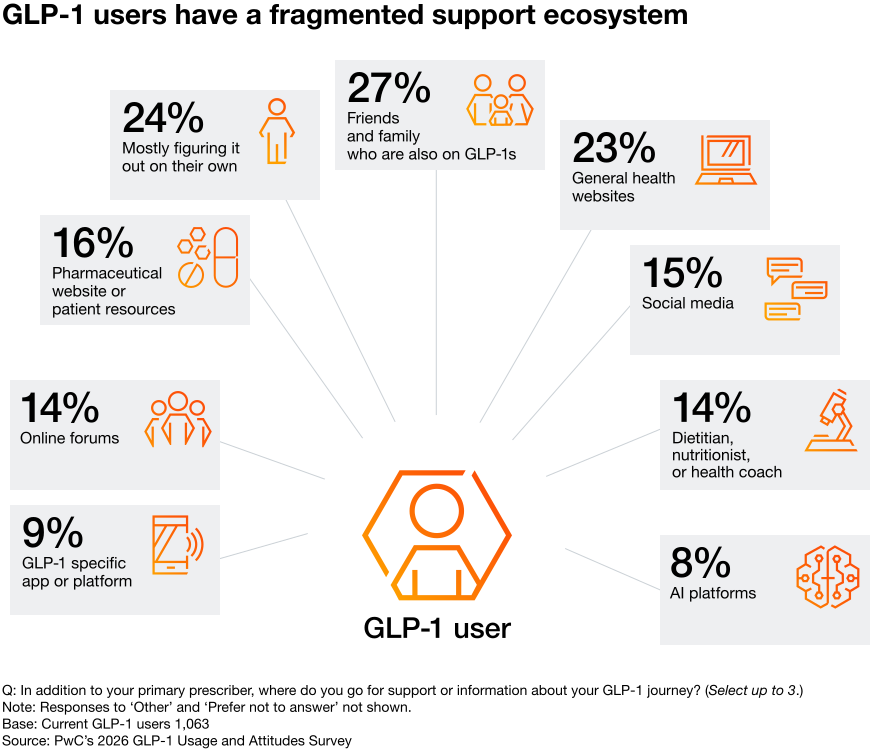
Most GLP-1 users (63%) say they got or plan to get their prescription from a primary care doctor; another 10% from a specialist and 7% via telehealth. But the support system after that is fragmented. Respondents say they’re turning to friends, family, social media, GenAI tools, and a patchwork of apps to figure out what to eat, what supplements to take, how to maintain muscle, and how and where to shop for clothes as their size changes. Peer support is doing a lot of the heavy lifting: 27% of current users rely on friends or family, rising to 36% among those considering the drug. Just 9% of current users have a GLP-1-specific app, and nearly a quarter say they're figuring it out on their own.
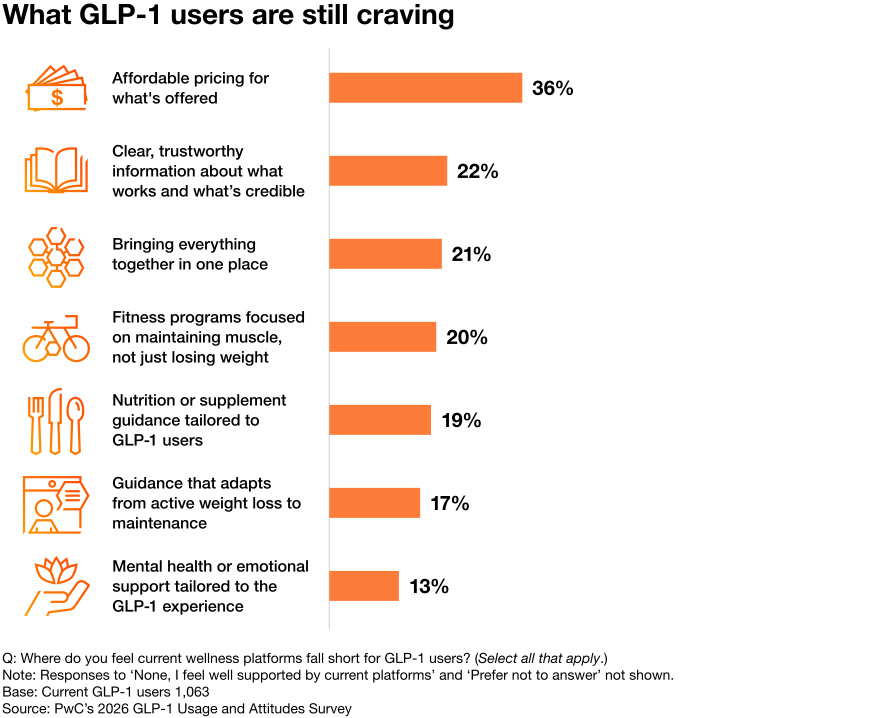
Roughly 85% of current users say companies are falling short—and 47% of current and lapsed users say they haven't seen brands do anything meaningful. What GLP-1 users want is largely consistent: affordable pricing, trustworthy information, and one place that brings it together. But only 23% feel well-supported by today's wellness platforms—the digital apps, subscriptions, and connected services designed to coordinate nutrition, fitness, mental health, and overall well-being. That's 77% of the market waiting to be served.
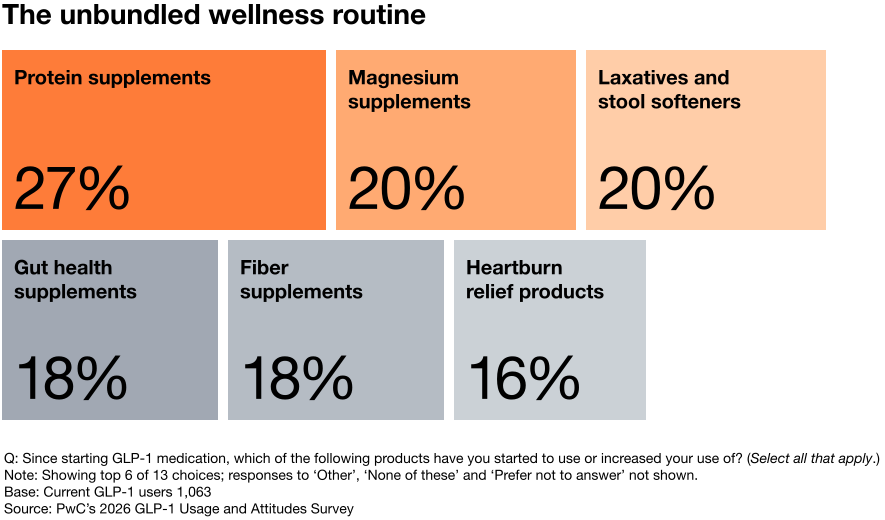
80% of current users and 74% of lapsed users reported using at least one supporting product alongside their treatment.
When asked what they want, GLP-1 users consistently point to an integrated platform that combines medication management, nutrition, fitness, and mental health support—paired with trustworthy information and fitness programs designed around strength training for muscle preservation, not just weight loss. More than 70% of current, lapsed, and considering users even say they're willing to share personal health data with consumer-facing companies in exchange for a more custom experience.
While there is no average GLP-1 consumer, what many have in common is the lack of an integrated support system. To address that gap, retailers can bundle GLP-1-aligned nutrition, supplements, and apparel into curated assortments and subscription formats. CPG brands can build portfolios designed to work together across a user’s day or week, with a variety of integrated products. Fitness operators and wellness platforms can integrate nutrition, fitness, and mental health support in one place, directly addressing the strength-training gap users are calling out. Brands across these categories can deliver the personalized, coordinated experience users say they're missing.
For consumer-facing companies, the winning move isn’t another standalone app or a single product. It's an ecosystem play.
With one in five U.S. households now including a current GLP-1 user, an increasingly mainstream shift is already reshaping grocery baskets, wardrobes, restaurant orders, gym routines, and wellness habits. And as clinical use cases for GLP-1s continue expanding well beyond diabetes and weight management into cardiovascular risk reduction, sleep apnea, alcohol use disorder, and even cancer progression, the rise in adoption is likely to continue. For brands that recognize they have consumers in the middle of a transformation, and that want to become active partners in the journey, this means rethinking a business across several fronts:
Users are already telling brands what they want. But 85% say companies are falling short. That gap is an opportunity. The winners will be the ones that rebuild the offer around who this consumer is becoming. The end of more isn't the end of growth. It's the start of a more deliberate kind, and the brands that meet this consumer where they're headed, not where they've been, will define what comes next.
Between May 4 and May 9, 2026, PwC surveyed 3,089 consumers, including 1,063 current GLP-1 users, 1,010 lapsed GLP-1 users, and 1,016 people considering using GLP-1s. The survey, conducted by Numerator, was designed to compare these GLP-1 consumer groups, not to represent all consumers. Some trends referenced in this article were based on a separate 2024 consumer dataset of 3,228 respondents. Other trends referenced in this article were drawn from Numerator’s GLP-1 transaction panel (May 2026 refresh, ~110K households, blended early- and recent-adopter cohorts at 6–8 months post-start).
GLP-1 medications are changing how people shop, eat, and dress. See what PwC's latest research means for your business.
PwC brings the industry insight, proprietary consumer data, and end-to-end capabilities to help consumer markets leaders turn the GLP-1 shift into business growth opportunities.
{{item.text}}
{{item.text}}


