








Fuelling a resilient future through powerful alliances, greener investment and greater use of renewables
The Energy Transition

Accelerating to net zero
Transportation. Manufacturing. Mining. Industries that have big power needs also need big change. Delivering radical decarbonisation by powering up renewables and building greener, sustainable infrastructures. Creating greater value for people, planet and performance.
Energy is a crucial input to all economic activity, and a secure and affordable energy supply has been a key enabling factor for global economic growth that has lifted millions out of poverty. However, with continued and overwhelming reliance on fossil fuel sources for primary energy supply, the production, supply and consumption of energy is responsible for approx. three quarters of global greenhouse gas emissions that drives global warming and climate change. The scientific evidence indicates that climate and weather extremes and their adverse impacts on people and nature will continue to increase with every additional increment of rising temperatures.
Transitioning energy production, supply and consumption away from fossil fuels and towards sustainable energy sources, without derailing economic growth and progressing steadily on the unfinished development agenda in developing countries is the greatest challenge of our times.
Achieving this is will be an extremely complex endeavour due to the increasingly narrow window of opportunity, and expected disruption to well established governance frameworks, political economy considerations, technology, financial and product markets, supply chains, and business models. Such a monumental change in status quo will impact all stakeholders, and present opportunities and threats.
Balancing the world energy trilemma
The energy trilemma is a constant challenge involving the balance of energy security, accessibility and affordability, and sustainability. In our Energy Transition strategies and implementation, we strive to ensure an optimal balance of all three components.
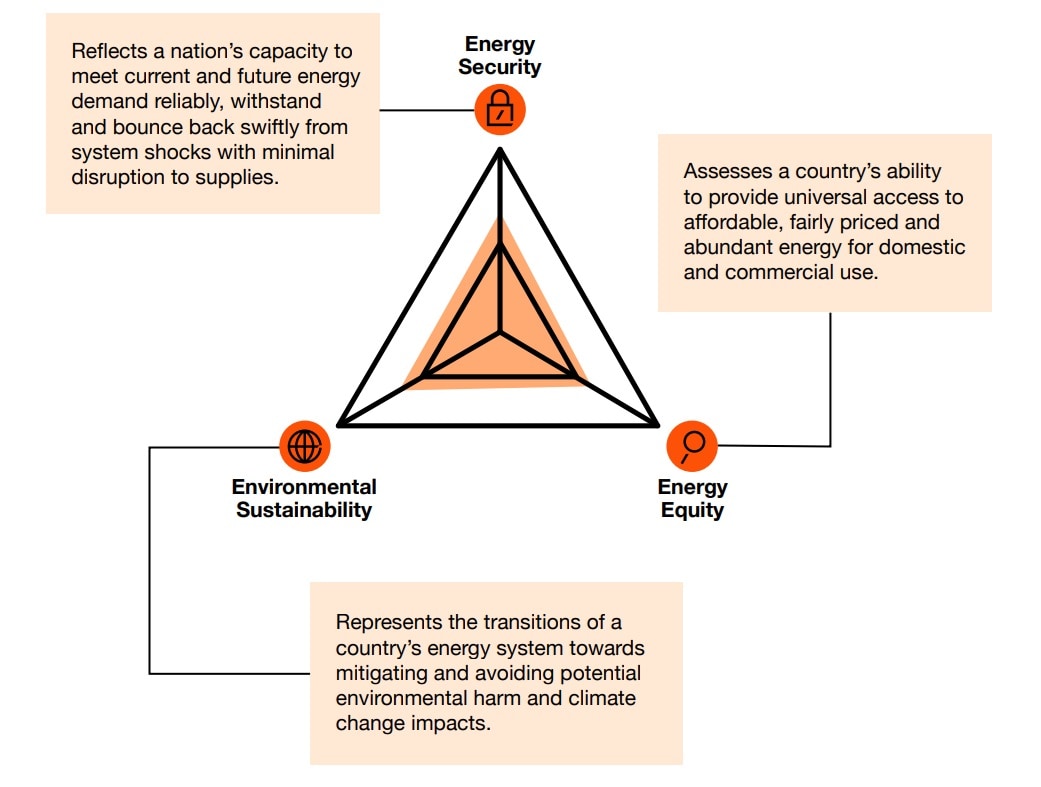
Energy in Indonesia
Indonesia has succeeded in meeting its growing energy demand, largely driven by exponential economic growth. However, this achievement is coupled with a largely unsustainable energy supply mix that relies on coal, oil, and other fossil fuels, worsening the global carbon footprint. In Indonesia, 87% of electricity generation comes from fossil fuel resources, highlighting the urgent need for a transition to low-carbon energy sources. There is an urgent need to shift the emphasis from the exploitation of national resources for economic growth to a more sustainable energy strategy.

The industrial and transport sectors together account for approximately 70% of final energy consumption from fossil fuels, indicating the required sectoral focus for a successful energy transition. Consequently, firms operating in these two sectors, along with the energy production and supply sector, have a significant role to play in achieving a successful energy transition.
Due to low electrification of the economy and overwhelming reliance on fossil fuels for electricity generation, fossil fuel dependence in the final consumption basket remains very high as well. Therefore, we believe that Indonesia requires focused, programmatic action on the supply and demand side.

Our perspectives
There are four major levers for decarbonising the economy. These levers must be applied simultaneously but to varying degrees, tailored to the specific realities of each country, economy, sector, and competitive position. This approach aims to accelerate the energy transition without compromising energy security and affordability.
Planning, executing, monitoring, and course-correcting the transition will require a comprehensive, whole-of-economy perspective.
We believe in the crucial role of the public sector in setting the stage and addressing market failures, and the ability of the private sector to innovate, protect, create, and sustain value within the frameworks established by the public sector.

To achieve accelerated and sustained energy transition across the economy, we believe that a programmatic approach covering governance frameworks, market structures, technology solutions, business models, financing, energy and carbon pricing, and enhanced private sector participation is essential.
We support the public sector in setting the stage considering the greatest good for the broadest set of stakeholders, and preparing to address market failures if they do occur. We work with the private sector in protecting, creating and sustaining value in a socially responsible way, within the field of play set by the public sector.

Accelerate energy optimisation
By changing how your organisation uses energy, you can save money and build resilience—increasing productivity, improving margins and reducing exposure to market swings and global events.
Learn more
An interplay of electrification and alternative fuels
Whilst Electric vehicles are a true megatrend for the 2020s they are not the whole picture. To decarbonize by 2050, the world will need to embrace alternative fuels as well. Scalability and commercial viability will be key. Sustainable Aviation fuel, Hydrogen and Biofuels will become an important power source of the future.
Learn more
A new design for life
70% of greenhouse gas emissions come from energy, industry and buildings combined so net zero won’t happen without a coordinated move to green infrastructure – at scale. We must radically reimagine how we live, work, travel and trade; how we produce and distribute. And our future cities? They will need customised, tech-powered green infrastructure solutions to design, create and sustain them. There is no greater challenge.
Learn more
A new formula for success
For the chemicals sector to catch up in the great energy transition, it must make huge strides. Moving to green energy, clean feedstocks and circularity; collaborating with agriculture and manufacturing and tapping into the potential of new and substitute chemicals. Decarbonising hard-to-abate sectors is a complex formula – and vital to get right.
Learn more
Green is the new gold
This is mining’s moment. The sector must increase capacity to provide critical minerals for the energy transition, while reducing carbon emissions. The move to low-carbon mining and circularity is key. Costs can be controlled by relocating, reinvesting and realigning vital inputs. And only then can the greener minerals of tomorrow be born. Our climate depends on them.
Learn moreEnd-to-end ESG and energy transition solutions
Our Energy Transition teams is made up of various industry, sector and service experts, whose diverse background and shared values are unified around a common driver to help clients anticipate challenges and unlock potential across the entire project-life cycle.
We focus on value creation and preservation, partnering with clients to support an equitable transition that tackles their specific decarbonisation and renewable energy imperatives, and the complex and multi-faceted ESG issues that result from their transition pathways.
We combine deep insight with human-led technology to build coherent strategic models that map risk variances and market shifts, revealing environmental and social impact potential and corresponding commercial opportunity.
Energy transition & ESG strategic narrative
- Developing narrative around your ambition to move from current to future state, identifying the shifts across your energy value chain
- Assisting with storytelling and change management for sharing your vision with internal and external stakeholders
Energy transition & ESG roadmap
- Building a detailed roadmap with actions across multiple horizons to connect near and longer-term transition activities
- Developing plans across workstreams* including climate change action, new operating models and infrastructure, economic development and workforce change, resource extraction and recovery
*Note that any of the supporting work streams can also be developed as standalone strategic roadmaps
Delivering sustained financial outcomes built on a deep understanding of market needs and expectation, we design, test and deploy investment solutions that align economic growth potential with environmental and social value.
Renewable energy project development support
- Supporting commercials, financing and execution of renewable energy projects including legal and tax advice
Clean energy financing
- Identifying and securing clean energy finance including understanding expectations of financial institutions and investors
Creating value from ESG in deals
- Identifying and activating the ESG levers that make companies more attractive to investors
Blended Finance and Green Financing
Our pillars to be compliant with Sustainable Finance:
- Regulation Monitoring
- Strategic Regulatory Gap Analysis
- Regulatory Transformation
- Risk management
- Corporate governance structure
- ESG rating methodology
- Climate risk reporting
Leveraging firm-wide capability in audit, advisory and governance, we build robust risk reporting and governance frameworks that isolate potential threats and elevate opportunity.
ESG strategic review and advisory support
- Assessment of materially significant risks and opportunities related to energy transition and broader sustainability scopes
- Advisory support on reporting and governance frameworks as to what is fit-for-purpose and intentions
ESG training
- Training support for Boards and Executive teams on the growing expectations around ESG reporting and action plans
Highlighting and providing legal solutions, tax optimisation and risk perspectives to address the complexities of energy transition.
Regulatory and legal support
Our legal team has deep and wide-ranging knowledge of the sophisticated legal frameworks across Energy, Utilities and Resources sectors. We have advised many reputable clients and investors on energy projects (including wind and solar projects) across the full project lifecycle, from planning up to multi-year operations. Our ability and experience in providing advice are among our key strengths when highlighting and providing legal solutions to address the complexities of energy transition. Energy companies are competing to become part of Indonesia’s energy transition initiatives and to combat climate change. Diversification of energy, energy efficiency and energy security are a few of the main topics around energy transition, and activities executing those initiatives may have legal issues or consequences (both regulatory and contractual). Legal compliance and governance play roles of the utmost importance in realising the nationwide objectives of a just energy transition. We can assist you with the following regulatory and legal support:
- We can analyse the legal and regulatory frameworks governing energy transition, encompassing mandatory and voluntary reporting obligations, decarbonisation strategies, renewable energy incentives, potential legal actions pertaining to environmental compliance within the Indonesian jurisdiction, and comprehensive legal challenges that may potentially hamper energy transition.
- We can provide tailored legal solutions to navigate complex regulatory landscapes in the energy sectors. This includes guidance on regulatory compliance, risk management, and enhancing competitiveness within evolving legal frameworks.
- With a deep understanding of the existing legal frameworks and performance of laws, we offer specialised expertise across various domains, including the transition to renewable energy sources. We can review contractual arrangements that are already in place, and identify potential legal issues and/or challenges that may arise from energy transition initiatives (such as early termination, rights of ownership, concessions, etc.).
- Leveraging our legal expertise, we may review sustainable investment structures and financing options, such as green bonds, carbon credits trading, and sustainability-linked loans from a legal perspective. This enables businesses to align their financial endeavours with their sustainability objectives, while ensuring compliance with relevant legal requirements.
Tax support
With the Energy Transition as one pivotal ecosystem for a nation’s net-zero commitment/target, the Government of Indonesia has applied and will introduce more fiscal/taxation incentives and disincentives. Further new investment for decarbonisation as part of the Energy Transition is typically new frontier, and lacks both tax guidance and precedent. With our in-depth understanding of tax rules and our global network, we should be able to navigate you along any sustainability path in the Energy Transition, particularly from tax optimisation and risk perspectives. We can assist you in the following tax support procedures:
- Tax Advisory on Energy Transition initiatives. This may include renewable energy investment, phasing out/down of coal-fired power plants, carbon storage investment, development of smart grids, etc., either locally or involving cross-border transactions.
- Tax Advisory on the possible integral parts of the Energy Transition, such as decarbonisation monetisation in the form of carbon market trading.
- Exploring potential tax incentives/facilities which can optimise the tax efficiency in investment related to Energy Transition, or activities and assistance in obtaining tax incentives/facilities.
How we can help
Our Energy Transition team helps clients unlock the environmental, social and economic impact of Indonesia’s energy transition.
We connect insight and expertise from a diverse capability set, shaping ecosystems that help organisations solve seen and unseen energy transition issues across their value chains.
Our experience drives confidence and trust in the delivery of meaningful outcomes, ensuring clients stay ahead of the forces reshaping the world, and unlocking their potential to find, create, preserve and recover value.
Speak to us about how we can support you in solving your energy transition challenges in a way that protects, create and sustains value.
Our presence
PwC Presence at the B20 Forum
Accelerating the Transition to Sustainable Energy Use
PwC Indonesia at 2022 B20 Energy, Sustainability & Climate Task Force Side Event - 10 August 2022
PwC Indonesia with the role of Lead Knowledge Partner to the Energy, Sustainability & Climate (ESC) Task Force, hosted the B20 Indonesia Energy, Sustainability and Climate Task Force side event with the theme “Accelerating the Transition to Sustainable Energy Use”, as it is one of the key factors in preventing catastrophic global warming and climate change.
PwC Indonesia at the B20-G20 Dialogue - 30 August 2022
As the Lead Knowledge Partner to the B20 Indonesia Energy, Sustainability & Climate Task Force, PwC Indonesia was pleased to participate in the B20-G20 Dialogue and support a strategic discussion around the policy recommendations of the Task Force.
Our team lead as the ESC Task Force Knowledge Partner and Energy, Utilities & Resources Lead Advisor at PwC Indonesia, Sacha Winzenried, moderated a lively panel discussion on how to accelerate the transition to sustainable energy without hampering the growth of developing countries.
B20 Conference
The green hydrogen economy
The green hydrogen economy will be an essential element of global decarbonisation to understand what will be needed to develop sustainable hydrogen technologies and markets.

Shaping the future of energy with foresight
Explore our statement of capabilities
Contact us
Sacha Winzenried
Advisor, PwC Indonesia


