



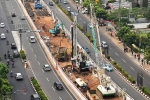





A decade, 521 transport infrastructures completed
This article has been translated by PwC Indonesia as part of our Indonesia Infrastructure News Service. PwC Indonesia has not checked the accuracy of, and accepts no responsibility for the content.
Investor Daily - Satu dekade, 521 infrastruktur transportasi rampung
3 Oktober 2024
By Heru Febrianto and Ichsan Amin
Jakarta, ID – During the 10-year administration of President Joko Widodo (Jokowi), the Transportation Ministry has successfully constructed 520 transportation infrastructure projects across Indonesia. This extensive infrastructure development aims to address disparities among the regions in the country.
Transportation Minister Budi Karya Sumadi stated that during the 10-year administration of President Jokowi, connectivity among regions has become increasingly robust with improved transportation accessibility and integrated services. In line with the national development mandate outlined in the National Medium-term Development Plan (RPJMN), the Transportation Ministry has constructed and rehabilitated/revitalised 521 infrastructure projects in the transportation sector over the past decade.
"One of the challenges we faced over the last 10 years is the disparity among regions in Indonesia. Therefore, we are continuously developing infrastructure in the transportation sector to enhance public connectivity and mobility," Budi Karya said at a press conference titled 'Transportation Sector Performance in the 10 Years of Joko Widodo Administration' at the Transportation Ministry Central Office in Jakarta on Tuesday (1/10/20204).
The Transportation Minister stated that 157 projects in the land transportation sector have been constructed and revitalised since 2015. This is followed by 193 projects in the sea transportation sector, 91 in the air transportation sector, and 80 in the railway sector. Some of these infrastructure projects are national strategic projects (PSNs), such as Nabire Baru Airport, the Jakarta-Bandung High-speed Railway, and Patimban Port.
“We are also continuously developing technology-based transportation, such as the Jabodebek LRT and the IKN Autonomous Rail Transit (ART), which is an autonomous railway, as well as the Jakarta-Bandung High-speed Railway (Whoosh),” he continued.
In addition to physical construction, the Transportation Ministry is also enhancing services by simplifying regulations, easing the process of obtaining permits, promoting good governance, fostering service innovation and digitalisation, and increasing its presence on the international stage.
To support connectivity in underdeveloped, remote, outermost, and border (3TP) regions, the Transportation Ministry has established pioneer services through the air bridge programme, the maritime highway, and pioneer buses and railways. Air bridge routes, which have been in place since 2017, have successfully reduced the prices of goods by around 30%-70%.
Meanwhile, in the railway sector, there are 10 pioneer railway routes that facilitate accessibility to major city centres. In the land transportation sector, there are 32 pioneer projects with an average growth of 1.48% from 2014 to 2024. In the maritime sector, there are 39 maritime highway routes connecting eastern and western Indonesia.
Simultaneously, the Transportation Ministry is enhancing urban transportation by providing urban mass transportation facilities that are both road-based and rail-based. Road-based urban mass transportation services are implemented using the 'buy the service' scheme.
Meanwhile, to provide rail-based mass transportation services, there are the LRT, MRT, and high-speed railway. The Transportation Minister is encouraging people to utilise public transportation services and reduce the use of private vehicles to prevent congestion in urban areas.
The Transportation Ministry is also promoting non-state budget (APBN) creative funding through public-private partnerships (PPPs) to accelerate the development of transportation infrastructure and facilities amid limited APBN resources. Creative financing has been implemented for the development of Bekasi Proving Ground, Patimban Port, and Dhoho Airport in Kediri.
Empty airport phenomenon
Despite the extensive infrastructure development in the air transportation sector, the Transportation Minister acknowledges that there is currently a phenomenon of empty airports in Indonesia. Budi Karya explained that this situation is due to several factors, particularly the impact of the COVID-19 pandemic.
He noted that one of the main causes was the drastic reduction in the global aircraft population, which has affected many manufacturers. "How? First, the global aircraft population drastically declined due to several factors, so major manufacturers are also not in good shape," the Transportation Minister stated.
Additionally, the availability of aircraft spare parts has been affected, particularly those from the Soviet Union and Ukraine, which has led to the suspension of many flights in Indonesia. "Secondly, the supply of spare parts was severely disrupted during the COVID-19 pandemic. Furthermore, spare parts from the Soviet Union and Ukraine could not be delivered," he stated.
The Transportation Minister emphasised that safety was one of the reasons why flights could not operate without spare parts. "So, many of our flights in Indonesia could not operate. There are no spare parts. The safety standards are high, so we cannot operate," he added.
Moreover, Budi Karya noted that purchasing power has also declined, impacting people's ability to use flight services.
In some cases, airfares must be increased to cover leasing and jet fuel costs. "Truthfully, purchasing power is decreasing. For some destinations, 70% [of the seats] must be filled at the upper limit tariff. If not, the leasing and jet fuel costs cannot be covered," he explained.
He stated that airport development, which has been implemented since 2014 in accordance with the directive from President Jokowi, was intended to meet the air transportation needs of various regions in Indonesia. When the airport development first began, the number of aircraft was 700, but after the pandemic, this number plummeted to 300 units.
Currently, the Transportation Minister stated that the number of operational aircraft is only around 420 units, a figure that has remained stagnant without significant increase. "At the time, we were building airports and the number of aircraft was approaching 700 units. However, after the COVID-19 pandemic, the number of aircraft decreased to 300, and now it is only around 420. It is stagnant; it is not increasing," he explained.
External factors
Meanwhile, aviation observer Gerry Soejatman stated that the air transportation sector will recover once the main external factors stabilise. For example, when the exchange rate for the US dollar is on par with people's income.
“On the other hand, other external factors, such as global political turmoil, do not affect global oil prices. Addressing these factors will invigorate our air transportation sector,” he said to Investor Daily.
Contact us