








Oil and Gas in Indonesia: Investment, taxation and regulatory guide - 14th Edition

As the global energy landscape continues to evolve, Indonesia’s oil and gas industry finds itself at a critical juncture. The world’s shift towards a more sustainable and low-carbon future presents both risks and opportunities for the industry. Balancing the ongoing decline in oil and gas production with the need for more sustainable practices poses a key challenge that requires attention.
Indonesian oil and gas production
Despite several noteworthy discoveries between 2023 and 2024, oil production in Indonesia continued to decline, dropping from 606 thousand barrels of oil per day (MBOPD) in 2023 to 580 MBOPD in 2024. This downward trend is primarily attributed to the diminishing output from many ageing wells and the challenge of technical factors such as unplanned shutdowns in various oil and gas working areas, posing a significant challenge to efforts aimed at boosting production.
Indonesia’s gas lifting performance exceeded expectations, achieving 6,802 MMSCFD, which surpassed the State Budget (APBN) target of 5,785 MMSCFD. This achievement was driven by the combined efforts of several KKKS. And then, in September 2024, national gas production set a record, climbing to 7,399 MMSCFD. The oil and gas production profile in Indonesia is presented as follows:
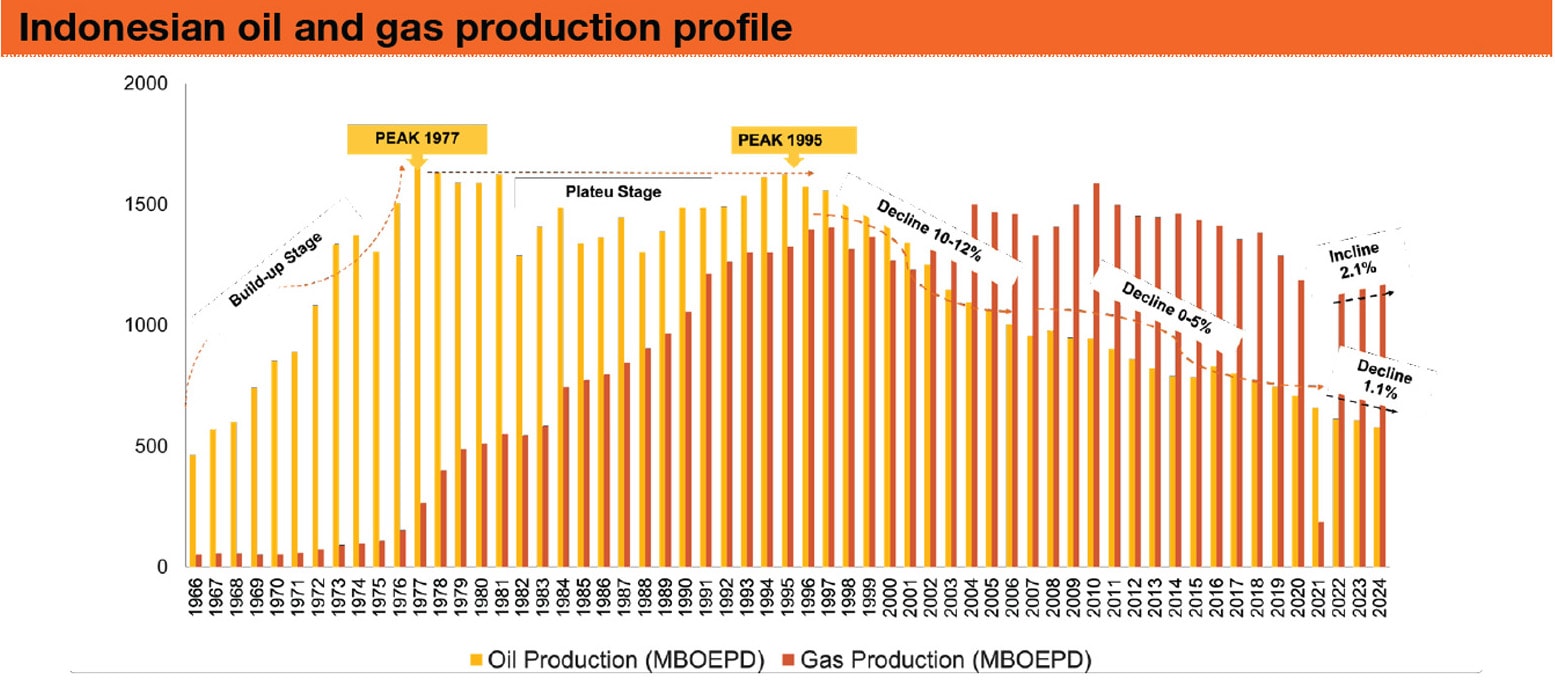
Source: SKK Migas, “SKK Migas 2023 Annual Report”, 2024
The role of oil and gas in energy transition
Energy transition is a complex, multi-faceted process requiring coordinated policy action, significant financial investments, and robust infrastructure development. The Government’s alignment of the 2024 RUKN policies with the JETP roadmap provides a clear framework for balancing economic growth with emissions reduction targets. However, achieving these ambitions will depend on accelerating renewable energy deployment, modernising the national grid, and mobilising private sector investment. While progress is being made, the scale of the transition necessitates sustained policy support, international cooperation and financial commitment to ensure a secure, sustainable and inclusive energy future for Indonesia.
SKK Migas has launched the Indonesia Oil and Gas Strategic Plan (IOG 4.0) to achieve ambitious production targets by 2030: one million barrels of oil per day and 12 billion standard cubic feet of gas per day. The plan includes low-carbon initiatives such as new regulations, energy management, zero flaring, emission reductions, reforestation, and CCS/CCUS technologies. It explores the energy transition, renewable energy integration, and energy efficiency. The government supports CCS/CCUS through regulations that facilitate project approval, monitoring, and carbon credit monetisation.

Oil and Gas in Indonesia: Investment, taxation and regulatory guide - 14th edition
Indonesian Oil and Gas concessions and major infrastructure map