







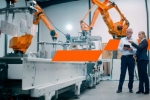



Among manufacturers, the next industrial revolution is here. More than half of leaders who responded to PwC’s Global Industrial Manufacturing Sector Outlook 2026, expect tech enablement and automation to nearly triple by 2030. Moreover, manufacturers are targeting new growth opportunities through AI-native operations and tighter integration across products, services, and ecosystems. But they aren’t all starting from the same place.
In fact, the top quintile of ‘future-fit’ companies are already pulling away from their peers. These companies are agile, innovative, and fast. They combine technology with clean data and interoperable systems, along with organisational cultures that learn and adapt quickly. As a result, they can reallocate resources, adopt technology, and mitigate risk faster than their competitors—gains that can quickly become self-reinforcing as new applications and solutions become available.
In our survey, future-fit companies already use advanced tech more intensively than others in both product design (46% versus 34%) and production and operations (37% versus 28%), with even wider gaps expected in the years ahead. Future-fit companies also report much higher levels of automation today than other organisations (with a median of 29% versus 15%), with plans to reach 65% by 2030 (versus just 45% for other manufacturers).
Here’s how other industrial manufacturers can start closing the gap:
Integrate across the value chain
Companies that deploy advanced tools in isolation—robotics in production, analytics in supply chain, AI pilot projects in engineering—should expect limited gains. In contrast, winning manufacturers treat AI and other cutting-edge technologies as a system, not a set of one-off projects. They integrate across the value chain, ensuring that design, production, supply chain, and other functions operate on shared data and connected workflows.
And integrate across technologies
Leaders also integrate across technologies, as AI, automation, analytics, and engineering systems draw from the same data, follow the same decision rules, and together help maintain a single operational view of the business.
Don’t get ahead of your organisation’s ability to implement new technology
Organisations that can’t experiment, redesign workflows, or deal with problems quickly will struggle to realise the value of tech or automation investments. Deficits in skills, learning access, and psychological safety are the warning indicators. Should these signs appear, managers should be encouraged to alert leadership immediately. Leadership that resists, dismisses, or punishes bad news could indicate a more serious problem.
Explore the full findings of PwC’s Global Industrial Manufacturing Sector Outlook 2026


Follow us