







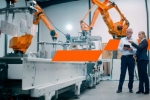


- The median share of industrial manufacturers that will have highly automated processes is expected to more than double – rising from 18% to 50%
- Companies that are already leading are expected to move further ahead – with the share of those with highly automated processes rising from 29% to 65%
- Industrial manufacturers expect growth to come from new activities beyond their traditional core, with 44% of total revenue projected to come from outside the manufacturing of industrial and consumer products by 2030
LONDON, 27 February 2026 – The share of industrial manufacturers who expect to highly automate key processes by 2030 will more than double, from 18% to 50%, according to PwC’s Global Industrial Manufacturing Sector Outlook, released today.
The study, which surveyed 443 senior executives across 24 territories, finds that the global US$16 trillion industrial manufacturing industry sits at a historic inflection point, with AI and other advanced technologies, automation, and industry convergence accelerating and fuelling opportunities for growth and productivity.
Ryan Hawk, Global Industrials and Services Leader, PwC US, said:
“As tech adoption and automation accelerate, advantage will shift from who has tools to who can adopt them and orchestrate them the fastest. Agile, tech-enabled, and future-fit manufacturers already have an edge – with the divide between those who are tech-enabled and those still operating with patched up systems to widen even further. The questions for manufacturers is do they know what to adopt and are their level of readiness to adopt it.”
Future-fit industrial manufacturers have an edge
“Future-fit” industrial manufacturing companies – the fastest, most agile, and most innovative 20% of companies identified in the survey – have a clear edge. Currently, a median of 29% of these companies have highly automated processes, compared with 15% of other companies. By 2030, that share is expected to rise to 65% for future-fit, versus 45% for others.
They also are more likely to use advanced tech in key parts of the value chain. For example, 46% of “future-fit” companies use advanced tech in product design and development, versus 34% for other companies; 37% of “future-fit” companies use it in production and operations, relative to 28% for others.
In terms of the overall deployment of advanced technology within value chain steps, two areas—first, production and operations, and second, product design and development—will lead the way, with heavy use reaching 76% (from 29%) and 72% (from 37%), respectively.
While the goals behind this investment boom vary by technology, they center on growth and productivity. AI is equally expected to deliver both (47% and 46% respectively), while robotics is seen as less about growth (13%) and more about productivity (78%).
Industrial manufacturers increasingly expect growth to come beyond their core
Even as industrial manufacturers look to technology and AI to drive growth, the report finds that manufacturers are also increasingly expecting growth to come from new activities beyond their traditional core. More than two-fifths (44%) of total revenue is projected to come from outside the manufacturing of industrial and consumer products by 2030.
The survey finds manufacturers shifting toward offerings that bundle a range of equipment, know-how, and services—such as intelligent and connected solutions, flexible equipment, extended services, and electrical and data center equipment. For their part, future-fit manufacturers are more likely than others to prioritize intelligent and connected solutions, as well as recurring or outcome-based models as part of their growth strategy.
70% of executives rate “developing new capabilities internally” as their top means of accessing growth opportunities. But while there is significant agreement about the importance of this kind of innovation, there is a clear gap between future fit companies and the rest when it comes to the capabilities to deliver it. Future fit companies are more likely to say their workforce is empowered to act on new ideas (74% to 59%), tolerate strategic risk taking (69% to 36%) and that they have data driven decision making processes (75% to 47%)
Ryan Hawk, Global Industrials and Services Leader, PwC US, concluded:
“Tech enablement and automation will surge across the sector, yet the most meaningful performance differentiation will come from how coherently those technologies, including AI and automation, work together. If manufacturers are to unlock the growth and productivity opportunities afforded by new and emerging technologies, they must treat AI and other advanced technologies as a system, not a set of projects and advanced tools in isolation.”
– ENDS –
Notes to Editors
About PwC’s Global Industrial Manufacturing Sector Outlook
PwC’s Global Industrial Manufacturing Sector Outlook 2026 gathered responses from 443 senior executives—all director‑level or above—from publicly listed industrial manufacturers across North America, South America, Europe, Asia, and the Middle East in late July 2025. For the purposes of this research, industrial manufacturing is defined as the sector involved in the design, fabrication, assembly, and servicing of machinery, equipment, components, and integrated systems that enable and support operational processes across diverse industries. To identify deeper patterns in the data, the analysis incorporated advanced statistical techniques that segment the group of manufacturing executives based on their behaviours, strategies, and performance outcomes. In addition, a group of respondents was identified using factor analysis across key measures of innovation and speed to market, as well as agility (i.e. how quickly a company reallocates capital and resources across projects and business units in response to performance and strategic fit). Respondents ranking in the top quintile on this composite measure were classified as ‘future fit.’
About PwC
At PwC, we help clients build trust and reinvent so they can turn complexity into competitive advantage. We’re a tech-forward, people-empowered network with more than 364,000 people in 136 countries and 137 territories. Across audit and assurance, tax and legal, deals and consulting, we help clients build, accelerate, and sustain momentum. Find out more at www.pwc.com.


Contact us