Turn insight into action
We help you solve the problems that matter most so you can act faster and move further.
What would you like to explore?
Industrial redevelopment offers an accelerated path for building data centres
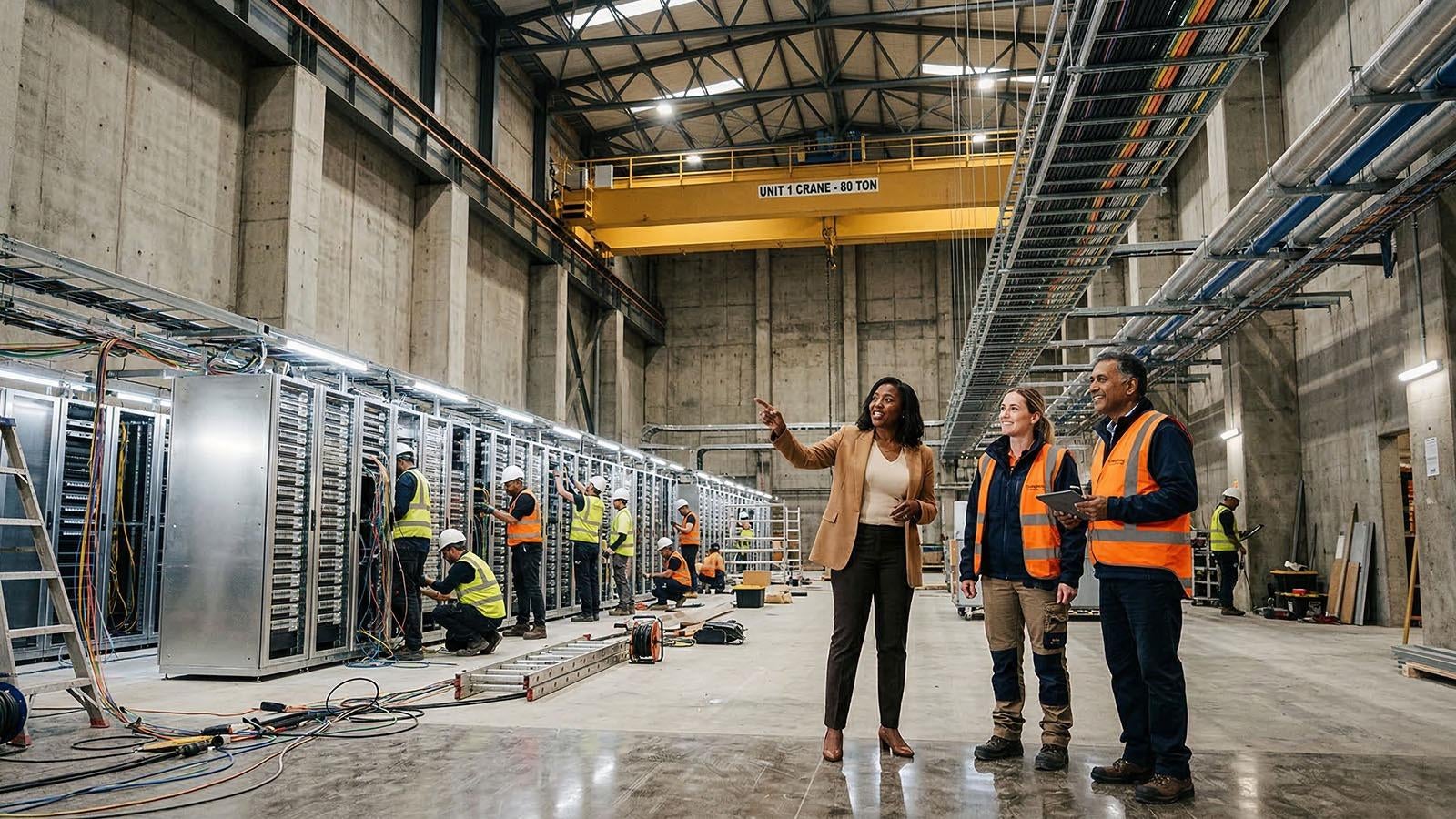
Access to electricity has become a critical bottleneck in data centre construction. Developers that convert industrial sites to data centre campuses can shorten time-to-power by repurposing much-needed grid connections and infrastructure.
The takeaways
- Data centre developers can shorten project timelines by building at existing industrial sites that already have grid connections and energy infrastructure.
- Savvy developers are expanding their selection criteria and seeking out industrial sites in areas outside established data centre clusters.
- Although industrial sites sometimes require major retrofits, the advantages often outweigh the downsides.
The fast-growing energy needs of data centres are colliding with the limitations of power systems worldwide. Data centre developers often must extend their project timelines because of lengthy queues for grid interconnections and much-needed upgrades to transmission and distribution networks. Building generation capacity at data centre sites has proven difficult in cases where parcels of land are too compact or where regulations limit new installations. Shortages of crucial equipment, such as transformers, can prolong delays. Local residents and business owners sometimes line up against data centres because they worry about air pollution, water scarcity, and rising electricity bills.
Facing such challenges, some developers have found success with an alternative location strategy: they’re building at established industrial sites that are already outfitted in the specific ways that data centres need. Factories and power plants typically sit near transmission corridors and high-capacity substations. Many of these facilities have not only grid connections but also onsite power generation or room to accommodate it. In certain geographies, industrial sites are joined to district heating systems that can absorb warmth from a data centre, lessening its cooling requirements. And some sites have a zoning status and environmental review history that make the permitting process for a data centre easier than it would otherwise be.
To repurpose grid-connected industrial sites, data centre developers do need to pay attention to certain matters. Power capacity may be contractually committed to other uses. Facilities may require major retrofits or remediation, and needed electrical equipment may be unavailable. The owners of attractive sites sometimes prefer to work with buyers or tenants who have other uses in mind. Market rules and utility processes can still impose queue delays. Community acceptance may prove slow to develop.
Nevertheless, experience suggests that existing industrial sites usually offer more advantages than disadvantages as locations for data centres. By adding these sites to their lists of potential properties, developers can more readily overcome the time-to-power constraints that so often reduce the value created by data centre projects.
Evaluating the site
Industrial redevelopment in practice
The factors described above underscore how important it is for data centre developers to understand what redevelopment entails and how it differs from building at greenfield sites. The examples that follow highlight some of the considerations at play in the evaluation of industrial sites.
Expanding site selection criteria
As part of its growth plan, one global developer of data centres sought to identify promising sites near Northern Europe’s five prime hubs: Frankfurt, London, Amsterdam, Paris, and Dublin. Sorting through greenfield and brownfield opportunities, the team realised, would require a comprehensive framework for assessing each location and estimating its value. Managers took their usual criteria for new sites (such as the distance to a Tier 1 internet node), adjusted them to apply to redevelopment sites, and supplemented the list with new criteria for redevelopment projects, such as existing grid interconnection assets and onsite generation assets.
Once the framework was established, managers used it to evaluate more than 20 sites, roughly half of which were redevelopment locations. This process involved speaking with local grid operators to understand current and planned power availability and transmission, as well as the feasibility of onsite generation. The evaluation team also engaged the owners of potential redevelopment sites to learn how easily those properties could be made ready to host a data centre. The thorough approach allowed managers to develop a clear estimate of each redevelopment site’s value and to engage productively in the bidding process.
Anticipating market dynamics
The expected growth of the data centre market has convinced many developers to look at locations beyond today’s clusters. Inexpensive renewable energy and generous government incentives are two of the features that may lead developers to build certain projects outside obvious high-demand areas. Grid connections, though, can still be hard to come by—which places a premium on redevelopment sites.
Low energy prices have particular appeal for data centre projects that aren’t governed by strict requirements for speed, uptime, or latency. These include centres intended for the training of AI models. On such projects, it’s mainly the cost of energy that determines whether the investment will pay off. Building on a grid-connected industrial site near a ready source of inexpensive power, such as a hydropower plant or a wind farm, lets the developer get the project up and running faster.
Developers can also benefit by selecting industrial sites when they are planning data centres supported by government programmes. The EU’s InvestAI initiative, for one, subsidises the building of data centres that will be devoted to training AI models. With this incentive in place, it may be even more advantageous for developers to select industrial sites, with their grid connections and comparatively modest set-up costs. In Singapore, the government has solicited bids to build data centres at former industrial sites on Jurong Island, the city-state’s long-standing energy and chemicals hub.
Competing with alternative uses
When it comes to bidding for industrial sites, data centre developers sometimes find themselves going up against other types of businesses. After all, many companies are interested in gaining access to the same power grid.
Varied interests such as these converged around one site with evident potential for reuse. On it stood a large chemical production plant with a contractually guaranteed supply of electricity from the grid. The corporate owner of the plant projected that its production would likely dwindle in the coming years, so the company began exploring the possibilities for leasing the site out to other tenants.
The owner invited data centre developers and other potential tenants to evaluate the site. Even amid the data centre boom, the winning bid came from another sort of business: utility-scale energy storage. The attributes of the site happened to make it especially attractive for energy storage, and it drew strong bids from storage providers. Data centre developers, for their part, found other sites that would meet their needs in a more economical way.
Managing complex construction requirements
Compared with new sites, existing factories and power plants can present data centre developers with some unique challenges during design, engineering, and construction. Data centres have special requirements, such as uninterruptible power, advanced cooling, and stringent security. Thorough environmental assessments also usually need to be conducted. Should the assessments reveal liabilities, developers must plan and carry out remediation.
Even allowing for such variables, some industrial facilities, such as printing plants, can be converted to meet a data centre’s requirements with only modest upgrades or alterations. Other facilities might need extensive retrofitting or demolition and replacement. These requirements put additional pressure on developers’ project schedules, which are often aggressive to begin with. Success in situations like these can come down to the developer’s ability to do careful planning, quality control, coordination, and risk management across all phases of the project.
Realising value
Actions for data centre developers and industrial companies
Building at industrial facilities won’t solve the power crunch for data centres on its own. But these sites can be a meaningful, scalable part of the answer. Below are actions that data centre developers, industrial and energy firms, investors, and utilities can take to improve the time-to-market for data centre projects, achieve energy resilience, and deliver community benefits.
Data centre developers can begin by analysing areas where decommissioned industrial sites offer the features that are most important to customers, such as proximity to major internet nodes or data centre clusters (for customers with strict latency requirements) or access to low-cost power (for those that prioritise affordability). In addition to considering decommissioned sites, developers can look at functional industrial locations with potential to generate more value for their owners if converted to host data centres. For certain projects, developers might explore site swaps with industrial firms. In a site swap, an industrial operation would move to a new location, allowing a site in a crowded, high-demand area to be repurposed.
Industrial firms, energy companies, private investors, and other site owners can analyse the existing or former production sites in their portfolios to see whether they have the space, grid connection, and internet links necessary to accommodate data centres. The retirement of coal and gas plants, for example, can create development opportunities because they’re close to stranded interconnection points. If these general criteria are met, then companies can carry out a more detailed analysis of other features, such as environmental quality, operating and energy cost profiles, and access to the heat grid. This analysis will help the owner determine which types of data centres the site would work best for and whether the expected returns on leasing or selling the site are more attractive than the expected returns from maintaining the site’s current use.
Utilities and grid operators can also take actions that will help them gain from redevelopment, provided they help regulators understand the possible approaches, along with the effects on electricity prices and on long-term investment plans. When a site is redeveloped for a data centre, the utility might charge the developer a special rate for the new large load, along with a fee for improvements to the grid connection. Other pricing models can reward data centres for building their own generation capacity at existing interconnection points (so the data centre doesn’t strain the grid) or for supporting grid flexibility through demand curtailment or other mechanisms. Utilities might also consider hosting data centres at their own generation sites, where the centres can draw power directly or build generation capacity that feeds excess power into the grid.
As data centre demand continues to outstrip the growth of the power system, developers are exploring every available means of getting the electricity they need. Converting grid-connected industrial sites can help developers move faster by leveraging existing transmission adjacency, substations, zoning history, and sometimes onsite generation. The winners will be the teams that retool their site selection practices and find locations offering overlooked value.
Contributors
Brian Burns, TMT Strategy&, Partner, PwC United Kingdom
Danny Touma, Energy Transition, Partner, PwC Middle East
Daryl Walcroft, Global Engineering and Construction Leader, PwC United States
Related content

Want ROI from AI? Go for growth
Some companies get more than cost savings from AI—they’re achieving growth. PwC studied what these AI leaders do differently from everyone else.
30 min read

Global Infrastructure Outlook 2025–50: Accelerating human progress
A staggering US$151.1 trillion of capital is needed to build and maintain infrastructure in the coming decades.
19 min read
Nine AI-fuelled business models that leaders can’t ignore
AI is fundamentally changing how companies create, customise, and scale products and services. Explore what’s ahead and how you can prepare.
15 min read
