







{{item.videoDuration}}
{{item.title}}
{{item.text}}

{{item.videoDuration}}
{{item.text}}


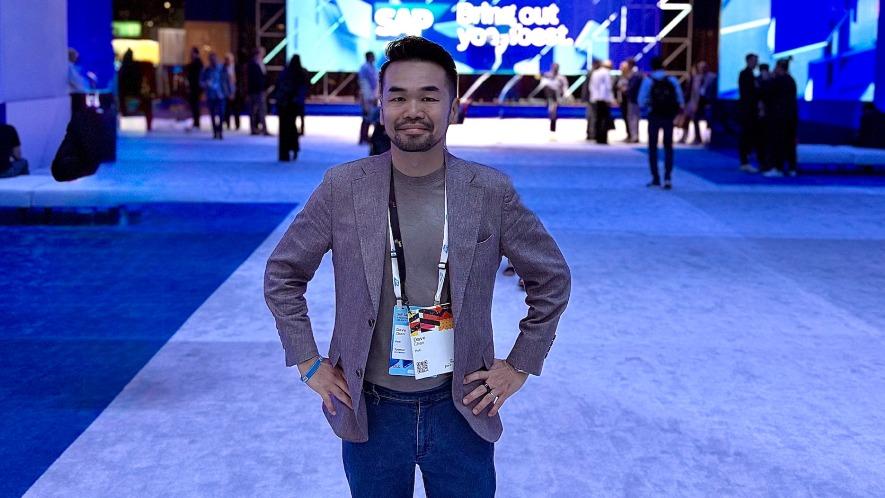
In this blog series, I’m talking to leaders from across our global SAP practice to bust myths, share successes, and find out what makes them tick. Today, I spoke with Dave Chen, who leads our SAP practice across Singapore, Thailand, Indonesia, Malaysia, Vietnam and the Philippines.
Martin: Let’s kick off with some quick-fire questions. What SAP myth do you want to bust?
Dave: I want to debunk the myth that SAP public cloud is only for small businesses in certain industries. We’ve successfully introduced it in large enterprises, including some of Japan’s biggest shipping companies. And we’ve deployed it for hospitals, education, and clients in other sectors.
The most important thing is understanding each client’s business needs and working out which solutions deliver the best fit in the client’s existing IT environment. For our latest hospital client, we delivered a fast SAP public cloud implementation with a clean core approach sticking to standard SAP functionality, because the client needed support with back-office processes rather than clinical areas.
Martin: What excites you most about the PwC SAP alliance?
Dave: I’m proud of our ability to bridge the gap between business and IT. We provide end-to-end solutions that help clients solve complex problems from strategy through to execution. That might be figuring out what products to sell in certain markets or how to reinvent their businesses. Or it might be supporting them through mergers and acquisitions, where public cloud is a great fit because it enables rapid deployment to address day one needs. Our ability to focus on clients’ business needs distinguishes us from straightforward systems integrators, which tend to focus exclusively on technology and lack the experience to challenge clients on their vision.
Sometimes, a challenge is exactly what clients need. For example, we’re speaking with a transportation client that did a brownfield private cloud SAP deployment because their old SAP ECC apps were reaching end of life. The IT team wanted to solve the “burning platform” issue quickly, but they didn’t fully consider the business needs. Now, the organisation is having to embark on a much longer journey to retrofit the lift-and-shift deployment cloud implementation that’ll support the company’s business transformation for years to come. If they’d been challenged early on, they could have chosen the right path the first time and saved themselves a significant amount of time and money.
Martin: What’s the most exciting project you recently worked on?
Dave: We recently helped a government-owned pension fund on a complex end-to-end transformation. It included treasury management and bond tracking, as well as the core finance, procurement and HR processes. It’s a massive responsibility, because almost every citizen in the country has a pension in that fund, so it’s vital that the calculations are accurate. We embraced an AI-first approach and introduced new ways of working. To support this, we’ve built multiple apps for the client on SAP Business Technology Platform (BTP).
Looking further back over my career in the PwC SAP alliance, my personal highlight was a huge implementation at a joint venture of three large shipping companies covering 50+ countries. We pulled it off in just eight months to support their day one operations.
Martin: Thanks Dave. Now, over to you. What other developments are you seeing in clients’ use of SAP across South East Asia?
Dave: Clients are feeling an increased sense of urgency to overhaul their on premise ERP and move to modernised new SAP Business Suite. Given geopolitical tensions and heightened market volatility, you might expect companies to move slowly and cautiously. But in fact, clients recognise that replacing outdated ERPs with modern platforms and new ways of working can sharpen their competitive edge. In parts of South East Asia, emerging markets are adopting transformation approaches rapidly. We’re currently seeing a big jump from the traditional world of shared services to pivot into cutting-edge AI such as agentic AI; unlocking huge cost savings.
SAP Business Data Cloud relates to another new development, which is that SAP is taking a much more holistic approach to complex enterprise IT environments. For example, Business Data Cloud enables much closer integration of SAP and non-SAP data. Many of our clients already run large data platforms on Databricks, so Business Data Cloud enables them to capitalise on their existing investments. On the AI side, there’s stiff competition with hyperscalers and other standalone products. Furthermore, SAP allows companies the flexibility to integrate with their existing environment, such as using Joule with Microsoft Co-Pilot, choosing which large-language model they use, etc. We’re not seeing dominance of a single AI agent, so the challenge is about orchestration. The launch of Business Data Cloud has come at a good time, because data and AI go hand-in-hand. AI can only be trusted if you’re using high-quality data.
In other news, we’ve developed new Back-office Express solutions that provide a flexible way to deploy SAP in weeks – not years. With so many AI and agent use cases available from day one, the solutions appeal to clients of all sizes and across all industries. They provide significant benefits in helping clients see the value of public cloud.
In addition, South East Asia is home to a huge amount of BTP app development. This is because we’re the first region to have an AI Centre of Excellence with SAP, which has given us fantastic co-development opportunities, close collaboration in supporting shared clients, and privileged access to SAP’s work in AI. Also, we have a dynamic and innovation team. BTP app development provides immense value, because it enables us to meet companies’ specific needs while still delivering “clean core” implementations (so clients will be able to take advantage of new SAP functionality as it comes out). Both the Back-office Express solutions and BTP app development enable us to take even better care of our clients and solve their most complex problems. And that’s something to be proud of.
I thoroughly enjoyed talking to Dave and hearing about the exciting work going on in the Asia Pacific region. I’m planning to reveal insights from more leaders across our global SAP alliance soon, so stay tuned and thanks for reading.
{{item.text}}
{{item.text}}


