Turn insight into action
We help you solve the problems that matter most so you can act faster and move further.
What would you like to explore?
AI readiness: Shaping the future AI landscape

A look at where countries and regions stand on AI and how they’re building capabilities for the years ahead.
With the emergence of generative AI chatbot services, we are witnessing rapid transformation in global markets as AI commercialisation accelerates. The AI market is projected to grow at an annual rate of 28% until 2028, potentially reaching approximately $830 billion by 2030. In this dynamic environment, developing and effectively utilising AI capabilities has become a critical imperative for both organisations and economies.
The AI stack
A comprehensive approach to AI readiness
Strengthening AI readiness requires integrated investment across the entire “AI stack”—comprising AI chip, infrastructure like data centres, AI models, and AI services. Each layer of this stack builds on the previous one, creating a foundation-to-application hierarchy. AI semiconductors particularly form the foundation of the AI ecosystem, as they determine the computational limits of what AI models can achieve. Without advanced chip capabilities, even the most sophisticated AI models and services face performance bottlenecks. Therefore, establishing design and manufacturing capabilities in the semiconductor area provides a fundamental competitive advantage that ripples throughout the entire AI stack.
Leading profiles
The four groups defining AI readiness
PwC has identified 10 leading entities that are enhancing their AI readiness through clear strategies. Analysing these entities based on the four components of the AI ecosystem (AI semiconductors, infrastructure, models, and services), PwC evaluated two key dimensions: how organically these elements connect to form an ecosystem and the robustness of their foundational capabilities. The analysis revealed four distinct groups:
First, “frontrunners” with strong ecosystem integration and foundational capabilities. Second, “tech pioneers” with robust semiconductor-focused foundational capabilities. Third, “chasing contenders” rapidly strengthening both ecosystem connectivity and foundational capabilities. Finally, “agile adapters” who are still developing connectivity and foundational capabilities but employ flexible strategies focusing on leveraging global resources or concentrating on specific core areas rather than developing independent capabilities.
Each group strengthens AI capabilities through unique strategies and characteristics, allowing us to identify trends, explore potential future directions, and prepare for enhanced competitiveness through case studies.
Recommendations
Strategies for advancing AI readiness
To improve their AI readiness, PwC recommends that countries should consider the following strategies:
1. Secure semiconductor capabilities
Securing AI semiconductor capabilities, which form the AI ecosystem’s foundation, will be the bedrock of expansion into wider elements such as AI service, model, and infrastructure. While establishing a self-sufficient AI semiconductor ecosystem, including design, manufacturing, to testing and packaging, would be ideal, this requires massive investment, talent development, and long-term policy support. Therefore, a more practical approach would be strategic positioning based on comprehensive analysis of existing human/material resources, collaboration networks, market conditions, geographical advantages, and policy environments. It is recommended to focus on the investment in areas that maximise existing strengths while strengthening semiconductor manufacturing capabilities through international collaboration.
2. Establish and implement consistent policy direction and governmental support
Current AI leaders like the United States and China differ in approach but share a common characteristic: clearly defined governmental roles driving growth across the AI industry. The US focuses on encouraging private investment and creating flexible environments for market-driven innovation. China, conversely, rapidly drives corporate and market growth through government-led development policies. Ultimately, regardless of approach, establishing clear, consistent direction with continuous support proves beneficial.
3. Utilise global resources effectively
Beyond independent capability development efforts, we suggest strategies to attract global companies or pool resources through international collaboration across various AI ecosystem areas including R&D, talent development, and cluster construction. Sharing accumulated knowledge and expertise also promotes rapid development. Examples such as large language model (LLM) releases through joint international R&D and Japan’s efforts to create advanced semiconductor clusters demonstrate the effectiveness of leveraging global resources.
Strengthening AI capabilities represents a long-term, gradual development process rather than a short-term goal. Developing balanced capabilities across the entire AI stack, from semiconductors to services, requires a consistent and systematic approach aligned with strategic and clear objectives rather than fragmented attempts. Those who establish clear priorities, communicate closely with relevant stakeholders, and actively pursue international collaboration to build comprehensive AI ecosystems will likely maintain competitiveness in the future AI era.
AI readiness: Shaping the future AI landscape
Related content
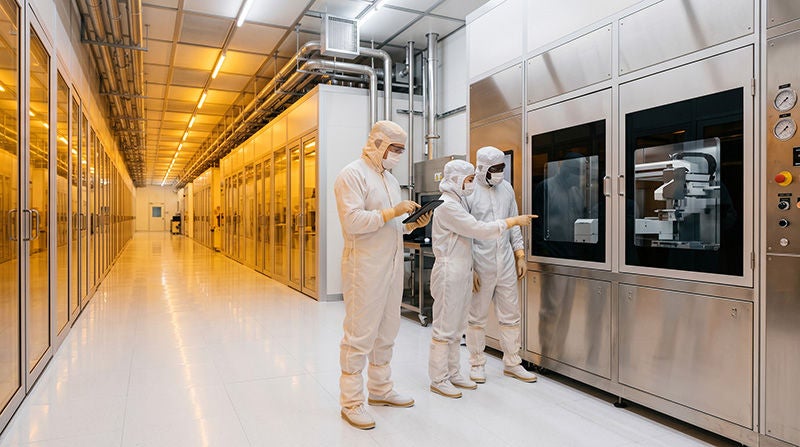
Who will innovate the next wave of AI semiconductors?
Investment in AI within the semiconductor industry is rapidly increasing, mainly driven by GPU-based AI chips. As custom AI semiconductors emerge.
6 min read

Quantifying the value of Responsible AI
PwC research shows companies investing in responsible AI could achieve higher valuations and revenues while reducing adverse AI-related incidents.
12 min read

How AI is transforming research and development
Integrating AI into R&D strengthens innovation and shortens development cycles. It’s not a tech upgrade, it’s a strategic shift, supported by PwC.
12 min read
Get in touch
Glenn Burm
Global Semiconductors Leader
PwC United States
Wilson Chow
Global TMT Industry Leader, Partner
PwC China
