








Manufacturers are leveraging this powerful technology to enhance products throughout their lifecycle.
How can blockchain power industrial manufacturing?
Industrial companies are showing there’s more to blockchain than cryptocurrencies.
Manufacturers are developing blockchain implementations that have the potential to help them streamline operations, gain greater visibility into supply chains and track assets with unprecedented precision. Blockchain has potential to revolutionize how manufacturers design, engineer, make, and scale their products. What’s more, because of its power to foster trust among competitors who must nonetheless cooperate within common ecosystems, it’s rewriting how firms interact.
¹ PwC’s Global CEO Survey 2019, ² PwC’s Global Blockchain Survey

Explore further
- Blockchain’s industrial impact
- Data for the life of the aircraft
- Automotive track and trace
- Best practices for blockchain solutions
Blockchain’s industrial impact
From sourcing raw materials to delivery of the finished product, blockchain can increase transparency and trust at every stage of the industrial value chain. Among the pain points it could help address are:
- Supply-chain monitoring for greater transparency
- Materials provenance and counterfeit detection
- Engineering design for long-duration, high-complexity products
- Identity management
- Asset tracking
- Quality assurance
- Regulatory compliance
Blockchain-powered solutions can seamlessly aggregate all of this information, delivering significant value for industrial companies, and can also help unlock the full potential of other advanced technologies like augmented reality, IoT and 3D printing.
Data for the life of the aircraft
Commercial aircraft are made up of hundreds of thousands or even millions of parts. Despite advances in sensor technology, data analytics and cloud computing, it can still be next to impossible to know which parts are on which plane, when they were last serviced and by whom.
Blockchain technology could provide the solution, increasing asset utilization, boosting aftermarket values and enhancing safety.

Automotive track and trace
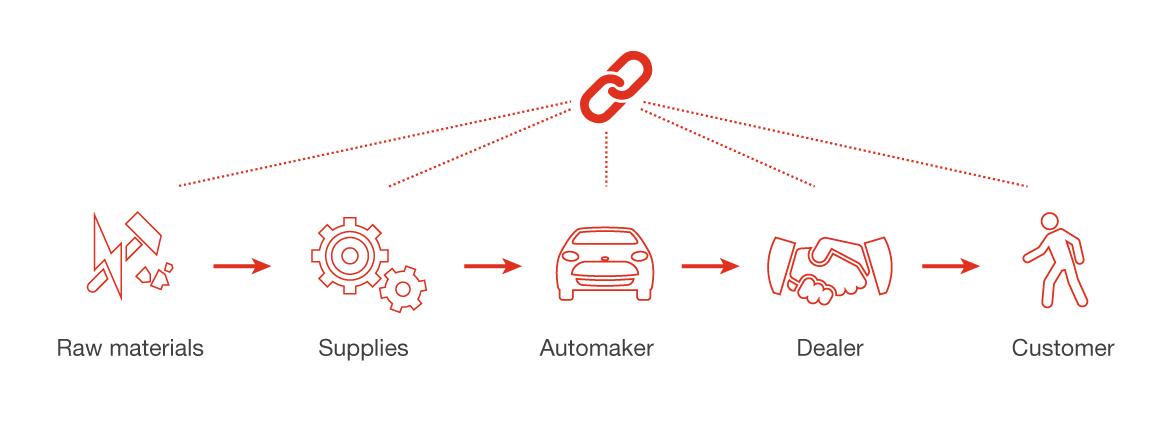
Carmakers manage massive and complex supply chains. And auto manufacturers are ultimately accountable to customers and regulators for their vehicles’ reliability and safety. Sufficient visibility into the provenance of the vehicles’ parts and their journey from the mine to the showroom floor is often lacking.
A blockchain-enabled solution would help automakers to track every step of that journey into all supply chain tiers. This could improve recall response and improve inventory management.
Best practices for blockchain solutions
Blockchain solutions can create value for industrial companies in a number of ways. But that doesn’t mean it’s an equally tenable solution for all companies or every industrial manufacturing sector.
By focusing on four key areas early in their blockchain efforts, companies can set themselves on a path toward successful execution.
- Make the business case: Commit to new ways of working, frame the problem and the solution and start small, then scale out.
- Build an ecosystem: Focus on a cooperative few, broaden your network and work across the value chain
- Design deliberately: Confront risks early, consider privacy applications and invest in data and processes
- Navigate regulatory uncertainty
- Shape the trusted tech decision, monitor evolving regulation and use existing regulation a guide
Be an industrial blockchain leader
There is still plenty of room for industrial companies to be blockchain pioneers. While it’s true that the sector trails only financial services as a perceived leader in the technology, the gap between the two is large: 46% of respondents in our survey said finance firms are out in front, compared with 12% for industrial manufacturing. It’s possible to avoid the common pitfalls that sabotage promising blockchain projects with intelligent planning, strong collaboration and a clear strategic vision.
How PwC can help
Any blockchain solution, no matter how prescient, is only as good as its execution. This is where PwC excels—by offering proven specialization in managing complex implementation programs from start to finish.
What PwC delivers:
- Business and functional requirements
- Design, development, testing and training of blockchain solutions
- Integration and management of third party implementation partners
- Rigorous PMO and proactive management of overall efforts