hero image

Beyond oil: GCC’s expanding trade agenda gains momentum

Middle East Economy Watch - November 2025

The GCC is advancing a new phase of economic openness — expanding trade agreements, deepening global value-chain integration and strengthening its position as a bridge between Asia, Africa and Europe

In this edition of Middle East Economy Watch, we explore how the Gulf Cooperation Council (GCC) is deepening its commitment to trade liberalisation at a time when globalisation is under pressure in some parts of the world. 

As the global order becomes increasingly multipolar, the region’s economies are charting a confident new course by expanding trade relationships beyond the Middle East, positioning themselves as economic and geopolitical powerhouses. The United Arab Emirates (UAE), for example, has been signing multiple trade agreements in the last few years, while the other GCC states are also advancing trade-positive agendas, making steady progress through both bilateral and GCC-level negotiations.

While trade is supportive of diversification, oil remains central to the economies of many Middle Eastern states. We unpack the implications of recent production hikes by OPEC+ set against the softening in oil prices in recent months, touching US$60 for the first time since 2020. Yet, amid these shifts, resilience and renewal define the region’s trajectory. Non-oil growth is robust in most of the GCC and in some of the other Middle Eastern countries, such as Egypt where growth is rebounding strongly on the back of decisive reforms.


Economic performance and outlook

OPEC+ pauses further hikes as glut concerns grow 

In the months since our last report, OPEC+ has boosted production more rapidly than many oil market observers had expected. By September, the group had effectively restored the 2.2m barrels per day (b/d) in production that was ‘voluntarily’ removed from the market in January 2024 by eight countries – including Saudi Arabia, Iraq, the UAE, Kuwait and Oman. Other OPEC+ members, including Bahrain, continue to operate under the group-wide quotas that were last set in October 2022. 

The UAE was granted an extra 0.5 million b/d production, acknowledging its significant capacity growth during nearly a decade of output restraints. However, its current allocation remains nearly a third lower than its capacity – representing the largest relative shortfall of any OPEC+ member. Then in October, OPEC+ began to gradually taper the 1.6m b/d in voluntary cuts that were implemented in May 2023.

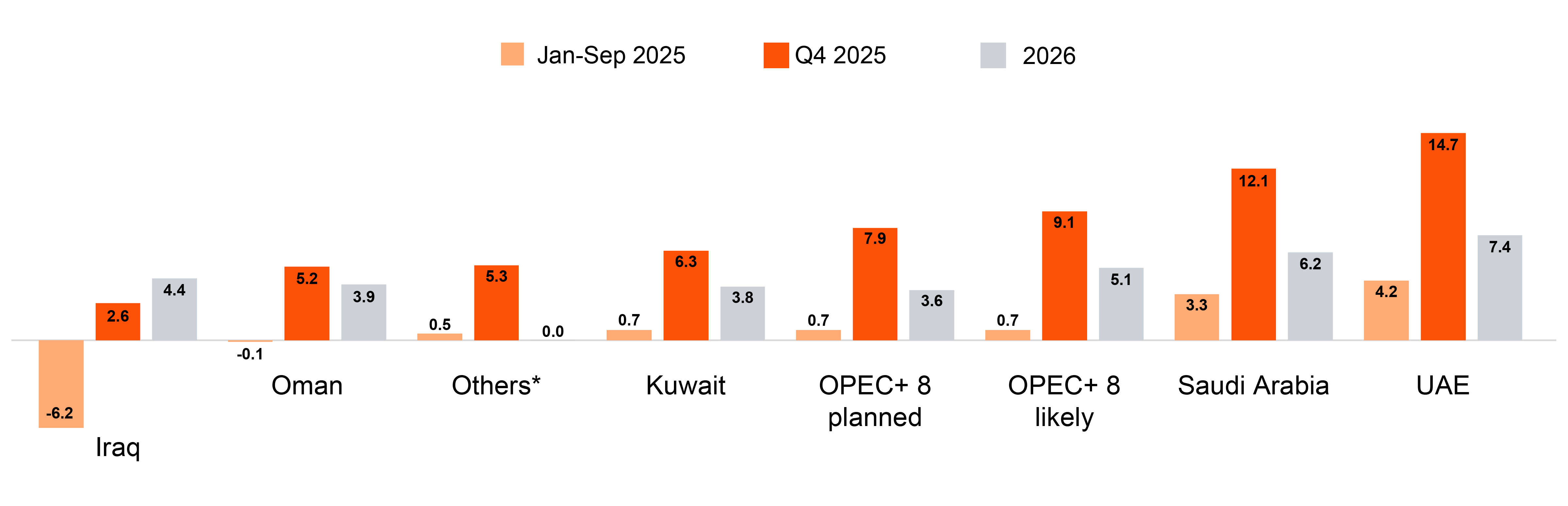
It’s worth noting that actual production often varies substantially from official quotas, with OPEC+ maintaining a compensation policy that requires countries, such as Iraq, to offset past overproduction.1 As a result, although the average quotas of the eight countries rose by 2.7% year-on-year (y/y) during the first nine months of 2025, their actual production was only 0.7% higher, according to OPEC+ secondary source data.2

However, the International Energy Agency (IEA) estimates the production of Iraq and several other countries this year was substantially higher.3 The two notable exceptions were the UAE, where production rose 4.2% y/y in this period, supported by its additional allocations, and Saudi Arabia, where output climbed 3.3%, reflecting a rebound from its earlier, deeper voluntary cuts.

Looking ahead, the momentum is expected to strengthen. In Q4 2025, production from the eight countries is expected to be up by 7.9% y/y (2.4m b/d), driven by implementation of new production plans announced through early October.4 If Kazakhstan maintains its September production level of 1.84m b/d - around 0.3m b/d above its quota, then production could be up 9.1% y/y, as the country has consistently emphasised that it neither intends nor has the capacity to curb private sector output.5

On current plans, annual average production in 2026 will be up at least 3.6% y/y, and even higher if Kazakhstan maintains current production rather than implementing its substantial compensation pledges. The largest contribution in 2026 will come from the UAE, with output expected to rise by 7.4%.

Oil production growth (% y/y over the periods shown)

Oil production growth (% y/y over the periods shown)

Source: OPEC, PwC analysis; *Others: Algeria, Russia and Kazakhstan. In the “likely” scenario, Kazakhstan’s production remains at the September level through 2026


The increased production by OPEC+ is one of several factors weighing on oil prices, along with strong production growth by non-OPEC+ countries in the Americas and growing concerns about weaker global demand. The IEA forecasts a nearly 4m b/d of excess supply in 2026.6 That said, there are geopolitical risks to supply, particularly expanded sanctions on Russia, as well as a potential recovery in industrial demand if trade uncertainty abates, which could temper oversupply concerns.7

On 17 October, the spot price for Brent crude dropped to US$60 for the first time since 2020. This compares with an average of US$71 for the first nine months of the year and $81 in 2024. Against this backdrop of softening prices and market uncertainty, OPEC+ has decided to pause further production increases in early 2026, delaying the restoration of the remaining 1.3m b/d of cuts until market conditions warrant a reassessment. 

The latest IMF forecasts are for fiscal deficits in 2026 – 3.7% of GDP for Saudi Arabia and 9.9% of GDP for Bahrain, assuming oil would be at US$66 per barrel, with surpluses for the UAE, Qatar and Oman. Kuwait is the outlier – its fiscal year begins in April and the IMF only sporadically publishes central government forecasts, but World Bank forecasts point to a deficit of 4.5% of GDP in 2026/27. Overall, GCC fiscal balance forecasts are projected to remain broadly similar to 2025, with higher output expected to partly offset weaker prices. However, if oil remains lower for longer, fiscal positions across the region are likely to come under renewed pressure, testing the resilience of spending plans and reform commitments.

Real economic growth remains robust

Higher oil production, irrespective of prices, provides a boost to real GDP growth. The OPEC+ tapering is the main reason why the International Monetary Fund (IMF) in October revised up its growth forecasts for most of the GCC, including lifting its forecast for Saudi growth to 4.0% in 2025 and 2026.8

However, the non-oil sector is also growing strongly in most countries. In the first half of the year (H1), Abu Dhabi led the GCC with 6.4% non-oil growth, while Qatar recorded 5.3% and Saudi Arabia 4.2%. Leading indicators in the second half of the year are also looking robust; for example, Saudi Arabia’s Riyad Bank Purchasing Managers’ Index (PMI) surged to 60.2 in October 2025 – the highest level since 2014 – driven by the fastest hiring growth in 16 years,9 while the UAE’s index stood 54.2 in September.10

Growth has been broad-based. Among the four GCC countries that had reported H1 GDP at the time of writing, nearly all sectors recorded positive performance, with only a few exceptions, such as communications in Qatar. In most cases, sectors expanded by at least 3% and several posted double-digit gains, such as hospitality in Oman which grew by 12.3%, while retail and wholesale trade in Qatar rose by 11.6%. 

In addition to country and sector-specific drivers, several common elements facilitated growth across the GCC. The easing of US interest rates stimulated credit growth, while low inflation, averaging only 1.5% across the region in the first seven months of the year helped sustain demand. Excluding rent increases in a few hotspots, particularly Riyadh and Dubai, consumer prices across much of the region were nearly flat. 

Elsewhere in the Middle East, performance was more mixed. Egypt’s economy grew by 4.9% y/y in H1 (calendar year), marking its best six-month performance since 2021. Reforms implemented since 2024, including currency depreciation, have boosted competitiveness and investment. This was despite the war in Gaza, which continued to hurt Suez Canal traffic and tourism. If the ceasefire negotiated in October can be sustained, then that should provide a boost not only to Palestine, but also to Egypt, Jordan and Lebanon.

Why it matters

While oil continues to play a central role in the GCC’s economic landscape, diversification efforts are clearly gaining momentum. The region’s non-oil sectors are proving increasingly dynamic and resilient, supported by investment, reform and expanding trade ties. Although the oil market remains inherently difficult to forecast – and a prolonged period of lower prices could weigh on fiscal positions – robust non-oil activity is helping to sustain growth and confidence across much of the GCC. Steady production levels may further cushion short-term pressures, while markets such as Dubai are demonstrating how diversification can meaningfully reduce exposure to oil cycles and underpin long-term economic stability.


Beyond oil: the GCC’s expanding trade agenda

The GCC's evolving trade landscape

The GCC has long been deeply integrated with global markets, but this openness has mainly reflected high import dependence—largely to meet domestic consumption needs—alongside export concentration in hydrocarbons. While this model supported sustained growth and fiscal strength, it did not build the broad industrial base or diversified export capacity now seen as essential for long-term resilience. 

In recent years, both external shifts and domestic policy priorities have prompted GCC governments to elevate trade agreements as a central instrument of economic strategy. Externally, heightened trade policy uncertainty, periodic supply-chain disruptions, and the rise of protectionist measures have underscored the importance of secure and diversified market access. Internally, diversification agendas aimed at expanding non-oil exports and attracting higher-value investment have created a stronger rationale for deeper trade integration.

Recent progress in GCC free trade and partnership agreements 

The UAE has emerged as the region’s most proactive trade architect, engaging in a rapid series of Comprehensive Economic Partnership Agreements (CEPAs) since 2022. By October 2025, 20 CEPAs have either entered into force or signed with the most recent coming into effect with Australia and Malaysia. Oman has concluded its own CEPA with India, and Qatar has launched discussions, signalling that bilateral tracks are gaining traction within the GCC.

At the GCC level, negotiations have started or resumed with several partners. Talks with the UK began in 2022, with an FTA expected to boost bilateral trade by 16% and enhance the GCC’s access to British technology and expertise.11 The latest signal of this renewed engagement came with UK Finance Minister Rachel Reeves’s visit to Saudi Arabia for the Future Investment Initiative summit, the first such visit in six years, where a £6.3 billion ($4.8 billion) package of new bilateral trade, procurement, and investment commitments was announced.12

A preliminary agreement was also reached with Pakistan in 2023; and negotiations with Indonesia and Japan started in 2024. Discussions with Türkiye and ASEAN are expected to follow, while the European Union has restarted internal work on a Sustainability Impact Assessment on a potential agreement with the GCC, and has opened a bilateral negotiation channel with the UAE in parallel.

Number of FTAs/CEPAs signed or in force

Number of FTAs/CEPAs signed or in force

Source: Observer Research Foundation Middle East (ORF ME), news reports, WTO


The GCC’s trade geography is also shifting east- and south-ward, driven by expanding partnerships with Asia and Africa. China has become the region’s largest trading partner, accounting for over 10% of GCC exports in 2024, followed by India, while Asia collectively absorbs more than 70% of the bloc’s oil and gas exports.13 Beyond hydrocarbons, Asia’s engagement has deepened through investment and operations: a survey of 136 Chinese enterprises found that nearly 90% plan to expand in the Middle East, and one in three already earn at least 20% of global revenue there—supported by record new business registrations, faster approvals, and more flexible joint-venture rules.14 At the same time, GCC capital flows into Africa exceeded US$53 billion in 2023, largely targeting infrastructure, energy, and technology. This broader reconfiguration of global trade and investment reflects a world in which economic gravity is shifting toward Asia and Africa, and the GCC is redefining its geographic advantage as it strengthens its role in emerging intercontinental trade corridors.

Why agreements now: Strategic benefits grounded in the GCC’s economic model

The case for expanding trade agreements today rests on the GCC’s evolving economic structure. As the GCC states work to broaden domestic production, the question is how they can trade more strategically, in ways that build competitive industries, deepen integration into global value chains, and secure access to key inputs and markets. New and modernised trade agreements provide the framework to achieve this, aligning the region’s outward orientation with its diversification and industrial ambitions.

The five priorities below show how trade can drive regional transformation:

Diversification plans in the GCC increasingly involve mid- and downstream manufacturing (metals, petrochemicals derivatives, mobility components, renewables equipment). These activities depend on predictable access to intermediate goods and critical inputs. Modern agreements can improve the reliability and cost of those inputs by clarifying tariff schedules, technical standards, and procedures for approvals and mutual recognition. They also create structured channels for investment cooperation in upstream resources and processing, an area where the GCC investors, including sovereign wealth funds, can be complementary to partner country resource endowments. The UAE-India CEPA, for example, reduced or eliminated tariffs on a wide range of industrial inputs including aluminium products, petrochemical feedstocks, and electrical components, supporting downstream manufacturing in both economies. It also included investment and cooperation provisions encouraging joint ventures in renewable-energy technology and food processing, areas central to the UAE’s industrial strategy.

Ideally positioned to serve as a natural bridge for global commerce, the GCC’s major gateways, most notably the UAE’s Jebel Ali Port and Free Zone, Khalifa Port and Jeddah Islamic Port, already handle significant cargo flows linking these regions. The next step is to use this connectivity to support production and light processing that add value before goods are re-exported. Recent trade agreements make this shift more achievable by simplifying customs procedures and clarifying rules of origin, allowing firms to carry out limited manufacturing, assembly, or packaging within the GCC while still qualifying for preferential access in partner markets.

Several governments are expanding this model. In the UAE, the Khalifa Economic Zones Abu Dhabi (KEZAD) and Jebel Ali Free Zone are hosting industrial clusters in metals, polymers, and food processing, while Oman’s Sohar and Duqm are aligning their free-zone frameworks with new trade deals to attract manufacturers. By combining trade infrastructure with a widening network of FTAs and CEPAs, the GCC can evolve from a transit hub into a platform for regional production and distribution, strengthening its east-west positioning and generating higher-value employment and technology transfer.

Recent CEPAs are designed not only to reduce tariffs but also to improve the terms under which companies can invest, provide services, and exchange data across borders. This broader coverage reflects the changing composition of the GCC’s economies, where non-oil growth is increasingly driven by sectors such as logistics, finance, tourism, and professional services.

Earlier agreements such as the GCC–Singapore and GCC–EFTA FTAs already incorporated services schedules, liberalising areas such as finance, maritime transport, and telecommunications. The more recent UAE CEPAs with Malaysia, Australia, India, Indonesia, and Türkiye build on this foundation by extending cooperation into newer, fast-growing areas including professional, financial, and digital services, as well as provisions that facilitate the temporary movement of skilled workers and enhance regulatory coordination.

By incorporating these elements, the GCC’s latest trade agreements are enabling regional firms to compete more effectively in expanding services markets, while also attracting international investors into domestic sectors that benefit from greater competition, technology transfer, and higher regulatory standards.

For trading partners, the GCC’s appeal lies not only in its geographic position as a global transit hub but also in the size and purchasing power of its domestic market. In 2024, the GCC accounted for around US $2.8 trillion in GDP – equivalent to roughly 74% of the Middle East’s total output at market exchange rates and 57% at purchasing power parity.15 This represents substantial and concentrated demand within a small number of economies that combine high income levels with relatively stable macroeconomic frameworks. At a time when many countries are seeking predictable demand and credible investment environments, the GCC’s scale and stability are valuable negotiating assets in trade discussions.

Trade agreements are also central to sustaining the non-oil transition. By enabling predictable market access and facilitating investment, trade can help build long-term capabilities and drive productivity gains. The GCC’s continued openness to trade also distinguishes it at a time when many economies are turning inward. This outward orientation is enabling the region to forge broader strategic and investment partnerships that extend its economic influence and create new channels for deploying its sovereign wealth in ways that support a post-oil future. More diversified trade relationships and supply chains are likewise strengthening resilience to global shocks and helping moderate import-related cost pressures – one reason why, excluding housing, inflation across much of the region has remained low in recent years.

Enablers that can accelerate the benefits of GCC trade agreements

The GCC’s expanding network of FTAs and CEPAs demonstrates clear momentum, but realising their full value depends on effective coordination, implementation, and utilisation. Addressing the following areas would significantly amplify the economic impact of recent and future agreements.

The GCC economies are at different stages of diversification, with varying sectoral strengths and domestic policy objectives. Some members prioritise protecting emerging industries, through tariffs, local content rules, or subsidies, while others prefer a more open approach. These differences do not preclude cooperation but can slow consensus on common external positions, especially in complex negotiations involving services, standards, or digital trade. A structured platform for internal policy alignment would help ensure that the region’s external trade engagements reinforce, rather than compete with, each member’s development strategy.

A pragmatic path forward has been to pursue GCC-wide and bilateral agreements in parallel. This dual-track strategy allows momentum at the national level while collective negotiations continue. CEPAs, negotiated individually, offer greater flexibility in pace and coverage, enabling states to include newer areas such as services, investment, digital trade, and sustainability. In contrast, GCC-level FTAs tend to focus on the liberalisation of goods and tariffs and require broader consensus across six economies.

That said, the parallel-track approach also brings risks. Overlapping agreements with differing rules of origin, customs documentation, and standards commitments can complicate compliance for businesses operating regionally. If not well coordinated, this could fragment rather than integrate the GCC’s trade regime, reducing the benefits of scale that bloc-level agreements are meant to deliver. A more systematic coordination mechanism, such as a GCC trade policy council or shared CEPA review platform, could mitigate these risks by harmonising key provisions so that bilateral commitments remain consistent with regional objectives.

The GCC customs union, launched in 2003, remains the institutional foundation for regional trade integration but is not yet fully implemented. These gaps create uncertainty and administrative costs, especially for firms trading across multiple member states. 

Progress on common rules of origin, coordinated customs procedures, and data-sharing systems would make the bloc function more like a single market. This, in turn, would ensure that bilateral CEPAs and GCC-level FTAs complement rather than conflict. When customs authorities apply consistent rules and digital documentation systems are interoperable, firms can use inputs sourced anywhere in the GCC to qualify for preferential access under an external agreement.

Even well-designed agreements deliver limited value if businesses are unaware of them or find them too complex to use. Governments and chambers of commerce can raise awareness through sector-specific outreach, digital portals, and simplified guidance on how to claim preferences. Equally important is monitoring utilisation – tracking metrics such as the share of shipments claiming preferences, rejection rates, and average customs clearance times. Establishing regular feedback channels between policymakers and the private sector would allow trade authorities to fine-tune implementation and address procedural bottlenecks early.

A reliable and competitive trading partner

Together, these measures would move the GCC from agreement-signing to effective, value-creating implementation. By improving coordination, completing the customs union, and ensuring that firms can actively use the preferences available to them, the region can multiply the benefits of its growing network of FTAs and CEPAs. In doing so, it will strengthen its position as a unified, reliable, and competitive trading partner at a time when predictability and openness are global differentiators.

Data and projections

Data and projections - Nov 2025

Source: PwC analysis, National statistical authorities, IMF estimates and forecasts (WEO, Oct 2025) and for Lebanon and Palestine, World Bank (Oct 2025). *GDP: Q1 (UAE and Kuwait); Inflation: July (Kuwait). Fiscal forecasts for Kuwait including substantial off-budget income retained by sovereign funds.


Chart of the quarter: Services drive the UAE’s current surplus to an 11-year high

The UAE’s current account surplus rose to 14.5% in 2024, the highest since 2013. This is a remarkable achievement during a year of modest oil prices, which highlights the extent to which the UAE’s economy has diversified over the last decade. 

Oil prices in 2024 were nearly 30% lower than in 2013, which is part of the reason why the trade surplus, traditionally the main driver of the UAE’s current account, was much lower, at only 12% of GDP, compared with 31% in 2013. However, the services balance was nearly as high, at a record 11.7% of GDP. By contrast, back in 2013, the services account had registered a 7% of GDP deficit. Most GCC states have a structure services deficit, as the UAE also did until 2019. 

The dramatic change – an improvement of 19% of GDP since 2013 – is a result of a surge in services exports, particularly travel and tourism, but also business and financial services. Meanwhile, the main drag on the current account remains remittance payments by migrant workers, the main component of the transfers balance, which registered a 12% of GDP deficit in 2024, on par with its level for several years. The final component of the current account, income from foreign investments, rose to a record 2.9% of GDP surplus, as the UAE’s stock of foreign assets grows.

Chart of the quarter - Nov 2025

Source: Central Bank of the UAE


Middle East Economy Watch - September 2024

Download latest issue

Economy Matters

A blog by the economists behind PwC’s Middle East Economy Watch

{{filterContent.facetedTitle}}

{{contentList.dataService.numberHits}} {{contentList.dataService.numberHits == 1 ? 'result' : 'results'}}
{{contentList.loadingText}}

Contact us

Stephen Anderson

Stephen Anderson

Chief Strategy & Technology Officer, PwC Middle East

Richard Boxshall

Richard Boxshall

Global Economics Leader and Middle East Chief Economist, PwC Middle East

Tel: +971 (0)4 304 3100

Carlos Garcia

Carlos Garcia

Partner, Middle East Customs & International Trade, PwC Middle East

Tel: +971 56 682 0642

Jing Teow

Jing Teow

Partner | Economic Policy and Strategy, PwC Middle East

Tel: +971 (0)56 247 6819

Follow us