





Jordan’s business leaders are looking ahead with renewed confidence and a clear reinvention mindset. The latest findings of PwC’s 29th Global CEO Survey show that despite recent geopolitical and economic shocks, CEOs stand out for their optimism on growth, readiness to scale AI and their willingness to expand into new sectors to unlock new sources of value. What occupies Jordan’s business leaders today is whether they are transforming fast enough to keep pace with rapid technological change and whether their organisations will remain competitive in an uncertain future. Supported by the second phase of Jordan’s Economic Modernisation Vision, launching this year, the focus on innovation and capability-building is positioning businesses to create new opportunities and future-ready skills for youth.

"For today’s CEOs, the scope and speed of change in our world demands careful analysis, management, and planning. Everything around us is transforming – markets, professions, trade and technology. In this environment, business leaders are well positioned to step in, extend their hand and strengthen the potential of Jordan. CEOs in the country are investing through uncertainty, scaling AI, expanding into new sectors, and forming strategic partnerships to unlock new sources of value. They are building resilience not as a defensive posture, but as a foundation for sustainable growth and long-term competitiveness."
Key findings
% of CEOs in Jordan expect economic growth in their own territory to strengthen over the next 12 months
% of business leaders report having a culture that supports AI adoption% have entered new sectors over the past five years to drive diversification and growth
% of CEOs cite geopolitical conflict as their top risk in the year ahead, while concern about technological disruption has fallen to 13%, down from 30% last year, as AI’s role shifts from disruption to enablement.
1 Renewed confidence and investment momentum
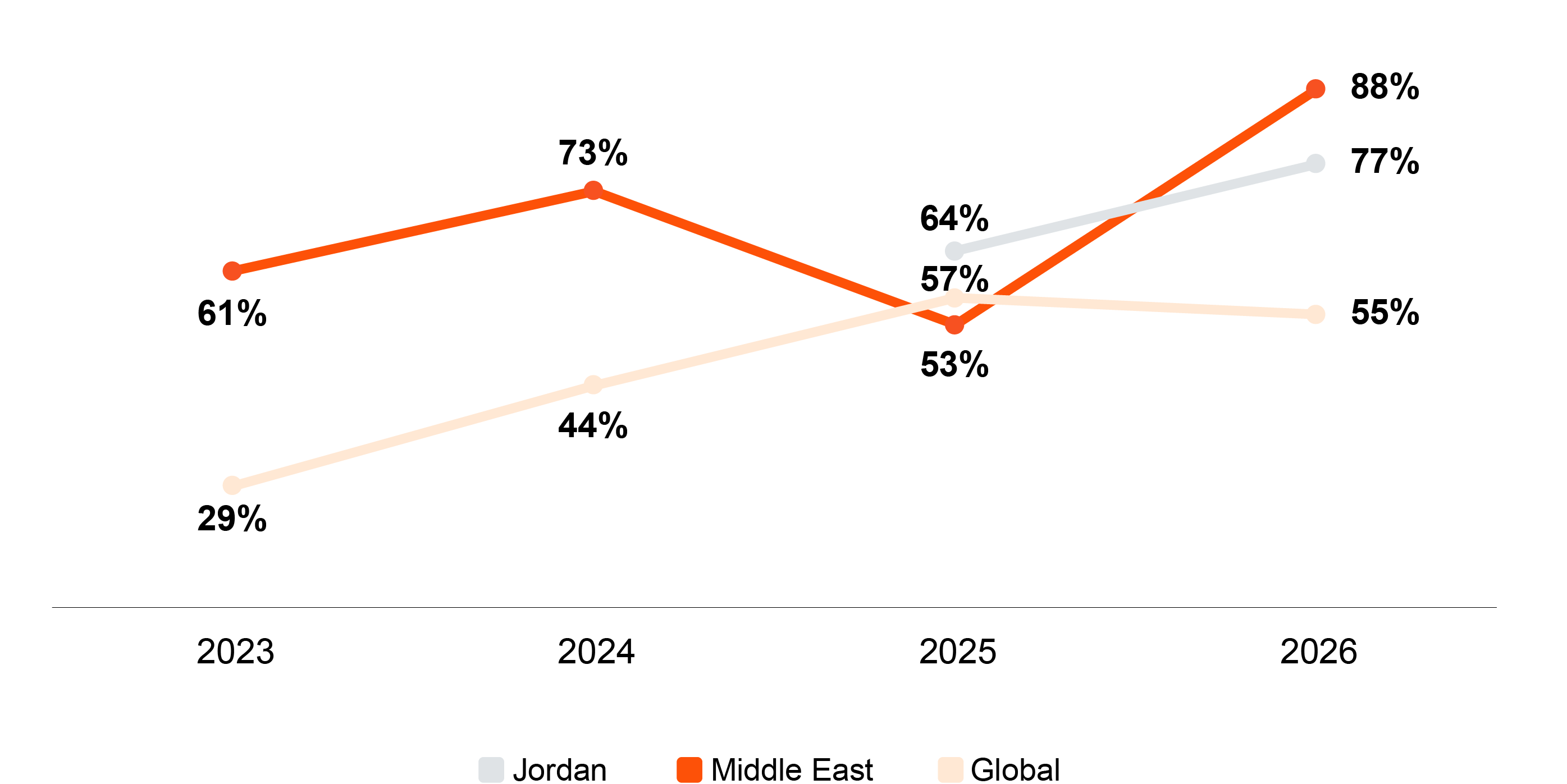
Jordan’s remarkable domestic resilience has enabled it to withstand the economic pressures stemming from wider regional geopolitical tensions. More recently, renewed optimism following the Gaza peace plan has lifted confidence in Jordan’s near-term growth prospects to an all-time high, with 77% of respondents expecting improved economic growth in their own territory over the next 12 months, up from 45% last year. Their confidence is shared across the Middle East, where 88% of CEOs expect growth in their home markets this year.
The World Bank expects Jordan’s economy to grow by 2.7% in 2026,1 continuing a decade of expansion in the range of between 2% and 3%.2
Figure 1: What do you believe economic growth (i.e. gross domestic product) will be over the next 12 months in your territory?
Despite the significant impact of external shocks on businesses in Jordan, with tourism hit hard, trade and transport disruptions pushing up shipping costs, and heightened uncertainty dampening investment sentiment, chief executives in the country remain cautiously optimistic. While these pressures have amplified existing economic challenges and unemployment rates, they have not undermined confidence in near and longer-term prospects.
When assessing their own companies’ outlook, 53% of CEOs in Jordan say they are very or extremely confident about revenue growth over the next 12 months, rising to 60% over the next three years, both higher than last year and above global averages. This optimism is largely pinned on hopes of greater stability in the region, along with Jordan’s skilled workforce, strong governance framework, the gradual recovery of the tourism sector, and ongoing economic reforms as part of the Economic Modernisation Vision 2033 (EMV).
The second executive programme of the EMV starts this year, moving from a foundation phase to implementing the priorities established by the vision.3 The 182 initiatives across the 25 key sectors will have a direct economic impact in Jordan between now and 2029. Successful sectors include high-value industrial manufacturing, mining, agriculture, tourism and sustainable resources. Key initiatives will include increasing agricultural exports, developing tourism projects such as the Amman and Karak cable cars, and strengthening renewable energy and natural gas projects. Investment is also a key pillar of the EMV, and this second phase includes major investment and public-private partnership projects, valued at JOD 7.8 billion (US$11 billion), most of which will be launched this year.
Figure 2: How confident are you about your company’s prospects for revenue growth over the next three years?

The internal investment programme under the EMV is also making it an attractive choice for intra-regional investment: the country ranks among the top 10 destinations where Middle East CEOs expect to allocate the largest share of their companies’ investments over the next 12 months.
There is significant interest from Saudi Arabia and the UAE targeting sectors such as logistics, technology, healthcare and energy, supported by new regional economic agreements, such as the UAE-Jordan Comprehensive Economic Partnership Agreement (CEPA). Business leaders from Saudi Arabia are also exploring the establishment of a central logistics hub in Jordan to strengthen regional trade links.4 This renewed momentum is also evident in recent healthcare investments, with Jordan signing $187 million5 in foreign investment agreements to modernise hospital infrastructure and accelerate digital transformation in medical services.
For their part, CEOs in Jordan are also backing the wider Middle East’s economic dynamism, with the biggest share of investment outside their home market going to Saudi Arabia (47%), neighbouring Iraq (36%) on strategic energy projects, finance and infrastructure, and the UAE (21%) in the year ahead.
2 AI-driven reinvention takes shape
Jordan shows a strong commitment to embedding AI across the workforce through coordinated public- and private-sector efforts, including government digital services such as the Sanad platform, the integration of AI into university education, and national digital literacy programmes. Digital transformation is one of the key pillars of Jordan’s Public Sector Modernisation Roadmap, which operates in parallel with the EMV to reinforce the country’s comprehensive modernisation approach, and is on course to digitise 100% of government services.6
This enabling environment is increasingly reflected in businesses. A significant 76% of CEOs in Jordan report having a culture that supports AI adoption, while 74% say their technology environment enables effective integration, both higher than the global average. Nearly half of CEOs in Jordan have also invested sufficiently in AI to meet their business objectives, compared with 40% globally.
As a result of this, 36% of Jordanian CEOs report applying AI directly within their products, services and customer experiences, in line with regional peers and well ahead of the global average of 19%. A similar share is also using AI to support strategy and annual planning. However, adoption remains less advanced in areas such as demand generation, fulfilment and support functions including finance and HR, suggesting further opportunity to scale AI’s impact across the enterprise.
Figure 3: To what extent has AI been applied in the following areas of your business? (SUMMARY NET: To a large or very large extent)

When it comes to hiring people with the right skills, CEOs in Jordan feel more confident about their organisation’s ability to attract high-quality AI talent (65%) than peers in the Middle East (59%) and globally (42%). Jordan benefits from a well-educated population and is also investing in upskilling its workforce. One of the key elements of the country’s National AI Strategy, for example, is to equip 15,000 public sector workers with AI skills by the end of 2027.7
CEOs in Jordan are also more likely than their global peers to expect workforce expansion rather than contraction because of AI. Nearly half (48%) anticipate increasing headcount in senior roles as a result of AI adoption, while 41% expect to hire more junior and mid-level talent.
Today, national initiatives such as the National Council for Future Technology and Digiskills Association equip young Jordanians with the skills needed to succeed in a technology-driven labour market. And starting at grassroots level, the second phase of the EMV also includes initiatives to build and upgrade 495 schools in the country, train 60,000 teachers, and expand e-learning.8 It is only likely that a deeper pool of well-educated and AI-skilled talent will be critical in helping Jordanian companies scale innovation, compete internationally and expand into global markets.
With 55% of CEOs in Jordan viewing innovation as a core component of their business strategy, compared with 33% globally, access to AI-ready talent is set to further accelerate innovation-led growth.
The financial benefits of using AI are also increasingly clear. PwC’s 28th Annual CEO Survey9 showed that companies in Jordan were already experiencing the positive impact of implementing generative AI (GenAI), with 46% saying revenue had increased over the previous 12 months as a result. This year’s survey shows 35% of CEOs reporting increased revenue from using AI, higher than 29% globally.
3 Acquisitions power CEOs to enter new sectors
For business and organisation leaders in Jordan, acquisitions offer a route to expand capabilities and access new markets, and 53% of CEOs in Jordan are planning at least one major acquisition, defined as being worth more than 10% of their company’s assets, in the next three years – up from 41% of CEOs globally.
Faced with complex geopolitical disruption and rapid technological change, CEOs in Jordan have been proactively adapting their businesses. Some 64% of business leaders in the country have started competing in new sectors and industries in the last five years, well above the global average of 42% and up from 54% CEOs in Jordan last year, highlighting a growing appetite for diversification and reinvention.
Over the next three years, CEOs in Jordan are most likely to seek to expand into financial services (38% of companies), technology, media and telecoms (34%) and industrial manufacturing and services (36%), all sectors with a strong presence in Jordan.10 This momentum will accelerate as the second phase of the EMV is implemented.
Figure 4: In which of the following industries (if any), outside of your own, will you seek to grow your business (including partnering with others to do so) over the next three years?

For nearly half of the CEOs surveyed in Jordan, more than 20% of company revenue over the past five years has come from competing in new sectors or industries. Looking ahead, this approach to diversification will be critical: businesses that reinvent themselves by building new capabilities, entering high-growth sectors and forming cross-sector partnerships will be best positioned to capture the next wave of growth, PwC research shows.11
4 Resilience through uncertainty - CEOs invest despite risk
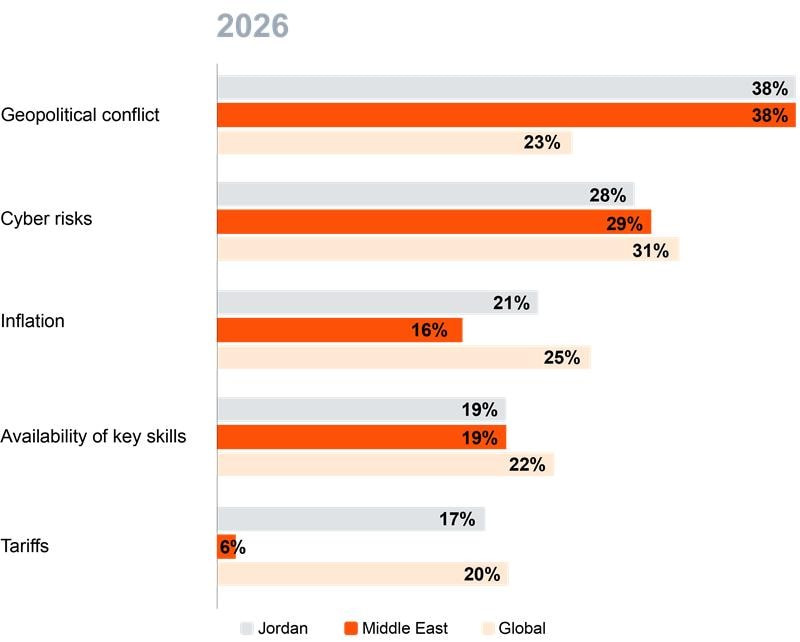
Geopolitical conflict remains the most significant perceived threat for CEOs in Jordan in the year ahead, cited by 38% of business leaders. While this remains elevated, it marks a notable decline from 55% last year, prior to the ceasefire, reflecting some easing of immediate concerns. And going forward this will not deter investment appetite, with business leaders indicating that they are still willing to pursue new, large-scale investments despite such shocks.
Cyber risk ranks second, as high-profile attacks on multinational companies continue to highlight the financial and reputational consequences of system compromises. In response, a majority of CEOs in Jordan, in line with regional peers, plan to strengthen enterprise-wide cybersecurity over the next three years, with around a third also intending to reduce reliance on technology providers based in jurisdictions they consider less trustworthy.
CEOs in Jordan have also been concerned about tariff-related risks. As a small, export-reliant economy Jordan has been exposed to the US tariffs and trade disruptions. Last year the IMF expressed concerns that having already absorbed the economic impact of the Gaza conflict, Jordan now faces additional pressure from heightened trade uncertainty.12 However, over the next 12 months, 57% of CEOs in Jordan do not expect tariffs to have any impact on profit margins.
Skills shortages are a recognised risk, though they do not rank among the top concerns in Jordan compared with geopolitical conflict, cyber risk or inflation. 19% of Jordanian CEOs identify the availability of key skills as a major threat over the next 12 months, up from 16% last year, indicating that talent constraints are a prominent consideration for business leaders.
By contrast, concern about technological disruption has fallen sharply. Only 13% of CEOs now cite it as a key threat, down from 30% in 2025, as the role of AI is increasingly viewed as an operational enabler rather than a source of disruption.
Figure 5: How exposed do you believe your company will be to the following key threats in the next 12 months? (SUMMARY NET: Highly or extremely exposed)

Your next move

Contact us:
Consulting Partner, PwC Middle East
Michael Orfaly
Jordan Country Senior Partner, Jordan, PwC Middle East