








The long view: how will the global economic order change by 2050?
The World in 2050
#world2050
Key findings
This report sets out our latest long-term global growth projections to 2050 for 32 of the largest economies in the world, accounting for around 85% of world GDP.
Key results of our analysis (as summarised also in the accompanying video) include:
- The world economy could more than double in size by 2050, far outstripping population growth, due to continued technology-driven productivity improvements
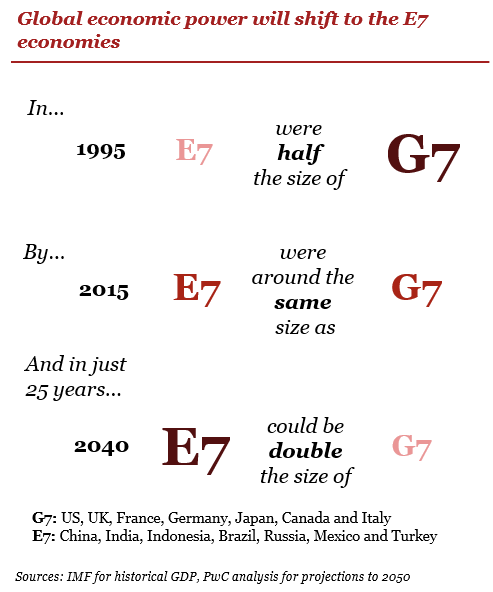
- Emerging markets (E7) could grow around twice as fast as advanced economies (G7) on average
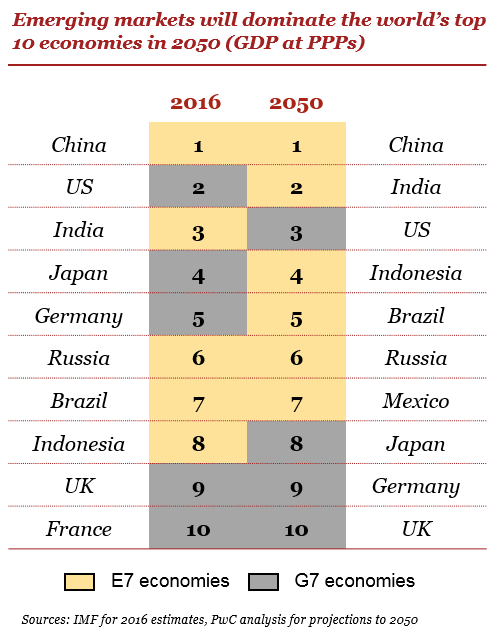
- As a result, six of the seven largest economies in the world are projected to be emerging economies in 2050 led by China (1st), India (2nd) and Indonesia (4th)
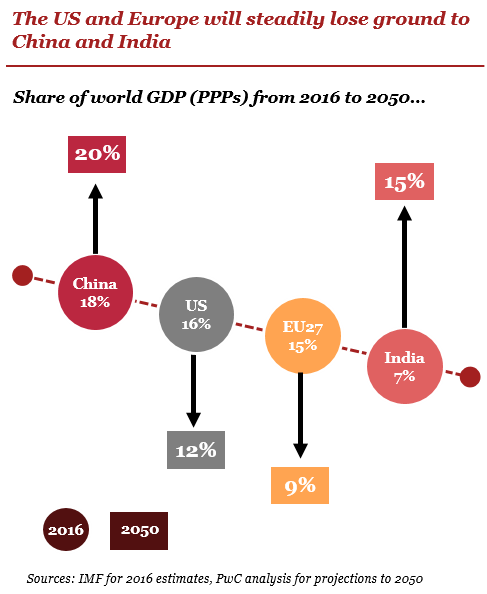
- The US could be down to third place in the global GDP rankings while the EU27’s share of world GDP could fall below 10% by 2050
- UK could be down to 10th place by 2050, France out of the top 10 and Italy out of the top 20 as they are overtaken by faster growing emerging economies like Mexico, Turkey and Vietnam respectively
- But emerging economies need to enhance their institutions and their infrastructure significantly if they are to realise their long-term growth potential.
Explore the World in 2050
View the infographics below for highlights of our GDP projections and explore the results further using our interactive data tool.
Further details are provided in our summary report, full report and slide pack.
World in 2050
60 second update from PwC's Chief Economist John Hawksworth on the long term outlook for global growth.

Challenges for policymakers
Our analysis also identifies a number of key challenges for policy-makers, including:
- Avoid a slide back into protectionism, which history suggests would be bad for global growth in the long run
- Ensuring that the potential benefits of globalisation are shared more equally across society
- Developing new green technologies to ensure that long-term global growth is environmentally sustainable
Please download our full report for more in-depth analysis of these policy issues.
Opportunities for business – winning in emerging markets
Our report, which can be downloaded in full below, also considers the opportunities for business:
- As emerging markets mature, they will become less attractive as low cost manufacturing bases but more attractive as consumer and business-to-business (B2B) markets
- But international companies need strategies that are flexible enough to adapt to local customer preferences and rapidly evolving local market dynamics
- Since emerging markets can be volatile, international investors also need to be patient enough to ride out the short-term economic and political cycles in these countries
Please also take a look at the research of our Growth Markets Centre for detailed examples of how companies can succeed in emerging markets.
Download The World in 2050: The Long View
How will the global economic order change by 2050?


Contact us