




CEOs in the Middle East’s Energy, Resources and Utilities (EUR) sector are entering their next phase of growth from a position of confidence that sets them apart from global peers. In PwC’s 29th Annual CEO Survey, EUR business leaders in the region report the highest levels of confidence globally in economic and revenue growth, supported by strong financial performance, long-term planning horizons and sustained capital inflows. Near-term policy uncertainty has also eased, with a more hydrocarbon-friendly US administration reinforcing confidence in the durability of global energy demand.
As hydrocarbons remain a core part of the global energy mix, the Middle East’s advantaged cost position reinforces its role as a long-term supplier of choice. The sector is also a critical engine of economic diversification in the region. As a result, Middle East EUR companies are deeply embedded in more long-term planning than many of their global counterparts.
With population increases creating growing energy demand, the challenge for EUR CEOs is no longer technology adoption, but the ability to deliver large-scale, interconnected programmes with discipline, predictability and resilience. While geopolitical, cyber and supply chain risks remain elevated, what defines the Middle East EUR sector is not low risk, but the scale, discipline, and maturity with which these risks are managed.
"What stands out this year is the maturity of the Middle East energy sector. Confidence is high and capital is available, but leaders are increasingly focused on what it takes to deliver at scale in a more complex environment. AI is already embedded across core operations, diversification is reshaping portfolios and resilience is being built deliberately into systems and governance. The challenge now is to turn these structural advantages into consistent, long-term performance as demand grows and energy systems become more interconnected."
Key findings for the region
% of regional EUR CEOs expect economic growth in their territory to improve over the next 12 months.
% of EUR business leaders say their organisation’s culture enables AI adoption, with usage across support services, strategy and demand fulfilment exceeding global averages.% of EUR CEOs plan at least one major acquisition in the next three years, with 97% expecting part of deal value to come from sectors outside their core industry.
% of regional EUR CEOs say they are highly or extremely exposed to geopolitical conflict, making it the most significant perceived threat facing the industry.
High confidence and strong investment momentum power the Middle East’s EUR advantage
A significant 94% of CEOs in the region’s EUR sector expect economic growth in their own territories to improve over the next 12 months, compared with a global average of 62% who feel the same about their territories.
This confidence is underpinned by a structural shift in the region’s role, from energy exporter to system builder, with sustained investment in renewables, grid modernisation and clean industrial zones. These investments are tightly aligned with national transformation agendas, linking energy diversification to industrialisation, localisation, and long-term economic resilience.
This optimism extends to company performance. 75% of regional EUR CEOs are confident in revenue growth over the next three years, up from 59% last year, while 45% are very or extremely confident in growth over the next 12 months, well above global averages (see Figure 1).
Figure 1: How confident are you about your company’s prospects for revenue growth over the next 12 months / over the next three years?

Crucially, this confidence is grounded in stronger revenue growth and higher profit margins. For the current fiscal year, regional EUR companies report average revenue growth of 12% and net profit margins of 14%, compared with global EUR averages of 9% and 11% respectively.
In the Middle East, EUR leaders also operate with longer time horizons than global peers; CEOs dedicate 26% of their time to five-year-plus planning, compared with 17% globally. The ability to commit capital over extended timeframes, supported by system stability, allows EUR leaders to plan beyond short-term cycles and make investments that support broader economic transformation.
Saudi Arabia and the UAE rank joint fourth as top global EUR investment destinations
Besides being one of the world’s most strategically important energy regions, accounting for around 30% of global oil production and 17% of global natural gas,1 the Middle East also has one of the world’s fastest-growing sustainable energy sectors, placing it at the forefront of the global energy transition.
The region’s sovereign wealth is also being actively deployed into renewables, grid modernisation, and low-carbon industrial ventures, reinforcing long-term investment momentum. Against this backdrop, Saudi Arabia and the UAE now rank jointly fourth among the world’s most preferred global EUR investment destinations, reflecting their scale, access to capital and policy stability with business environments that continue to attract long-term investment, even amid global uncertainty.
The global energy transition is elevating the role of chemicals and materials in critical minerals, battery inputs, and clean-energy value chains. Demand for copper, aluminium, lithium, and rare earths, essential for technologies such as EV batteries and grid systems, is accelerating as countries decarbonise. Critical mineral markets are now central to regional growth agendas, with Qatar, Saudi Arabia and the UAE actively expanding their mining, refining and supply-chain capabilities to diversify and capture value in these domains. These developments strengthen the long-term investment case for these markets as hubs for advanced materials, clean-energy value chains and downstream processing.
The reinvention imperative – scaling AI across energy systems
Innovation is becoming a defining feature of the Middle East’s energy transition. Key economies in the region are investing at scale in solar and wind, energy storage, green hydrogen, and digitally enabled clean-energy value chains. These efforts are increasingly supported by innovation in data, advanced analytics, and digital infrastructure, as energy systems become more complex and interconnected.
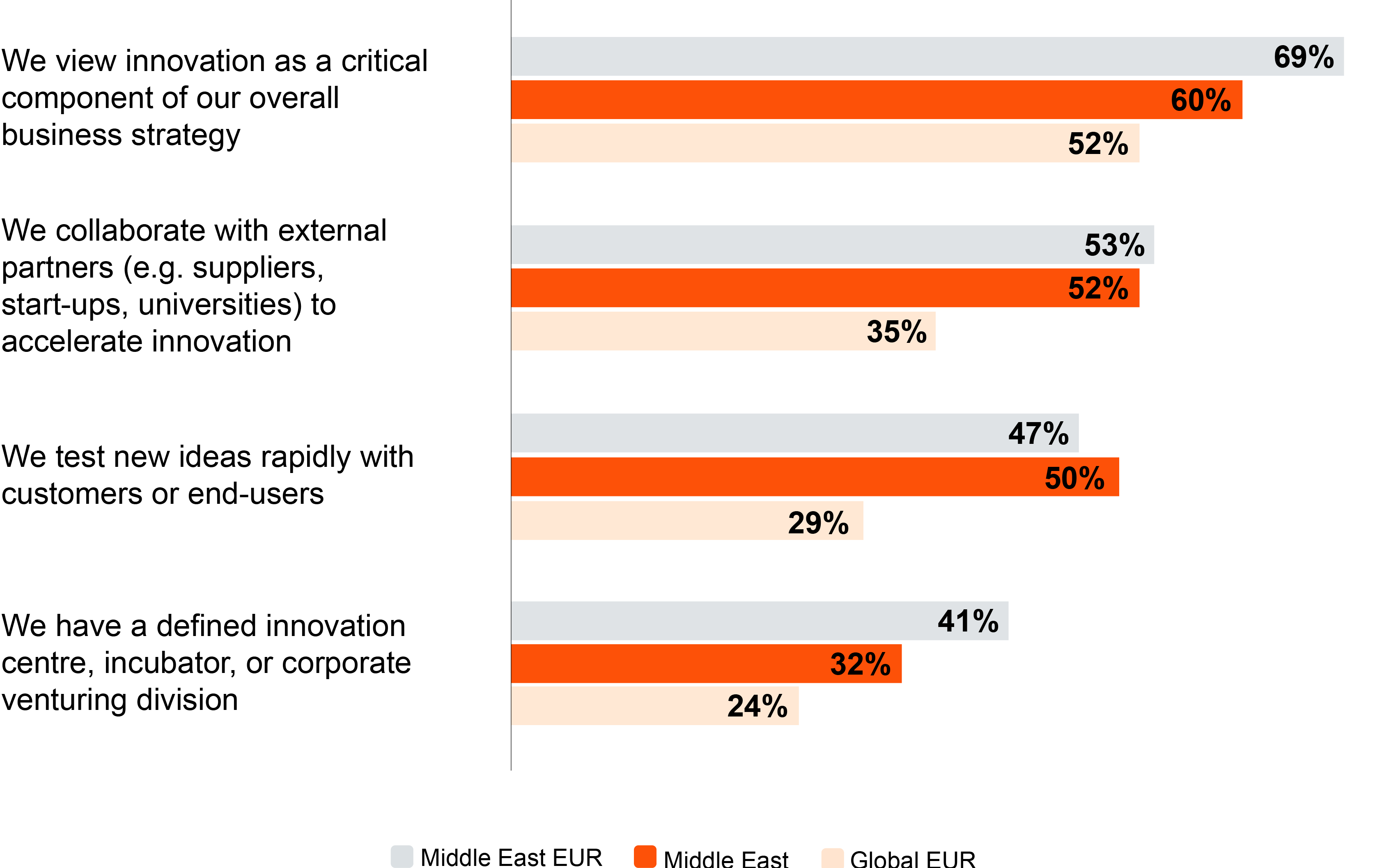
Survey findings have revealed that nearly 70% of Middle East EUR CEOs view innovation as a critical component of their overall business strategy, 53% collaborate with external partners to accelerate innovation, and nearly half are willing to test new ideas with end users (see Figure 2).
Figure 2: To what extent do each of the following statements characterise your company’s approach to innovation? (SUMMARY NET: To a large or very large extent)
Innovation is also extending into clean-energy value chains, with Qatar, Saudi Arabia and the UAE expanding upstream capacity, advancing downstream processing, reforming mining frameworks, and investing in digital solutions to build secure, efficient, and low-carbon supply networks. This innovation-led approach is strengthening competitiveness – with business leaders in the Middle East’s EUR industry reporting that 16% of their company’s total revenue from this fiscal year attributable to new products or services introduced in the last three years.
AI powering innovation
AI is increasingly the engine powering this innovation at scale, making a clear impact on energy systems. Across the Middle East EUR sector, AI is enabling more efficient optimisation of smarter, digital, and resilient grids, directly linking energy system performance with wider economic and industrial goals. These capabilities are increasingly critical as electrification accelerates and systems become more interconnected.
At the government level, AI is being advanced as a strategic capability for the energy sector, setting both pace and expectation for enterprise adoption. This leadership-driven approach is visible in the UAE’s ADNOC’s US$340m implementation of large-scale agentic AI to improve efficiency and decision-making across complex energy systems.
The momentum is supported by strong organisational readiness. A striking 90% of EUR CEOs say their organisation’s technology environment enables the integration of AI, well above global benchmarks and higher than any other industry surveyed in the region (see Figure 3). This suggests that, for many EUR organisations in the Middle East, AI adoption is less constrained by legacy systems but supported by modernised platforms capable of scaling new tools across the enterprise. 71% of EUR business leaders in the region have also reported having a clearly defined AI roadmap, 86% said that their organisational culture enables AI adoption, while 69% have formalised responsible AI and risk processes - all significantly above global averages.
Figure 3: To what extent do you agree with the following statements relating to AI use at your company?

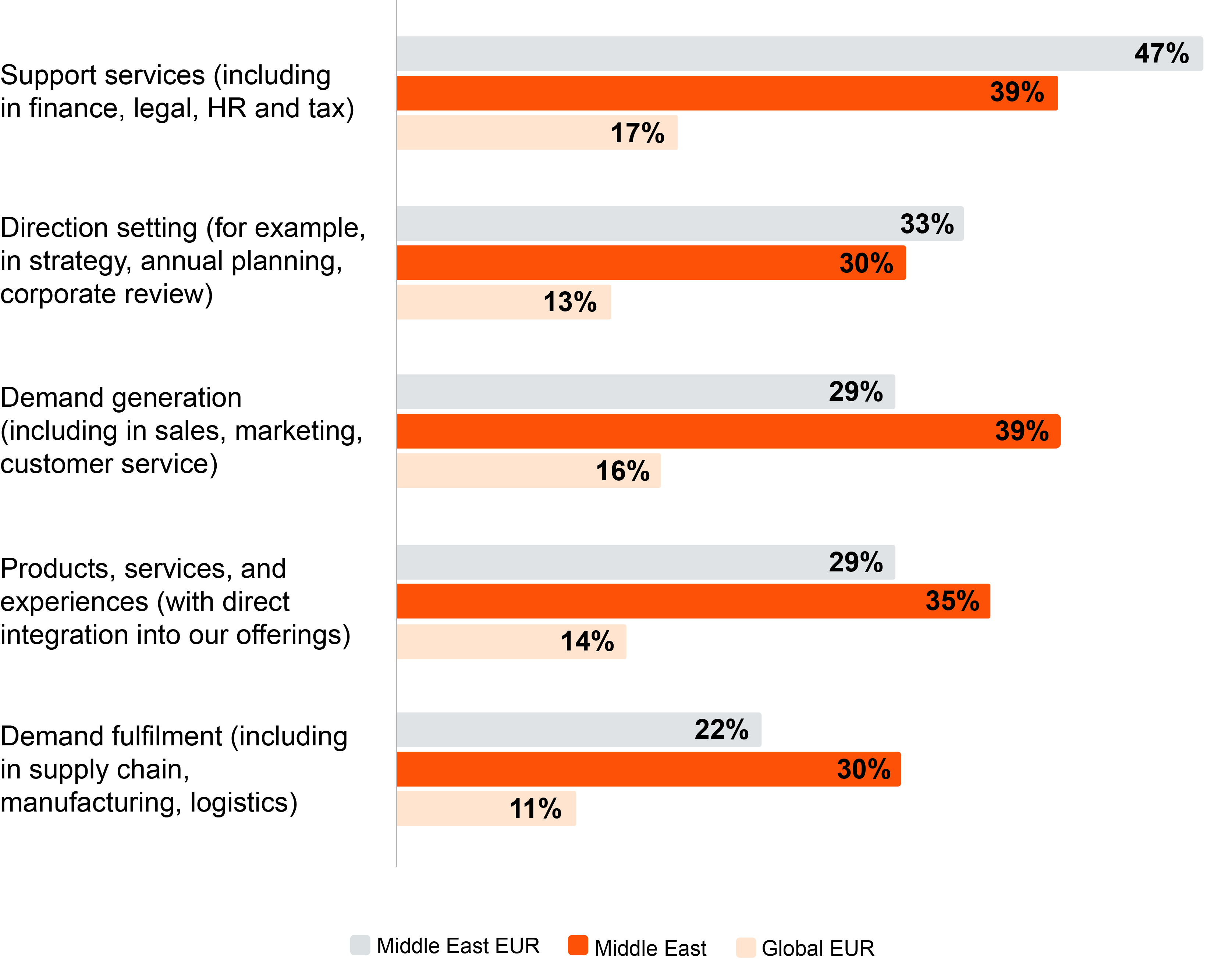
AI adoption is also broadening across the value chain, moving beyond pilot projects and is being used in day-to-day operations. Nearly half (47%) of regional EUR CEOs report extensive use of AI in support services, compared with 17% globally. One-third apply AI to strategic planning and direction-setting, versus 13% globally, while 22% use AI in demand fulfilment, double the global average (see Figure 4).
There are structural factors that drive this momentum. AI requires energy at scale, and the Middle East’s access to abundant, increasingly clean and cost-competitive energy provides a natural advantage. EUR assets can also offer real-world testbeds for AI deployment, from power systems to industrial operations. Combined with strong government support, this has enabled AI to move quickly into core operations in regional energy companies, bringing earlier returns in areas such as process efficiency, data utilisation and cost optimisation, all increasingly critical for the EUR sector.
Figure 4: To what extent has AI been applied in the following areas of your business? (Summary NET: To a large or very large extent)
Navigating talent constraints
While overall talent constraints in the EUR sector remain a challenge in the region – with 24% identifying skills availability as a risk for the next 12 months, down from 35% last year – targeted investment in EUR-focused education, localisation initiatives and workforce incentive programmes over the years have significantly strengthened the region’s local talent base. According to our survey findings, regional EUR leaders report relatively strong access to AI capability compared with global peers, and 57% say their organisation can attract high-quality, technical AI talent, compared with a global average of 41%.
Expanding beyond traditional boundaries
The Middle East’s EUR sector is operating at the intersection of energy, industry, infrastructure, and technology, reflecting a clear blurring of traditional industry boundaries. Climate change, rapid urbanisation, supply chain disruption, and growing resource nationalism are reshaping energy priorities globally. In the Middle East, these forces are creating both pressure and opportunity, pushing energy companies to innovate, form new partnerships, and expand into adjacent markets to sustain competitiveness.
This is reshaping M&A activity across the region. Findings from our survey indicate that 73% of regional EUR CEOs plan at least one major acquisition worth more than 10% of their company’s assets over the next three years, compared with 45% globally (see Figure 5). Over the past five years, 55% of CEOs have entered sectors where they previously had no presence.
Figure 5: How many major acquisitions, worth more than 10% of your company’s assets, is your company planning to make in the next three years? (Summary NET: One or more)

The nature of this expansion is particularly telling. Almost all Middle East EUR CEOs expect at least some future deal value to come from outside their core industry - nearly double the global average of 51%. Industrials and services, technology, and consumer sectors are the most attractive adjacencies over the next three years. CEOs cite increased market share, geographic expansion, and critically, the acquisition of capabilities such as skills, talent, data, and new operating models as the primary drivers of dealmaking, alongside portfolio diversification.
Transaction activity on ground illustrates how this is playing out in practice. Insights from our 2026 Transact Middle East report3 have indicated that governments and national champions are deepening investment in transition-enabling infrastructure, including cooling networks, operations and maintenance platforms, industrial energy efficiency, water and waste systems, and gas-to-clean pathways.
Saudi Arabian Mining Company (Ma’aden) has strengthened its position in critical materials through the acquisition of the remaining stake in its aluminium joint venture and a strategic stake in Aluminium Bahrain – reinforcing regional integration across minerals essential to electrification. Diversification is also evident across midstream, utilities, and infrastructure platforms. The UAE’s Gulf Navigation Holding’s acquisition of Brooge Petroleum and Gas Investment Company expands its role from transport into system-critical storage and terminals, while Saudi Arabia’s ACWA Power’s investment in Bahrain’s Al Ezzel independent power project deepens capabilities in regional operations and maintenance across power and water assets.
This illustrates diversification and value-chain expansion within the energy system, where companies are moving beyond asset ownership toward infrastructure platforms, services, and operational capabilities that enable decarbonisation and system resilience.
Risks, resilience and strategic capabilities
Geopolitical conflict remains the most significant near-term threat for EUR chiefs in the Middle East. Over half (51%) describe themselves as highly or extremely exposed to it, followed by cyber risks and climate change (see Figure 6).
Figure 6: How exposed do you believe your company will be to the following key threats in the next 12 months? (SUMMARY NET: Highly or extremely exposed)


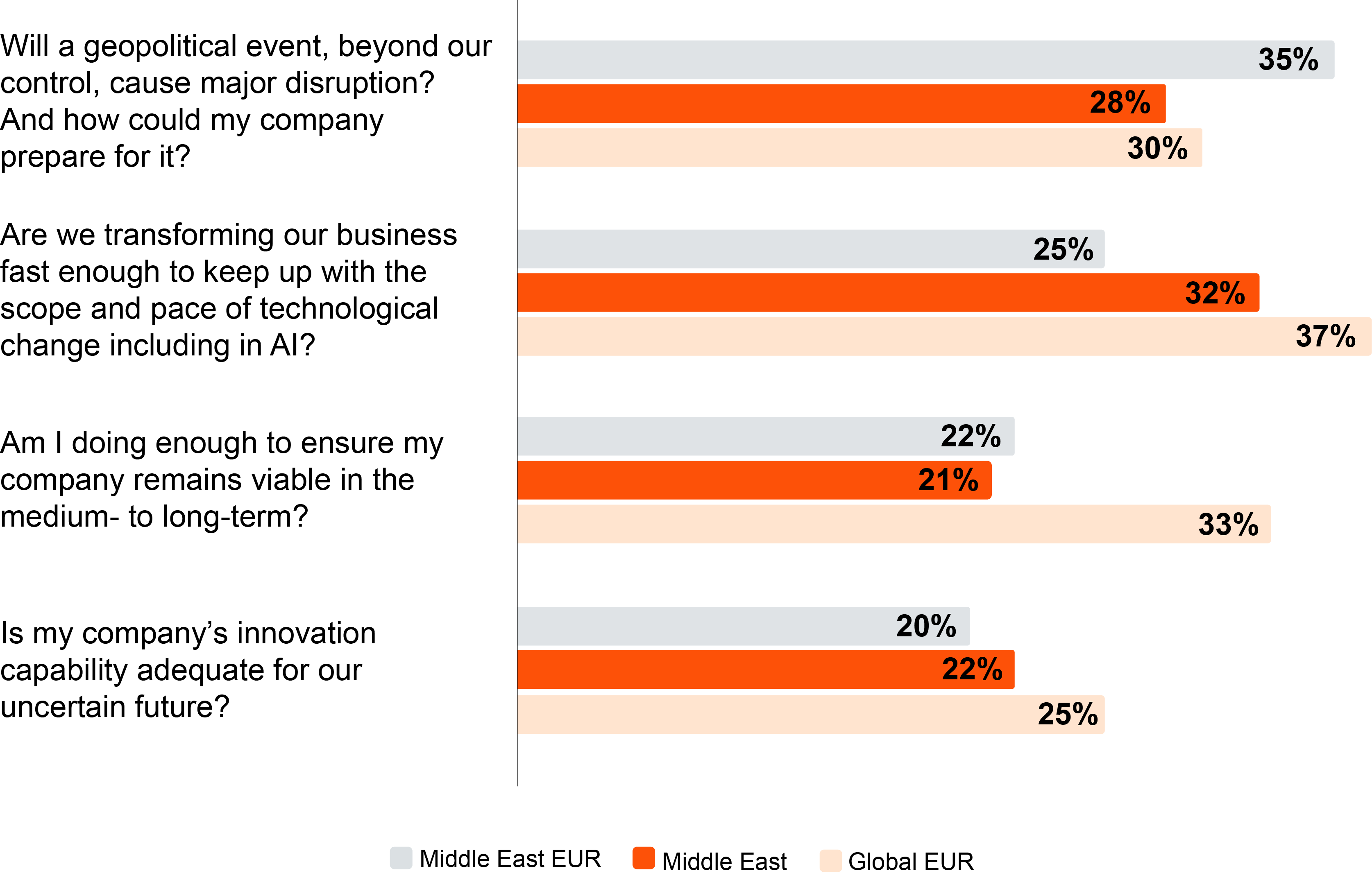
For 35% of CEOs in the EUR sector, the prospect of an external geopolitical event causing major disruption to business remains a primary concern. Tariff-related pressures are also intensifying, with 22% of EUR leaders expecting tariffs to impact profit margins over the next 12 months, the highest exposure reported across the industries we surveyed.
Geopolitical disruption has historically had an outsized impact on the EUR sector, affecting trade flows and operational continuity. However, repeated periods of disruption have materially strengthened resilience across the region. EUR leaders have invested heavily in cybersecurity (59%), while a notable percentage (41%) intend to reduce reliance on technology providers in less trusted jurisdictions. Supply chains are also increasingly being reconfigured to prioritise security of access and resilience over lowest-cost optimisation alone. Reflecting this, only one in five regional EUR CEOs say geopolitical uncertainty has significantly influenced decision-making around major new investments, while 65% report little or no impact.
This resilience is also reflected in organisational readiness. Nearly six in ten EUR leaders (59%) say their organisations can anticipate disruption, while 69% report being prepared to lead an effective organisational response, both the highest levels recorded across regional industries surveyed.
With immediate risk increasingly managed, leadership focus is now shifting to long-term value creation. A quarter of regional EUR CEOs say their most pressing concern is whether they are transforming fast enough to keep pace with technological change, while 22% question whether their organisations are doing enough today to remain viable over the medium to long term (see Figure 7). This marks a clear transition from defensive risk management to proactive transformation, setting the context for accelerated investment in digitalisation, AI and new operating models.
Figure 7: What is the question that concerns you most these days?
What does the next decade look like for EUR leaders?
While our CEO Survey findings reflect the confidence of EUR leaders across industries in the near and medium term, PwC’s economists have also looked further out to the decade ahead across sectors and analysed how two major global megatrends – AI and climate change - are driving industry reconfiguration (see figure 11) and the emergence of new domains of growth: markets where companies work across sector boundaries to meet fundamental human needs of how we build, care, feed, fuel, make and move, and how we connect and compute, fund and insure and govern and serve.4
According to PwC economists, in 2025 alone the energy sector experienced its 10th-highest level of pressure in the past 25 years, driven by climate change, rapid urbanisation and ongoing supply chain disruption. For EUR leaders in the region, this elevated pressure is not only a risk but a catalyst, creating opportunities to innovate, forge new partnerships and expand into adjacent markets. It also opens new value pools within the evolving “fuel and power” domain, where integrating complex value chains, scaling execution and managing risk across increasingly interconnected systems will define competitive advantage.
Over the next decade, the Middle East’s EUR sector will shift from energy production to system orchestration. By 2035, the ‘fuel and power’ domain alone could generate up to US$790bn in value, as energy integrates more deeply with mining, advanced manufacturing, chemicals, water, waste and logistics.
Figure 8: Industry reconfiguration in the decade ahead
Your next move:
As the sector shifts from energy production to system orchestration, the imperative now is to execute complex programmes at scale, industrialise AI and secure long-term resilience across value chains. Four priorities now stand out for Middle East EUR CEOs:
Shift from capital deployment to delivery excellence +
With capital available, the competitive advantage now lies in delivering complex programmes on time and on budget. CEOs must rethink how projects are planned, funded and governed. This includes planning integrated energy systems where generation, networks, storage, and demand work seamlessly together, rather than as standalone assets.
Industrialise AI, don’t pilot it
+
Energy leaders must move beyond experimentation and scale AI across core operations. From grid optimisation and predictive maintenance to real-time demand intelligence, AI should be embedded into system planning, asset reliability and network management, not confined to isolated pilots.
Secure critical inputs and capabilities +
As global demand for critical minerals accelerates, CEOs must look at targeted acquisitions, international partnerships and downstream investment. The objective is not only to secure supply, but to build integrated domestic value chains that support advanced manufacturing, clean energy and industrial transformation. By positioning the regional critical minerals sector as a stable and well-capitalised alternative in the global markets, they can help strengthen the region’s role as a trusted long-term partner in the global energy transition.
Build regulatory and localisation advantage
+
Shape pragmatic AI and industrial policy frameworks at national level, using trade levers and localisation strategies to support competitive domestic champions.
Watch our Industry Leaders Roundtable for more on PwC's 29th Global CEO Survey: Middle East findings, including deep insights into the key industries across our region. Recorded on 6 February.
Video
29th-ceo-survey-middle-east-findings-2026-industries video
40:41
More tools
Transcript

Contact us:
Dr. Raed Kombargi
Partner, Strategy& and PwC Middle East Energy, Utilities and Resources Leader, PwC Middle East



Follow us


