




Historically, defence spending in the MENA region has been sensitive to the ebb and flow in energy prices, however,recent global developments may have triggered a long anticipated tipping point in oil demand. The ripple effect of this phenomenon could potentially result in Middle Eastern nations reducing defence spending to balance budgets and fulfill other priorities, such as social and healthcare programmes.
As it currently stands, these countries continue to be largely dependent on energy exports for economic growth and the price of oil has a direct impact on the ability of these countries to modernize their military forces. A critical question is how can Middle East defence ministries achieve their strategic objectives while also implementing budget cuts to reduce government budget deficits?
In order to identify where efficiencies can be made, defence ministries in the region first need to analyse their current operating models. This will result in a long list of potential spend reduction options across different organisational areas within the ministry. These options can then be evaluated to understand if they can be implemented without impacting strategic objectives. We identify potential initiatives across a generic defence operating model.
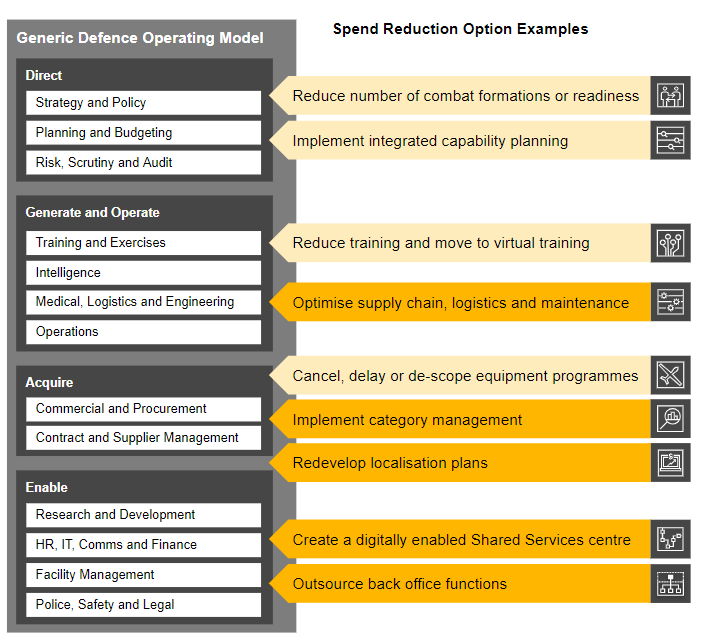
Often, Middle Eastern defence ministries make spending decisions that have not been aligned with national or other ministry strategies. This results in inefficiencies across front line equipment and personnel for potential missions. In best practice, defence ministries’ national strategies are translated into missions and a strategic balance of investment is used to define the most efficient and effective mix of force elements.

The Generate and Operate functions create mission ready deployable forces that are supported by a logistics chain. This supplies forces with the consumables they need and keeps equipment well-maintained. The logistics process is often inefficient resulting in stockpiles of inoperative inventory and equipment. Digitisation of the logistics chain through the use of control towers and sensor technologies results in efficient, optimally supported and high readiness forces.

The acquisition of commodities, equipment and services is vital to the deployment and sustainment of mission ready forces. Best practice defence ministries closely manage the acquisition delivery lifecycle from the definition of detailed requirements with stakeholders through to engaging with suppliers.They also incentivise localisation and support equipment throughout the lifecycle. If the acquisition lifecycle is not closely managed, inefficiencies can be built resulting in overspend on acquisition contracts that may be decades long and difficult to renegotiate.

Increasing the efficiency of ‘back office’ functions (HR, IT, Finance etc.) using a centralised service centre is an effective way of reducing spend without impacting front line capability. Enable functions in Middle Eastern defence ministries are often spread across geographies and internal organisations, resulting in a deconsolidated provision of enabling services. Shared services can increase performance and potentially create localisation opportunities through outsourcing.

Conclusion
The recent and potentially long term reduction in oil demand will undoubtedly put defence budgets in the region under strain. However, there are clear actions that defence ministries can take to reduce spend without impacting front line capability and strategic objectives. This involves analysing the Direct, Generate and Operate, Acquire and Enable functions and identifying opportunities to improve both efficiency and effectiveness while maintaining and even increasing military outputs. Recent global events may be the catalyst that defence ministries need to seize the opportunities highlighted and accelerate transformation efforts.

Contact us