




The frequency, complexity and scale of climate change events is leading to increased humanitarian challenges globally. It is fuelling poverty and instability and is likely to increase economic burdens on countries struggling to overcome the pandemic.
How can governments collaborate with the private sector to address climate change induced displacement and its impact on remote, evolving and complex landscapes?

Executive Summary
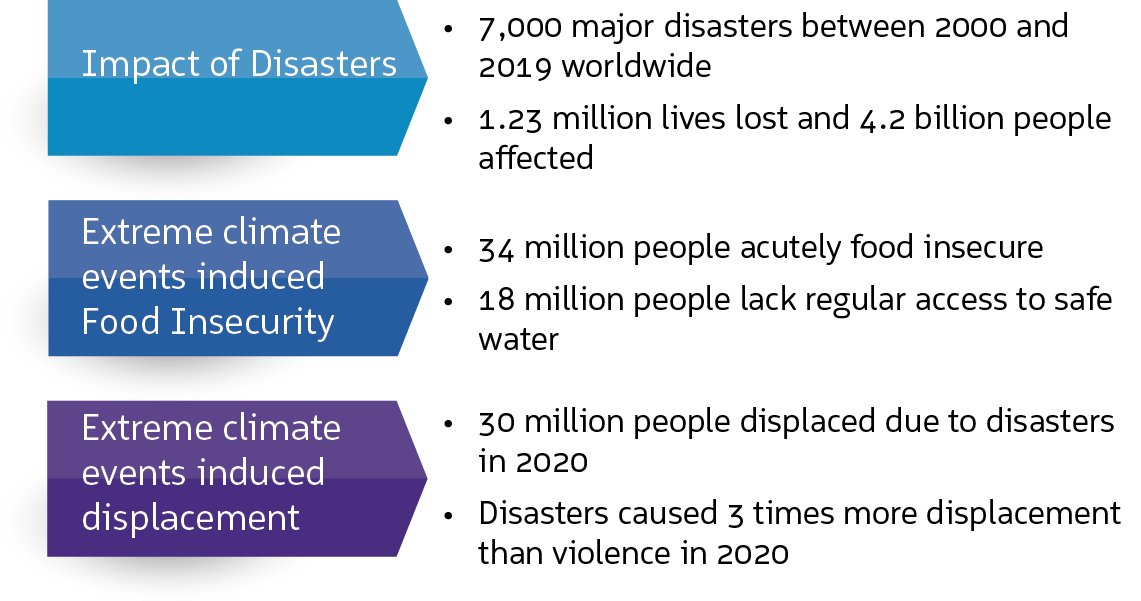
The increasing frequency, complexity and scale of climate change events is likely to have debilitating impacts on the state of global development, stability and prosperity. Over 7,000 major disasters occurred between 2000 and 2019, claiming 1.23 million lives and affecting 4.2 billion people worldwide.1 A total of 389 climate-related disasters were recorded in 2020, resulting in the deaths of 15,080 people, affecting 98.4 million others and inflicting $171.3 billion in economic damage.2 Today, due to extreme climate events, 34 million people are acutely food insecure while approximately 18 million lack regular access to safe water.3 In 2020, apart from causing destruction and scarcity, disasters forced over 33.4 million people to abandon their homes seeking shelter and security,4 internally displacing three times the number of people uprooted by violence and conflict.
The climate situation is rapidly fuelling poverty and instability5 and is likely to increase economic burdens on governments struggling with the management of the pandemic and ever-increasing humanitarian needs. In the current transition and recovery context, it is desirable for governments to integrate climate change adaptation and mitigation strategies into decision making and policy frameworks addressing recovery and resilience. Integration will secure governments and deliver on the global vision for sustainable development through purposive and indirect reduction in vulnerability and poverty, while building partnerships to protect our collective futures.
To rebuild climate resilient pathways for equitable development while addressing existing and emerging humanitarian needs, support that surpasses typical funding arrangements is available through private sector engagement. Through leveraging domain expertise, skillsets, networks and on-ground presence, collaborations between the private sector, non-profit organizations and governments are successfully addressing diverse humanitarian sector needs, many of which are relevant to countering the impact of climate change through immediate response or more embedded and engaged collaborations for long-term resilience. Successful private sector engagements can potentially be executed via multi-stakeholder collaborative models across geographies and affected communities with a focus on localising capabilities and capacities.
This paper presents an overview of current and emerging challenges from climate change and climate induced displacement, examples of collaborative models, available expertise addressing similar challenges in varied contexts, an integrative model for designing interventions and next steps for governments, non-profits and the private sector in executing these interventions.
The main objective of the paper is to provide recommendations for exploring non-traditional engagement partnerships with the private sector for developing solutions to address climate change induced displacement and its impact on remote, evolving and complex landscapes.
- 1. The Cost Of Climate Change and the Displacement Crisis
- 2. Planning and Preparedness for Climate Change During Transition
- 3. Building Resilience Through Adaptation and Localization
- 4. Private Sector Engagement, Moving Beyond Typical Funding Arrangements
1. The Cost Of Climate Change and the Displacement Crisis
Responding to 335 natural disasters in 2017 cost governments $340 billion while the cost of damage caused by natural disasters - ensuring response, reconstruction and recovery - increased by 359 percent between 2007-2017.6 A recent study on natural hazard mitigation7 estimates that $6 can be saved in disaster costs for every $1 spent on hazard mitigation. Mitigation funding not only helps governments prevent deaths but also ensures that communities are prepared and act for their safety during climate events. Pre-emptive measures and evacuation protocols not only save lives but also build trust between governments and vulnerable communities.
Disruptive and traumatic8 displacement demonstrates the ‘injustice and human cost of climate change’. Displacement caused due to the loss of land, living space and environmental changes including rising sea-levels, salinization and desertification is a potential threat to national stability.9 It is expected that 200 million climate migrants will be moving within or outside their countries by 2050.10 The cost of managing the rehabilitation and humanitarian needs of climate-distressed communities will stretch resources, infrastructure and social security budgets. Governments may need to share the ensuing capital costs in cash and kind through collaborations for health, shelter, food and nutrition support, technology, social infrastructure, finance, education and skills with a focus on preparedness.
2. Planning and Preparedness for Climate Change During Transition
Informed and committed to solving the challenges presented by climate change, governments have actively developed and implemented context specific strategies to mitigate and adapt to the impact of climate events. Some of these strategies have had positive impacts on reducing poverty and building resilience amongst at-risk and affected communities. However, in 2020, COVID-19 set back development goals and increased poverty for the first time in three decades, pushing 97 million more people into poverty in 2020.11
In 2021, a record 235 million people required humanitarian assistance and protection worth $35.1 billion.
COVID-19 has added a new layer to vulnerability across continents. The needs of the most vulnerable have been further exacerbated due to overwhelming impacts on health, livelihoods, education and social safeguards. It is estimated12 that in 2021, a record 235 million people needed humanitarian assistance and protection worth $35.1 billion. We recognize that planning and preparedness to address climate conscious recovery post COVID-19 is complex from a funding priority perspective for governments.
Rethinking health and education infrastructure, capacity building of local governance units and staff, improving digital access and capabilities, while protecting and sustaining livelihoods is critical to ensuring recovery. Through private sector support and social enterprises, advances have been made in designing customized shelters, real-time medical data management and predictive analysis without the Internet, microinsurance models safeguarding female microentrepreneurs against climate events, cashless food support, high quality disaster and displacement maps and mobile schools with minimal infrastructure. Relevant to addressing needs of displaced communities during a COVID-19 transition phase, these models and interventions are discussed in this paper.
3. Building Resilience Through Adaptation and Localization
Climate change has devastating impacts on the most vulnerable and poorest within affected and at-risk communities. Existing research13 indicates that its impacts are disproportionately experienced by least developed countries.
Least developed countries (LDCs), landlocked developing countries (LLDCs) and small island developing States (SIDS) comprising 91 countries with a population of approximately 1.1 billion are the most vulnerable to climate change as they face structural challenges and geographical disadvantages.14
Fishing communities, indigenous people small scale farmers, and poor people are especially vulnerable due to their dependence on agriculture, fishing and forests. Climate change and its resultant consequences can threaten livelihoods and food security in these communities.15
Creating climate champions within at-risk or vulnerable communities, allowing civil society to actively participate in planning and preparation while easing regulations for cross-border support from the private sector and non-profits can further reduce the burden on governments addressing needs of climate hotspots. While resilience building and skilling of refugees for financial independence has been successfully demonstrated through government, multi-lateral and private sector partnerships in refugee camps globally, the emerging role of the private sector in supporting government’s response to climate change-induced displacement and protection through socially cohesive models, which bring together host and refugee communities, is an area of ongoing innovations.
This paper presents three cases demonstrating model interventions – addressing the humanitarian needs of adolescent girls in the Lake Chad crisis, an employment program for Nicaraguan youth refugees in Costa Rica and a model intervention anchored by the private sector and non-profit experts with supportive regulatory frameworks from the governments of India and Nepal.
4. Private Sector Engagement, Moving Beyond Typical Funding Arrangements
Along with governments, the private sector has also risen to the challenge of climate change and demonstrated ‘climate leadership’. Over 6,000 companies and investors from 120 countries, representing at least $36 trillion in revenue, have committed to ambitious climate targets. While most commitments are focused on the overall reduction of carbon footprint via reduced gas emissions, it is also time for the private sector to engage in building climate resilience,16 with a view to create local competencies in the true spirit of localization.
There is a diversity in expertise presented by private sector players and institutions operating at all levels. The scope for collaboration between the private sector, governments, UN bodies and non-profits working at the forefront of humanitarian response is a developing area. Through assisting in building capacities to providing in kind donations for critical social infrastructure, education, health and social enterprises, the private sector is increasingly engaged in responding to humanitarian needs due to climate events. Through globally relevant examples, we conclude that by providing the private sector a conducive environment to collaborate for building and executing strategies in response to the multiple challenges posed by climate change, positive impacts can be achieved in sustainable and cooperative international development.
1. https://www.unicef.org/sites/default/files/press-releases/glo-media-Children_on_the_Move_Children_Left_Behind.pdf
2. https://reliefweb.int/report/world/global-humanitarian-overview-2022
3. https://unocha.exposure.co/why-the-climate-crisis-is-a-humanitarian-emergency
4. https://www.internal-displacement.org/global-report/grid2021/
5. https://unocha.exposure.co/why-the-climate-crisis-is-a-humanitarian-emergency
6. OCHA (2019) Global Humanitarian Overview 2019.
7. https://www.nibs.org/files/pdfs/NIBS_MMC_MitigationSaves_2019.pdf
8. https://www-cdn.oxfam.org/s3fs-public/file_attachments/bp-uprooted-climate-change-displacement-021117-en.pdf
9. IDMC (2018) No matter of choice: Displacement in a changing climate
10. https://www.worldbank.org/en/news/press-release/2021/09/13/climate-change-could-force-216-million-people-to-migrate-within-their-own-countries-by-2050
11. https://blogs.worldbank.org/opendata/updated-estimates-impact-covid-19-global-poverty-turning-corner-pandemic-2021
12. https://gho.unocha.org/
13. https://www-cdn.oxfam.org/s3fs-public/file_attachments/bp-uprooted-climate-change-displacement-021117-en.pdf
14. https://publications.iom.int/system/files/pdf/climate_change_and_migration_in_vulnerable_countries.pdf
15. https://reliefweb.int/sites/reliefweb.int/files/resources/GHO2021_EN.pdf
16. Companies and Climate Resilience: Mobilizing the power of the private sector to address climate risks: https://www.climatecentre.org/wp-content/uploads/Companies-and-Climate-Resilience-Mobilizing-the-power-of-the-private-sector-to-address-climate-risks.pdf