





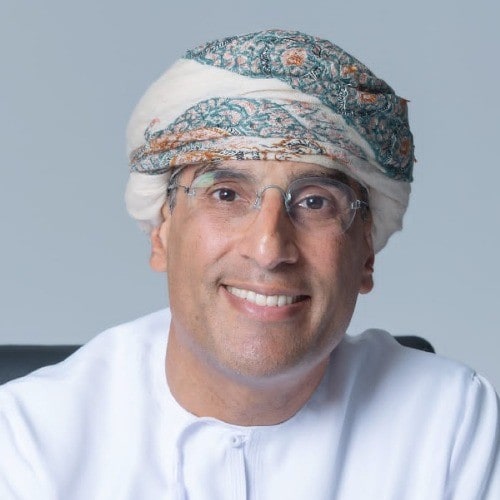
“In Oman, clear long-term policy direction under Vision 2040 is encouraging CEOs to invest beyond the short term, with innovation and AI moving rapidly from experimentation to impact. At the same time, skills availability remains a challenge. Business leaders must continue to build capabilities, develop local talent and use technology responsibly to stay competitive and rethink how they can create, capture and deliver value.”
CEOs in Oman are among the most confident globally, supported by an improving economic growth, a clear long-term policy framework and rapid diversification. The country’s Vision 2040 and the new Five-Year Development Plan are encouraging companies to invest beyond the short term, particularly in technology, renewable energy, industrials and services. Businesses are diversifying into new sectors faster than regional and global peers, while AI adoption is delivering clear revenue benefits and supporting job creation. Although skills shortages and cyber risks remain key concerns, CEOs are largely confident in their ability to manage disruption and capitalise on change, positioning Oman’s companies for sustained, resilient growth.
Key findings for the region
% of CEOs in Oman expect economic growth in their own territory to strengthen this year
% of CEOs in Oman have a high level of confidence in revenue growth over the next three years
% of CEOs plan at least one major acquisition in the next three years, a significant increase in M&A appetite compared to last year.
% of CEOs say their organisational culture enables AI adoption, providing a strong foundation for scaling AI at pace.
1 CEOs confident in Oman’s growth as economic outlook strengthens
Oman’s broader economic outlook is positive with a GDP growth of 3.7% in 2026,1 driven by investment in manufacturing, construction and services, while a conservative oil price assumption of US$60 per barrel provides stability and protects against volatility.2 Greater reliance on gas revenues and improving financial conditions are further supporting resilience and diversification. Against this backdrop, business sentiment remains strong, with 94% of CEOs surveyed in Oman expecting the country’s economy to grow – a level of optimism higher than that of CEOs globally about their own territories. The steady non-oil growth and supportive financing conditions have encouraged business leaders to think beyond short-term pressures and give them the confidence and security to invest for the medium to long term. 76% of business leaders in Oman have indicated that they are very or extremely confident of their own revenue growth over the next three years, compared with fewer than half (49%) of CEOs globally (see Figure 1).
This confidence is reinforced by policy continuity. Oman’s 11th Five-Year Development Plan begins in 2026, supporting the continuing diversification of Oman’s economy away from fossil fuels and into sectors including renewable energy, manufacturing, mining, tourism and fisheries.3Economic projections for Oman in 2026 are positive, with its leadership anticipating a 4% growth, with inflation maintained at a stable 1.4%.4
At the same time, CEOs in Oman remain acutely focused on near-term execution. According to survey findings, they have reported spending 45% of their time on issues with time horizons of less than one year, more than twice the share devoted to priorities extending five years or more. This reflects the reality of balancing immediate performance with long-term ambition. With nearly 60% of CEOs also confident in revenue growth over the next 12 months, higher than both global averages and last year’s levels, CEOs appear to be building organisations capable of performing today while positioning themselves strongly for tomorrow.
Figure 1: How confident are you about your company’s prospects for revenue growth over the next three years?

A compelling investment destination
Oman is increasingly emerging as a compelling investment destination for Middle East CEOs, underpinned by strategic location, improving fiscal discipline and accelerated regulatory reform under Vision 2040. The country now ranks among the region’s top 10 investment destinations for business leaders in the region, with its attractiveness rising by three percentage points year on year - from 9% to 12%.
There are deep economic ties with the UAE and Saudi Arabia, with large-scale investment partnerships spanning renewable energy, green metals, logistics, rail connectivity, digital infrastructure and technology. The UAE and Oman have strong historical relations. This relationship is now scaling further through investment partnerships valued at approximately Dhs129 billion,5 spanning renewable energy, green metals, rail connectivity, digital infrastructure, and technology. Saudi Arabia’s Public Investment Fund’s and the Oman Investment Authority’s strategic partnership signalling growing confidence from regional institutional capital.6 Qatari investment in Oman has also continued to expand. By the end of the third quarter of 2024, the value of Qatari investments stood at around US$1.27 billion (OMR 488m), with 15 Qatari companies actively investing across the Omani economy.7 For intra-regional investment opportunities, Oman CEOs also see the strongest potential in UAE, Saudi and Qatar.
2 Innovation-led growth accelerates as Oman scales AI adoption
Of the many questions concerning CEOs in Oman, three stand out – centred on transformation, long-term viability, and innovation. In the face of rapid technological change, leaders are asking:
- Are we transforming our business fast enough to keep up with the scope and pace of technological change including AI
- Am I doing enough to ensure my company remains viable in the medium- to long term
- Is my company’s innovation capability adequate for our uncertain future?
Against this backdrop, CEOs in Oman are placing bets on innovation, with a growing emphasis on understanding customer needs, taking calculated risks and developing new products and services. In 2025, Oman advanced five places on the Global Innovation Index to rank 69th out of 139 economies worldwide.8 Policy stability and capital inflows in growth sectors such as renewable energy, technology, and advanced manufacturing are further strengthening the country’s innovation environment.
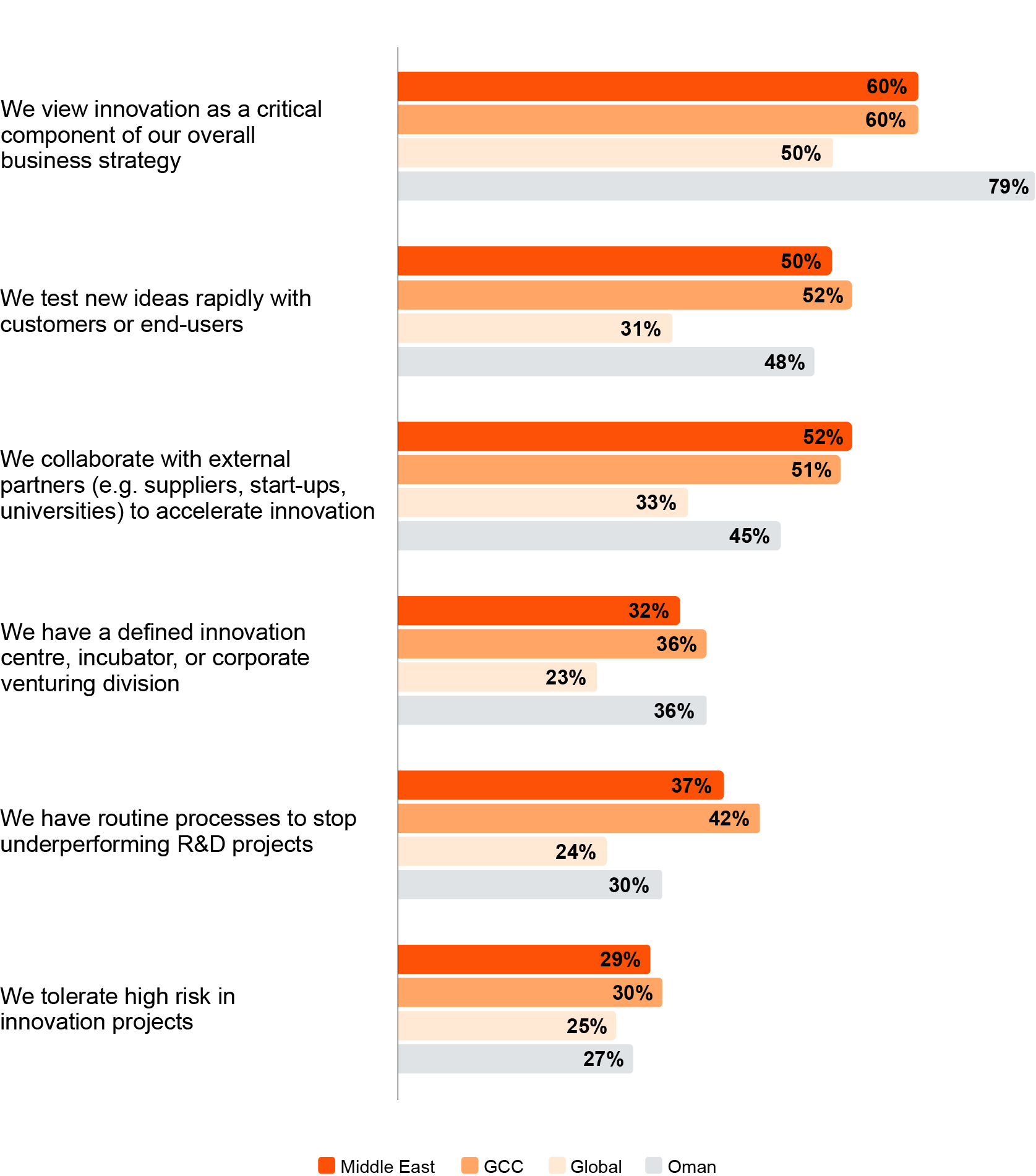
Within organisations, innovation is firmly embedded in strategy. Nearly four in five CEOs (79%) in Oman view innovation as a critical component of their overall business strategy. More than a third (36%) report having a defined innovation centre, while almost half (48%) are rapidly testing new ideas with customers and users. Collaboration is also a priority, with close to half of CEOs working with external partners such as suppliers, start-ups, and universities to accelerate innovation. In parallel, 27% of CEOs say they are also willing to tolerate high levels of risk in innovation projects, slightly above the global average.
As a result, greater agility in product development is translating into measurable outcomes. New products and services introduced over the past three years now account for around one-fifth (21%) of revenues for business leaders.
Figure 2: To what extent do each of the following statements characterise your company's approach to innovation (SUMMARY NET: Large or very large extent)
Scaling AI across the value chain
As part of a broader push to position itself as a regional hub for digital innovation, Oman is accelerating its national artificial intelligence (AI) agenda, allocating budgets to develop AI-powered applications, support research and development and improve public sector efficiency. The sultanate has invested approximately OMR60m ($156m) in AI between 2021 and 2024.9 This transformation is being supported by the Oman government’s National Program for Artificial Intelligence and Advanced Technologies, 10 designed to strengthen AI adoption in areas including cybersecurity, health, and law and administration.
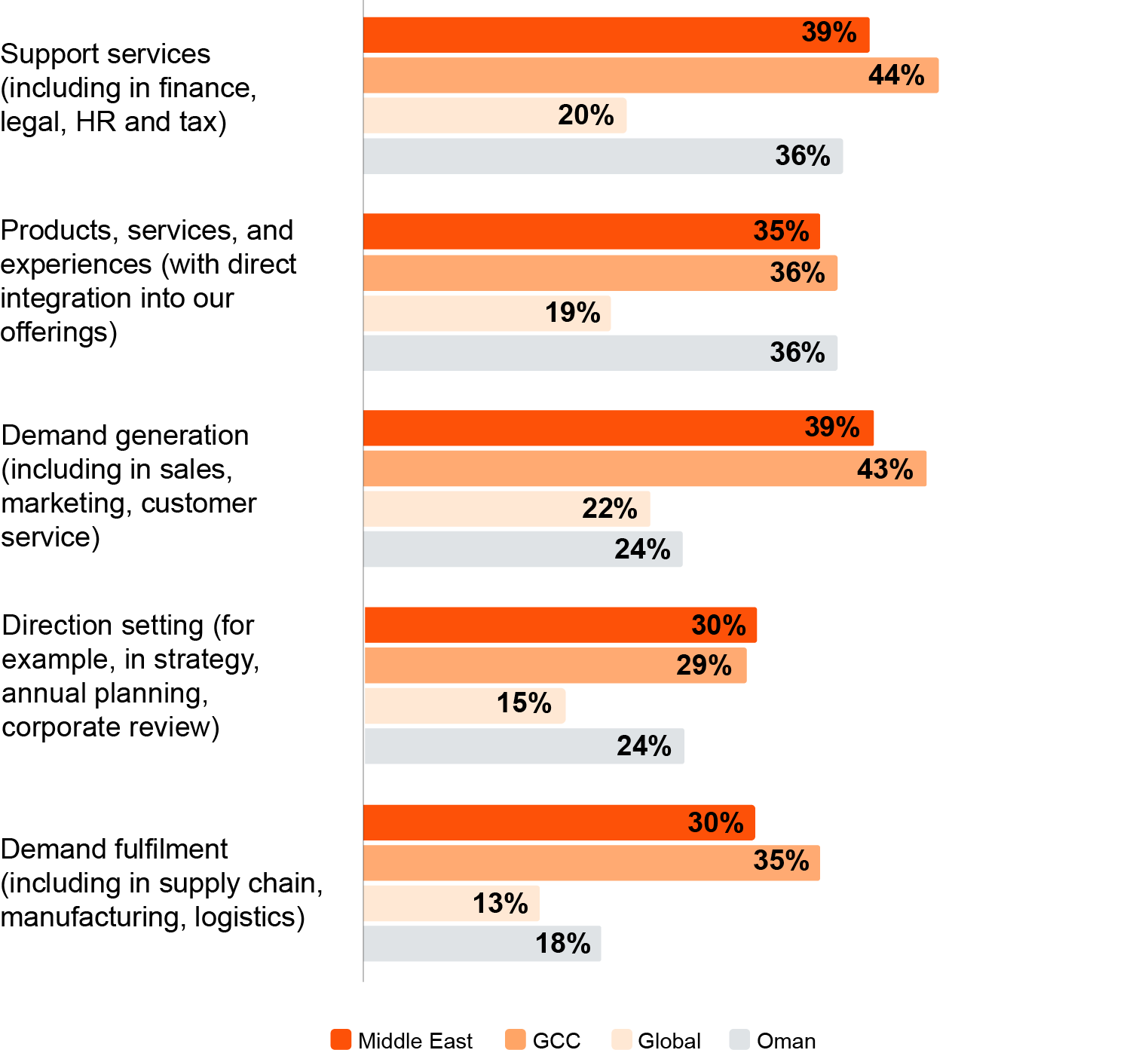
According to survey findings, businesses in Oman have reported significantly higher application of AI across every major area of the value chain – higher than global averages. Adoption is strongest in support services such as finance, HR, legal and tax, where 36% of business leaders in the country apply AI at scale, nearly double the global level of 20%. In customer-facing functions, 24% of CEOs use AI in demand generation. In demand fulfilment across supply chains and logistics, 18% of CEOs use AI compared to only 13% global averages. AI is also increasingly embedded in core offerings, with 36% of CEOs integrating it directly into products, services and experiences. In strategic decision-making, 24% of CEOs are applying AI to direction setting, higher than the global average of 15% (see Figure 3).
Figure 3: To what extent has AI been applied in the following areas of your business? (SUMMARY NET: To a large or very large extent)

Business leaders in Oman are also confident about the organisational foundations required to scale AI. A large majority of them agree that their culture enables AI adoption (84%), their technology environment supports AI integration (84%), and they have a clearly defined roadmap for AI initiatives (72%) - all well above global levels. In Oman, 34% of CEOs report that AI tools can access company data, yet 48% still face significant technology constraints, highlighting persistent challenges around siloed data and integration.
However, attracting high-quality technical and AI talent remains a challenge in Oman. Fewer than half of CEOs surveyed say they are able to secure the AI capabilities they need, below the GCC average. Understandably, development of local talent is now a priority, with increased emphasis on building a homegrown workforce capable of leading the country’s AI innovation agenda. CEOs are acutely aware of this, and many plan to increase AI-related hiring across all levels – junior, mid-level, and senior over the next three years.
3 Reinvention through diversification
The appetite for dealmaking is higher than last year, with 64% of CEOs in Oman planning to make one or more major acquisition in the next three years, compared with 44% in 2025 (see Figure 4).
Figure 4: How many major acquisitions, worth more than 10% of your company’s assets, is your company planning to make in the next three years? (SUMMARY NET: One or more)

As Oman’s economy diversifies, it has accelerated its transition toward a more diversified, multi-sector growth model over the past year. Business leaders are expanding into new markets and industries at a significantly faster rate than their global peers, with 64% of CEOs indicating an appetite for one or more major acquisitions, worth more than 10% of their company’s assets, in the next three years, higher than 41% globally.
Notably, 73% of CEOs say their organisations have begun competing in new sectors or industries over the past five years, double the share reported in last year’s survey, highlighting a sharp acceleration in strategic diversification. This is especially noticeable in Oman’s key industries: for example, telecoms provider Omantel is expanding into cloud computing, cybersecurity and fintech,11 while energy giant state-owned Petroleum Development Oman is moving beyond oil and gas to renewables and mineral extraction.12 Key sectors benefiting from this dealmaking drive in Oman are technology, energy, utilities and resources, and industrials and services.
4 Skills availability emerges as the primary risk for CEOs in Oman
While geopolitical conflict ranks as the top threat for CEOs across the region in the year ahead, business leaders in Oman continue to identify the availability of key skills as their key threat over the next 12 months – unchanged from last year. As the country intensifies efforts to expand opportunities for Omani nationals and reshape its labour market, roles that have traditionally relied heavily on expatriate talent are increasingly expected to be filled by citizens.13 This shift is driving rising demand for specialised capabilities, particularly in high-skill IT and digital roles, where local talent pipelines are still developing. In line with this, survey findings have also indicated that about 50% of business leaders surveyed in Oman said their company has difficulties finding and retaining talent – significantly higher than global and GCC averages
Figure 5: How exposed do you believe your company will be to the following key threats in the next 12 months? (Showing sum of highly or extremely exposed)
Cyber risk closely follows skills availability as a top concern for business leaders in Oman and the rest of the Middle East. In response, 58% of CEOs in Oman said they were planning to improve enterprise-wide cybersecurity over the next three years, while nearly 40% said they would reduce their reliance on technology providers based in jurisdictions considered less trustworthy.
Despite geopolitical uncertainty remaining among the top threats, CEOs in Oman see themselves well prepared to respond effectively to any disruption (73% compared with 39% globally), and to find new opportunities in that disruption (48% compared with 29%). Business leaders remain firmly focused on growth, broadly in line with the GCC and Middle East averages. A significant 70% of CEOs said geopolitical uncertainty (including tariffs) would have little or no impact on their likelihood of making new investments. Rather than acting as a brake on growth, tariffs are increasingly seen as a catalyst to explore new markets and diversify trade relationships. In parallel, Oman is leveraging its strategic position along major trade routes to strengthen its role as a logistics and trade hub, supported by ongoing investment in ports, free zones, and airport infrastructure.14
Business leaders in Oman see clear opportunities for growth despite the geoeconomic fragmentation reshaping global markets. They recognise that sustaining momentum will require new growth drivers, rooted in skills development, long-term investment in human capital and the responsible use of technology across artificial intelligence, digital transformation, and cybersecurity.
With more than 80% of CEOs reporting access to capital to fund new initiatives, confidence remains high in the stability of the economy and Oman’s attractiveness as an investment destination. This confidence extends to the climate transition, supported by growing national efforts in renewable energy and green hydrogen development. As Oman advances its Vision 2040 agenda, the combination of confidence, discipline and adaptability positions businesses to compete more effectively, both regionally and globally.
Your next move
Contact us:
Consulting Partner, PwC Middle East
Omar Al Sharif