





“In Bahrain, as economic diversification delivers tangible results, CEOs are acting with confidence and intent. AI is moving from experimentation to real impact, while dealmaking is being used strategically to diversify and build new capabilities. At the same time, leaders are strengthening resilience across cybersecurity, talent, and supply chains, laying the foundations for durable, long-term value creation.”
CEOs in Bahrain are notably optimistic about future growth, reflecting strong economic momentum in the country and tangible advances in diversification under Economic Vision 2030. Expansion across non-oil sectors, including financial services, technology and tourism, and rising foreign investment and regional capital flows are supporting robust corporate performances. Confidence extends into the medium term, driving a strong appetite among CEOs for acquisitions and expansion into new industries. Technology, particularly AI, is a key enabler for companies, already delivering tangible revenue gains and supporting job creation.
Key findings for the region
% of CEOs in Bahrain expect economic growth in their own territory to strengthen, in line with high levels of confidence across the GCC.
% expect strong revenue growth over the next three years.
% of Bahrain CEOs plan at least one major acquisition in the next three years.
% of companies plan to improve enterprise-wide cybersecurity to address cyber risks, one of the key concerns for CEOs.
1 Rising confidence amid sustained economic momentum
CEOs in Bahrain enter the year with a strong sense of confidence, underpinned by the economic momentum and the country’s clear commitment to reinvention. 94% of CEOs expect the country’s economy to grow, in line with peers across the GCC (93%) and well above the global average, where just 55% of CEOs anticipate growth in their home markets.
This optimism is the result of strong domestic demand, regional expansion opportunities and higher investment levels in the services, finance and technology sectors, all providing a supportive environment for revenue growth for businesses in the country.
Economic data makes it clear that Bahrain’s focus on diversifying its economy through the Economic Vision 2030 plan is delivering tangible results. The fastest growing area of the economy has been in the professional1 and technical sector2 which expanded by 12% in the second quarter of 2025, followed by retail and wholesale activities at 6.7%. This is reinforced by World Bank research, which shows growth increasingly driven by non-oil sectors, including financial services and fintech, tourism, and logistics and forecasts Bahrain’s economy to grow by 3.5% in 2026.3
Growth is also being supported by strong foreign investments into the country. As one of the most diversified economies in the region, Bahrain offers a robust regulatory and legislative framework, a strong ease-of-doing-business environment, increasing its appeal as a regional hub for trade, investment, and industrial activity. Economic integration with key regional partners in the region is deepening. Saudi Arabia and Bahrain have launched the second phase of their industrial integration initiative,4 aimed at expanding bilateral trade, accelerating investment, and strengthening cross-border supply chains.
This builds on already strong ties: Saudi direct investment in Bahrain reached SR35 billion (US$9.3 billion) in 2023, accounting for around 20% of total foreign investment. Saudi utility provider ACWA Power is actively expanding its footprint in Bahrain,5 strengthening its regional presence through investments in power generation and water desalination, including the acquisition of stakes in three Bahraini power and desalination companies completed in December. The UAE is also a major investor, ranking among Bahrain’s top three sources of foreign capital, with cumulative direct investment of AED16.5 billion by 2024, around 10% of total FDI inflows.6
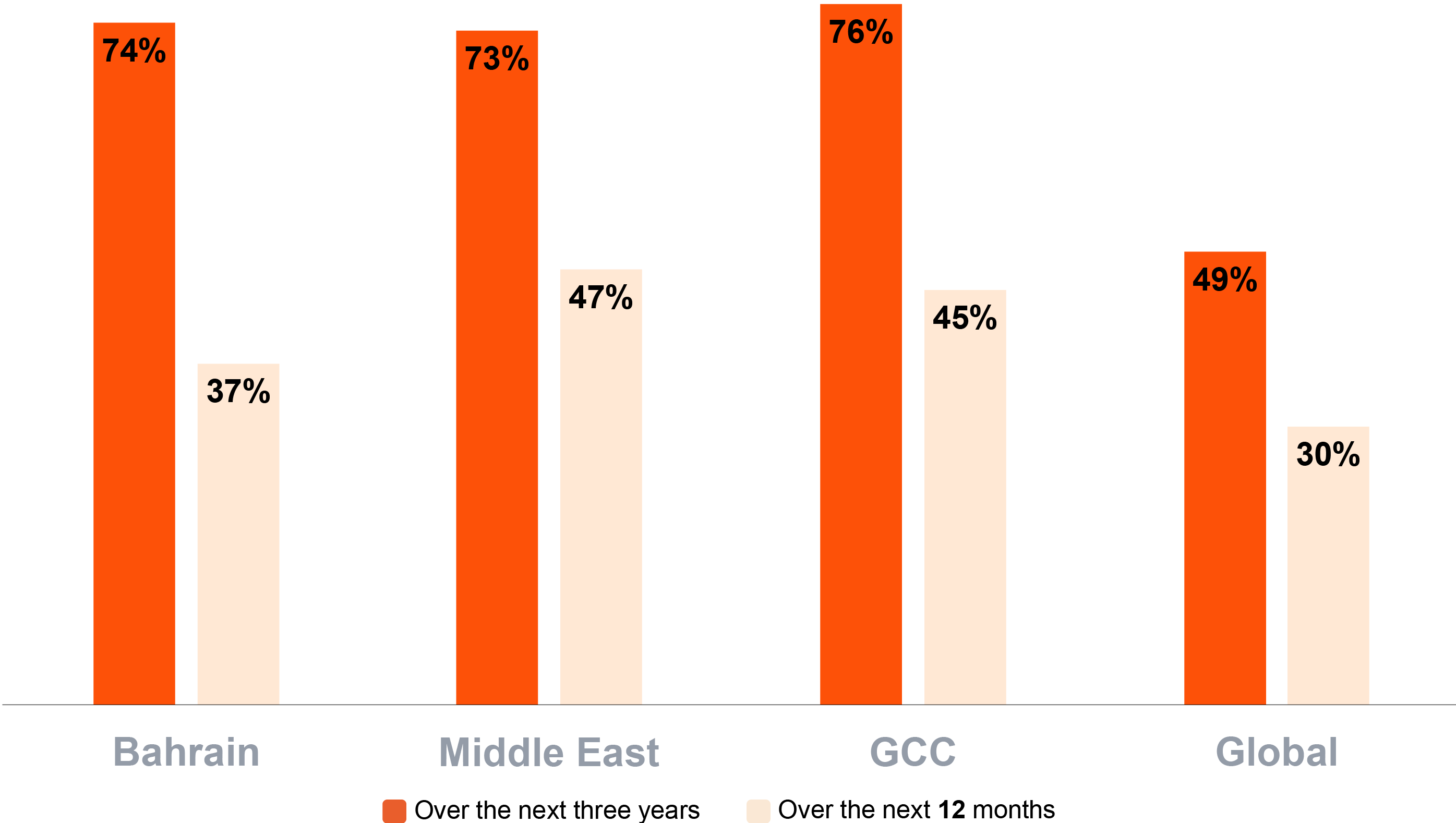
At the business level, this economic and investment momentum is reinforcing confidence as CEOs look to the future, with 74% expecting revenue growth at their company over the next three years, significantly ahead of 49% globally (see Figure 1). However, CEOs are more cautious about the coming 12 months, with 37% forecasting revenue growth, amid continuing geopolitical uncertainty. Revenue growth and profit margins for the current fiscal year are ahead of global averages, with CEOs in Bahrain reporting average revenue growth of 10% compared with 8% globally, and profit margins of 12% compared with 10% globally.
Figure 1: How confident are you about your company’s prospects for revenue growth over the next 12 months / over the next three years?
2 AI as a catalyst for innovation and growth
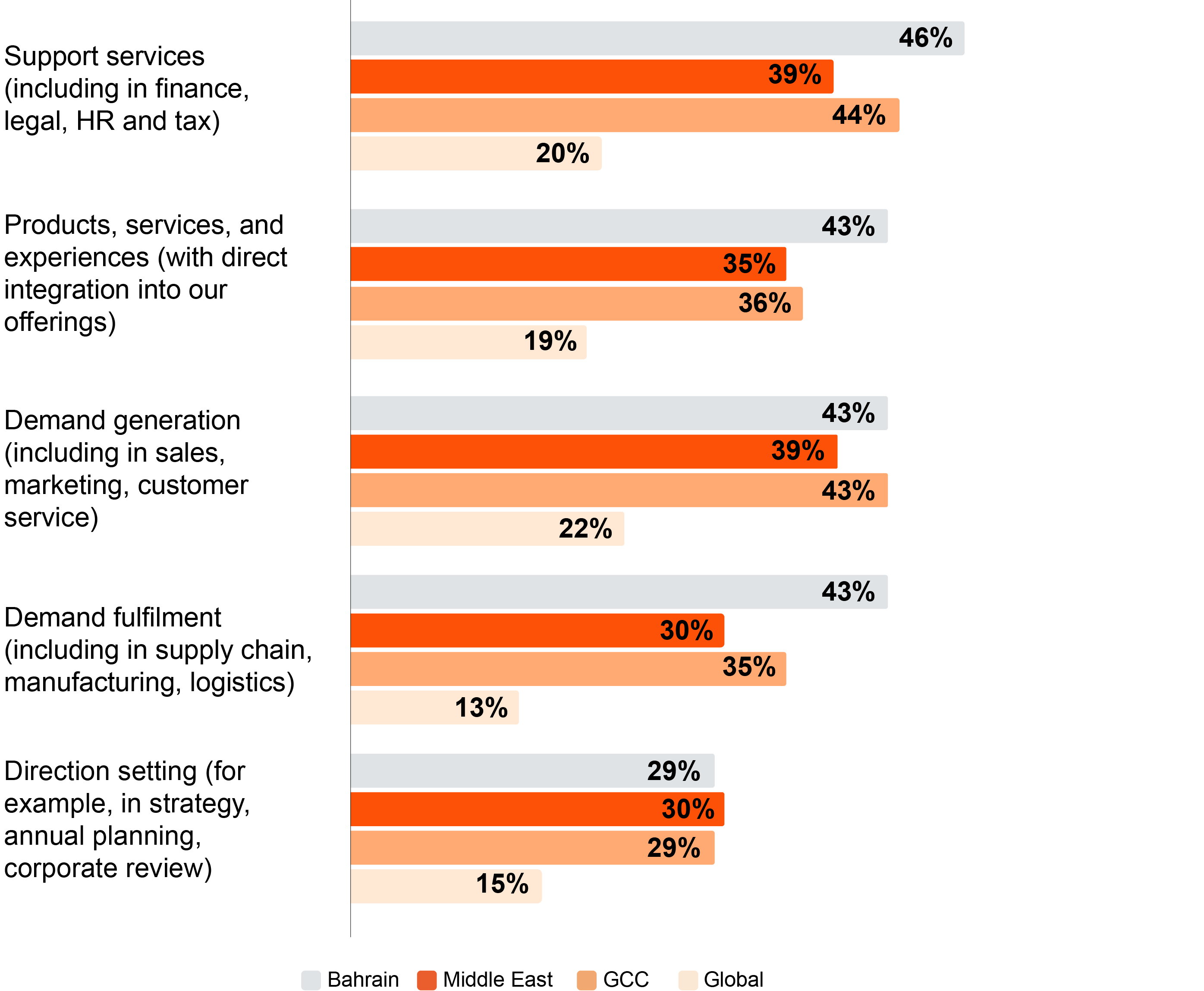
Technology, particularly AI, is playing a central role in enabling and accelerating transformation and diversification in Bahrain. Survey findings indicate that businesses in Bahrain have applied AI in their products and services, demand fulfilment and support services such as finance and human resources at a faster rate than global averages (see Figure 2).
Figure 2: To what extent has AI been applied in the following areas of your business? (SUMMARY NET: To a large or very large extent)
CEOs in Bahrain are also confident they have created the right conditions for their AI investments to thrive. 79% say the company’s technology environment enables the integration of AI, 76% that the culture is supportive, and 70% said they have a clear roadmap for AI initiatives.
These responses demonstrate how investment in cloud infrastructure, data platforms and digital skills across the region has increased organisational readiness for AI deployment.
Both government entities and private companies in Bahrain are working to maximise the potential of AI, with the government completing six National Digital Economy Strategy initiatives in 2025,7 to accelerate AI adoption and the rollout of advanced digital services.
This includes setting up the country’s first AI and emerging technologies directorate within the Information and eGovernment Authority (iGA). AI skills development is also a priority, and the Artificial Intelligence Academy at Bahrain Polytechnic has been set up in collaboration with Microsoft to train both teachers and students to innovate with AI and gain professional qualifications.8
The national focus on skills is returning positive results, with 67% of CEOs in Bahrain saying they can attract top technical talent for AI roles. 91% of CEOs in Bahrain plan to hire more people in junior roles as they implement AI initiatives (compared with 28% globally), and 64% to hire more people in mid-level positions (29% globally). CEOs in Bahrain are relatively less concerned about the availability of key skills than global averages (14% compared with 22%).
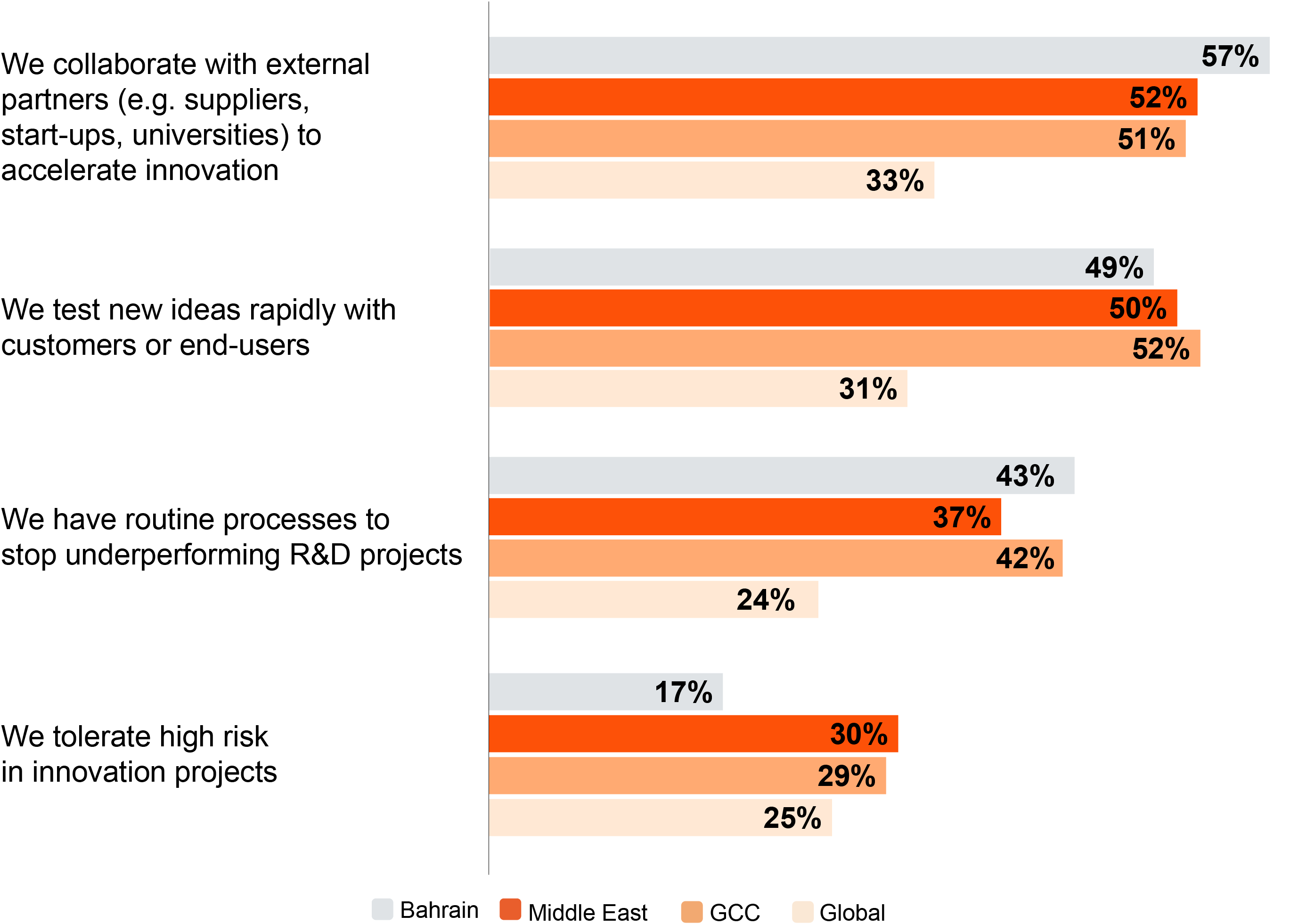
While AI adoption is well underway, CEOs in Bahrain still expressed slightly more caution in some areas of their approach to innovation than peers in the region. Companies favour a collaborative approach with controlled risk, which means working with regulators, creating internal guardrails and adapting to evolving rules for sustainable growth. 17% of CEOs in Bahrain said they tolerate high risk in innovation projects, compared with 30% in the GCC, and 37% view innovation as a critical component of their business strategy compared with 60% in the GCC and 50% globally (see Figure 3).
Figure 3: To what extent do each of the following statements characterise your company’s approach to innovation? (SUMMARY NET: To a large or very large extent)
3 Reinvention anchored in deals and diversification
The expectation of future growth is supporting a strong appetite for deals in Bahrain, with 86% of CEOs planning at least one major acquisition, defined as being worth more than 10% of the company’s assets, in the next three years.
In Bahrain, where companies are already expanding into new sectors, nearly half of the business leaders surveyed in the country said they have started competing in new industries in the last five years, a higher share than globally (42%). 40% anticipate that more than 20% of total deal value will be from industries outside their own, compared with 16% globally (see Figure 4). Gaining access to new customers, new capabilities (including talent and data), and particular technologies or intellectual property (IP) are the main drivers for making acquisitions, the survey shows.
Recent dealmaking in Bahrain has shown how M&A activity can be a strategic lever for long-term value creation. With Saudi Arabian Mining Company (Ma’aden)’s acquisition of a 20.6% stake in Aluminium Bahrain (Alba) for US$964 million,9 it has meant strengthening upstream and downstream integration across critical materials while anchoring Alba more firmly within a regional industrial value chain. For business leaders in Bahrain, such transactions highlight the role of dealmaking in securing scale, resilience, and supply-chain integration, supporting competitiveness in priority sectors and reinforcing Bahrain’s position within the GCC’s evolving industrial ecosystem.
Factors supporting diversification in Bahrain include the clear structure and transparency for dealmaking outlined by the Central Bank of Bahrain’s (CBB) regulatory framework, and progressive fintech policies which have fostered the growth of start-ups and driven M&A in the financial sector in particular.10
Figure 4 Of the acquisition(s) that your company is planning to make in the next three years, what proportion of the total deal value do you expect will be from sectors or industries outside your own?

4 Growing resilience to geopolitical and cyber risks
CEOs in Bahrain identified geopolitical conflict as the biggest threat to their company over the next 12 months, cited by 49% of respondents, followed by cyber risks (40%) and climate change (31%).
In response to this risk landscape, business leaders are taking a proactive stance, with 66% planning to improve enterprise-wide cybersecurity over the next three years (see Figure 5), ahead of GCC (56%) and global averages (47%). Just over a third of Bahrain’s CEOs are also planning to reconfigure their supply chain and supplies of critical products to countries that are more secure, and 29% indicated restructuring tax obligations because of geopolitical exposure.
Figure 5: To what extent do you expect your company to take each of the following actions in response to potential geopolitical risk, over the next three years? (SUMMARY NET: To a large or very large extent)

Effective leadership today extends beyond crisis response to proactive preparedness. Informed by lessons from recent global shocks and enabled by technological progress, CEOs in Bahrain are strengthening resilience with 63% confident in their organisation’s ability to respond effectively to disruption, and 46% saying they can anticipate disruption before it occurs.
Bahrain’s business leaders are entering the next phase of growth with confidence. More than half expect tariffs to have a minimal impact on profit margins this year, signalling resilience to near-term cost pressures. At the same time, nearly a quarter (23%) identify climate change’s impact on business performance as a key trust concern among stakeholders, a reminder that longer-term risks are increasingly shaping expectations of value creation. The defining challenge now is to deliver consistently at scale: managing immediate risks while translating structural advantages into sustained, long-term performance.
Your next move
Contact us:
Consulting Partner, PwC Middle East
Mohamed Al Mahroos
Partner, Bahrain Country Senior Partner, Government & Public Sector, Tax & Legal Services, PwC Middle East