











A step toward building trust and supporting Indigenous communities
Our commitment to Truth and Reconciliation
Land acknowledgment
We at PwC Canada acknowledge that we work and live across Turtle Island, on the land now known as Canada. These are the lands of the ancestral, treaty, and unceded territories of the First Nations, Métis, and Inuit Peoples.
We recognize the systemic racism, colonialism, and oppression Indigenous Peoples have experienced and still go through, and we commit to allyship and solidarity.
Our Indigenous Reconciliation Action Plan
We’re honoured to share PwC Canada's Reconciliation Action Plan, which seeks to foster truth and reconciliation with Indigenous Peoples across our nation. It reflects our ongoing dedication to building a more inclusive society. It also formalizes our understanding that reconciliation is an imperative for corporate Canada that will lead to improved outcomes for Indigenous Peoples and Canada as a whole.
Our actions set out in this plan are organized under six pillars:

Our commitment
Establish and support inclusive leadership practices and governance frameworks that acknowledge and integrate the concept of Two-Eyed Seeing. These frameworks promote accountability for the commitments we make on our journey towards reconciliation.
| Our actions |
PAIR phase | Completion timeline |
|---|---|---|
| Create a communication strategy to increase awareness and provide updates on our progress and ongoing reconciliation initiatives both internally and externally. | Phase 2 |
Ongoing |
| Conduct a comprehensive review of our policies and practices to identify gaps and opportunities for improvement, aiming to strengthen our Indigenous Reconciliation efforts. | Phase 2 | Ongoing |
| Create and establish an operational team responsible for implementing and executing on our reconciliation initiatives while ensuring Indigenous perspectives are actively included. | Phase 1 | Year 1 |
| Leveraging our PwC Canada tools and technologies, establish a data management process with robust mechanisms for tracking, measuring and reporting on the progress and outcomes of our reconciliation initiatives. | Phase 3 | Year 1 |
| Develop and implement an Indigenous Relations Policy that aligns with the Truth and Reconciliation Commission's Call to Action #92 and the United Nations Declaration on the Rights of Indigenous Peoples (UNDRIP). | Phase 1 | Year 1 |
| Ensure sustained leadership commitment to implementing the Reconciliation Action Plan, and establish support mechanisms across the firm to uphold accountability for our reconciliation commitments. | Phase 1 |
Year 1 |
| Ensure leadership actively engages and builds relationships with Indigenous communities. | Phase 2 | Year 2 |

Our commitment
Increase Indigenous representation in our workforce by implementing comprehensive recruitment, collaboration, and support strategies.
| Our actions | PAIR phase | Completion timeline |
|---|---|---|
| Collaborate with Indigenous organizations and communities to promote job postings, internships and co-op programs across all lines of service and provide visible representation. | Phase 3 | Year 2 |
| Actively support educational and early-career recruitment initiatives for Indigenous students through mentorships, scholarships and partnering with Indigenous employment and education organizations. | Phase 3 | Year 2 |
| Explore partnerships with post-secondary institutions and Indigenous organizations to support Indigenous students pursuing degrees in accounting, finance and STEAM (science, engineering, arts, technology and mathematics). | Phase 3 | Year 3 |
| Develop and implement a targeted recruitment strategy for Indigenous students and experienced professionals with the purpose of increasing Indigenous representation across all staff levels in the firm. | Phase 3 | Year 3 |

Our commitment
Foster an inclusive, supportive, and growth-oriented environment for Indigenous talent by providing opportunities for professional development and career advancement.
| Our actions | PAIR phase | Completion timeline |
|---|---|---|
| Continue to support PwC Canada's IIN to provide a platform for community building, sharing experiences and fostering a sense of belonging. | Phase 3 | Ongoing |
| Create a safe and welcoming workplace where Indigenous people and cultures are acknowledged, celebrated and respected. | Phase 3 | Ongoing |
| Elevate Indigenous voices by ensuring PwC Canada's IIN can provide recommendations, feedback and guidance to leadership. | Phase 3 | Year 1 |
| Enable Indigenous employees through mentorship and career progression frameworks that support, guide and contribute to the professional growth of our Indigenous talent. | Phase 3 | Year 2 |
| Ensure the process for employees to self-identify as Indigenous is designed to allow for secure and confidential disclosure of their identity, and explore opportunities to safely and respectfully encourage self-identification. | Phase 3 | Year 2 |

Our commitment
Promote economic reconciliation by fostering sustainable economic opportunities and partnerships for Indigenous communities through PwC Canada's business practices and initiatives.
| Our actions | PAIR phase | Completion timeline |
|---|---|---|
| Expand PwC Canada's supplier diversity programs to incorporate sourcing and purchasing from Indigenous-owned businesses. | Phase 3 | Ongoing |
| Develop and implement a reporting tool to profile, monitor and gather information and data on PwC Canada's Indigenous suppliers. | Phase 3 | Year 1 |
| Collect and analyze relevant data on procurement from Indigenous suppliers and establish a procurement spend target from Indigenous-owned businesses. | Phase 3 | Year 3 |
| Create a strategy to advance Indigenous procurement by educating employees within procurement and throughout the practice about opportunities to engage with Indigenous businesses. | Phase 3 | Year 3 |
| Create a process to support Indigenous suppliers in procurement opportunities. | Phase 3 | Year 3 |
| Identify potential partnerships with Indigenous-owned businesses to create mutually beneficial collaborations. | Phase 3 | Year 3 |

Our commitment
Foster a deeper understanding and appreciation of Indigenous culture, histories, and contributions, as well as the legacy of residential schools through comprehensive education and cultural awareness initiatives.
| Our actions | PAIR phase | Completion timeline |
|---|---|---|
| Review, identify and implement learning and development initiatives to expand Indigenous cultural knowledge and competency for all partners and staff at PwC Canada. | Phase 1 | Ongoing |
| Continue to organize and host events that recognize and celebrate Indigenous culture, including observances such as National Indigenous Peoples Day and the National Day for Truth and Reconciliation, by featuring presentations and educational sessions led by Indigenous speakers and educators. | Phase 2 | Ongoing |
| Develop land acknowledgement guidance that allows for partners and staff to deliver authentic, respectful and meaningful land acknowledgements. | Phase 2 | Ongoing |
| Introduce additional educational courses that provide insights into Indigenous perspectives, customs and community protocols, tailored for team members involved in Indigenous-focused projects. | Phase 3 | Year 3 |

Our commitment
Support the development of Indigenous communities and organizations by leveraging PwC Canada's resources, expertise, and network.
| Our actions | PAIR phase | Completion timeline |
|---|---|---|
| Strengthen ties between Indigenous communities, non-Indigenous governments and corporate Canada to create opportunities in economic empowerment and reconciliation. | Phase 3 | Year 2 |
| Establish connections and foster interactions with the broader Canadian business community to exchange knowledge and encourage the advancement of reconciliation initiatives within the corporate sector. | Phase 3 | Year 2 |
| Encourage employees to volunteer their skills and expertise to support Indigenous businesses and community projects. | Phase 3 | Year 2 |
| Co-develop Indigenous-led community development initiatives. | Phase 2 | Year 2 |
PwC Canada’s Reconciliation Action Plan
Together, we’re building a future where everyone can thrive.
Reconciliation in Action
Sharing stories that shape our collective journey.
About the artist
Stuart Pagaduan is a Coast Salish artist and culture and language teacher. He feels it's a privilege and honour to be able to combine his passion for art, education, and culture into a rewarding and successful career.
Stuart credits his grandparents for instilling in him the value and importance of his ancestral language and culture. Stuart has dedicated himself to echoing the teachings and values of his elders to ensure a hopeful future for the youth of his community.
In terms of his art, Stuart is thankful to his mentor and uncle, the late Seletze’ (Delmar Johnnie), for giving him an opportunity to learn. This experience turned Stuart into a proud advocate and lifelong learner of Coast Salish art. Stuart has experience in many different mediums, and he continues to expand on modern Coast Salish art. He has a unique style that’s reflected in his choice of creatures, paralleled with ancient Cowichan stories. He continues to dedicate himself to keeping his language and culture alive and carrying on the legacy of his elders.
Our Reconciliation commitment
With Call to Action #92, the Truth and Reconciliation Commission of Canada called on corporate Canada to address the historical injustices faced by Indigenous Peoples in Canada.
As we work towards reconciliation at PwC Canada, it’s critical for all of us to develop our understanding of Indigenous histories, cultures, and peoples and increase our knowledge of past and present relationships between Indigenous and non-Indigenous Peoples. We acknowledge that each of us comes to this work from different places of awareness, bringing diverse skills, experiences, and understandings.
Truth and Reconciliation is a collective responsibility and a shared journey. We all have a role to play.
Our commitment
At PwC Canada, Indigenous Reconciliation is inherent to our purpose of building trust in society and solving important problems. We commit to fostering mutual respect and driving sustainable change to empower Indigenous communities and citizens. We strive to amplify Indigenous perspectives and contribute meaningfully to a future where Indigenous and non-Indigenous Peoples thrive.
Guiding principles
Guided by the principles of respect, reciprocity, and trust—gained through our journey in understanding Indigenous history—PwC Canada will use its position in the Canadian economy to contribute to a more just and equitable future.
We’ll collaborate with Indigenous Peoples by understanding their historical context, actively recruiting and promoting Indigenous talent, partnering with Indigenous-owned businesses, and building strong relationships with Indigenous communities.
A message from the Chair of our Indigenous Reconciliation Advisory Committee
“It’s an honour to serve as the chair of PwC Canada’s Indigenous Reconciliation Advisory Committee. I am a member of the Kitigan Zibi Anishinabeg First Nation, situated in the Outaouais region in the province of Québec. I was born and raised in a Montréal suburb, but I spent most of my summers in my community with my aunts and kokom (Algonquin word for grandmother) learning about traditional food, culture, crafts, stories, and language.
It is with great pride that I take on this leadership role, and I’m proud of the work we are doing at PwC Canada to advance reconciliation. I am honoured and grateful for the opportunity to share my insights, and I’m looking forward to the contributions we will make and the impact we’ll have for future generations.”
Jessica Paul
Assurance Partner and Chair, PwC Canada’s Indigenous Reconciliation Advisory Committee

Our Indigenous Reconciliation Advisory Committee
To support this initiative, PwC Canada has established the Indigenous Reconciliation Advisory Committee (IRAC). This internal working group includes members from various service lines and regions across Canada and both Indigenous and non-Indigenous representatives. The mandate of the IRAC is to advance the PwC Canada Indigenous Reconciliation Strategy through fostering trusted, collaborative, and respectful relations between the PwC Canada community and Indigenous Peoples.
The IRAC contributes subject matter expertise and knowledge of the firm’s working environment, as well as understanding and experience of working with Indigenous communities, organizations, and businesses.
The mandate of the IRAC is separate and distinct from that of the Indigenous Inclusion Network, which is a key stakeholder in the work performed by the IRAC. PwC Canada’s inclusion networks are employee-driven communities for members and allies to learn about and celebrate diverse cultures.
Our journey towards reconciliation
Video

In conversation: mentors & mentees
Meaningful mentorship can be an act of reconciliation. Mel Fowle and Jennine Tiedemann share how PwC Canada's Indigenous mentorship program helps remove barriers, amplify Indigenous voices, and open doors to career growth.
Indigenous mentorship programs
PwC Canada provides mentorship through CPA Canada’s Mentorship Program for Indigenous Students. The goals of the program are to support Indigenous students through their high school years, help them understand the benefits of pursuing post-secondary education, expose them to the business environment, and help them consider potential job opportunities, including careers in business, finance, and accounting.
PwC Canada also offers a firm-wide Indigenous mentorship program. This program was developed by the IIN to support Indigenous staff to have equitable access to professional growth and leadership opportunities, including learning from individuals from similar backgrounds.
Indigenous Inclusion Network
The Indigenous Inclusion Network (IIN) is an employee resource group created in 2020 to cultivate a sense of belonging among Indigenous employees within PwC Canada. Since its inception, it has expanded to welcome many allies.
The IIN issues monthly newsletters and holds sharing circles to inform the broader firm about Indigenous culture. They also promote Indigenous-focused events and initiatives, such as Truth and Reconciliation Day and Indigenous History month among others.
Cultural awareness training
PwC Canada demonstrated its commitment to education by introducing the 4 Seasons of Reconciliation mandatory training for all partners and staff in June 2022. Recognizing the importance of this initiative, we have embedded it into our onboarding process for new hires.
Created by the First Nations University of Canada and Reconciliation Canada, the 4 Seasons of Reconciliation is a significant educational effort. Its primary goal is to foster a renewed relationship between Indigenous and non-Indigenous Peoples. It provides participants with essential understanding of the history and impacts of colonization, residential schools, and the Truth and Reconciliation Commission of Canada.
In addition to the 4 Seasons training within our onboarding process, PwC worked with Indigenous Corporate Training to offer training on the RESPECT model of how to engage with Indigenous Peoples.
Investing in Indigenous youth and post-secondary education
PwC Canada continues to support one of Canada’s largest Indigenous charitable organizations, Indspire, which helps build and support future Indigenous leaders through education, awareness, and mentorship experiences. As part of the firm’s journey towards truth and reconciliation, we’re passionate about providing guidance, mentorship, and resources to support Indigenous students in reaching their full potential.
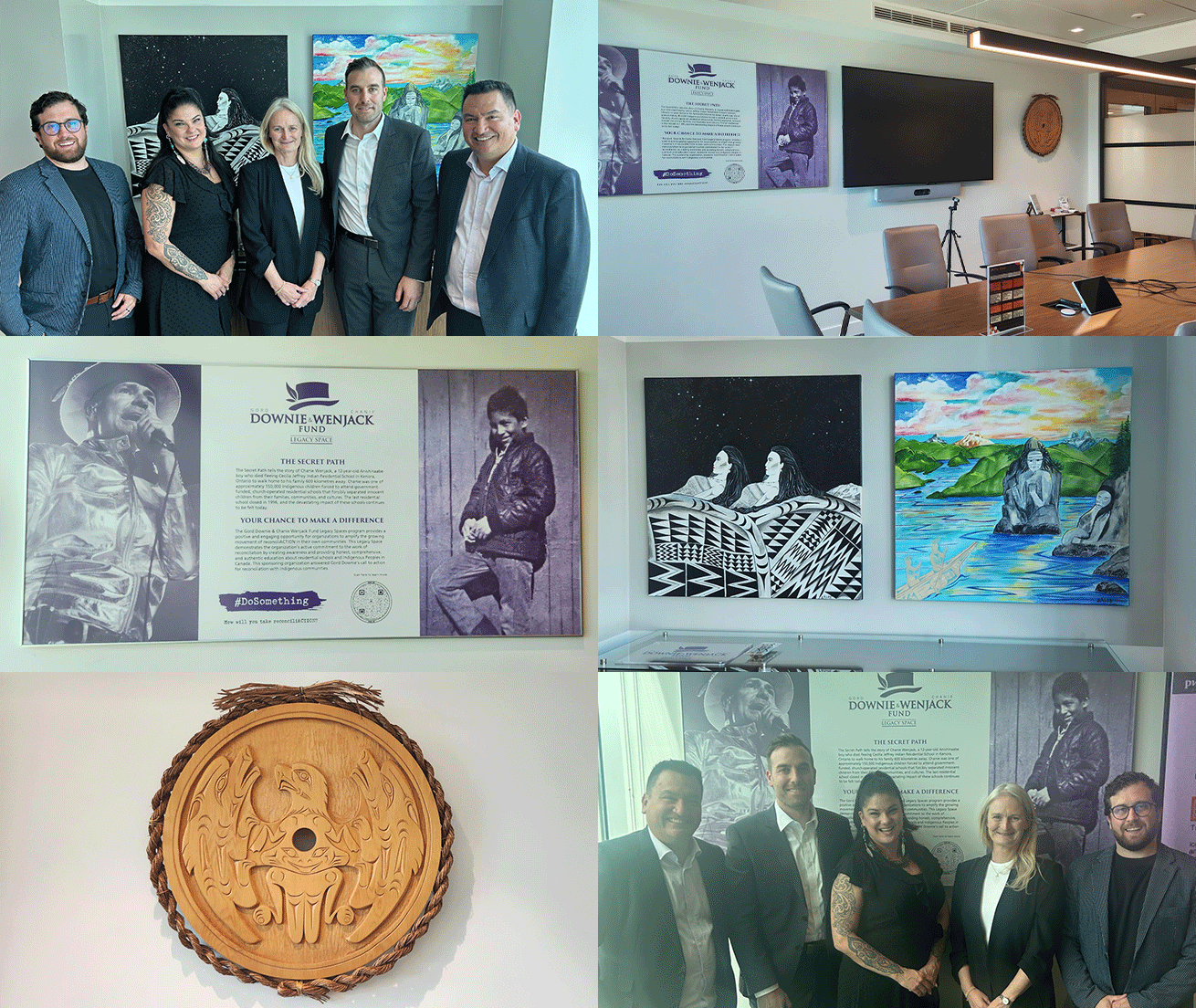
Gord Downie Chanie & Wenjack Fund Legacy Space
PwC Canada is demonstrating its support for the Gord Downie Chanie & Wenjack Fund (DWF) through a five-year commitment to their work and the creation of a Legacy Space within our Vancouver office.
Inspired by Chanie’s story and Gord’s call to build a better Canada, the DWF aims to build cultural understanding and create a path towards reconciliation between Indigenous and non-Indigenous Peoples. DWF’s work centres around improving the lives of Indigenous people by building awareness, education, and connections between all people.
Legacy Spaces are safe, welcoming places where conversations and education about Indigenous history—and our collective journey towards reconciliation—are encouraged and supported. They also serve as symbols and reminders of the important work each of us needs to undertake, particularly employers, to respond to the Truth and Reconciliation Commission’s 94 Calls to Action.
Land Acknowledgement guide
PwC Canada developed and introduced a land acknowledgement guide to help our partners and staff craft authentic and meaningful land acknowledgements. This helps our staff appreciate Indigenous protocols and express gratitude for the land we occupy.
Delivering a land acknowledgement provides individuals the chance to investigate the history of the land they live and work on, as well as learn about the Indigenous Peoples who have been its caretakers since time immemorial.
PAIR Committed
PwC Canada has achieved Partnership Accreditation in Indigenous Relations (PAIR) Committed status with the Canadian Council for Indigenous Business.
PwC Canada has shown its commitment to advancing Indigenous economic development, fostering Indigenous employment, and learning about Indigenous cultures and traditions by achieving PAIR Committed status. Companies that join PAIR indicate to communities that they’re reliable business partners, excellent employers, and supportive of Indigenous communities’ prosperity. Committed companies have their performance verified by an external party.
PwC Canada’s PAIR Committed status shows our dedication to improving our relations with Indigenous Peoples.