









Understand your organisation’s greenhouse gas (GHG) emissions across the entire value chain, so you can strategically manage risks and seize opportunities
Climate change and carbon management

Why is carbon management important?
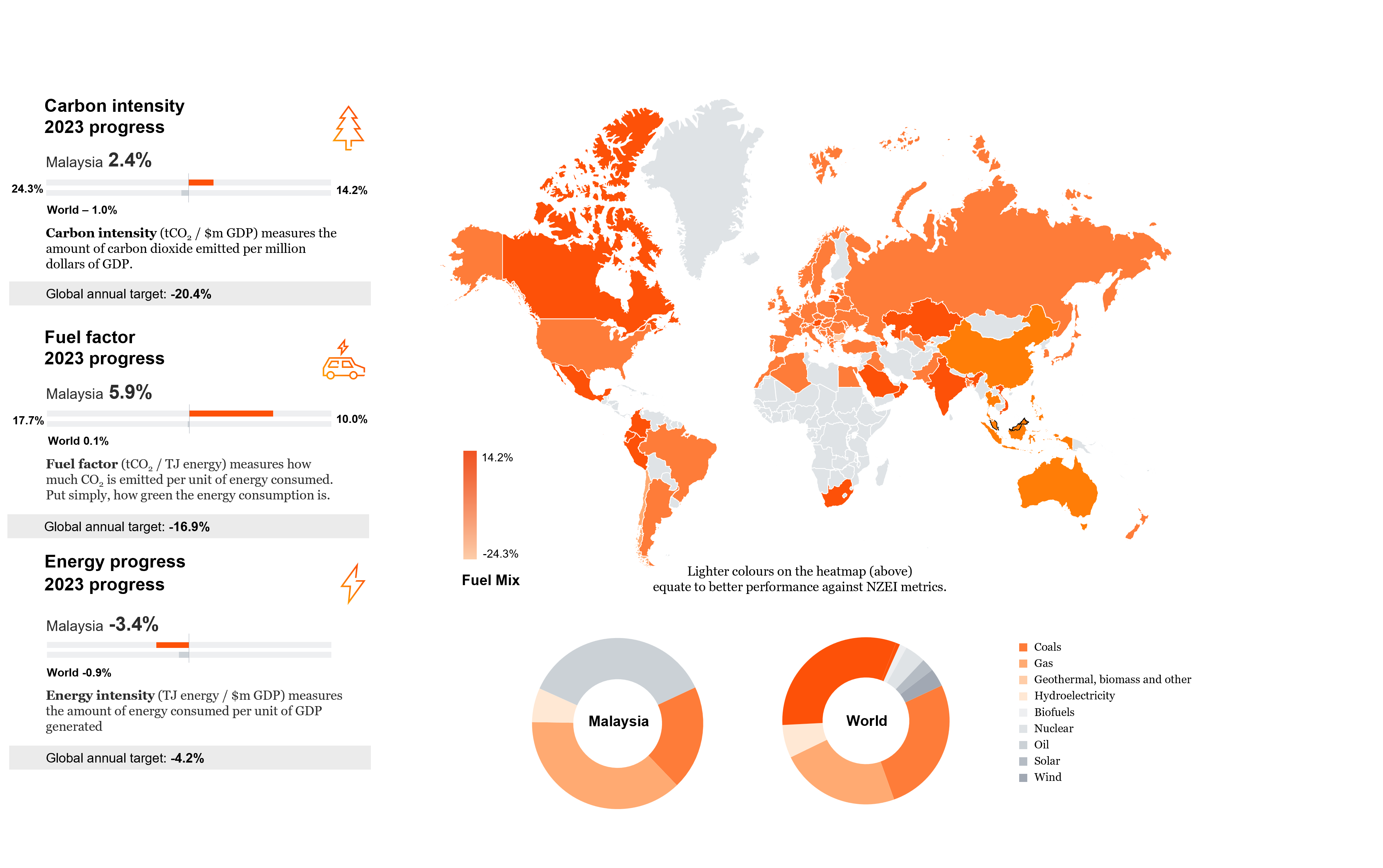
PwC’s Net Zero Economy Index 2024 reveals that global decarbonisation efforts have stagnated to its lowest level in over a decade, with a mere 1.02% reduction in carbon intensity in 2023. Malaysia, on the other hand, has seen an increase of 2.4% in carbon intensity. This suggests an ever-widening gap between climate ambition and action—and the window for action is closing.
Here’s how we can help



- Establish and review your organisation’s GHG emissions baseline
- Develop an emissions calculation approach aligned with selected international standards, such as the GHG Protocol
- Recommend data collection and proxy methodologies for reliable representation of emissions and ongoing maintenance
- Review or establish internal carbon pricing mechanism
- Set science-based targets to guide strategic decision-making and as interim checkpoints
- Identify appropriate pathways to achieve net zero emissions
- Facilitate a just transition to net zero
- Develop a net zero roadmap and a five-year implementation plan that outlines immediate actions to achieve net zero goals
- Enhance and transform key enablers such as governance structure, policies and key performance indicators to embed the operationalisation of net zero across the organisation
- Integrate climate and net zero considerations within core corporate functions to support the business transformation
- Facilitate capability building to build general awareness and topical knowledge to support implementation
- Provide support in submitting commitments and targets to the Science Based Targets initiative (SBTi)
- Support the development of carbon offset projects as part of offsetting strategy or carbon credits generation for companies in pursuit of their net zero or carbon neutrality objectives
Conduct gap analysis against the recommendations of the Task Force on Climate-Related Financial Disclosures (TCFD)
- Identify relevant climate risks and opportunities
Conduct material assessments against identified climate risks and opportunities
Conduct scenario analysis to assess the impacts of transition and physical risks
Integrate climate risks and opportunities into existing enterprise risk management frameworks
Explore related case studies
- Private healthcare provider
- Government sustainable fund
- Leading global integrated palm oil player
- Malaysian state government
- Malaysian investment holding company
- Global palm oil and agribusiness company
Private healthcare provider
Challenge: The client wanted to review and assess their GHG emissions inventory with the objective of enhancing the accuracy and effectiveness of tracking, monitoring and managing Scope 1, Scope 2 and Scope 3 emissions data across their operations.
Solution: We conducted a comprehensive evaluation of the client’s GHG emissions inventory, including identifying and defining both operational and organisational boundaries. To streamline and enhance the data collection process, we developed a GHG data collection template and a Group GHG Accounting Manual. e also conducted a targeted training session for the data owners, equipping them with the necessary knowledge to effectively utilise these tools. The training emphasised the role of data collection in advancing the client’s overall sustainability agenda.
Results: The client’s GHG baseline inventory is now aligned with the requirements set forth by the GHG Protocol. This alignment has facilitated the establishment of a standardised methodology for GHG accounting, allowing for consistent tracking and monitoring of GHG emissions.
Government sustainable fund
Challenge: The state wanted to transition into a low-carbon economy by developing a Green Economy Policy and Carbon Trading Strategy framework.
Solution: We identified priority areas for the state’s green economy by analysing the existing policy framework and international case studies on crafting green growth policies for a low-carbon economy. Additionally, we developed a carbon trading scheme, which included an evaluation of current regulations surrounding carbon emissions and the necessary documentation to facilitate the implementation of carbon trading projects. We also identified key strategic policies and green growth initiatives for the state to foster a greener economy.
Results: A committee was established to oversee the implementation of the selected green growth initiatives, alongside various carbon credit-generating projects. This created new potential revenue streams for the state and further supported the implementation of green growth initiatives.
Leading global integrated palm oil player
Challenge: As part of their net zero journey, the client’s management sought to formalise their decarbonisation commitments and identify potential nature-based solutions (NbS) that would act as levers in their endeavour. Concurrently, the client was preparing for compliance with the European Sustainability Reporting Standards, in line with the requirements under the Corporate Sustainability Reporting Directive (CSRD). To support these efforts, the client sought to evaluate and enhance their GHG emissions reduction strategies through detailed analysis and strategic planning, with NbS integrated as key components of their decarbonisation strategy.
Solution: We carried out a GHG baseline and inventory gap analysis by examining Scope 1, Scope 2 and Scope 3 emissions in accordance with the ISO 14064 standard and the GHG Protocol’s Land Sector and Removal Guidance. We prepared a report outlining key findings and recommendations, while also enhancing the client’s carbon calculator to ensure compliance with the ESRS E1 standard. Additionally, we evaluated the client’s emissions reduction pathways and targets, exploring various mechanisms for emissions reduction and co-led a validation workshop with the Steering Committee to gather feedback and input. We also developed a strategic response plan that aligns with the Science-Based Targets initiative (SBTi). For NbS, we scoped activities following relevant guidelines and performed an initial assessment to identify potential climate solutions within the client’s landbank.
Malaysian state government
Challenge: To support the state’s ambition to achieve net zero by 2050, it sought to develop a comprehensive strategy focused on net zero objectives and the operationalisation of carbon markets.
Solution: We established a GHG emissions baseline and inventory aligned with the Intergovernmental Panel on Climate Change (IPCC)’s standards. This was accompanied by an operational manual and supporting Measurement, Reporting and Verification (MRV) mechanisms to enable continuous monitoring and timely updates of the state’s GHG inventory.
Once the GHG emissions baseline and inventory are established, we identified potential decarbonisation pathways, including setting emissions reduction targets and action plans across key economic sectors such as energy, transportation, industrial, agriculture and forestry. Furthermore, we developed a mechanism—accompanied by robust guidelines—to enable the crediting, trading and retirement of carbon credits domestically. We also developed a strategic roadmap for the state’s participation in Article 6 of the Paris Agreement, laying the groundwork for the international trading of carbon credits.
Malaysian investment holding company
Challenge: The client’s ambition was to achieve net zero across their operations and the regions in which they operate, and needed to develop a net zero strategy and roadmap.
Solution: We began by assessing the client’s existing GHG emissions data and net zero commitments, taking into account both national and state-level obligations, peer targets and the methodologies outlined by the SBTi and the Science Based Targets Network (SBTN). This analysis enabled us to set interim targets across the client’s operations and service areas.
We then developed net zero pathways that encompass five focus areas: energy, circularity, built environment, mobility and biodiversity. Additionally, we identified accompanying flagship initiatives to deliver significant impact and support the client’s net zero journey. Lastly, we crafted a net zero roadmap that extends to 2030 (mid-term) and 2050 (long-term), serving as a guide for the client’s decarbonisation journey.
Global palm oil and agribusiness company
Challenge: The client engaged us to conduct a climate risks and opportunities (CRO) assessment, using scenario analysis to determine the potential climate-induced financial impacts on their business, both qualitatively and quantitatively. The assessment required the inclusion of a methodology, framework and tool to ensure alignment with CRO reporting requirements under the IFRS S2, formerly TCFD.
Solution: We performed a refresh of the client’s existing CRO through a completeness and materiality assessment. In doing so, we identified potential CROs that had not been captured previously by assessing relevant global frameworks, national priorities based on the clients’ countries of operation and insights from industry peers.
Following the assessment, we developed impact pathways to understand the potential financial impacts of the identified CROs on the client’s business units and critical assets. We then developed a Climate Risk Assessment Tool that utilised climate scenarios from the IPCC and NGFS to run scenario analysis to model financial impacts on the client’s assets.
To facilitate capacity building and learning, we conducted engagement sessions with end-users to facilitate knowledge transfer on how to operationalise the tool and considerations for any necessary future adjustments.