









Manufacturing does not need another system of record. It needs a connected operating platform.
The question every manufacturing board should be asking is not “does our ERP still work?” It is “can our ERP connect the decisions that now run the business?”
Most manufacturers are not held back because their ERP has stopped working. Orders are still captured. Materials are still issued. Production is still running. Inventory is still counted. The ledger is still closed. By every operational measure, the machine works.
The problem is more subtle. The system records the business, but it does not always connect the business. A production delay appears in one place. A material shortage appears in another. A supplier risk sits inside procurement. The margin impact only becomes visible once finance has reconciled the numbers. A quality issue is captured, but it is not always linked quickly enough to production, inventory, customer orders, and cost. By the time leadership sees the full picture, the decision window has often narrowed.
For manufacturers, that is the real modernisation question. Not whether the current system can process transactions, but whether it can support the operating model the business now needs.

Manufacturing has become a connected decision environment
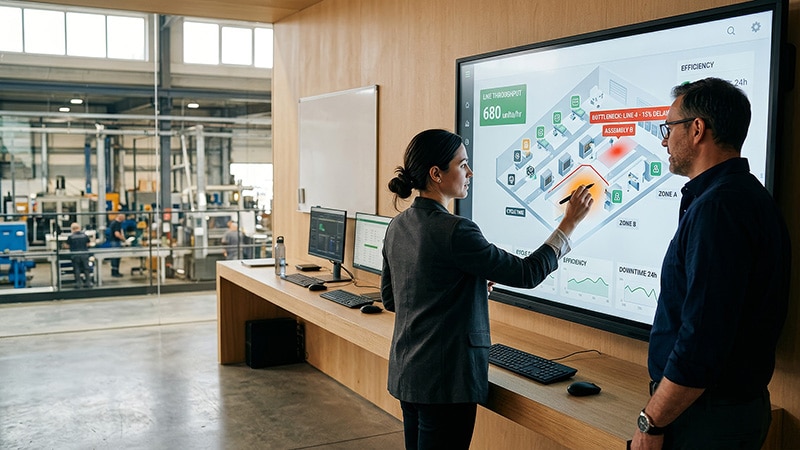
Modern manufacturing is no longer a linear chain of plan, buy, make, and sell. It is a connected decision environment. A change in demand affects production scheduling. A supplier delay changes material availability. A quality issue changes inventory status, customer commitments, and working capital. A cost movement changes product profitability. A maintenance issue affects throughput, delivery promises, and margin.
This is where many traditional ERP environments struggle. They may be reliable systems of record, but a large number were not designed to give manufacturers a single operating view across planning, procurement, production, inventory, costing, quality, maintenance, and fulfilment.
That is why ERP modernisation in manufacturing should not be framed as a technology refresh. It should be framed as an operating model decision.
Why Oracle Fusion Cloud is a strong fit for manufacturers
Oracle Fusion Cloud Manufacturing is part of Oracle Fusion Cloud Supply Chain and Manufacturing, a suite that spans product lifecycle management, supply chain planning, procurement, supply chain execution, order management, and logistics. For manufacturers, this matters because the value is not in any single module. The value is in how the modules work together.
A manufacturer needs product and engineering data to flow into planning. Planning needs to connect to procurement and material availability. Procurement needs to connect to supplier performance and cost. Production needs accurate work definitions, work orders, resources, and schedules. Quality needs to sit inside the production lifecycle, not outside it. Finance needs costing and margin visibility that reflects what is actually happening on the shop floor.
Oracle Fusion Cloud Manufacturing delivers core discrete and process manufacturing capabilities in the cloud, allowing manufacturers to set up, manage, execute, and cost production operations. It supports in house manufacturing of standard products, configured products for discrete manufacturing, contract manufacturing, outsourced work order operations, project specific execution, and mixed mode manufacturing that runs discrete and process production in the same plant.
The point is simple. Oracle Fusion is not a finance backbone with manufacturing bolted on beside it. It is a platform that can connect the operational and financial realities of manufacturing on a single foundation.
The modules that matter most
For a manufacturing leadership team, the conversation should begin with business capability, not software terminology. These are the areas where Oracle Fusion Cloud is most relevant.
Together, these capabilities change the ERP conversation. The question becomes less “which system records the transaction?” and more “which platform connects the decision?”
Where intelligence fits, without becoming the whole story
Embedded intelligence deserves a place in this conversation, but as an enabler of the platform rather than the headline. Oracle positions built in AI and agentic applications inside Oracle Fusion Cloud Supply Chain and Manufacturing to support planning, production and delivery, assisting with areas such as planning exceptions, inventory shortages, work order management, logistics diagnostics, summaries, and recommendations within governed business processes.
That is useful, but it is not the foundation. Intelligence is most valuable when it is embedded inside the manufacturing processes where decisions are already being made. Without connected data across planning, production, inventory, quality, procurement, and finance, any layer of analytics simply sits above fragmented processes.
In other words, the advantage is not that the platform has AI. The advantage is that it can bring intelligence into a genuinely connected manufacturing operating model.

A short test for the leadership team
Can your leadership team answer these questions without exporting data from several systems or reconciling spreadsheets by hand?
| Which production lines are most exposed to material shortages this month? | Which products are under margin pressure once actual production costs are considered? |
| Which suppliers present the greatest risk to production continuity? | Where is working capital trapped in slow moving or excess inventory? |
| Which quality issues are affecting production efficiency, fulfilment, or customer commitments? | Can finance, procurement, production and supply chain teams all see the same operational picture? |
If the answer is no one, the issue may not be that the ERP has failed. It may be that the ERP environment has not kept pace with the way manufacturing decisions are now made. That gap costs margin, working capital and speed today, not in some future scenario.
How can we help?
At PwC Digital Services, we approach ERP modernisation as a business transformation, not simply a system implementation. We begin by assessing digital maturity, scoping existing processes and, where needed, re engineering those processes ahead of ERP implementation. After go live, we provide support and application evolution services that continue to enable better planning, greater visibility and more informed decision making across the enterprise.
For manufacturers, that means helping leadership teams see where operational complexity, fragmented data, manual workarounds and disconnected processes are quietly limiting performance, and then shaping an ERP roadmap that connects finance, procurement, planning, production, inventory, quality and supply chain execution around the decisions that matter most.
Beyond these core ERP capabilities, our wider portfolio of digital services complements this approach, spanning cybersecurity, data and AI solutions, bespoke software development, IT managed services, cloud and infrastructure. Oracle Fusion Cloud can be a central part of that journey because it brings together the enterprise and manufacturing capabilities required to run a more connected, visible and responsive manufacturing business.
The manufacturers who pull ahead this decade will not simply be the ones that replace an old ERP. They will be the ones that use modernisation to redesign how the business plans, makes, costs, controls, and delivers.
Stay up to date with our latest
thought leadership
Contact us