









This blog was originally published on 4 August 2023 and has been updated as at April 2026 to reflect recent developments. The content and people information presented are current as at the time of publication.
More of us are working remotely, thanks to the rise of technology and flexible jobs. That means you might earn money from your home country—or anywhere in the world. It's a trend that’s created more high net worth individuals who can earn income globally while staying at home.
Every country taxes foreign-sourced income differently. Let’s get clear on the key questions you need to ask, so you can treat each income source properly for tax. We’re here to help you get it right.

1. I heard that my income from overseas is now taxable in Malaysia. Is this true?
Up till 1 January 2022, we did not have to worry about foreign-sourced income (“FSI”) when it comes to filing our tax returns. However, since 1 January 2022, the blanket exemption on FSI has been removed. Consequently, FSI received in Malaysia by a tax resident from outside Malaysia is now taxable in Malaysia, unless the specific conditions for exemptions are met.
This move by the government of Malaysia was also to meet international best practices Malaysia had committed to adhere to by 31 December 2022.
In response to the feedback received after the initial announcement, an exemption was granted for the following income received in Malaysia from 1 January 2022 to 31 December 2036, subject to conditions:
- Foreign-sourced income (all classes of income except for income received from a partnership business in Malaysia)
- Foreign-sourced dividend income received through a partnership business in Malaysia
2. Are there any conditions for resident individuals to qualify for the FSI exemption?
Qualifying FSI is exempt from tax provided the income has been subjected to tax in the country of origin. FSI received from individuals is regarded as having been subject to tax in the country of origin if:
(a) Income tax or withholding tax on the FSI has been paid or is payable; or
(b) Tax is not imposed in the country of origin because of:
(i) The taxation system of the origin country
(ii) The FSI of the individual falling below the taxable threshold in the country of origin
(iii) Income that is given an exemption through a tax incentive
(iv) In the case of foreign dividend income, it has been subject to underlying tax
(v) Foreign dividend income that is paid from underlying profits arising from operating profits, which have not been subjected to tax due to:
● Unabsorbed losses or capital allowances
● Profit arising from capital gains
● Tax incentives that are in compliance with the country’s substance requirements; or
● Tax rules under a tax consolidation regime
3. Any dividends I receive should be from the profits of an entity. Does this mean that the dividend income I have received has been subject to an underlying tax in the foreign country?
Unfortunately, this is not a straightforward issue.
Based on clarifications with the Malaysian Inland Revenue Board, the foreign dividend must be subject to withholding tax or an underlying tax at the company that is paying the dividend. If no tax is paid at the level of the dividend paying company, the FSI exemption may not be applicable.
Please refer to the illustration below:
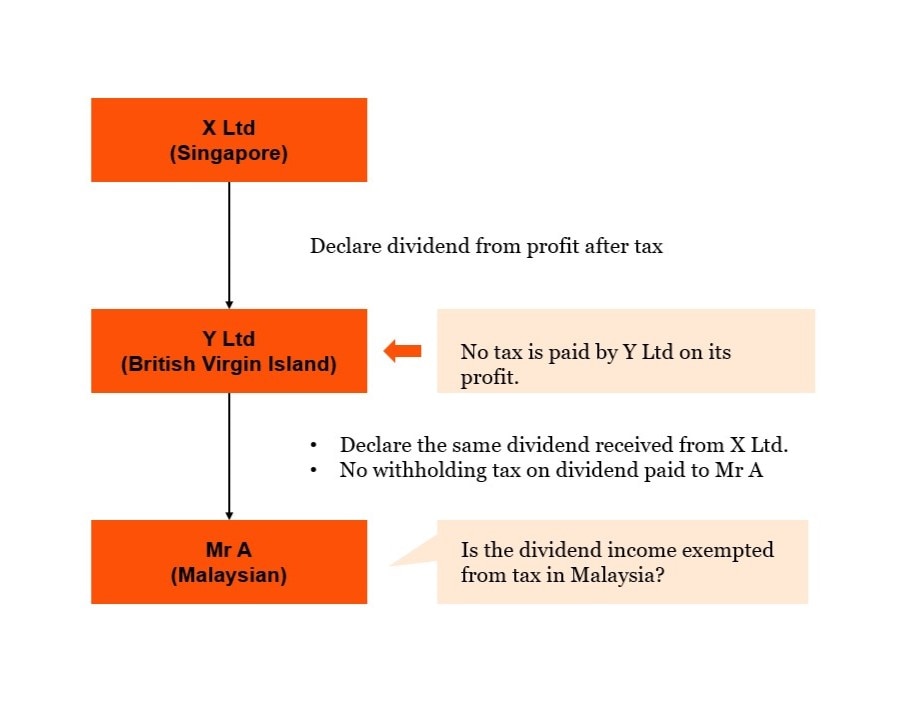
Based on the scenario above, dividend income received by Mr A could be taxable if received in Malaysia unless the individual is able to demonstrate (with evidentiary support) that no underlying tax has been paid by Y Ltd due to any one of the reasons as stated in item Question 2(b)(v) above.
In this regard, it will be challenging for individuals receiving foreign dividend income to ascertain whether or not the income has been duly subject to underlying tax. Given that Malaysia has a Self Assessment system, the onus would be on the taxpayer to prove this. As such, it is advisable that detailed reviews are carried out in determining whether or not the FSI exemption is applicable.
4. My FSI is exempted. Do I still need to declare it in my tax return?
Yes. Although the FSI received in Malaysia is exempted until 31 December 2036, the resident individual must still make a declaration in their Malaysian income tax return that the relevant FSI received in Malaysia qualifies for exemption, and retain the required relevant supporting documentation to prove this. You may have noticed that a new disclosure section on FSI has been included in the return forms starting from YA 2022.
5. I did not remit FSI into Malaysia. Does this count as income received in Malaysia?
Presently, the tax authority has clarified that only income that is brought into Malaysia via cash or electronic funds transfer is considered as remitted income. If the income derived is kept overseas, this would not be considered as income received in Malaysia.
6. I work remotely for an overseas company while physically in Malaysia and my income is already subject to tax overseas. Is this considered an FSI?
Assuming you are exercising employment, as you carry out your duties physically in Malaysia, such employment income would be deemed derived from Malaysia, regardless of whether your employer is a Malaysian resident or where the salary is paid or received. The income in relation to the period during which the employment is exercised in Malaysia would not be regarded as FSI and would be subject to tax in Malaysia based on the duration of the employment exercised in Malaysia. Although there are exemptions for short term employment under the domestic law as well as the tax treaty reliefs, these exemptions are not automatically given. A claim has to be made when the Income Tax Return Form is submitted and the individual is required to keep sufficient documents to support the position taken.
Assuming that yours is not an employment situation, and that you are a freelancer providing services to overseas clients while physically residing in Malaysia, this would likely be regarded as business income derived from Malaysia if the work is predominantly carried out in Malaysia.
Do note that remote working arrangements, be it for overseas employers or as a freelancer with overseas clients, will create issues around personal tax. In a situation where the same employment/business income is subject to tax in both countries, further consideration is required on the claim of tax relief in the form of unilateral or bilateral tax credit on the foreign tax suffered.
Given the complex tax issues arising from remote working arrangements, careful prior planning will help to ensure you are compliant with the stringent tax requirements in Malaysia.
Do reach out to us if you have any questions or concerns in making the correct declarations in your income tax returns for income from foreign sources that you are contemplating bringing into Malaysia.