









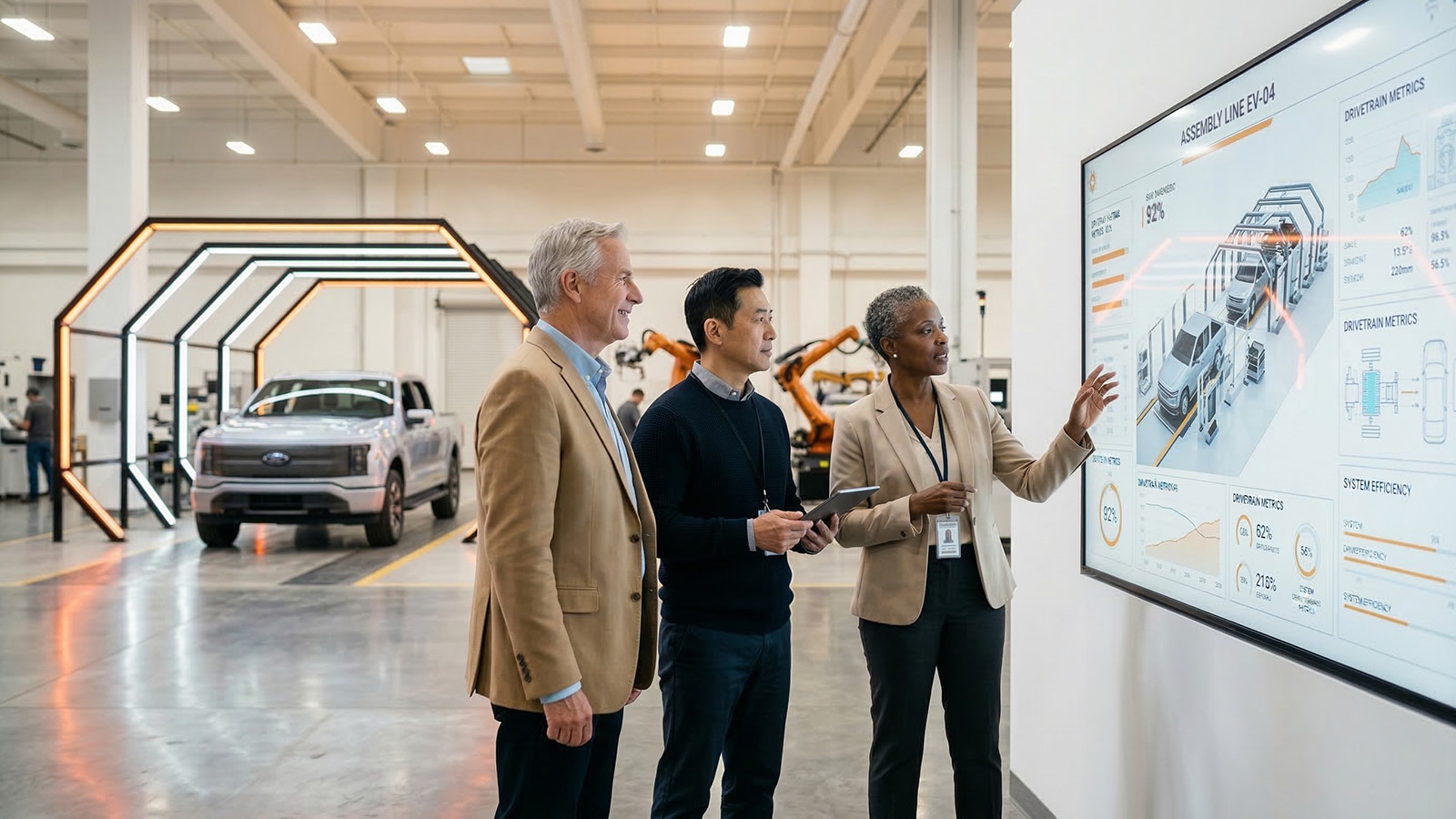
Realising value from AI is much like this. Many organisations have no shortage of “AI buildings” —pilots, proofs of concept, clever tools—but without a clear plan linking AI to growth, reinvention, and decision-making, the portfolio stays impressive but doesn’t translate to results. Encouragingly, the conversation on AI is shifting beyond isolated experiments and pilot projects to enterprise-wide impact. Yet for many organisations, enthusiasm has not translated into sustained performance.
That disconnect often comes down to who is really leading the agenda. AI succeeds when it’s led by the business—and fails when it’s led by technology alone.
Without a clear purpose anchored to strategic outcomes, responsibility for growth becomes unclear. Different teams go after different goals, performance is measured inconsistently, and AI becomes an efficiency add-on with limited strategic impact.
Rome wasn’t built in a day, so act early to take control of your AI performance and achieve results. Let’s not wait for disengagement and fatigue to set in.
The AI fitness gap among businesses needs to be addressed critically, as revealed in PwC’s AI performance study, a benchmark of 1,217 companies globally. Organisations need to recognise the difference in how AI leaders focus, structure, and scale their efforts—only 20% of organisations are capturing 74% of all AI-driven returns currently. What does it take to change this narrative?
A question of fitness
Real value from AI comes not from simply adopting tools, but from working with AI as a co‑creator of value—embedding it into decisions, workflows, and growth strategies. It’s about looking at AI as a true collaborator, beyond just an assistant.
Establishing the right foundations matter: linking AI investment directly to measurable business outcomes, ensuring that data is accessible and reliable so that it can be scaled and monetised to achieve revenue growth, reduce costs, and mitigate risks, in line with Malaysia’s AI Nation 2030 agenda.
Our findings show that AI leaders are decisive in three areas. They aim AI at reinvention and growth, build targeted AI foundations, and scale proven AI practices across the enterprise. This is ‘AI fitness’ at its core.
Critically, AI is only as powerful as the intent and values guiding its use. It’s a steep learning curve for business leaders. We’ve never had to lead a workforce that is no longer fully human. New leadership capabilities are taking centre stage, hinging on responsibility, ethics, and trust for AI to deliver lasting impact, beyond aspirations and vanity metrics.
Trust is the real test of AI scale
As AI becomes more autonomous, trust increasingly determines how far—and how safely—it can scale. Without proper safeguards, the risks of errors and vulnerabilities will outweigh the new opportunities created by agentic AI.
Trust must be deliberately built into strategies, tested rigorously, and reinforced through governance for AI's benefits to reach organisations, industries, and societies equitably. Malaysia’s MY-AI Standards, grounded in a trust‑by‑design approach, signal a clear national commitment to advancing secure and responsible AI standards, while addressing the need for ASEAN interoperability.
Enabled by trust, AI moves beyond internal optimisation to unlock value across industries and the wider economy.
Touching everyday lives through AI
Indeed, the full impact of AI is only realised when it's embedded into how people live, work, and contribute to the economy, much like cities thrive when infrastructure connects people, services, and sectors. This ambition is reflected in Malaysia’s push to drive value across key, interconnected sectors through the National AI Roadmap 2021–2025 and the AI Technology Action Plan 2026–2030.
Similar momentum is building across other ASEAN economies. From Singapore’s Smart Nation journey to Philippines’ National AI Centre for Research and Innovation, AI is being used to drive synergies across industries and government agencies.
Within the financial ecosystem, AI is already delivering tangible results: from real time fraud detection that strengthens trust, to more inclusive underwriting and credit scoring decisions, tailored to unserved and underserved communities. It’s also transforming contact centre operations through agentic AI systems that can adapt and orchestrate decisions across complex financial processes, helping to bridge access gaps.
With 22 sectors (or 697,000 workers) in Malaysia, expected to be significantly affected by AI, digitalisation, and the green economy over the next three to five years according to TalentCorp, the case is clear: elevate AI beyond organisational fringes to drive economy-wide impact.
Innovate boldly: Go broad or go deep
To move ahead, organisations must be deliberate about where to focus. AI leaders are twice as likely to have AI scaled or embedded across major parts of the value chain, elevating the role of strong leadership for enterprise-wide impact. This is in step with Malaysia’s 2026 investments, such as the Sovereign AI Cloud which focuses on moving AI from pilots to shared, scalable infrastructure, reinforcing regional AI priorities. Ultimately, our nation’s innovation trajectory is anchored on producing more creators beyond consumers of AI.
This must be reflected at the organisation level, with C-suites leading the charge:
At the national level, Malaysia’s Global AI Village (GAIV) demonstrates how this shift to co-creation can be amplified, through collaboration with ecosystem partners such as the National AI Office (NAIO).
Empower your people
Giving employees access to AI tools is not the hard part. The real work lies in building the skills, confidence, and judgement people need, to use AI meaningfully in their roles. Only 42% of Asia Pacific employees trust AI-generated insights enough to act on them, compared with 60% of AI leaders.
The narrative needs to change in the following ways:
When trust, capability, and leadership behaviour move together, AI shifts from a learning exercise to a powerful source of competitive advantage for organisations.
AI that’s built to last
Like well-planned cities, AI that delivers lasting value is built on fitness, not iconic projects. Organisations that align ambition with strong foundations, trust, and leadership, are the ones that turn AI into sustained performance.
National AI ambitions, standards, and shared infrastructure can accelerate this journey. But for business leaders, success can only be realised when they move from siloed, tentative steps to holistic measures: diagnosing their AI fitness, closing critical capability gaps, and scaling what works with discipline and trust. Ultimately, AI fitness is the real differentiator—leadership is what builds it.
What are the differentiating factors of AI fitness?
Our global research identified nine key factors that determine a company’s AI fitness—essentially, how ready and able it is to turn AI investments into real results.
Six of these are foundational capabilities that make AI reliable and scalable—from having a clear AI strategy and sufficient investment, to the right data and technology, talent, governance, and innovation culture.
The other three reflect how AI is used across the business (how broadly and deeply AI is embedded, the sophistication of its applications, and whether it’s capturing new value through industry convergence). Together, these factors paint a holistic picture of AI readiness and where top AI performers excel.
Benchmark your AI fitness
Take our five-minute AI Fitness quiz to identify how your organisation stacks up against industry peers and AI leaders. Get a quick baseline of your strengths and gaps—a starting point to plan the next steps of your AI journey.
Read our global report
Find out what AI leaders are doing differently to achieve growth.
Our AI focus areas
Explore how we can work with you to realise value from your AI investments.


Contact us