






On 17 November 2026, PwC Mauritius welcomed more than 170 guests to its Asset & Wealth Management and Banking Conference 2026 at Hennessy Park Hotel, Ebène. Held under the theme “Ahead of the curve: Insights into industry evolution”, the conference brought together speakers and panellists to explore two themes shaping the future of Mauritius as an International Financial Centre (IFC): Banking in the digital era and Mauritius as a platform for investment into Africa.
1 Welcome address by Anthony Leung Shing
Opening the conference, Anthony Leung Shing, Deputy Regional Senior Partner of PwC Africa East Market Area & Country Senior Partner of PwC Mauritius, reflected on the priorities identified at the first edition of PwC’s Asset & Wealth Management conference three years ago, including developing and attracting specialist talent and broadening the services delivered from Mauritius. While acknowledging the progress made, he said Mauritius had not moved as far or as fast as hoped, and stressed the need to move further up the value chain by creating more opportunities for Mauritians to participate in decisions around capital flows:
"For PwC, this is what value creation means: having Mauritians originate deals, review risk and make decisions about capital flows. It is about giving the next generation of Mauritians the opportunity to have a seat at that table and to build international careers out of Mauritius. We cannot change what is happening to the world, but what we can change is how we respond as Mauritius. A good place to start is by looking at how investors view Mauritius and their experience. Clear requirements, timely decisions and less duplication are the basics, but they make a lot of difference for the investor. Getting these basics right often depends on how the private and public sectors work together."

2 Speech by The Hon. Mr Dhaneshwar Damry, Junior Minister of Finance
The Hon. Mr Dhaneshwar Damry, Junior Minister of Finance, in his speech outlined the Government's ambition to strengthen Mauritius' position as an International Financial Centre (IFC) and facilitate investment into Africa, emphasising the importance of Government and private-sector collaboration:
"Our new story is to make Mauritius a de-risking centre for capital into the continent of Africa, whether it's financial capital, technology capital or human capital, to touch the lives of not only 1.4 million people, but 1.4 billion people. We can create the environment and the ecosystem, but it is the business leaders who make business happen. Our job as Government is to create an enabling environment, open the country and make investors feel welcome. One of the things that the Ministry of Finance has done is to set up a tax committee that will work in consultation with every stakeholder in the country and hopefully in 2027, we'll have legal certainty and clarity on the tax system."

3 Speech by Dr. The Hon. Mrs Jyoti Jeetun, Minister of Financial Services and Economic Planning
Dr. The Hon. Mrs Jyoti Jeetun, Minister of Financial Services and Economic Planning, highlighted Africa's growing investment opportunities and the need for Mauritius to strengthen its role in supporting the continent's financial development:
"Our future cannot depend exclusively on the establishment of more structures or the volume of transactions processed through our jurisdiction. We must move up the value chain. This means developing deeper expertise in asset and wealth management, fund structuring, investment advisory, risk management, insurance, reinsurance, financial technology, and specialised professional services. We must also attract talent. Develop local capabilities and create opportunities for our young professionals to participate in increasingly sophisticated areas of international finance. Government has done a lot of work in the Strategy Report for the Financial Services Sector that we published last year. We are also continuing that work further in Vision 2050, where we see financial services industry as the largest sector of GDP contributing 29 percent of our GDP in the future."

4 Keynote Speech by Costa Natsas, Financial Services Leader, PwC Africa
In a keynote speech, Costa Natsas, Financial Services Leader at PwC Africa, explored how artificial intelligence, tokenisation and emerging forms of digital money are reshaping the industry. He highlighted the need for financial institutions to rethink their operating models, move beyond isolated technology applications and strengthen resilience as new opportunities and risks emerge:
“Money is becoming programmable. Tokenisation may change how everything works, how we settle and how we pay. But what does this mean for Mauritius? I think the country can become a settlement and interoperability gateway, using the infrastructure that it already has. It is a complicated puzzle and it requires all players to work together. Where does the risk sit? With the customer, the stablecoin provider or the platform? That is where we need certainty: legal certainty, tax certainty, and the private and public sectors working together.”

5 Panel discussion 1: Banking in the digital era
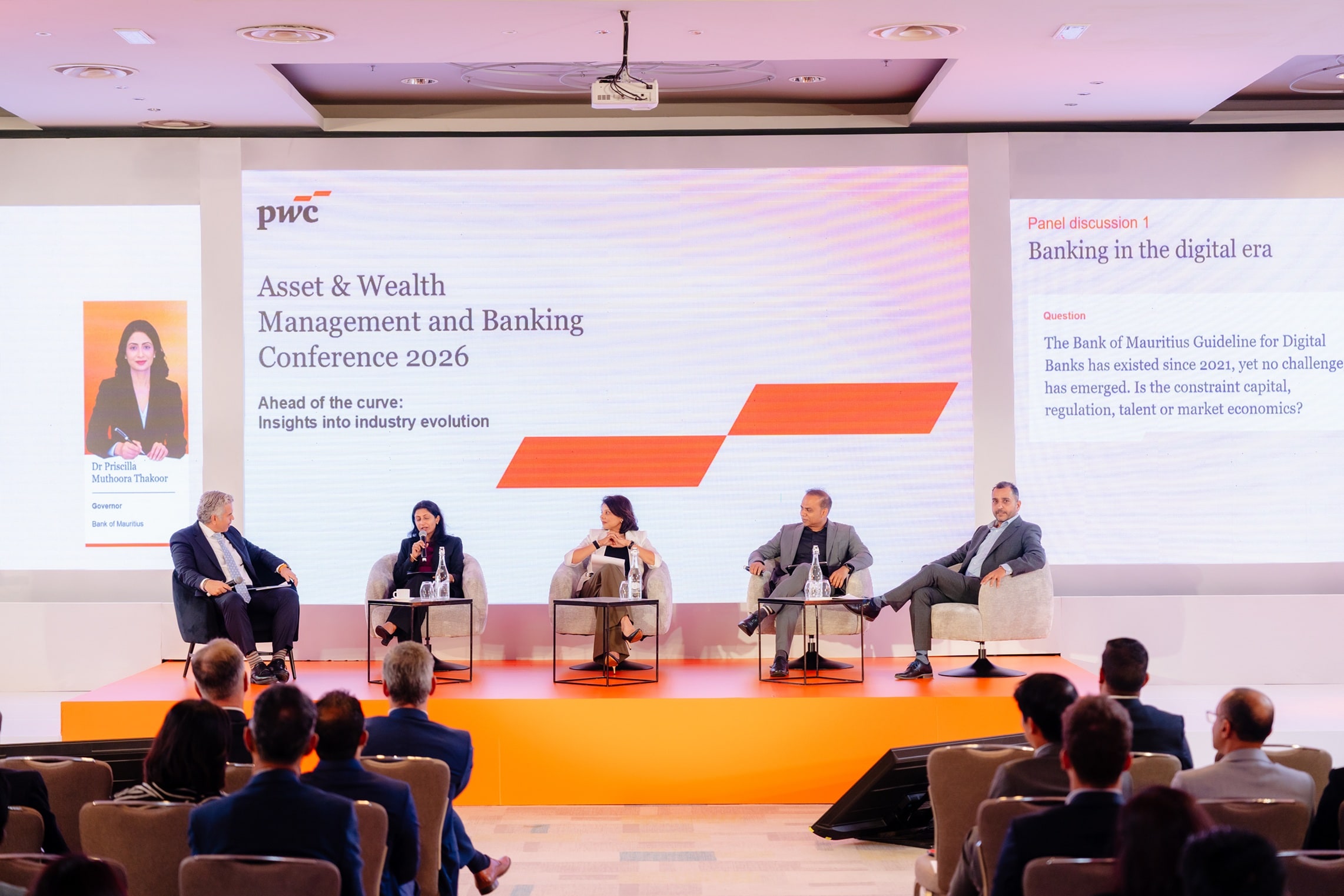
The first panel discussion, “Banking in the digital era”, was moderated by Costa Natsas and featured panellists Dr Priscilla Muthoora Thakoor, Governor of the Bank of Mauritius, Hajrah Sakauloo, Chief Executive Officer of HSBC Bank (Mauritius) Limited, Sandeep Mohapatra, Head of Digital Transformation & Technology at Absa Bank (Mauritius) Limited and Vikas Sharma, East Africa Advisory Leader and Africa Cyber Leader at PwC Africa. The panel examined how financial institutions can innovate without compromising trust, security and stability. Panellists considered the regulatory conditions needed for digital banking, including the balance between new services and effective oversight. They also highlighted the importance of customer confidence as banking becomes more digital.
A central concern was the experience of customers and investors dealing with multiple institutions. Panellists discussed repeated documentation requests, lengthy onboarding processes and fragmented interactions, pointing to opportunities for better connectivity, faster decisions and more efficient service delivery. These improvements, they noted, must be achieved without weakening due diligence or regulatory safeguards.
The practical application of AI was also explored. Rather than relying on technology adoption alone, banks need reliable data, redesigned workflows and people with the skills to use new systems effectively. Cybersecurity and operational resilience featured prominently, as digital services expand, institutions must meet growing expectations for convenience and personalisation while protecting the reliability of their operations. It is clear that the fast-paced adoption of AI is reshaping the risk landscape for the banking sector. While responsible and well-governed use of AI offers enormous opportunities, financial institutions must first put in place the safeguards to manage the risks it creates.

From left to right:
Moderator:
- Costa Natsas, Financial Services Leader, PwC Africa
Panellists:
- Dr Priscilla Muthoora Thakoor, Governor of the Bank of Mauritius
- Hajrah Sakauloo, Chief Executive Officer of HSBC Bank (Mauritius) Limited
- Sandeep Mohapatra, Head of Digital Transformation & Technology at Absa Bank (Mauritius) Limited
- Vikas Sharma, East Africa Advisory Leader and Africa Cyber Leader at PwC Africa
6 Keynote Speech by Nicolette Jacobs, Asset & Wealth Management Leader, PwC Africa
In the second half of the event, the focus shifted to the future of Asset and Wealth Management, as Nicolette Jacobs, Asset & Wealth Management Leader at PwC Africa, presented findings from PwC’s Global Asset and Wealth Management Sector Outlook 2026, involving asset managers and distributors. She highlighted how changing investor expectations, technological innovation and growing competition are challenging traditional business models, making strategic clarity and execution increasingly important for long-term competitiveness.
“Greater scale or assets under management are no longer a guarantee of success. What matters is strategic clarity and consistent alignment behind it. What differentiates high-potential performers is operational momentum, speed to market, innovation and the ability to reallocate capital away from products that no longer support their priorities. Execution capability cannot guarantee future viability on its own. Technology only gives you an edge when it changes how decisions get made and how work gets done. Competition doesn't just come from other asset and wealth managers anymore. It also comes from platforms, data providers and new entrants from outside the industry. To become future-fit, firms need both a clear strategy and the ability to deliver it.”
Nicolette Jacobs also outlined practical steps to improve firms' readiness for the future, including aligning capital, talent, products and partnerships with their chosen business models, investing in digital and analytical capabilities, and adapting to changing client needs.

7 Panel discussion 2: Mauritius as a platform for investment into Africa
The second panel, “Mauritius as a platform for investment into Africa”, was moderated by Nicolette Jacobs and brought together Rubina Toorawa, Country Head of Mauritius and Regional Head of India at Apex Group, Thierry Hebraud, Chief Executive Officer of The Mauritius Commercial Bank Ltd, Thomas Van Poucke, Executive Director at Sanlam Trustees International and Dheerend Puholoo, Tax Leader and Partner at PwC Mauritius. The discussion focused on what Mauritius must do to move beyond its traditional role in structuring cross-border investments. Panellists highlighted the need to attract fund managers, investment decision-makers and more substantive financial activity to Mauritius, enabling capital to be originated, managed and deployed through a stronger local ecosystem.
Certainty, capability and value creation emerged as key considerations for competitiveness, alongside predictable tax and regulatory treatment, responsive processes and a coherent investor experience across banks, management companies, advisers and other service providers. Developing specialist local talent, retaining professionals and making Mauritius an attractive base for international decision-makers were also highlighted as important to strengthening the local ecosystem.
The panel also considered how a stronger ecosystem could support Mauritius’ role in financing opportunities across Africa, including through closer collaboration between banks, asset managers, development finance institutions, insurers and professional advisers. Against growing competition from other International Financial Centres (IFCs), speakers emphasised that treaty access and a longstanding reputation are no longer sufficient on their own, highlighting the need for Mauritius to translate its positioning into better services, stronger capabilities and greater economic substance.

From left to right:
Moderator:
- Nicolette Jacobs, Asset & Wealth Management Leader, PwC Africa
Panellists:
- Rubina Toorawa, Country Head of Mauritius and Regional Head of India at Apex Group
- Thierry Hebraud, Chief Executive Officer of The Mauritius Commercial Bank Ltd
- Thomas Van Poucke, Executive Director at Sanlam Trustees International
- Dheerend Puholoo, Tax Leader and Partner at PwC Mauritius
8 Closing remarks by John Li
Closing the conference, John Li, Financial Services Leader at PwC Mauritius, reiterated the need to translate the industry's ambitions into tangible progress. While acknowledging Mauritius' established strengths as an International Financial Centre (IFC), he stressed that maintaining its competitiveness would require faster implementation and closer collaboration across the financial services ecosystem:
"The real question today is how quickly we turn our ambition into implementation. There needs to be urgent action. Our past success gave us credibility, but it doesn't guarantee our future relevance. The opportunity now for Mauritius is to move beyond just being viewed as a jurisdiction through which investment is structured. We need to move to a platform where investment into Africa will be originated, managed and supported. The next phase of Mauritius' development will not be achieved by just one policy, one institution or one technological solution. It can only be achieved through alignment and execution. Let's measure success by the outcomes that we will all deliver together."

He concluded by encouraging participants to build on the momentum generated by the conference and work collectively towards strengthening Mauritius' position as an International Financial Centre (IFC).
By bringing together policymakers, regulators and financial services leaders, PwC Mauritius' Asset & Wealth Management and Banking Conference 2026 provided a platform for meaningful discussions on the industry's evolving challenges and opportunities. By fostering dialogue between the Ministry of Finance, the Ministry of Financial Services and Economic Planning and key industry players, including banks and offshore management companies, PwC Mauritius seeks to build trust, encourage collaboration and connect different perspectives across the financial services ecosystem, helping translate shared ambitions into concrete action for the future of Mauritius as an International Financial Centre (IFC).
Contact us

Anthony Leung Shing, ACA, CTA
EMA Deputy Regional Senior Partner, Country Senior Partner, PwC Mauritius
Tel: +230 404 5071




Vikas Sharma
Africa Cyber Leader & Regional Consulting & Risk Services (C&RS) Leader, PwC Mauritius
Tel: +230 404 5015


