
Energy trading risk management: Meeting the challenges of Japan’s market transformation

  • 2025-08-20

In the previous article in this series, we examined the dynamic development of Japan’s electricity wholesale markets in recent years (link). The increased market depth and liquidity are creating a broad range of opportunities for market participants to adopt more sophisticated hedging strategies to manage price risks more effectively.

This article provides an overview of commonly used hedging strategies involving derivative instruments and outlines the corresponding risk management implications, including selected global best practices.

Hedging strategies using derivatives instruments

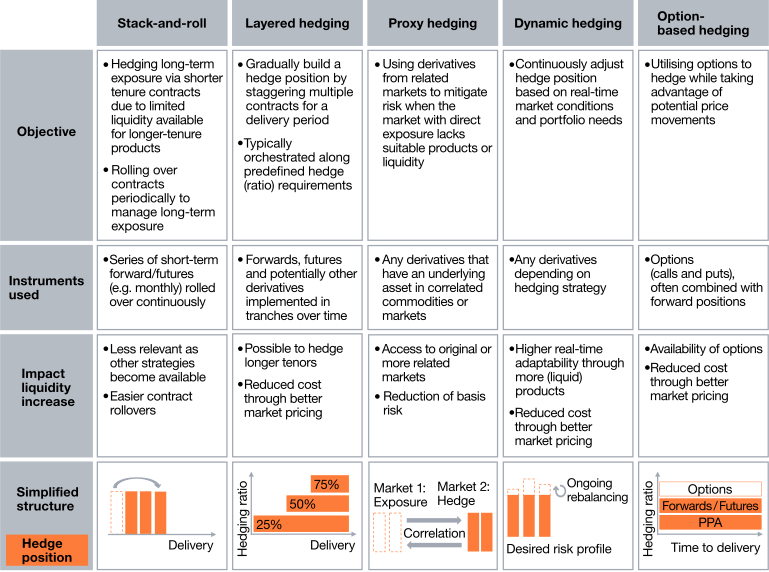
Expanded market liquidity enables participants to hedge future exposures more directly and facilitates the application of common hedging approaches. Please see Figure 1 for an overview of common applications and the impact of higher market liquidity.

Figure 1: Overview of common hedging strategies and the impact of higher market liquidity

  • Higher liquidity of longer-dated delivery periods reduces the reliance on traditional stack-and-roll strategies, where shorter-term instruments (e.g. monthly or quarterly futures) are used to cover long-term exposures and are gradually rolled over. While such strategies may still offer tactical benefits (e.g. price optimisation), they are no longer essential.
  • In parallel, improved liquidity facilitates layered hedging strategies, where participants incrementally hedge portions of future exposure according to a predefined schedule. For example, a retailer may hedge 25% of anticipated demand two years ahead, 50% one year ahead and the remaining 25% in the prompt year, effectively smoothing the hedge entry and reducing timing risk.
  • Increased availability of market instruments also reduces the need for proxy hedging, where related but imperfectly correlated instruments are used due to illiquidity in the target market. With more instruments available, market participants can hedge exposures directly, reducing basis risk and simplifying risk management workflows.
  • Another relevant application in electricity markets is dynamic hedging, where hedge positions are frequently adjusted in response to market price movements to maintain a desired risk profile. The most common form is delta hedging, which is used typically by market participants with nonlinear exposures. It aims to offset the delta (price sensitivity) so that small moves in power price do not affect the portfolio’s value. As prices move, the hedge is continuously rebalanced, which is a practice that becomes more viable in a liquid market.
  • Finally, the recent introduction of options trading in the Japanese power market opens the door to option-based hedging strategies. These instruments (e.g. call or put options) are used to cap or floor uncertain exposures and allow market participants to structure hedges tailored to their specific risk tolerance and market outlook.

Risk management implications

These strategies, while offering greater flexibility, introduce risk management challenges. Market participants must consider not only the specific hedge structure but also how it interacts with broader risk categories, with market risk (price volatility), credit risk (counterparty default) and liquidity risk (access to sufficient funds) being the most relevant. These risks are fundamentally influenced by the choice of derivative contracts. Most companies use customised over-the-counter (OTC) contracts or standardised exchange-traded futures to fix prices for future delivery periods. OTC contracts offer flexibility regarding collateral agreements (reducing liquidity risk) but expose companies to credit risk. Futures contracts, traded on centralised exchanges and guaranteed by a clearing house, minimise credit risk but introduce liquidity risk from daily settlement requirements. Visualising trade-offs as a ‘risk management triangle’ helps companies balance these conflicting risks. As Figure 2 illustrates, minimizing one risk often increases exposure to another. For example, avoiding hedging altogether eliminates credit and liquidity risk but maximises market risk. Similarly, while OTC contracts allow the reduction of liquidity risk, they increase credit risk. Conversely, exchange-traded futures reduce credit risk but require margin payments, increasing liquidity risk. Ultimately, optimising risk management requires a tailored approach based on a company’s specific circumstances and risk tolerance.

Figure 2: Risk triangle of trading

Recommendations and international best practices

To enable risk management to successfully address the challenges of the dynamic electricity market, participants need to adopt improvements along the entire value chain. The most important improvements are:

  • Establish robust risk governance and oversight: This involves establishing clear trading mandates and risk limits for the front office, and creating an independent risk management function that comprehensively addresses risk identification, assessment, control and mitigation. A key component is regular stress testing to ensure adequate capital and liquidity are maintained under adverse conditions. Industry best practices are increasingly aligning with those of the financial sector, as observed in international markets. For instance, many German energy trading companies are voluntarily adopting risk and control frameworks that align with national financial industry compliance standards, known as ‘MaRisk’. Although not legally required, these companies are setting high benchmarks by incorporating elements such as internal audits and mandatory continuous review processes into their risk management practices.
  • Consider all risk types, including liquidity risk: A comprehensive risk framework must address all major risk types, including liquidity risk. This necessitates dedicated capital allocation not just for market and credit risk, but also for liquidity risk, which is frequently overlooked. The drastic electricity and gas price swings of 2022 vividly highlighted the critical importance of liquidity risk management, as many utilities faced significant financial turmoil. Subsequently, numerous European governments provided ad-hoc loans to market participants to prevent liquidity shortages stemming from high margin calls, with a €100bn ‘Margining Financing Instrument’ loan program by the German government being the largest. These events prompted market participants to adjust their hedging strategies. For instance, market participants restructured their portfolios by diversifying procurement sources and shortening contract tenors to mitigate the risk of sudden and substantial margin calls. This allows for a more back-to-back hedging approach, aligning sales and procurement more closely. Overall, recent years have seen European market participants intensify their focus on enhanced stress analysis for extreme market events, strengthened counterparty risk assessment and more rigorous liquidity monitoring.
  • Improve deal life cycle processes: Rising trading volumes in spot and derivatives markets are significantly increasing the complexity of the entire trading value chain. This includes diversifying deal capturing channels, risk KPIs across all portfolios, mounting deal confirmation and settlement requirements, and increasing regulatory hurdles. Additionally, new trading instruments and tenors require adjustments in pricing practices to allow for a full view on risks. Therefore, pricing methodology and appropriate tools should be developed early on when accessing new markets alongside other process improvements.
  • Invest in advanced IT systems for trading & risk: Essential for modern trading operations and effective risk management is a performant trading system (ETRM: Energy Trading Risk Management) and a robust IT infrastructure. Key capabilities include unified, real-time position views across all marketplaces, automated deal capture and valuation, and frequent risk reporting. Additionally, automated trading and algorithmic solutions are becoming essential for efficient strategy execution, particularly in maturing markets. Higher trading volumes, tighter bid-ask spreads and shorter arbitrage windows require speed and data-driven decision-making that are difficult to match for manual traders.

The next column in this series will provide an overview of the key requirements for a modern trading IT landscape, examine recent trends and discuss implementation strategies.

Key contributors

Kazuyoshi Mori

Senior Manager, PwC Consulting LLC

Email

Friedrich Schultz

Manager, PwC Consulting LLC

Email

{{filterContent.facetedTitle}}

{{contentList.dataService.numberHits}} {{contentList.dataService.numberHits == 1 ? 'result' : 'results'}}
{{contentList.loadingText}}

Contact us