


Confidence in both global and domestic economic growth has fallen behind global peers, driven by concerns over macroeconomic volatility, tariffs and ongoing external disruptions. In response, many leaders are adopting a more cautious approach to near‑term investment and expansion.
These sentiments are reflected in PwC’s 29th Global CEO Survey – Thailand, which highlights how Thai CEOs are navigating a growing set of overlapping challenges, from economic uncertainty and geopolitical tension to rapid technological change. At the same time, they’re accelerating organisational transformation to strengthen resilience and remain competitive over the long term.
Economic confidence weakens amid global and domestic uncertainties
Thai CEOs entered 2026 with a heightened sense of caution compared with previous years, shaped by both global and domestic uncertainties.
Less than half of Thai CEOs are confident about the global economy
Q. What do you believe economic growth will be over the next 12 months in the global economy?
Source: PwC’s 29th Global CEO Survey
When asked about prospects for the global economy, fewer than half of Thai CEOs (46%) expect improvement over the next 12 months, well below the global average of 61%. At the same time, pessimism has increased, with 37% now expecting a decline in growth, compared with 34% last year.
Thai CEOs are less confident about the national economy
Q. What do you believe economic growth will be over the next 12 months in your territory?
Source: PwC’s 29th Global CEO Survey
Views on the domestic economy have also weakened. This year, 42% of Thai CEOs expect a slowdown or contraction, up from 34% last year. Just over one‑third (34%) believe the Thai economy will improve in the next 12 months.
Revenue growth expectations have become more restrained
Q. How confident are you about your company’s prospects for revenue growth?
Note: Showing only ‘Very confident’ and ‘Extremely confident’ responses.
Source: PwC’s 29th Global CEO Survey
Thai CEOs’ expectations for their own organisations’ revenue growth have become more restrained. Just 24% are very or extremely confident in revenue growth over the next 12 months, down from 27% last year and below the global average of 30%. This highlights the continued headwinds facing Thai businesses.
A challenging landscape ahead
The cautious sentiment among Thai CEOs is reflected in the risks they consider most pressing. Macroeconomic volatility and cyber risks are viewed as the most significant threats (both at 29%), followed by technological disruption and tariffs (both at 25%).
Risk landscape for Thai CEOs in the next 12 months
Q. How exposed do you believe your company will be to the following key threats in the next 12 months?
Note: Showing ‘Highly exposed’ and ‘Extremely exposed’ responses.
Source: PwC’s 29th Global CEO Survey
Opportunities taking shape
Although short‑term confidence among Thai CEOs has weakened noticeably, this year’s survey shows that many business leaders remain focused on the future, continuing to prioritise strategic opportunities that will shape their organisations’ long‑term competitive position.
Amid ongoing uncertainty, opportunities have not disappeared; rather, they are evolving and becoming more clearly defined in critical areas. Two trends stand out in particular: the expanding role of AI in business, and the move by Thai organisations beyond traditional industries to create new sources of growth.
AI is becoming part of everyday business
AI is becoming a more established part of business activity in Thailand. Although adoption levels are behind their global peers, many Thai CEOs are beginning to apply AI in practical ways as part of their efforts to modernise operations.
The integration of AI varies significantly across business functions. While only a minority of Thai CEOs are adopting AI at scale, 22% report using AI to a large or very large extent within their products, services and customer experiences, slightly above the global average of 19%.
However, Thailand is still on a learning curve when it comes to translating AI adoption into tangible financial results.
Most Thai companies have yet to see financial returns from AI investments
Q. In the last 12 months, what impact did AI have on the following at your company?
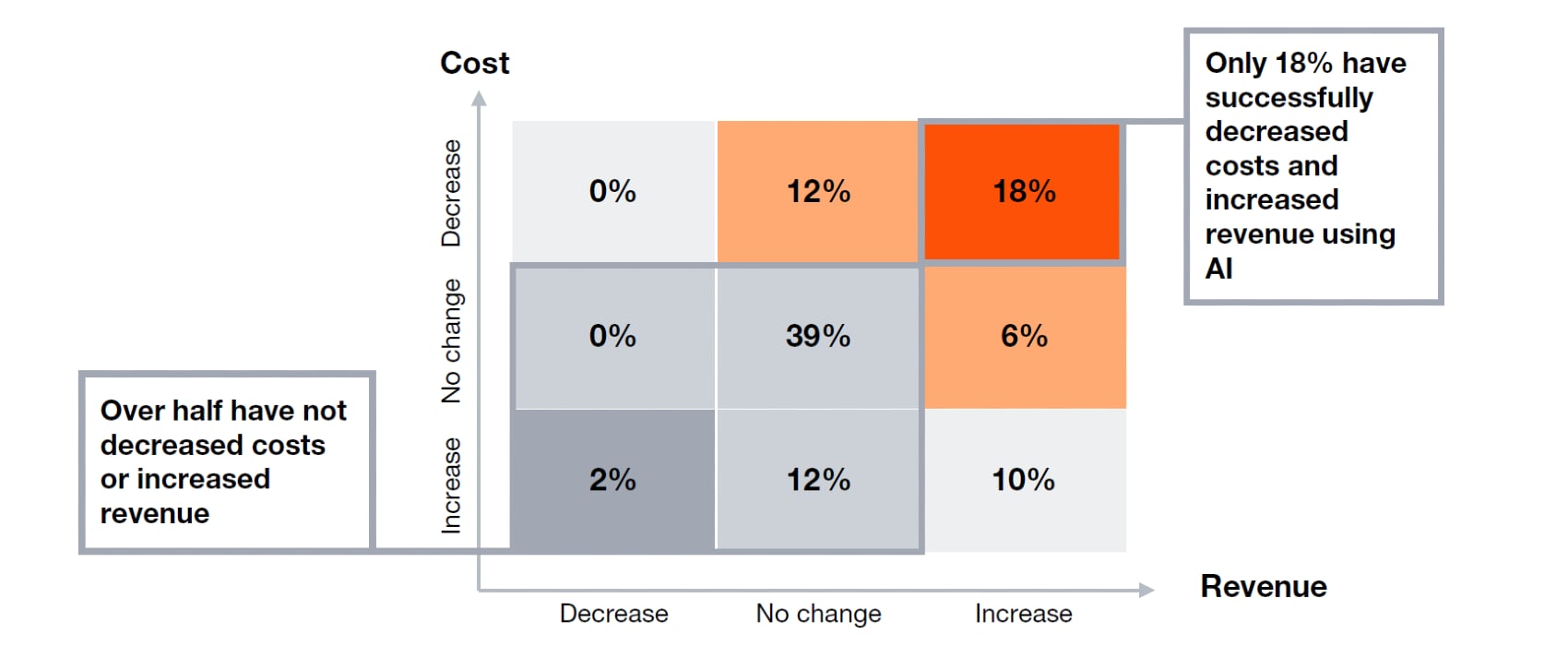
Note: Increases and decreases are changes of 2% or more. ‘No change’ is a change between a 2% decrease and 2% increase. This doesn’t show ‘Don’t know’ responses.
Source: PwC’s 29th Global CEO Survey
Just 18% of Thai CEOs report achieving the optimum scenario—where AI has both increased revenue and reduced costs. This small proportion highlights that most organisations have yet to fully realise the commercial benefits of their AI investments.
For many companies, AI hasn’t made a noticeable financial difference. In fact, 39% indicate there has been no change in either revenue or costs. This suggests that many AI initiatives are still in the pilot phase or haven’t been scaled sufficiently to affect overall business performance.
Megatrends are in collision
Technology, climate change, and rising geopolitical tensions are colliding to transform industries both globally and in Thailand. These powerful forces are prompting organisations to look beyond their traditional markets and consider new avenues for growth, as highlighted in PwC’s Value in Motion research.
In response, Thai CEOs, like their peers worldwide, are re‑evaluating where and how they operate. As industry boundaries blur, more companies are diversifying beyond their core sectors to capture emerging opportunities and manage evolving risks.
Companies that entered new sectors report higher confidence in growth
Q. In the last five years, has your company begun competing in new sectors or industries in which it hadn’t previously competed?
Share of Thai CEOs who entered new sectors in the past five years
Source: PwC’s 29th Global CEO Survey
More than half of Thai CEOs (56%) report that their companies have begun competing in new sectors or industries over the past five years, beyond their traditional areas of operation, while 42% have not yet expanded into new sectors.
Importantly, the survey also reveals a clear relationship between expansion into new sectors and executives’ confidence in future revenue growth, particularly over the next 12 months. Companies with no revenue from new sectors report high confidence in growth among only 18% of CEOs.
This figure increases to 33% among companies where approximately 25% of revenue comes from new sectors. The share rises sharply to 75% for companies with 50% of revenue derived from new sectors.
Top five sectors attracting Thai CEOs
Q. In which of the following industries (if any), outside of your own, will you seek to grow your business (including partnering with others to do so) over the next three years?
Note: Showing the top five industries selected.
Source: PwC’s 29th Global CEO Survey
Thai CEOs are increasingly focusing on sectors that align with Thailand’s underlying structural demand and areas of competitive strength. Health services have now become the top strategic priority for 24% of Thai CEOs.
Beyond healthcare, hospitality and leisure (21%) remain a natural extension of Thailand’s world-renowned tourism industry, while industrial manufacturing, technology, and transportation and logistics (all at 14%) reflect new avenues created by supply chain shifts and accelerating digital transformation.
The road to reinvention
Thai CEOs are entering a period where short‑term pressures remain intense, yet other significant concerns reveal a deeper focus on the future.
Two leading concerns stand out: ‘Am I doing enough to ensure my company remains viable in the medium to long term?’ (34%), and ‘Is my company’s innovation capability adequate for our uncertain future?’ (32%).
These issues reflect a broader shift in mindset among Thai business leaders. They recognise that sustained competitiveness requires a willingness to adapt, evolve and reinvent themselves to stay relevant in a rapidly changing environment.
Innovation capability remains limited, highlighting the need for reinvention
Q. To what extent do each of the following statements characterise your company’s approach to innovation?
Note: Showing only ‘To a large extent’ and ‘To a very large extent’ responses.
Source: PwC’s 29th Global CEO Survey
Despite this clear recognition, the data suggests that many organisations are still establishing the foundations needed to innovate at scale.
Thai companies are in an early stage of building innovation muscle. Only 27% place innovation at the core of their strategy. Just 19% collaborate externally or test ideas quickly with customers.
While Thai CEOs are fully aware of the importance of innovation, this awareness has yet to translate into bold ambition. In an uncertain economic climate, innovation is pursued cautiously.
Climate change: shifting from awareness to strategic integration
Although climate change is firmly on the agenda for Thai organisations, yet most remain at the early stages of embedding climate considerations into their core decision-making processes.
Notably, 45% of Thai CEOs say their company face at least a moderate risk of significant financial loss from climate change in the year ahead—a figure broadly in line with the global average of 42%.
While Thai CEOs generally recognise the climate‑related risks, they aren’t yet taking the necessary steps to mitigate those risks. Only a few CEOs have systematically considered climate risks and opportunities.
Climate considerations are still missing in most business decisions
Q. To what extent does your company have defined processes that account for the opportunities and risks associated with climate change in the following areas?
Source: PwC’s 29th Global CEO Survey
Only 27% of Thai CEOs agree to a large or very large extent that their companies have well-defined processes that consider climate‑related risks and opportunities in product design and development.
Similarly, just 24% incorporate climate factors into supply chain and sourcing decisions, and a mere 15% do so when allocating capital, including in mergers and acquisitions.
These figures highlight a clear gap between climate awareness and action. While Thai CEOs acknowledge the importance of climate change, systematic integration into core business decisions remains limited.
Trust is a foundation for reinvention
Amid an increasingly complex and volatile business environment, stakeholder trust has become an issue that CEOs can no longer afford to overlook. Rising pressures around transparency, scrutiny of executive decision‑making, the use of data and technology, and sustainability considerations all reflect heightened expectations of corporate leadership.
At the same time, the rapid advancement of AI—while fostering confidence—can also give rise to public concern if organisations fail to put responsible AI governance in place.
Many Thai CEOs experienced stakeholder trust concerns
Q. In the past 12 months, to what extent has your company experienced any of the following trust concerns from your key stakeholder groups (e.g., the board, customers, regulators, investors, employees)?
Note: Showing aggregate of ‘To a moderate extent’, ‘To large extent’, and ‘To a very large extent’ responses.
Source: PwC’s 29th Global CEO Survey
Thai CEOs are facing growing pressure on trust from multiple angles. The top concerns are demands for greater transparency (43%) and tighter scrutiny of leadership decisions (41%). Questions around data use and privacy (35%), climate impact on business performance (32%) and ‘Responsible AI’ (31%) highlight rising expectations in both digital and sustainability areas.
It is increasingly clear to Thai CEOs that trust is no longer a soft reputational asset, but a core leadership issue. Heightened demands for transparency and closer examination of executive decision-making reflect a broader shift: boards, investors, regulators and employees now expect stronger governance, greater accountability and clearer, more consistent communication at every level of the organisation.
Discover how Thai CEOs are navigating 2026 and reshaping strategies.
PwC’s 29th Global CEO Survey – Thailand
Contact us


Survey methodology
We surveyed 4,454 CEOs in 95 countries and territories (including 59 from Thailand) from 30 September through 10 November 2025. All quantitative interviews were conducted confidentially. In this report, some figures in the charts may not total 100% due to rounding percentages and, in certain instances, the exclusion of responses such as ‘neither/nor’, ‘other’, ‘none of the above’, ‘don’t know’ and ‘prefer not to say’.
Authors


Download our report
Discover how Thai businesses can strengthen their foundations and seize new opportunities for sustainable growth.
Explore more
PwC’s 29th Global CEO Survey
Contact us
Marketing and Communications
Bangkok, PwC Thailand
Tel: +66 (0) 2844 1000, Ext. 4713-15, 18, 22-24, 26, 28 and 29


