



{{item.videoDuration}}
{{item.title}}
{{item.text}}

{{item.videoDuration}}
{{item.text}}
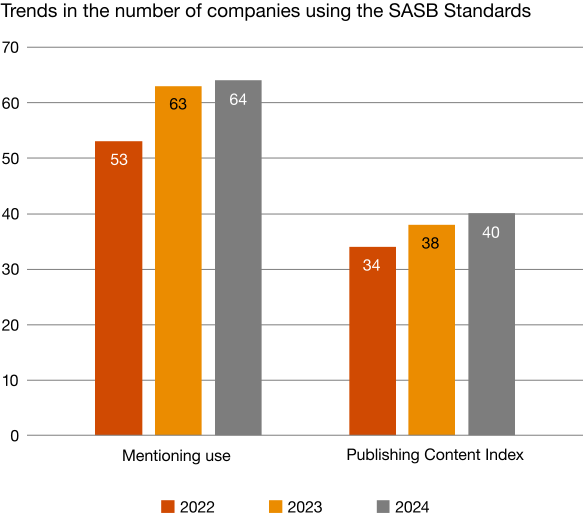
Among TOPIX 100 companies, 62 use the SASB Standards, of which 40 have also created a SASB Content Index.
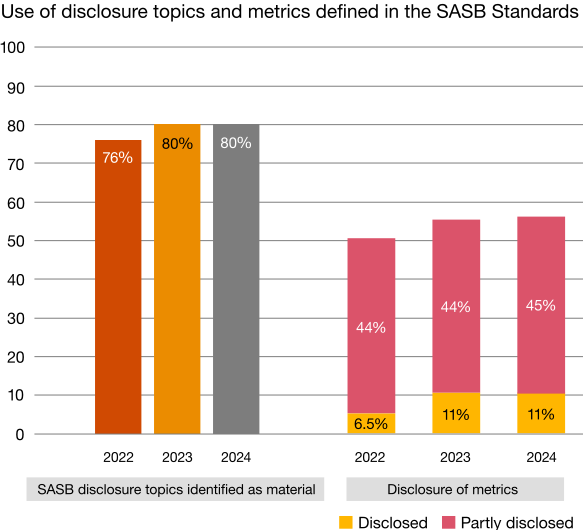
Materiality assessments by TOPIX 100 companies identified 80% of SASB disclosure topics as material, reflecting a high level of alignment.
Of the SASB metrics applicable to TOPIX 100 companies, 56% were disclosed. Of these, 11% were fully disclosed and 45% were partially disclosed.
In March 2025, the Sustainability Standards Board of Japan (SSBJ) issued three standards (the SSBJ Standards)—Universal Sustainability Disclosure Standard, Application of the Sustainability Disclosure Standards; Theme-based Sustainability Disclosure Standard No. 1, General Disclosures; and Theme-based Sustainability Disclosure Standard No. 2, Climate-related Disclosures—which are aligned with the IFRS Sustainability Disclosure Standards.
Consistent with the IFRS Sustainability Disclosure Standards, the SSBJ Standards require entities to refer to the SASB Standards and consider their applicability as a source of guidance. Specifically, when identifying sustainability-related risks and opportunities and when determining material information about them, entities must refer to the SASB Standards’ disclosure topics and metrics and consider their applicability.
This survey aims to shed light on the current state of sustainability disclosures by Japanese companies and the challenges they face by examining the extent to which disclosures by TOPIX 100 companies align with the SASB Standards.
The survey findings highlight both the areas where Japanese companies are currently responding well to the SASB Standards and the areas where further improvement is needed. In doing so, the findings provide useful information to support Japanese companies and investors in further adapting to sustainability disclosure standards.
In 2024, 62 companies disclosed use of the SASB Standards, of which 40 published a SASB Content Index. While some companies may in practice be using the SASB Standards without disclosing this, the pace of increase in both the rate of use and the number of companies publishing a Content Index slowed in the 2023–2024 period compared with the previous year.
In Japan, phased mandatory application of the SSBJ Standards is under consideration to begin with the fiscal year ending March 2027. As a result, most TOPIX 100 companies are expected to need to use the SASB Standards. The SSBJ Standards stipulate that entities must refer to the SASB Standards and consider their applicability as a source of guidance. The survey findings suggest that further application of the SASB Standards will be an important challenge for companies as they prepare to comply with strengthened regulatory requirements.
In TOPIX 100 corporate materiality assessments, 80% of the disclosure topics in SASB Standards were identified as material. In 2024, material issues identified by companies continued to align closely with disclosure topics; however, the survey also found that disclosure topics not identified as material were concentrated in certain issue categories.
Looking at disclosures of metrics under the SASB Standards, 11% were fully disclosed by the companies surveyed and 45% were partially disclosed. Partially disclosed metrics increased by one percentage point from 2023, while the percentage of fully disclosed metrics remained unchanged. At the same time, insufficient or partial disclosure was concentrated in certain issue categories.
We examined Japanese companies’ approaches to utilising the SASB Standards in preparation for the anticipated mandatory application of the SSBJ Standards. In Section 1, we confirmed that the pace of increase in the use of the SASB Standards has slowed. In Section 2, we found that although 80% of disclosure topics were identified as material, the SASB Standards were not being sufficiently applied in certain general issue categories. Based on these findings, we identified challenges and summarised possible utilisation approaches for six general issue categories, including Product Design & Lifecycle Management and Product Quality & Safety. We believe that the use of the SASB Standards will support companies in adapting to regulatory requirements and in strengthening their sustainability disclosures.
{{item.text}}
{{item.text}}
Hidetoshi Tahara
Partner, PricewaterhouseCoopers Japan LLC
Kuniyoshi Suzuki
Director, PricewaterhouseCoopers Japan LLC
Keiko Kafuku
Manager, PricewaterhouseCoopers Japan LLC
Kenji Yoshida
Manager, PricewaterhouseCoopers Japan LLC
Miki Funakoshi
Senior Associate, PricewaterhouseCoopers Japan LLC