


Stating its purpose to ‘contribute to the enrichment of the quality of life around the world’, Daiichi Sankyo has been working for many years on the global development of anti-cancer agents and other pharmaceutical products and the creation of an array of healthcare services. With a long history of drug discovery that spans the centuries since the Meiji era (1868-1912), Daiichi Sankyo has developed numerous new drugs. Now, the company is implementing DX strategy and organisational reforms globally to further enhance its strengths and achieve its future vision. The following is a talk session between Daiichi Sankyo and PwC Consulting, which supports such initiatives.
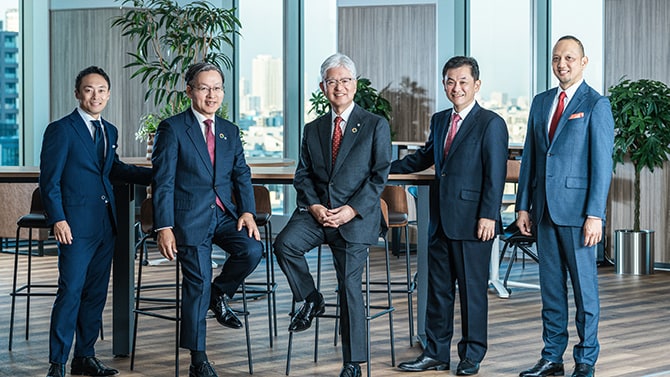
The pharmaceutical leader Daiichi Sankyo is currently the top biotech and pharma company in Japan by market capitalisation (approximately 7,928.3 billion yen as of 9 November 2023), and is also ahead of its competitors in DX promotion. The company supporting its initiatives is PwC Consulting.
From Daiichi Sankyo, Hiroyuki Okuzawa, Representative Director and President & COO; Masahiko Ohtsuki, Director and Senior Managing Executive Officer, Head of Global DX and Chief Digital Transformation Officer (CDXO) and Yasuo Uesugi, Vice President, DX Planning Department, Global DX participated in the session. From PwC Consulting, Pluek (Eddie) Viriyahboubpha, Partner/Senior Officer and Kei Takahashi, Director participated and asked Daiichi Sankyo’s members about their passion.
Daiichi Sankyo’s 2030 Vision of becoming an ‘Innovative Global Healthcare Company’
Hiroyuki Okuzawa (hereinafter Okuzawa): Daiichi Sankyo has defined its 2025 Vision as becoming a ‘global pharma innovator with a competitive advantage in oncology’. To achieve this target and steadily shift to further growth to achieve the 2030 Vision of an ‘innovative global healthcare company contributing to the sustainable development of society’, we formulated our 5-year business plan ending in FY2025. The current business plan identifies ‘four strategic pillars’ as strategically important initiatives: ‘maximise 3ADCs’, ‘profit growth for current business and products’, ‘identify and build pillars for further growth’ and ‘create shared value with stakeholders’. As a foundation to support the execution of these four strategies, we are working to implement data-driven management through DX, company-wide transformation through advanced digital technology, and agile decision-making through a new global management structure.
Pluek Viriyahboubpha (hereinafter Eddie): Daiichi Sankyo’s major products worldwide are anti-cancer agents. They are antibody-drug conjugates (ADCs) that combine small molecule drugs with bio-pharmaceuticals, and the high level of chemical synthesis technology related to ADCs is a major strength of Daiichi Sankyo today. This means the 2025 Vision of ‘global pharma innovator with a competitive advantage in oncology’ is being steadily realised.
Okuzawa: Our anti-cancer agents use the ADC technology developed in our own laboratories. The anti-cancer agent, which was first marketed in 2020 with our proprietary technology, has been administered to patients around the world at a faster rate than initially expected. In our FY2023 forecast announced on 31 October this year, revenue was revised upwards to 1,550 billion yen; an increase of 100 billion yen compared to the initial forecast announced in April. This revision is due to the impact of forex and an increase mainly in the sales of anti-cancer agents. Our ADC technology can be applied to multiple products, and there are currently five pipelines under development. Therefore, the 5-year business plan is progressing well, and the FY2025 revenue target is now expected to be 2,000 billion yen; some 400 billion yen higher than our initial forecast of 1,600 billion yen.
Kei Takahashi (hereinafter Takahashi): Now that achievement of the FY2025 target has become more likely, could you also talk about the strategic initiatives you are focusing on towards the 2030 Vision?

Pluek Viriyahboubpha, Senior Executive Officer, Partner, PwC Consulting (left) and Kei Takahashi, Director, PwC Consulting (right)
Okuzawa: Daiichi Sankyo is currently working on realising Healthcare as a Service (Haas). This is a new business model providing health and medical services that are optimised and tailored to each individual by utilising a variety of data and advanced technologies. In addition to the treatment of diseases, there are many peripheral symptoms and quality of life (QOL) concerns, and there is an urgent need to address these issues. I believe that the era of HaaS will have arrived in 2030. Towards the realisation of HaaS, we want to play a leading role in developing a total care ecosystem and a place for collaboration across health promotion, prevention, treatment and prognosis with companies and organisations in the health and medical fields, data providers and IT companies. We also want to develop a total care platform that enables the distribution and use of data by linking data from various health and medical fields connected to individuals.
Eddie: What do you emphasise within the company in laying the foundation for such innovations as the creation of proprietary ADC technology and HaaS?
Okuzawa: One important thing is to instil the ‘One DS Culture’. This is our company culture, under which all Daiichi Sankyo employees can work energetically beyond any barriers. It also represents a company culture-building initiative in which each and every employee takes ownership. As the foundation for fostering the ‘One DS Culture’, we have defined ‘Core Behavior’, which consists of three essential types of behaviour.
We consider our people, who are responsible for the realisation of various strategies, to be our most important asset. Our strengths in ‘science and technology’, such as our proprietary ADC technology, and ‘our people’ as assets, represent the uniqueness that allows Daiichi Sankyo to establish a global presence alongside mega pharma companies around the world. Since April 2011, the global head structure has been in operation and overseeing corporate functions in Japan, the US and Europe. While developing our value chain globally, we will strengthen our corporate culture and operating model based on science and technology. We will become a company where talented people both in Japan and abroad want to continue working.
Science and technology are undeniably the source of our strength. For more than 100 years, since the days of our former company, we have been transforming the power of science into value that contributes to society. Science is our hope, and we desire to further enhance, sophisticate and turn it into product value, so that it can also become hope for as many patients as possible who are waiting for medicines. With these thoughts in mind, we are now running TV commercials and other media with the slogan ‘Science is hope’.
Promoting DX globally with a diverse and flexible organisation
Takahashi: I think in order for Daiichi Sankyo to leverage its strength and realise its strategy it will be essential to instil the One DS Culture and to build an operating model on a global level. So please give us an overview of the ongoing Project 4D (Daiichi Sankyo Data-Driven Decision Making).
Okuzawa: ‘Project 4D’ was initiated to realise data-driven management for speedy and sound decision-making globally. We are working to integrate global management information by standardising data generated from global business processes. In order to visualise management information in a timely manner on a global level, we are using an integrated data analytics platform (IDAP). This is a mechanism that centralises all internal and external data, processes it according to its purpose and outputs it using analysis systems.
Takahashi: I believe that the best way to create an operating model that generates significant competitiveness is to unify various operations while enhancing quality and efficiency towards further value creation. I recognise that DX plays an important role in this way, so could you tell us about the DX strategy at Daiichi Sankyo?
Masahiko Ohtsuki (hereinafter Ohtsuki): In order to support the realisation of our 2030 Vision of becoming an ‘innovative global healthcare company contributing to the sustainable development of society’, as Okuzawa-san mentioned at the beginning of the session, with digital technology, we set up the DX Promotion Unit in FY2020. The first step was the formulation of the 2030 DX Vision. This unit was renamed ‘Global DX’ in April 2023 and is now accelerating its global operations.
Takahashi: What are the characteristics of an organisation that promotes DX globally?
Ohtsuki: I think one of the characteristics of Global DX is that it has both a ‘data department’ and an ‘IT department’, which can be described as the two wheels of DX. Another characteristic is that the organisation also has IT organisations in the US and Europe under its umbrella as direct reporting affiliations. The cybersecurity function was transferred to Global DX from another organisation. A group within the DX Planning Department had been responsible for HaaS, but in April 2023, its function was expanded and an independent organisation was established under Global DX as the HaaS Planning Department. For Daiichi Sankyo, this function can be described as a ‘new business’ under the umbrella. I believe that this type of structure is rare compared with other companies in our industry. In terms of human resources in the organisation, there is an equal proportion of ‘professionals from the original IT organisation and members who have been dedicated to data processing’, ‘those transferred from various organisations within the company’ and ‘external mid-career hires’. I believe that we have created an organisation with the diversity and flexibility needed to promote DX.
Eddie: As Head of ‘Global DX’, and also as Chief Digital Transformation Officer (CDXO), what policies do you yourself think important, Ohtsuki-san?
Ohtsuki: As the CDXO, I believe that digital is just a tool and we must achieve transformation with that tool. Currently, Daiichi Sankyo communicates its DX measures for internal use as ‘ABCDX’, where AX is ‘Activity Transformation’ (transformation of daily business activities); BX is ‘Business Process Transformation’ (transformation of overall value chain processes including drug discovery, development, production and marketing); and CX is ‘Culture Transformation’ (transformation of company culture that leads to the ‘One DS Culture’). These transformations are related to each other and should be promoted as a trinity to ensure that Daiichi Sankyo (D) is transformed (DX). For us, DX does not just mean digital transformation. I want that to always be kept in mind.
Transforming the future with an accountable mindset
Eddie: We now turn to Uesugi-san, who is leading the transformation on the frontline as Vice President of the DX Planning Department. What are the key points that you prioritise when promoting the various initiatives?
Yasuo Uesugi (hereinafter Uesugi): We have been updating our systems, including organisation and human resource development, in order to make effective use of diverse data. I believe that the key is to instil a culture of transformation through the use of digital technology. Furthermore, we must raise the awareness, knowledge and skills of our people who are responsible for promoting DX. For example, we hold monthly in-house seminars to delve deeply into each topic related to DX. The seminars sometimes invite prominent outside professionals, and there have been times when the number of participants exceeded 2,000. We have also prepared programmes that go beyond the lecture-style format, such as workshops where participants can actually experience advanced technologies. Here, participants can try technologies such as generative AI and the metaverse, and come up with ideas, which are then discussed to the fullest extent. Furthermore, we provide security training for executives, including the president, in order to promptly address information and cybersecurity incidents that have become increasingly serious in recent years. These seminars and workshops are organised with the support of PwC, which provides us with its know-how.
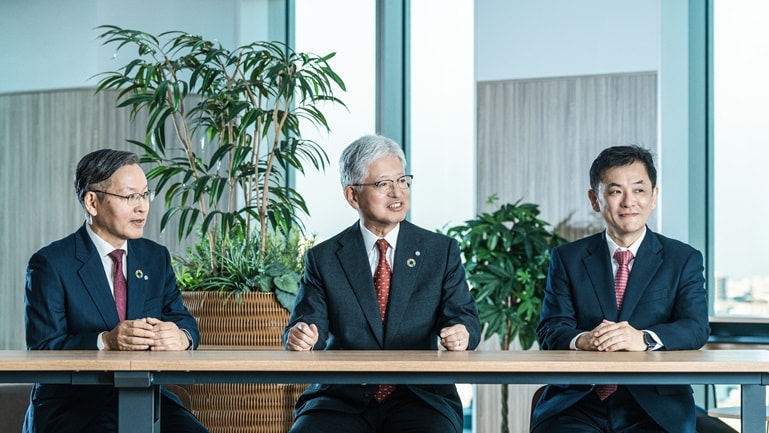
Masahiko Ohtsuki, Director and Senior Managing Executive Officer, Head of Global DX and Chief Digital Transformation Officer (CDXO), Daiichi Sankyo (left); Hiroyuki Okuzawa, Representative Director and President & COO, Daiichi Sankyo (middle); and Yasuo Uesugi, Vice President, DX Planning Department Global DX, Daiichi Sankyo(right)
Eddie: I have the impression that, at Daiichi Sankyo, the top management has been strongly communicating its desire to promote DX, and both managers and frontline personnel have been highly motivated to engage in DX.
Takahashi: DX is meaningful only when it is instilled in the frontline and the frontline is actually transformed. I feel that, under the direction of its top management, Daiichi Sankyo is speedily carrying out transformations while firmly involving the frontline.
Okuzawa: Again, my first priority as president is people. I aim to create a robust organisation where a diverse workforce from around the world can trust each other and grow under the ‘One DS Culture’. To this end, I am currently devoting as much of my time and effort as possible to enter into dialogue with internal and external stakeholders. The President’s Caravan is part of this effort. In FY2023, I visited all of our offices in Japan to communicate the company’s targets and my ideas, and to engage in frank and open dialogue and discussion directly with employees. By involving them in dialogue and discussion, what used to be ‘the company’s problems and targets’ can be perceived as ‘their own problems and targets’. I call this the ‘accountable mindset’ (the mindset of taking ownership of problems to break out of the status quo and achieve the desirable results). I believe that such a mindset creates strong engagement and organisation. From 2024 and onwards, I will be touring group companies around the world.
Ohtsuki: It reminds me of a quote, ‘It is not the strongest of the species that survives, nor the most intelligent that survives. It is the one that is most adaptable to change’. When the environment changes, no matter how strong you are, no matter how intelligent you are, you will not be able to survive—you have to adapt to changes. I believe that we need to transform ourselves well.
Uesugi: I will work to ensure that all internal and external stakeholders consider Daiichi Sankyo’s transformation through DX promotion as a contributor to the realisation of its 2030 Vision. I want our employees to be involved in DX, not just as participants, but as owners who will proactively lead the way. I believe that the realisation of our Vision, ‘innovative global healthcare company contributing to the sustainable development of society’, can only be built on each individual’s ownership.

Hiroyuki Okuzawa
Representative Director and President & COO, Daiichi Sankyo. After graduating from Hitotsubashi University, he joined Sankyo Company in 1986. He has extensive global experience, including a total of eight years in Germany, and was in charge of Asian and Latin American operations. In April 2021, he assumed the post of Executive Officer, Head of Corporate Planning & Management Division and CFO, and in June 2021, Director, Executive Officer and Head of Corporate Planning & Management Division, CFO. Following the appointment of Director, Senior Executive Officer and Head of Corporate Planning & Management Division, CFO in 2022, he assumed his current position in April 2023.
Masahiko Ohtsuki
Director and Senior Managing Executive Officer, Head of Global DX and Chief Digital Transformation Officer (CDXO), Daiichi Sankyo. After Completing the Doctoral Program at the Graduate School of Pharmaceutical Sciences, the University of Tokyo, he joined Sankyo Company in 1987. After working at a research institute, he was transferred to a subsidiary in the US, and successively served as President, R&D Planning Department, R&D Division, Vice President, Research Oversight Function, R&D Division, and Vice President, Business Development & Licensing Department. In April 2020, he assumed the post of Senior Executive Officer, Head of Digital Transformation Management Division, and in June 2020, Director, Senior Executive Officer, Head of Digital Transformation Management Division, Chief Information Officer (CIO), before assuming his current position in 2023.
Yasuo Uesugi
Vice President, DX Planning Department, Global DX, Daiichi Sankyo. He joined Daiichi Pharmaceutical in 1991 and engaged in non-clinical safety research of drug candidate compounds at a research institute. He has served as union official since 2002. Since 2008, he has worked in the Business Administration Department, Human Resources Department, General Affairs and Procurement Department, and IT Planning Department at the head office, before assuming his current position in 2020. He is working to create a global pharma innovator using data and digital technology.
Pluek (Eddie) Viriyahboubpha
Partner/Senior Officer, PwC Consulting. He specialises in healthcare and life sciences, transformation strategy, change management and technology. He has over 20 years of experience in global organisational leadership in consulting firms and pharmaceutical companies. He has extensive experience and expertise in organisational strategy, IT/DX, patient support programmes, international business development and new business launches.
Kei Takahashi
Director, PwC Consulting. Before joining PwC, he worked at a strategy consulting firm. As an Account Lead for a major pharmaceutical company in Japan, he is leading from strategy formulation to implementation support for company-wide transformation on a global level, starting with DX. He is also the launch leader of the healthcare entrants initiative, which provides cross-industry support for companies entering the healthcare industry. In addition, this initiative supports companies from various industries that are considering newly entering the sector or business expansion.
This report is a translation of PwC's sponsored contents リーディングカンパニーとPwCコンサルティングが語るこれからの経営課題 未来を拓く企業たち (https://forbesjapan.com/articles/detail/68028), originally published by Forbes Japan in January 2024. Although we have made every effort to provide an accurate translation, in the event of any differences in interpretation between this translation and the original, the original takes precedence.
Contact us
Related Content