




{{item.videoDuration}}
{{item.title}}
{{item.text}}

{{item.videoDuration}}
{{item.text}}
2020-04-01
PwC Purpose is to ‘build trust in society and solve important problems.’ In this series, we introduce case studies of cooperation with municipalities to address the challenges faced in their respective regions based on this purpose.
(from left to right)Suda, PwC Miyagi, Aoyama, Komatsu
Participants
Yoshiaki Suda, Mayor of Onagawa, Miyagi
Takahiro Aoyama, Manager, Public Private Partnership Office, Industry Promotion Division, Onagawa, Miyagi
Yosuke Komatsu, Representative Director, Asuenokibou (NPO)
Takayuki Miyagi, Partner, Public Services, PwC Consulting LLC
In March 2019, 30 members of PwC Consulting visited Onagawa, Miyagi, which is known as a town that achieved a swift recovery following the Great East Japan Earthquake. In order to consider what they could do as a firm, they conducted a field study of social problems through dialogue with and observation of local non-profits and people of the local community. The visit gave rise to the internal Social Impact Initiative (SII), in which consultants across divisions get together as a team to support the construction of a model for solving social issues that is also profitable as a business. The team is currently carrying out R&D on various solutions to social problems, including support for social innovation, establishment of a social impact management method, and acceleration of social finance. In this article, the participants reflected on the social impact management activities by the SII team members together with the town of Onagawa, highlighting the importance of visualization and the possibilities of future urban development.
Takahiro Aoyama, Manager, Public Private Partnership Office, Industry Promotion Division, Onagawa, Miyagi
Field study of social problems(March, 2019)
Miyagi
A year or so has passed since we first visited Onagawa. I can still vividly remember the moment of surprise when I stepped out of the station. I wondered if this lively townscape before me was really from a town that was hit by a tsunami. And then when I met with people and heard their stories, I was immediately drawn to their enthusiastic attitude. Most of all, I was very inspired by seeing first-hand how the public and private sectors came together to work on urban development. I knew I couldn’t just let that inspiration go wasted, so I launched the Social Impact Initiative soon after I returned to Tokyo.
Komatsu
As a representative of an intermediary support organization in Onagawa, I was in charge of making arrangements for a training program for the team from PwC Consulting when they made their first visit. What impressed me was that they asked many questions after the lecture, when we were walking through the town, and at the friendly gathering following the training, and that with the firm had many employees deeply interested in social problems and earthquake recovery. After the training, I sent an e-mail expressing my gratitude, and Mr. Miyagi replied, “If there’s ever anything we can do, let me know, and we’ll be onto it.” I thought it would be interesting to see what would develop if we kept up ties with this group of people who had shown such a strong interest in our town.
Aoyama
When I first heard about the visit, I was told something like, “Some people from a leading international consulting firm are coming for a visit, so we want you to talk to them about something.” (Laughing) I wasn’t sure what I should talk about, but I ended up telling them what we had done in the eight years (at the time) since the earthquake, as I usually did. After the talk, they asked so many questions that I could tell they were full of zeal.
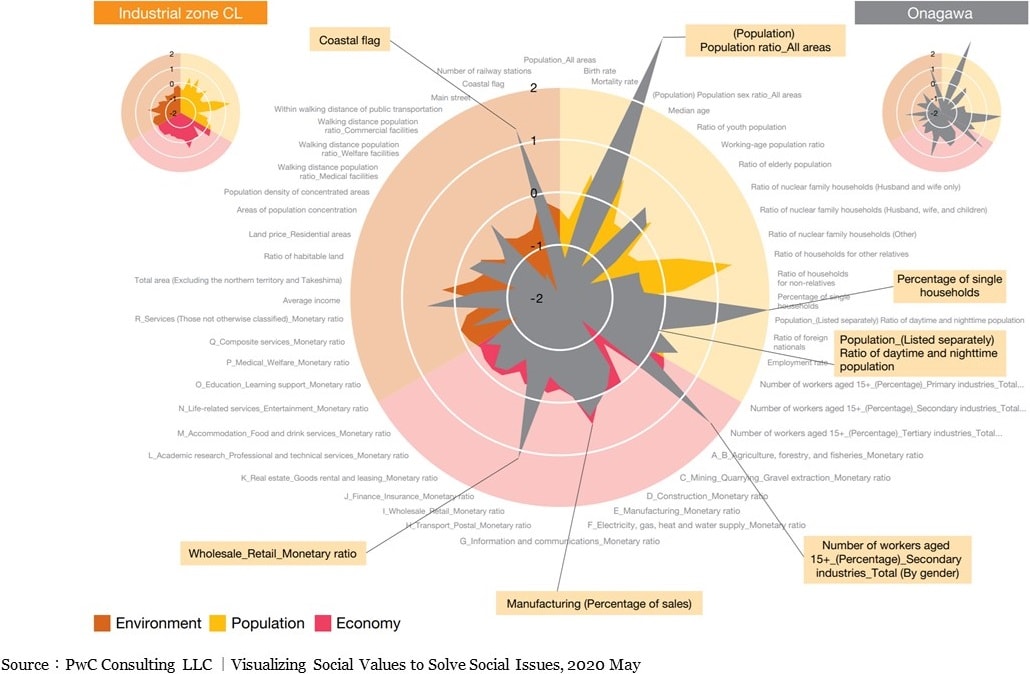
In solving social problems, the SII takes an approach with a focus on visualizing the social and environmental changes (i.e., social impact) created by the activities and investments to amplify the positive social impact. Based on the basic policy and other specifics on community development set forth by Onagawa, we first defined the scope of the impact assessment as (1) population growth, (2) strengthening of disaster-resistance, and (3) stability of municipal finance, and set two impact goals, which are “increasing social population change per habitable area” and “improving financial indicators.” As part of the brainstorming to identify the important factors for achieving the goals, we held on-site interviews and conducted a clustering analysis of about 1,724 local governments, identifying ones with social structures similar to Onagawa based on statistics and comparing them. Moreover, to retrace how the social impact in Onagawa had taken shape so far, we used a logic model presenting causal relationships between the town’s resources (people, goods, and money) and environmental capital and the social impact (change) created. As a result, we identified the fact that the town had a solid foundation for discussing overall optimizationand made investment to solve the current and future problemswas Onagawa’s social performance drivers (factors behind success).
Suda
I was also surprised at how attentively everyone at PwC Consulting listened to what I had to say. Above all, they continued to come back on a regular basis, and each time, they analyzed things like our recovery efforts and new community development from an outside perspective and put them into words. That was much appreciated.
After the earthquake, Onagawa used a lot of national funds for community development. We knew we couldn’t and didn’t want to use that money in a way that would bring embarrassment. Always keeping that in mind, we worked on community development in such a way as to ensure that the people in Japan would later be satisfied with how Onagawa used the funds to recover.
At the time, we didn’t have a clear picture of what the right answer would be like. We had also been acting instinctively, so we were often unable to provide a good explanation of what we had done or what was the driving force behind the success. PwC Consulting’s report brought quite a bit of clarity in that regard.
Miyagi
First, we focused on visualizing the challenges faced by Onagawa following the earthquake, various actions that the town had taken in response, and the resulting social impact. By doing so, we hoped to develop a mechanism for managing the social impact, in which we could, for example, pursue another goal by changing a certain indicator. This would help institutions to make investment decisions and create a positive flow of money. We also believe that involving many different people will make it possible to expand the social impact.
Yoshiaki Suda, Mayor of Onagawa, Miyagi
Suda
Seeing an analysis based on statistical data took me by surprise. After the earthquake, we had believed that the town’s population had been steadily decreasing, but when they showed us the social population growth rate by habitable area during a certain period within the cluster including Onagawa, it painted a completely different picture than what we had in mind. This was completely different from the awareness of people actually living in Onagawa, and it was very educational to see how a phenomenon would look different depending on how we approach to it.
Thanks to the cooperation of PwC Consulting and many others, we have finally reached to the stage where we can work on external communication to show the path we have taken to recovery to those outside of Onagawa. We believe we have a responsibility to do so.
Miyagi
We have developed a model that logically explains the mechanism by which Onagawa achieved a miraculously speedy recovery following the earthquake. Once we verify that it would be truly instrumental for social impact management, eventually we hope to disseminate the model far and wide not just as a recovery success story but as a referential case study for solving social issues in areas all over Japan and the world.
I also heard that community development efforts led by the younger generation had been underway in Onagawa before the earthquake, looking 20 to 30 years down the road. I believe therein lies the foundation for promoting new community development themselves.
Aoyama
Yes, there was such a trend in Onagawa. In 2010, the population of Onagawa was around 10,000, but a regional bank made a prediction at the time that by 2035 the population would drop to 6,000. The chamber of commerce took it as a critical situation and started the “Onagawa Community Development Workshop” right away. It already felt like young people were stepping forward and the older generation was stepping back at that time.
Suda
Still, I wouldn’t say that such awareness was particularly high. Onagawa has long been both a fishery and a commercial town, so there may be a sort of flexibility in its culture for changes in the environment. You can tell it from the fact that the people started take measures as soon as they heard the warning that the population would drop by half in just over 20 years. And it was also apparent when, after the earthquake, the so-called “elders” among the leaders of the town said right away, “Now you who are young should build your own town.”
Analytics of Onagawa
Takayuki Miyagi, Partner, Public Services, PwC Consulting LLC
Yosuke Komatsu, Representative Director, Asuenokibou (NPO)
Komatsu
As Mr. Miyagi said, those in disaster-stricken areas, and probably other places as well, can learn a lot from the capabilities of the people of Onagawa to create something from nothing and the various measures they implemented. That’s why I’m so grateful to PwC Consulting for providing support by creating a logic model and data analysis. If Onagawa’s efforts were a 10, we had only been able to communicate 1 out of 10, and they showed us what 10 looked like. Moving forward, I hope to work together to take those results from 10 to 100.
I’ve been told many times that the success was a result of Onagawa’s unique characteristics. Every time I heard it, I thought that should not be true, but as the mayor said, up to now we haven’t been able to explain the success well. PwC Consulting’s report shows logically that the same success can be achieved in other places as well. My organization has many staff members who are experienced in international cooperation, and even they say that Onagawa is a treasure trove of learning. I believe this is an example that would not only provide tips for regional revitalization in Japan but also serve as a useful reference around the world.
Miyagi
At first, we visited the town hoping that we might be able to provide some kind of support for Onagawa’s future growth, but now we’ve begun to feel that our mission is to advocate the town’s efforts following the earthquake as a versatile “Onagawa Model.” And to refute the claim that these efforts worked only in Onagawa, I also think it’s important that we from the business world—not the town of Onagawa itself—present the model with objectivity.
For our part, as a global business, we at PwC Consulting very much hope to promote the “global communication” that Mr. Komatsu talked about. I hope to make use of the results of our research not just to the town but broadly in society.
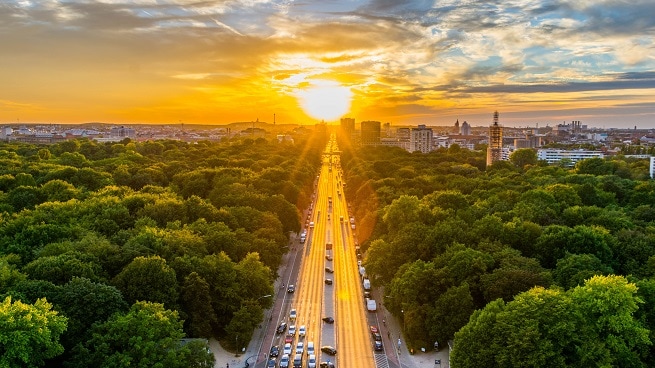
The main road of the town that leads straight from Onagawa Station to the sea
Suda
For the town as well, this relationship didn’t start out with us expecting support from PwC Consulting. You just used the word “mission,” but from our standpoint, aside from that sense of mission, your strong interest in being involved with our town has always come through. I want you to know that seeing that made us excited about working together to create some kind of new value.
Miyagi
I’m very happy to hear that.
Aoyama
I, too, am simply happy with what has come about. We have been struggling in a sort of daze ever since we decided to stay and live here after the earthquake, and you came up with a proper logic model addressing what even we didn’t see in our efforts. This might be what we should have done ourselves, but now that we have this report we have new enthusiasm that we can pass it on to the next generation so that they can utilize it.
Suda
PwC Consulting has provided visualization and analysis of what we had done, and now I hope the firm will continue to help us by analyzing the process of ongoing community development for the future move forward with us as one of the parties concerned.
Mr. Miyagi said, “involving many different people will make it possible to expand the social impact.” We call those people “active population,” and we hope to continue steadily involving those who are not residents but are engaged in various activities in Onagawa. Through these people, we hope to bring in from the outside what the town cannot provide on its own, and achieve more exciting things more quickly and on a bigger scale.
Aoyama
Speaking of the partnership between PwC Consulting and Asuenokibou, we’re just at the end of the introduction stage. I look forward to moving into the development and elevation stages as we maintain our various connections to one another.
Visualization of social impacts is important to solve complicated and serious social issues.
Takayuki Miyagi
Partner, PwC Consulting LLC
{{item.text}}
{{item.text}}
