

Hungarian CEOs are facing both growing short-term threats and the ongoing pressure of technological transformation, which requires a long-term, strategic focus. While they remain optimistic about the global economic outlook, they are increasingly uncertain about the prospects for Hungarian economic growth. According to PwC’s 15th Hungarian CEO Survey conducted last autumn, Hungarian CEOs spend 60% of their time on issues with a time horizon of less than one year – significantly more than their global counterparts. This leaves less time for business viability, innovation, and AI adoption, long-term strategic issues that are becoming more and more prominent.
Key survey findings:
CEOs are optimistic about global economic growth, but less confident about local economic growth
Hungarian CEOs are far more optimistic than their global counterparts about growth prospects for the global economy: 71% are confident about global economic growth, compared to 61% globally, and only 5% expect a slowdown from the previous year. However, the outlook for the Hungarian economy is now more nuanced. Compared to the previous 60%, only 53% expect growth to accelerate this year, which clearly shows a decline in confidence.
Companies’ revenue expectations are also more pessimistic than in previous years: only 31% of Hungarian CEOs anticipate revenue growth over the next 12 months, which is the lowest figure in the survey’s fifteen-year history. However, the three-year revenue growth outlook is more optimistic, with 48% of Hungarian CEOs and 49% of global CEOs expressing greater confidence.
CEOs’ macroeconomic expectations also reflect moderate confidence: they predict an annual average exchange rate of 397 forints to the euro, 4.6% inflation, and 1.5% GDP growth for 2026.
The regulatory environment emerges as a top concern
There has been a shift in how threats are perceived: for the first time since 2023, risk perception among CEOs has increased significantly. This year, the Hungarian regulatory environment topped the list of concerns (51%), ahead of inflation and macroeconomic volatility (both 43%). There was a slight increase in the percentage of respondents worried about geopolitical conflict (37%; up from 36% in last year’s survey), while cyber risks continue to rank as a top threat (37%, compared to 31% globally). The proportion of CEOs concerned about the availability of key skills has decreased significantly (from 44% to 32%), as has the proportion of those concerned about technology disruption (from 35% to 24%).
Uncertainty relating to tariffs is a new consideration: 75% of Hungarian CEOs anticipate little to no impact, while 12% believe tariffs will negatively impact profit margins. Our survey data shows that in a world of elevated threats, CEOs are feeling less inclined to make big moves. In Hungary, 18% of CEOs say they are less likely to make large new investments due to the geopolitical situation – a trend observed across many sectors.
Uncertain ROI for AI, strong foundations are essential
The biggest question on CEOs’ minds is whether they are transforming fast enough to keep pace with technological change, including AI. Although we are in the early stages of the AI era, organisations are already deploying AI across the business, but company-wide integration is still limited. In Hungary, CEOs say they are applying AI to a large or very large extent to areas such as demand generation (18%), customer experience (17%), and support services (12%).
Measurable business value is also limited: only 13% reported additional revenue as a result of AI adoption, and the situation is not much better in cost reduction. Most of the Hungarian companies surveyed (77%) have not reduced costs or increased revenue as a result of their use of AI.
The survey highlights the importance of strong AI foundations: organisations with a stable technology environment, responsible AI processes, and a clearly defined roadmap are three times more likely to realise revenue or cost benefits (28% revenue growth in the past 12 months, compared to 9%, and 33% cost reduction compared to 12%, for organisations with strong AI foundations in Hungary).
Although there are no significant differences in stable AI foundations globally and in Hungary, the disparity in benefits is striking: far fewer companies are realising benefits in Hungary. While 12% of global CEOs report both revenue growth and decreased costs, this figure is only 6% in Hungary.
“Now that AI has been around for a while, more and more connections are revealed. One of the key findings from this year’s survey is that AI readiness in Hungary has realised limited results. The question is whether we all understand readiness in the same way, and if so, what other reasons might explain the more modest results? We can only speculate at the moment, but exciting findings could emerge in the coming years that will impact the use of AI,”

Industry transformations
Companies are increasingly recognising that growth requires crossing traditional industry boundaries. Based on data from the past five years, 35% of Hungarian CEOs and 42% of global CEOs are now competing in new sectors. Meanwhile, fears of recession have led to a significantly lower appetite for expansion than is seen globally.
Among CEOs planning to make at least one major acquisition in the next three years, a similar proportion (34% in Hungary, 44% globally) expect to do deals outside of their existing sector or industry. Last year, this figure was 42% in Hungary and 60% globally.
“There are several ways to remain competitive, and one of them is to expand into other sectors. This intention is clear globally as well as in Hungary, but its extent in Hungary is likely to be significantly impacted by caution regarding growth prospects. However, the technology sector is less attractive in Hungary,”
Szabolcs Mezei pointed out.PwC’s earlier research suggests that over the next decade, industries will reconfigure to meet human needs in new ways, leading to the formation of new domains that cross traditional sector lines.

“As the structure of the economy transforms, value will increasingly come from organisations that can connect the dots across traditional industry boundaries. By focusing on evolving customer needs and using technology to dramatically change the way business operates, business leaders can unlock a step change in growth,”
Innovation: aspiration and reality
According to 53% of Hungarian CEOs, innovation is central to their company’s business strategy, however, we see a significant gap between aspiration and reality. Only a fifth of companies (18%) tolerate high-risk innovation projects, and few (16%) have routine processes in place to stop potentially underperforming R&D projects.
However, companies with a strong foundation in innovation achieve faster overall revenue growth and higher profit margins, which underscores the need for a long-term and consistent innovation strategy. PwC’s experts emphasise that reinvention cannot be achieved through isolated ideas, but rather through systematic development.
Trust and sustainability: new expectations, shifting priorities
Concerns about trust have intensified globally, including in Hungary. Eighty-one percent of Hungarian CEOs say their company experienced trust concerns to at least a moderate extent in the last year on topics such as AI safety, data privacy, transparency, and the impact of climate change on business performance. Yet few companies systematically integrate climate risks into decision-making: only one in three Hungarian companies has a suitable process for incorporating sustainability considerations. According to PwC’s analysis, most companies today are focusing on energy demand, increasing resilience, and changing customer needs – but the trend is clear: sustainability reporting and related expectations are on the rise.
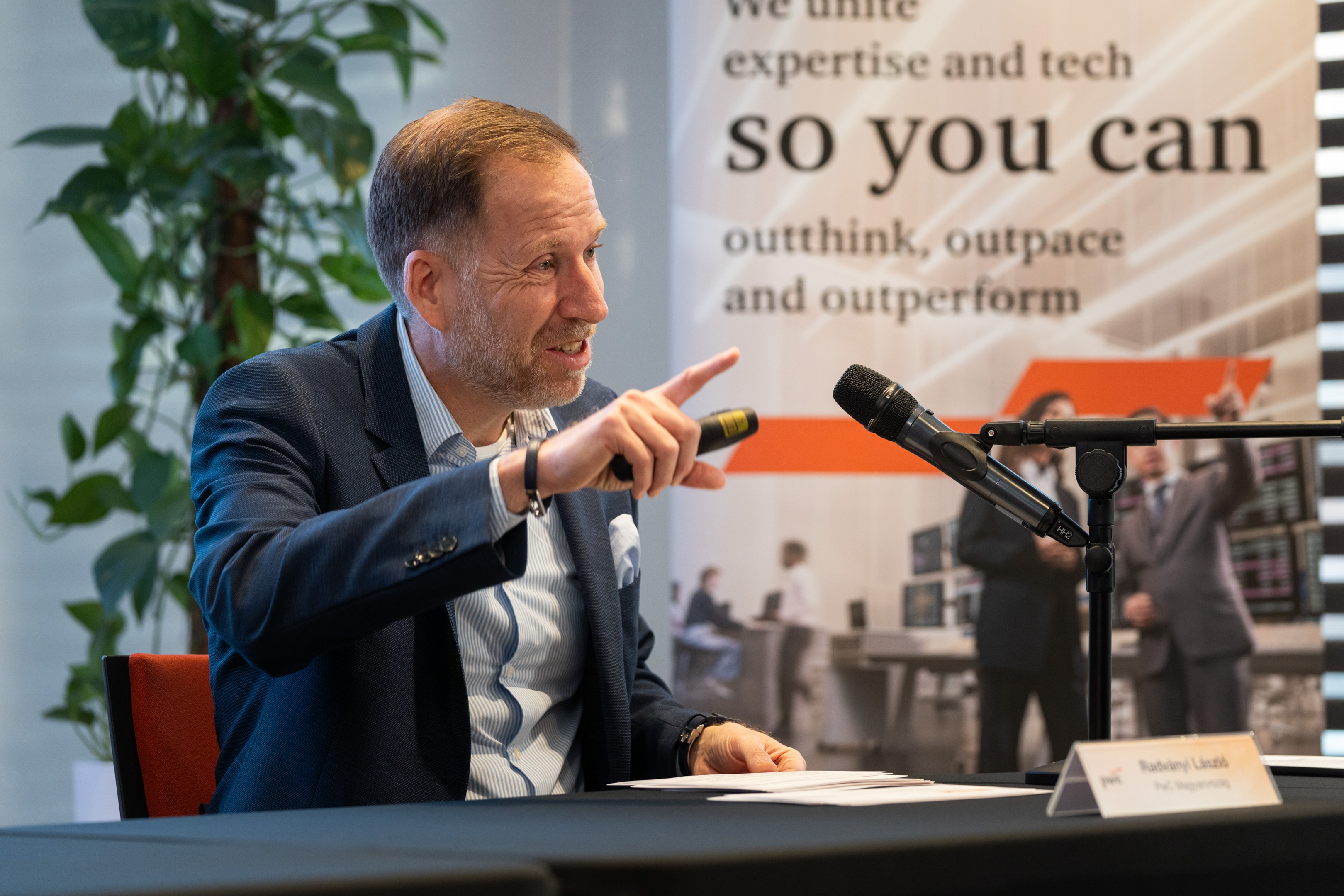
László Radványi added:
“Feedback from CEOs confirms that in times of uncertainty, every organisation must rely on its own values and community. Trust, transparency, and cooperation are the principles we can depend on, even as the world around us rapidly changes. To remain competitive in the long term, we must now consciously strengthen our relationships with our clients and be bold enough to redefine old operating models. If we make good use of this opportunity, we will not only adapt but also benefit from it.”
CEOs struggle with “the tyranny of the urgent”
The tension across time horizons is a recurring theme in our survey. Globally, CEOs spend 47% of their time on issues with time horizons of less than one year, while in Hungary this figure is 60%. They can only dedicate 10% of their time to activities with a horizon of more than five years. According to PwC’s experts, this focus on short-term issues is understandable in the current economic situation, but it could be a major obstacle to strategic development: companies need to invest time in long-term transformation programmes, particularly in AI and innovation.
“Today, CEOs must navigate long-term, technology-driven transformation in a fundamentally unfavourable investment environment. Hesitation is not an option. Trusting AI is no longer a question, but decision-making, preparedness and proper use are major challenges,”
said László Radványi.The key to the future lies in balancing across time horizons: companies must occasionally swap the proverbial microscope for a telescope to remain competitive both today and tomorrow.


Even more results?
Download the report
Notes to editors:
Methodology:
We conducted our fifteenth Hungarian CEO Survey based on PwC’s Annual Global CEO Survey. The aim of the research we conducted in parallel with the global survey was to gain a more comprehensive picture of what Hungarian senior executives think, and what expectations and growth opportunities they have.
In the Hungarian survey, PwC’s experts conducted in-person interviews with the CEOs of 210 Hungarian companies between October and December 2025, and collected quantitative data by means of questionnaires. We contacted companies that PwC industry groups selected from the following sectors: financial services; technology, media and entertainment; telecommunications; retail and consumer; industrial manufacturing; automotive; government and public sector; healthcare and pharma; energy and utilities; hospitality and leisure; real estate; agribusiness and food; SSC, banking; insurance, and other financial services.
Our cooperating industry partners are Trade Magazine and AIPM.
About PwC
At PwC, we help clients build trust and reinvent so they can turn complexity into competitive advantage. We’re a tech-forward, people-empowered network with more than 364,000 people in 136 countries. Across audit and assurance, tax and legal, deals and consulting, we help clients build, accelerate and sustain momentum.
© 2026 PwC. All rights reserved. In this document, “PwC” refers to the PwC network and/or one or more of its member firms in Hungary, each of which is a separate legal entity. For further details, please see www.pwc.com/structure.
Contact us