







The state of Vietnam's Crypto Market

Five pillars to develop a legal framework for cryptocurrencies proposed by SBV, aiming at strengthening the regulatory environment

Legal status & roadmap for legalisation
- Establish clear definitions to distinguish electronic money, virtual currency, crypto‑assets, tokens, and CBDC, aligned with international standards
- Initiate pilot programs, roadmaps, sandboxes for crypto exchanges, custodial wallets, Initial Dex Offerings (IDOs), and evaluate the outcomes to support the creation of long-term regulations

Streamline management and coordination
- Establish a government‑controlled management board with representatives from relevant Ministries to oversee construction and implementation of initiatives, ensure legal alignment, and collaborate with the international

Management, licensing and risk control
- Develop licensing and oversight for digital asset services in Vietnam
- Set clear standards, including security and Anti Money Laundering (AML) measures
- Assign roles i.e., Security tokens to the SSC, utility tokens to the Ministry of Industry and Trade (MoIT), stablecoins to the SBV
- Include Virtual Asset Service Providers (VASPs) in AML regulations
- Standardise consumer protection and dispute resolution measures

Education to enhance population awareness
- Develop educational programs on financial and technological virtual assets
- Promote awareness about virtual assets by educating the public on investment risks, citizen rights & obligations, etc.
- Develop training programs for law enforcement agencies

Taxation policy & CBDC
- Issue taxation guidelines with income from sources e.g., trading, remittance, etc. or with the VASPs
- Construct mechanism for tracking money flow and generate tax incentives, as crypto remain a borderless concept
- SBV recommended the 2-level CBDC model (with SBV issues / commercial banks distribute) to provide a safe means of payment
Several development scenario has been tested to illustrate the expected orientation of Vietnam crypto regulation environment
Officially recognise crypto’s legal status |
Low case: Impose clear/strict regulatory framework |
Base case: Impose generic/relaxed regulatory framework or based on global acts |
|---|---|---|
Scenario description |
Crypto exchanges is permitted with defined compliance terms & conditions for transactional limits, AML, tax schemes, VASPs, etc. |
Crypto exchanges is permitted with general and minimal crypto-specific limitations, supported by international cross-border regulatory frameworks |
Scope coverage |
Banks, PSPs, crypto exchanges, stock companies, etc. with VASP licenses (domestic prioritised) authorized by the government |
Competitive participation from foreign/international financial institutions, PSPs, crypto exchange players |
Compliance & fraud protection |
High: Custodian may have to be performed through licensed VASPs |
Medium to low: Can allow self-custody wallets & decentralised storage |
Government stance |
Prioritise maintaining strict control of capital flows, protections for key stakeholders and maintaining the current economy openness & stability |
Prioritise maximising economic benefits from capital cross-border flows, improving the economy openness |
Impact on investors
|
|
|
Implications |
Prioritises stability and fraud protection but sacrifices capital inflows and investors enthusiasm. Market growth remains limited, slowing integration with global crypto ecosystems |
Attracts significant capital, accelerates digital economy growth, and deepens investor participation. However, this introduces higher compliance and systemic risk exposure |
Let's navigate complexity with confidence, together.
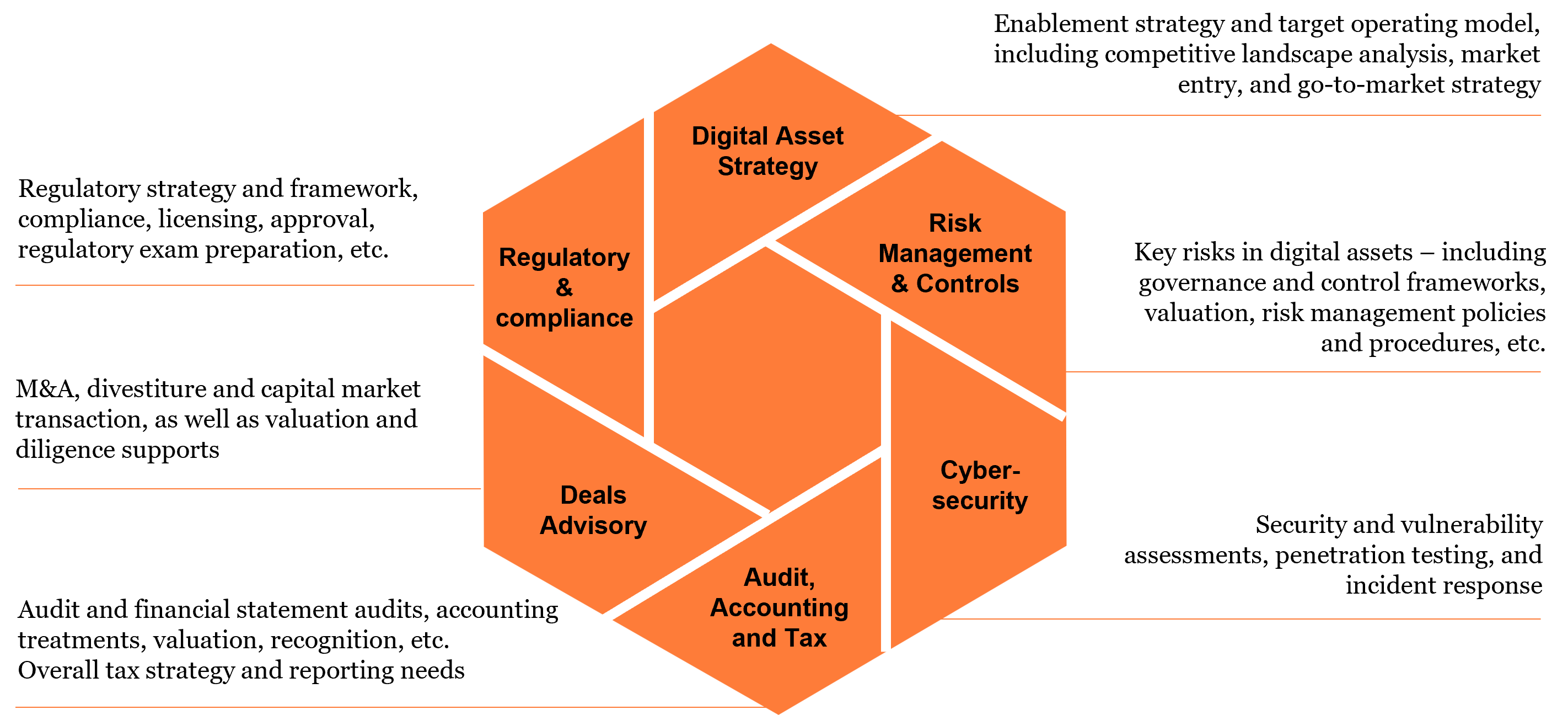
What Services does PwC provide around Digital Assets?
Using human-led and tech-powered approach and experiences, our Digital Assets help clients navigate this ecosystem and build the solutions they need to tackle today’s challenges.
We serve a wide range of Service Providers, including crypto exchanges & custodian, payment processors, digital asset banks, financial institutions, token issuers, central banks, governments, regulators & policy makers, and others.