

Next generation leaders to set the bar higher
Family businesses have several advantages over other types of business, including genuine commitment, passion and loyalty. Family members feel fully in control of the business and its ownership. While employees feel more attached working at family firms as they have common interests in the performance; for example, they have a long-term timeframe to exceed the clients’ expectations without any pressure to report to shareholders.
On the other hand, the authority and management power that the current leaders need to pass on to the next generation is a perennial problem for family businesses. Those challenges include emotional involvement, lack of formal training and preparation, and unprofessional attitude. And because succession planning is sensitive and delicate, nobody wants to discuss it. Prospective successors need to be equipped with proper education and management experience, but some family businesses ignore these factors. Last, most family businesses adopt a succession plan with an unprofessional approach, so the plan becomes very vague and difficult when the transition time arrives.
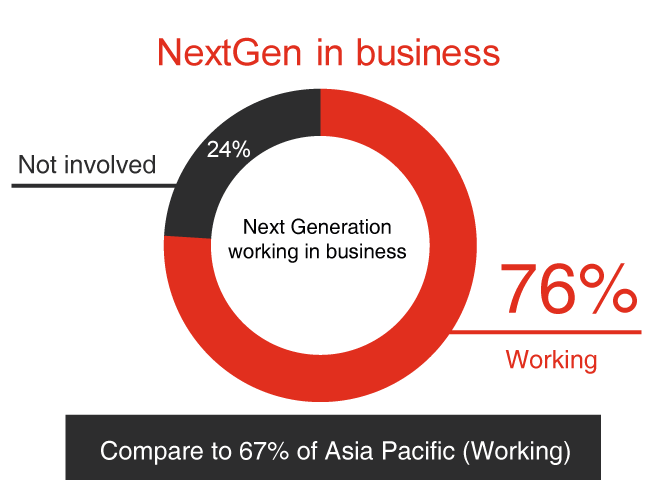
Regarding this issue, the survey asked family business leaders in Thailand about their succession plans, 76% of the respondents revealed that they have next generation family members working in the business, which is higher than APEC family businesses (67%). Also, 29% of Thais are in a senior executive position while 48% in APEC were on the leadership team. All Thai respondents unanimously said that key people in their businesses were aware of the succession plan, and 75% of those revealed that the succession plan has been discussed among family members.
Interestingly, the survey revealed a higher proportion of women in management teams for family businesses in Thailand (26%), compared to 22% in Asia Pacific. Additionally, 31% of next generation Thai family members working in the business are women. This is quite high compared to Asia Pacific, with an average of only 19%. There are two main reasons for this; first, more Thai women have access to education. According to Bloomberg4, Thailand secures the highest rank of women enrolling in a university. And second, within the business environment, Thai culture gives more opportunities to female leaders to work freely and run the organisation.
More than half of Thai decision makers (57%) revealed that they have a succession plan in place. And one in three respondents (32%) said they have the family constitution or protocol in place; while 29% of Thai leaders had a plan to entry and exit provision.
Although they have a succession plan in place, the lack of a formal plan could be a problem. When the current leader passes on the control to the next leader, he/ she might not be ready or unaware of how to take on the full level of responsibility. Furthermore, an informal plan may lead to a rough transfer of authority as other family members and key stakeholders don’t give full support to the new leader.
Forty-eight percent of plan to pass the leadership/ management/ ownership of the company to a next generation family member in 10 years or later, while 29% plan for the transition in three to five years, and 24% plan for six to ten years.
To groom the next business chiefs, current leaders have three main expectations for the next generation family members, who should 1) gain experience from inside the family business (23%), 2) gain experience outside of the family business (21%) and 3) graduate from a business school (19%). This is the same for APEC as well.
Q12a: Are there any next generation family members involved in the business who are…?

According to the Next Generation of Family Business Leaders Survey Report 2016 5, next generation leaders should prepare for their future role by first, gaining outside experience. This is one of the expectations that the older generation would like the next gens to have. The young leaders will get valuable skills and it also signals to other employees that you are in the family firm not only because of the family name.
Second, handle change with care. Changing what the previous leaders spent their lives building is sensitive and difficult. Managing this sensitivity comes in to play to avoid conflicts and resistance among family members and fellow employees. Finally, take a proper appraisal. An assessment with constructive feedback will help young leaders grow, develop and make sure they’re able to plug any gaps with a proper approach. These recommendations not only make the transition smooth, but also help make their expectations a reality.
PwC Thailand’s NextGen Club offers holistic approaches to learn, lead, and connect
Realising the important role of family business leaders, PwC Thailand has initiated the NextGen Club, offering young leaders and successors a holistic programme of training so that young leaders can learn, lead, and connect.
This is where tomorrow’s leaders will be inspired, skills will be exercised, and connections will be established for NextGen members to embark on their own journeys and continue the family business legacy.


Contact us
Sinsiri Thangsombat
Entrepreneurial and Private Business Leader, Assurance Partner, PwC Thailand
Tel: +66 (0) 2844 1000


