
Sustainability for SMEs: Hard, but not impossible

“For SMEs in Singapore, sustainability isn’t just tough – it's getting tougher.” That’s the stark reality revealed by the inaugural SME Sustainability Barometer, launched at the 2025 Singapore Fintech Festival. The message is clear: without urgent action, small- and middle-sized enterprises (SMEs) risk falling behind in a world where sustainability is fast becoming non-negotiable.
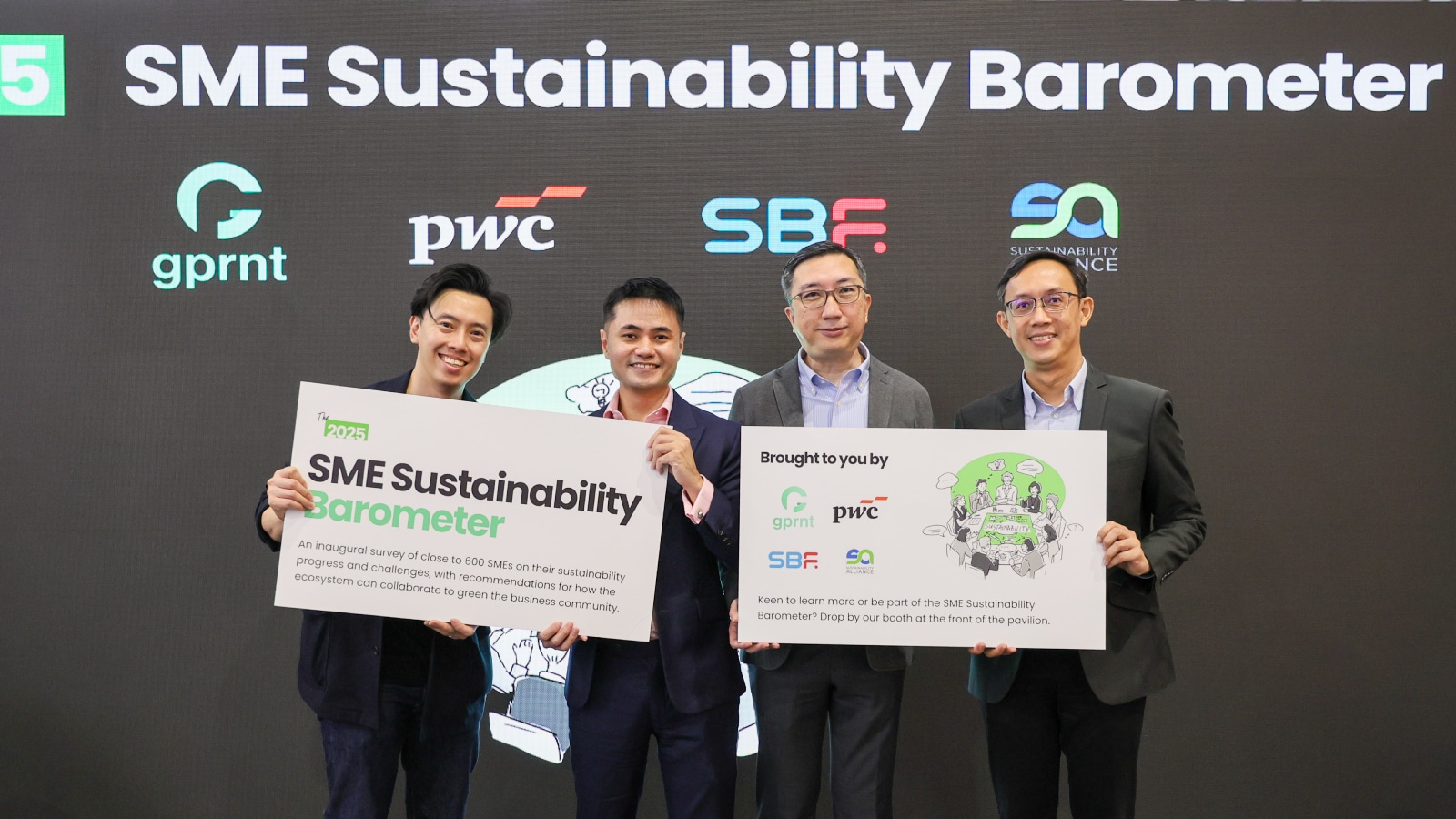
Why is sustainability still such a struggle for SMEs? The Barometer, developed by Gprnt and PwC Singapore, and supported by the Singapore Business Federation and Sustainability Alliance, surveyed nearly 600 SMEs and uncovered three critical barriers.
- Money: 52% of SMEs report constraints in funding sustainability initiatives
- Skills: 46% feel they lack the right skills to embrace sustainability
- Time: 43% say they cannot spare the time to commit to sustainability
These challenges explain why three out of four domestic SMEs have yet to begin their sustainability journey. Even more striking: 73% have not accessed or utilised any form of government support, despite Singapore’s enabling environment.
Government-backed initiatives such as the Queen Bee programmes provide upskilling support and financial assistance while tools such as Gprnt streamline sustainability reporting and data management.
Yet, sustainability remains challenging for SMEs.
The Barometer doesn’t only diagnose the problem; it offers a roadmap. Its recommendations range from practical steps to ambitious initiatives, all anchored in one principle: sustainability cannot be solved by any single actor. It demands simplicity, collaboration and shared solutions.
“Nearly three-quarters of Singapore’s SMEs have yet to tap available sustainability support. Closing this gap is critical to help them start and sustain their green journeys — a key objective of this study. Through collective action and a coordinated ecosystem approach, we can lower barriers and build a compelling business case for SMEs to take action. At PwC, we see sustainability as an opportunity for growth and resilience, and we’re proud to collaborate with Gprnt on this meaningful study.”
Start small, start now. SMEs should appoint sustainability champions – individuals empowered to lead the charge. Their initial responsibilities can be modest: raising awareness internally, identifying potential decarbonisation levers or exploring available support schemes. These small wins build momentum. Local success stories prove such an approach work1. Local businesses like pallet manufacturer Xcel and ceiling fan producer SPIN have embedded sustainability into their core value proposition, starting with champions and scaling from there. Their progress shows how dedicated leadership within SMEs can turn sustainability from an aspiration into reality.
To accelerate momentum, the Barometer calls for a unified sustainability passport. This would enable SMEs to showcase their sustainability progress clearly and credibly, reducing friction with stakeholders and building trust across their value chain. Tools and frameworks alone won’t suffice, though. Collaboration is the multiplier. SMEs, Trade Associations and Chambers, or anchor buyers must engage actively to create virtuous feedback loops, in which shared learning and collective action unlock impact at scale.
“When SMEs go green, they don’t act alone. They lift the networks around them – buyers, suppliers, customers, and financiers. They green the value chains they power, and in doing so generate high-quality data from the ground up.”
“Gprnt’s digital utilities play a catalytic role in helping businesses to automatically generate their basic sustainability metrics at no cost, which greatly lowers the barrier for local SMEs to get started. But to truly bring SMEs into the fold, we need to go further by layering clearer market signals and real incentives atop these foundations, in the form of green procurement, financing, and market access opportunities. This requires collective effort across the public and private sectors to make sustainability not just viable, but valuable.”
The inaugural Sustainability Barometer calls for stronger interconnections where individual agency at the SME level is backed by collective support across the network. Future editions could potentially track progress and shift perceptions, enabling SMEs to turn sustainability from a daunting obligation into a strategic opportunity.
The takeaway? Sustainability for SMEs is difficult, but not impossible. With champions, collaboration and clarity, the barriers of money, skills and time can be overcome. The question is no longer whether SMEs can afford sustainability; it’s whether they can risk ignoring it.
For more information, please view the 2025 SME Sustainability Barometer report or visit our Asia Pacific Centre for Sustainability Excellence website.
References
1 2025 SME Sustainability Barometer – p,22
View the 2025 SME Sustainability Barometer report
Visit our Asia Pacific Centre for Sustainability Excellence website


