
Asset and Wealth Management 2030
Capital in Motion
PwC Singapore’s Asset and Wealth Management (AWM) Conference 2026 at the Asian Civilisations Museum brought industry leaders, asset and wealth managers, institutional investors (global public investors, sovereign investors, pensions and insurance companies), family offices, and other professionals together. Minister of State Dinesh Vasu Dash delivered a keynote address, sharing insights on the prospects for asset and wealth management in Singapore and in Asia Pacific, setting the stage for productive discussions.
The theme ‘AWM 2030: Capital in Motion’ focused on key trends and drivers shaping the future of capital. Discussions include the evolution of private markets (such as infrastructure, energy transition, and private credit), new capital sources and the transformative role of technology and innovation. The keynote address, along with fireside chats and panels, highlighted Asia Pacific’s growing influence in global capital markets and Singapore's position as a leading gateway for global investors and asset managers.
Session title: Keynote address – Asia Pacific growth and Singapore's strategic role
Dinesh Vasu Dash, Minister of State, Ministry of Culture, Community and Youth & Ministry of Manpower
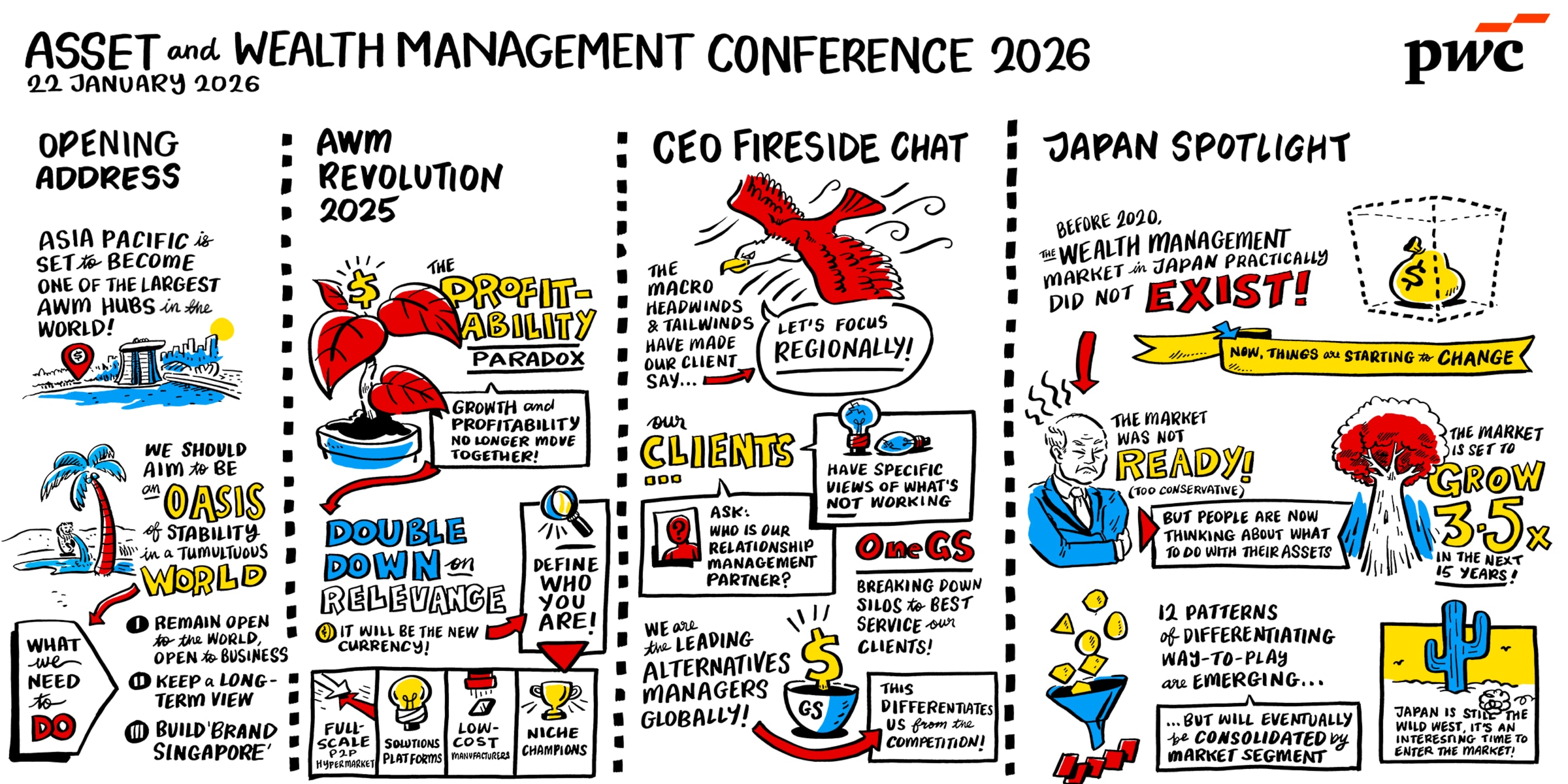
The total global pool of investable wealth is set to climb beyond USD481 trillion by 2030, with the Asia Pacific region’s assets under management (AUM) expected to grow the fastest, at a CAGR of 6.8%1. As a global financial centre, Singapore plays a pivotal role in channelling fund flows that drive economic expansion and innovation. Singapore aims to be an oasis of stability in a tumultuous world by:
- Remaining open to the world, attracting thousands of multinationals and supporting local companies in tapping overseas growth, which reinforces our competitive edge amid rising protectionism.
- Maintaining a long-term view through building a strong ecosystem to help entrepreneurs with promising start-ups scale their businesses, enable venture capitalists to recirculate capital and support a broader culture of innovation.
- Building trust in ‘Brand Singapore’ through strong partnerships among the government, businesses, and workers, ensuring inclusive growth and harmonious industrial relations.
1 The profitability paradox: Competing for relevance and returns, PwC, 24 November 2025
Session title: AWM Revolution 2025: Spotlight insights – Relevance and the profitability paradox
Paul Pak, Partner, Asia Pacific and Singapore Asset and Wealth Management Leader, PwC Singapore
The AWM industry is experiencing significant changes, characterised by the ‘profitability paradox’, where revenue does not necessarily guarantee profit. The key factors driving market divergence include clarity in targeting and service models, alongside the need for strategic trade-offs.
In this evolving landscape, relevance has emerged as the new currency. Firms that have a clear strategic direction can bolster competitiveness and profitability, avoiding the pitfalls of ambiguity that often lead to increased operating and technology costs. Asset managers identify several crucial steps to transform and future-proof their business models as they approach 2030:
- Integrating AI and automation to effectively manage scale, complexity and costs across diverse markets.
- Combining investments, financial planning and digital engagement into a single client interface to facilitate efficient governance within an integrated ecosystem.
- Leveraging intelligence to personalise portfolios, enhance client engagement and improve risk management.
Session title: CEO fireside chat – Staying competitive in a shifting Asia landscape
Daphne Chan, Managing Director and CEO, Goldman Sachs Asset Management Singapore
Paul Pak, Partner, Asia Pacific and Singapore Asset and Wealth Management Leader, PwC Singapore
In Asia, it is important for asset and wealth managers to focus on products and solutions diversification and understand their competitive advantages to remain relevant. With macro headwinds pushing clients to look beyond their home markets and invest more regionally, asset and wealth management companies must be able to recognise and leverage their distinct strengths and comparative advantages to stand out from the competition.
- Asset and wealth managers must be clear about how they can add value.
- Know when and how to collaborate with other firms.
- Embrace technological advancements like AI to boost productivity and improve services
Session title: Panel: The future of capital – Wealth transition and evolving investor preferences
Kai-Niklas Schneider, Partner, Clifford Chance
Ping Ping Lim, Vice Chairwoman, LGT Private Banking
Trevor Persaud, Head of Strategic Partnerships, AIA IM
Maan Huey Lim, Partner, Asset and Wealth Management Tax Leader, PwC Singapore
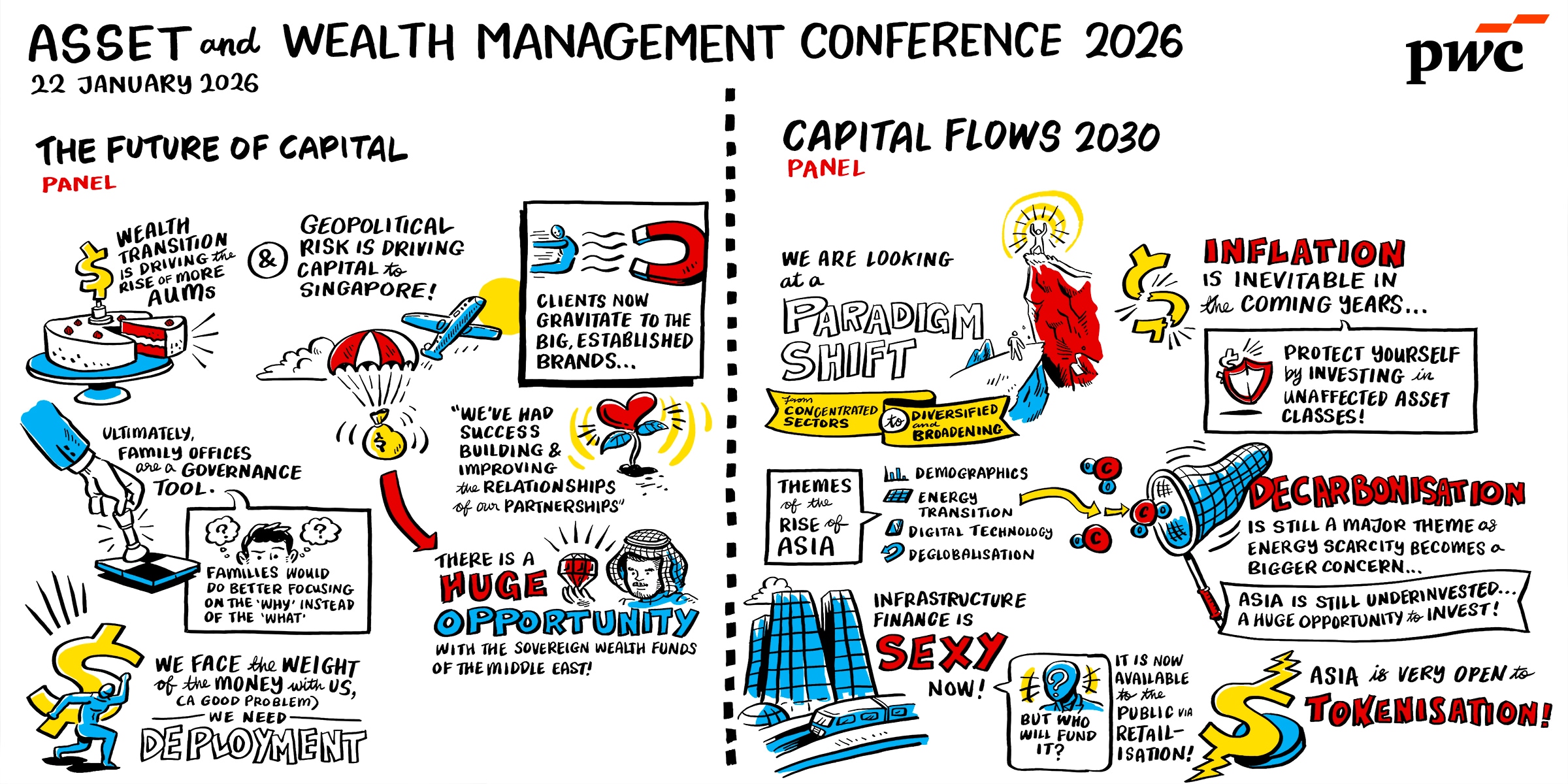
By 2030, the rapid growth of private wealth, particularly in Asia, and the increasing influence of sovereign capital is expected to significantly shape the asset and wealth management sector, driving regional investment flows and boosting demand for stronger onshore presence and local partnerships. North America will remain dominant, but Asia Pacific is where new wealth is emerging, reinforcing the need for deeper localisation and regional connectivity. Technology and innovation will continue to unlock liquidity and broaden access to new investor segments.
Against this backdrop, several trends are shaping how asset managers should respond:
- Wealth transition is accelerating AUM growth, with liquidity events playing a central role in expanding family wealth and prompting families to reassess whether previous asset allocation decisions still align with their evolving needs. This is occurring as geopolitical shifts continue to redistribute wealth and reshape investor behaviour.
- As wealth structure grows more complex, family offices are becoming central to investment decision-making. Their focus now extends beyond the ‘what’ to the ‘why’, underpinned by increasingly structured governance frameworks.
- Private capital and alternatives continue to outpace traditional asset classes. Next‑generation investors are reinforcing this momentum through stronger demand for sustainable, impact‑driven and tech‑enabled investment opportunities. At the same time, institutional investors, such as sovereign and pension funds, are seeking bespoke strategies, deeper local presence and alignment with political and developmental priorities.
In response to these trends, asset managers must innovate, differentiate and strengthen governance capabilities, forge strategic partnerships in private markets and adapt to the growing trend of retailisation in private assets.
Session title: Panel: Capital Flows 2030 – Diversification amid the sustainability push
Tariq Ahmad, Head of APAC and Co-Head Global Official Institutions, Franklin Templeton*
Chenhua Shen, Fund Partner, I Squared Capital
Rapheal Erasmus, Managing Director, Pentagreen Capital
Christina Mason, Partner, Asset and Wealth Management, PwC Singapore
Looking ahead to 2030, the AWM industry faces a number of challenges. The recent geopolitical shift towards deglobalisation, coupled with uneven demographic trends, is heightening investor caution despite the potential in emerging markets. Inflation is likely to persist in the coming years, while decarbonisation remains a key theme against the backdrop of increasing energy scarcity.
Despite the challenges that lie ahead, there are clear opportunities, solutions and promising developments within the asset management industry:
- Asia Pacific markets are transitioning from concentrated sector exposures to diversified, multi-market portfolios as investors seek to enhance resilience.
- Access to private markets is expanding, with success hinging on effective product design, liquidity management, investor education and regulatory readiness.
- With inflation expected to persist, asset managers increasingly focus on asset classes less sensitive to inflationary impact to maintain stability.
- Energy constraints are accelerating investments in renewables, data centres, EV infrastructure and next-generation assets, supported by innovative financing models.
- Asia’s under-allocation in global portfolios presents structural opportunities across private markets, infrastructure and credit sectors.
- Private credit in Asia is maturing, playing an increasingly significant role in financing infrastructure and transition assets.
- Singapore and Hong Kong lead Asia's tokenisation efforts, enhancing liquidity, transparency and investor access within financial markets.
* Role held at the time of the panel.
Session title: Spotlight – Japan’s AWM sunrise
Toshiya Tsutsumi, Partner, PwC Japan
Before 2020, the AWM market in Japan was almost non-existent. Traditionally conservative by culture, many individual investors keep half of their assets in cash. However, attitudes are changing, and more people are now considering new ways of managing their assets. Regulatory measures have been introduced to encourage households to move their savings into capital markets while supporting long-term demand for professionally managed assets. With this positive momentum, driven by regulatory changes, improved market conditions and innovative financial products, the wealth management market is expected to grow by 3.5 times in the next 15 years.2
2 Strategy& (PwC) analysis
Conclusion
Overall, the conference underscored the need for asset and wealth managers to innovate, adapt and strengthen governance, while capitalising on the expanding Asia Pacific market and evolving capital sources to succeed in the coming decade. The forum reinforced Singapore's position as a key financial hub; well-positioned to embrace global capital flows and unlock new growth opportunities through collaboration and innovation.
Key takeaways from the AWM Conference 2026 at a glance
Step inside our AWM Conference 2026: Capital in Motion
Catch the key moments—from Minister Dinesh Vasu Dash’s keynote to panels on private markets and innovation. Join our mailing list to stay updated on future events and their exclusive insights.


© 2015 - 2026 PwC. All rights reserved. PwC refers to the PwC network and/or one or more of its member firms, each of which is a separate legal entity. Please see www.pwc.com/structure for further details.