
PwC Global Internal Audit Study 2023
How this study can help you
Our IA studies have helped to capture new ideas, stimulate debate, and unlock new opportunities for IA functions to evolve, add value, and remain relevant. The insights shared in this report can help not just IA leaders, but those who rely on IA’s ‘superpowers’ to give them confidence, and help see risk differently.
IA Leaders
- Update or create your IA strategy
- Support case for investment and change initiatives
- Have different conversations with stakeholders on new risks or topics
- Identify ways to achieve better return on investment (RoI) from technology
- Train your IA team and plan your talent strategy
Board and Business Executives
- Update or create your IA strategy
- Support case for investment and change initiatives
- Have different conversations with stakeholders on new risks or topics
- Identify ways to achieve better return on investment (RoI) from technology
- Train your IA team and plan your talent strategy
Second Line Leaders (Risk, Compliance, etc.)
- Update or create your IA strategy
- Support case for investment and change initiatives
- Have different conversations with stakeholders on new risks or topics
- Identify ways to achieve better return on investment (RoI) from technology
- Train your IA team and plan your talent strategy
Five key findings
Our survey highlighted five compelling findings. Each is explored further in this report, focusing on why they matter to IA and its stakeholders, the value to the organisation, and practical tips to address them.

1. Megatrends are creating a complex and interconnected risk multiverse
Recent megatrends are creating risks in new areas that are unprecedented in scale and complexity. IA is uniquely positioned to give the organisation confidence to navigate these challenges and find a new direction—and new opportunities.

2. IA needs more involvement in strategic areas to remain relevant
Driven by increased complexity and higher stakes, business executives are opening the door for IA to help them address more strategic areas. IA can choose to engage differently with its stakeholders to provide new strategic value, or risk becoming irrelevant.

3. IA can be a unifying force
First and second line have ‘levelled up’ their capabilities and response to risk. IA can help combine expertise across the organisation to harness momentum and forge something stronger together.

4. IA’s human ‘superpowers’ are more important than ever
Technology has become exponentially more sophisticated, providing organisations with access to more data and opportunities than ever before. IA must continue to evolve its human capabilities to ensure it can turn data into decisions, build new relationships, and help others to see risk differently.

5. IA can boost its RoI by changing its approach to technology
Technology investment in recent years has not yielded the returns many have expected and the next wave of technology is already here. IA needs to recalibrate its approach and work with others to unlock the potential of technology; but the window is closing fast.
1. Megatrends are creating a complex and interconnected risk multiverse
IA is uniquely positioned to help the organisation navigate risk and change
Today’s megatrends are driving rapid global change in areas like technology, geopolitics, climate, supply chains, regulation, and workstyle reform. These changes are not occurring in isolation, but rather they are interconnected, interwoven, and ‘stacking up’ to create complex risks. In other words, organisations are facing a new reality—a ‘risk multiverse’.
This complexity is amplified by the globalised nature of modern markets, faster information flows, and more sophisticated expectations of consumers, regulators, and stakeholders—and greater consequences for failing to meet these expectations. This brings with it more blind spots and new types of disruption—or ‘company killers’.
The result can be that organisations slow down, lose confidence in their strategy and roadmap, and are unable to steer quickly through change or avoid hazards. This can mean disruption at best, or obsolescence at worst. This is forcing organisations to speed up transformation and change their core strategies. PwC’s 27th Annual CEO Survey found that 45% of CEOs do not think their organisations will be economically viable in ten years’ time if they continue on with their current strategy.
A chance for IA to shine
To succeed in this new reality, organisations will need different approaches, skills, and technology. For IA, it means they are needed more than ever. Our survey showed Singapore respondents ranked IA’s top attributes as its (1) independence and objectivity, (2) risk and controls mindset, and (3) collaborative approach. Enhanced by IA’s organisational reach, this unique combination makes IA ideally placed to help organisations connect the dots and navigate risk and complexity.
When equipped with the right technology, vision, and talent, IA’s ‘superpowers’ can not only protect value, but also create value by ensuring the organisation can capture the upside of risk. Our survey found that, in addition to better governance, more risk awareness, and stronger internal control, executives believe that a high-performing IA function can help:
- Optimise business processes and systems
- Provide confidence to make better and faster management decisions
- Obtain trust from external stakeholders, including investors, regulators, and customers
Ultimately this can mean organisations have the confidence to adjust their risk appetite to take more risks and move quicker—all of which is critical in responding to the megatrends and remaining viable as an organisation.
For IA, This means that IA leaders must be bold. They must voyage into uncharted territory where there is no roadmap.
Responding to the megatrends
We are seeing examples of IA functions pushing forward to tackle today’s megatrends. The following are examples of IA's response to supply chain disruption, rapid IT modernisation, and acceleration of Artificial Intelligence (AI).
(i) Supply chain disruption
One example of multi-layered complexity has been the recent supply chain disruption. This caused a crisis where demand was difficult to forecast, goods were hard to source, transportation was hard to find, and routes were backlogged and unpredictable. Volatility rippled throughout the supply chain and introduced significant risks to business models and processes, putting it high up on the agenda for many organisations.
Singapore IA functions, in comparison to their global counterparts, seem more prepared in case of supply chain disruptions. Our survey found that 56% of Singapore’s IA functions address supply chain disruption in their audit plan, compared to 47% globally, and 15% plan to do so in the next one-to-three years. Many, however, are wondering how they can tackle risks and disruption that occur with such scale and speed.
IA realises that to address the speed of these risks, all parts of the business need to be aligned, with second and third line working alongside the business to ensure communication is fluid and early warning (or ‘risk sensing’) systems are built in. For IA, this has included working with Compliance to automate supplier due diligence processes, leverage third party intelligence data, and refocus vendor audits and monitoring. IA can use its vantage point to look across the end-to-end supply chain and challenge whether resilience and business continuity arrangements are robust, and management has stress-tested the supply chain for blind spots or weaknesses, such as supplier dependencies.
(ii) Rapid IT modernisation
Accelerated by the COVID-19 pandemic, many organisations have had to turn to technology to help adapt their strategies and commercial and operational models to remain viable. This has forced Singapore’s IA functions to reflect on how they can keep pace with this change, and reconsider where in the change lifecycle they should be involved. The investments that organisations have made in recent years—from large enterprise resource planning (ERP) system implementations, introduction of AI, machine learning, automation, and cloud solutions—have meant old IA approaches may no longer work, and new skills are needed. This includes approaches to new risks around responsible AI, collaborating with outside specialists, or with guest auditors from the business. It has also meant being bold enough to stop IA activity that is not adding much value.
The pharmaceutical, life sciences, and medtech industry, for example, has experienced rapid growth and groundbreaking innovation in recent years. This has included streamlining and automating research and product development, leveraging technology for clinical trials, and a shift towards remote interactions. This has changed the strategic and commercial landscape for organisations—and patients—but also forced IA functions to reflect on their own approaches.
(iii) AI accelerating fast
The rapid emergence of AI marks the beginning of a new phase of IT modernisation. Traditional AI is advancing, and Generative AI is so powerful and easy to use, it’s poised to change business models and revolutionise how work gets done. A wide array of risks have already emerged, including risks to decision-making, privacy, cybersecurity, regulatory compliance, third-party relationships, legal obligations, and intellectual property. This is explored further in PwC’s Managing the risks of generative AI publication.
IA will be a key facet of addressing these risks and helping ensure the upside and RoI from AI can be realised. This includes providing stakeholders with confidence that there is a responsible governance framework around AI and appropriate controls are embedded in underlying processes. This may require IA to step outside of its comfort zone and become involved earlier in the change lifecycle to assess whether the organisation’s AI strategy is appropriate and transformation risks are being addressed.
In parallel, IA has to determine how to harness the potential of AI and other technology, like RPA, to evolve its own capabilities and ways of working. In the past 12 months, just 23% of Singapore’s IA functions have invested in RPA or AI for use inside the function. Many IA functions are still grappling with adopting and using more basic technology, like audit workflow or analytics tools, and so the arrival of AI is causing many IA leaders to reflect on how best to approach it. Some IA functions have ‘hit a wall’ with their technology strategy as the returns from previous investments have not always met expectations—or they are not clear on the actual problem they are trying to solve with technology. We explore this further in section 5 of this study.
Levelling up: Actions to consider
2. IA needs more involvement in strategic areas to remain relevant
IA can choose to provide new strategic value or risk becoming irrelevant
A door being opened
PwC’s Global CEO Survey asked CEOs what they consider to be the top threats to their business. Inflation and macroeconomic volatility topped the list. Our Singapore IA Survey shows, however, that nearly 50% of Singapore’s IA functions are not addressing these two top threats in their audit plan, and one in 10 have no plans to do so at all.
If IA is not tackling an organisation’s greatest threats, how can it be considered the last line of defence? It may be that IA does not believe it’s within its mandate to address some of these areas. For some, these threats are perceived as not auditable and for others, IA may lack the confidence or skills to tackle them.
The good news is that the door has been opened for IA. Our survey of the Singapore market shows that many business leaders want more strategic engagement with IA early and proactively with 87% wanting IA to be involved during the risk identification and assessment stage and over 50% seeking IA involvement in management strategy and planning. This may be driven by a multitude of factors, including the complexity of today’s risks, the need to provide comfort to others, awareness of the benefits of better governance, and/or recognition of IA’s value and potential.
Strategic risks are not always easy to see, and are sometimes not the ones documented in the risk register. They will also be specific to each organisation, so it’s important for IA to have the right Board and executive relationships—and sufficient opportunity to talk—to understand what matters. IA must be willing to challenge strategic decisions when risks indicate a course correction is needed; however, to do this effectively IA may need to reposition itself with stakeholders and be willing to have different conversations in order to be heard.
Examples of strategic areas some IA functions are auditing
- Digital transformation, including the alignment of the IT and business strategy, adoption and use of AI (and its responsible use), and reliability of data used in strategic decision-making
- Mergers and acquisitions (M&A), including robustness of due diligence and approval processes, financial model reliability, coverage and quality of risk data used, process and controls integration, and appropriateness of the criteria used to measure synergies and RoI
- Research and development (R&D) and product design, including spend controls, alignment to business strategy, and incorporation of technology and data. This is particularly important for industries where R&D approaches have changed over recent years, such as the pharmaceutical sector
- Workforce transformation, including its impact on oversight, risk and control ownership, customer response, and risks in meeting other strategic objectives, such as talent and skill gaps
- Inflation, including inflation risk mitigation, budgeting and forecasting processes, hedging programs, pricing adjustments, procurement strategies including long-term contracts, and alternative sourcing models
- Macroeconomic volatility, including macroeconomic risk assessments and risk mitigation plans, consideration in strategic plans, physical location / production / vendor concentrations and supply chain resiliency plans, business continuity and crisis response plans, and insurance coverage analysis
Management wants better risk conversations
Our survey indicated that IA has the opportunity to have more high quality, open, and frequent conversations with management about risk. It shows that only 23% of stakeholders classify their risk conversations with IA leaders as of sufficient quality and frequency.
The benefits of better risk conversations can include new insights on emerging risks, more focused and timely assurance, and a fresh perspective on other opportunities. Singapore Survey found 77% Chief Financial Officer report having good quality and frequent conversations with the IA leaders. The figure is higher in comparison to the global survey (60% vs 77%). This can help the business course-correct where necessary, particularly for leaders who worry about the longer-term viability of their organisation.
Practically, this may mean changing the format and style of stakeholder meetings, engaging earlier when a new strategic initiative is being considered, and communicating more frequently outside of the normal audit cycle. It can sometimes be as simple as IA asking its stakeholders to explain their business strategy, priorities, and expectations for the future.
Examples of how IA can have better risk conversations
The definition of ‘better’ will differ from stakeholder-to-stakeholder, but we have seen effective IA teams engage with their stakeholders by:
- Offering a viewpoint and commentary on new or draft business strategies and plans. IA can maintain objectivity whilst still offering a perspective based on their cumulative experience and ability to see risk differently
- Authoring discussion papers or presentations on emerging risk areas or topics, outside of regular audit reports, which can offer an ‘early warning’ or prompt discussion. Our survey found that half of IA functions are authoring position papers on new risks, trends or regulation
- Summarising findings from multiple audit reports into broader root causes and themes at a company level. This can also be mapped to trends in the industry
- Bringing other expertise from first or second line teams, or external advisors, to broaden debates and offer other perspectives; for example, in topical or risk workshops
- Sharing materials from industry or technical sources and/or communities of interest. This can help highlight industry-level trends or emerging risks
- Agreeing ‘value-based’ metrics and Key Performance Indicators (KPIs) for IA, so it can be measured against the value it adds to stakeholders
Levelling up: Actions to consider
Use visualisation tools to present elevated insights and to show how IA is connecting the dots across risks and organisational silos. Vary the nature, timing, and extent of reporting to fit different needs and different stakeholders.
Illustrative quadrant showing IA risk focus and approach
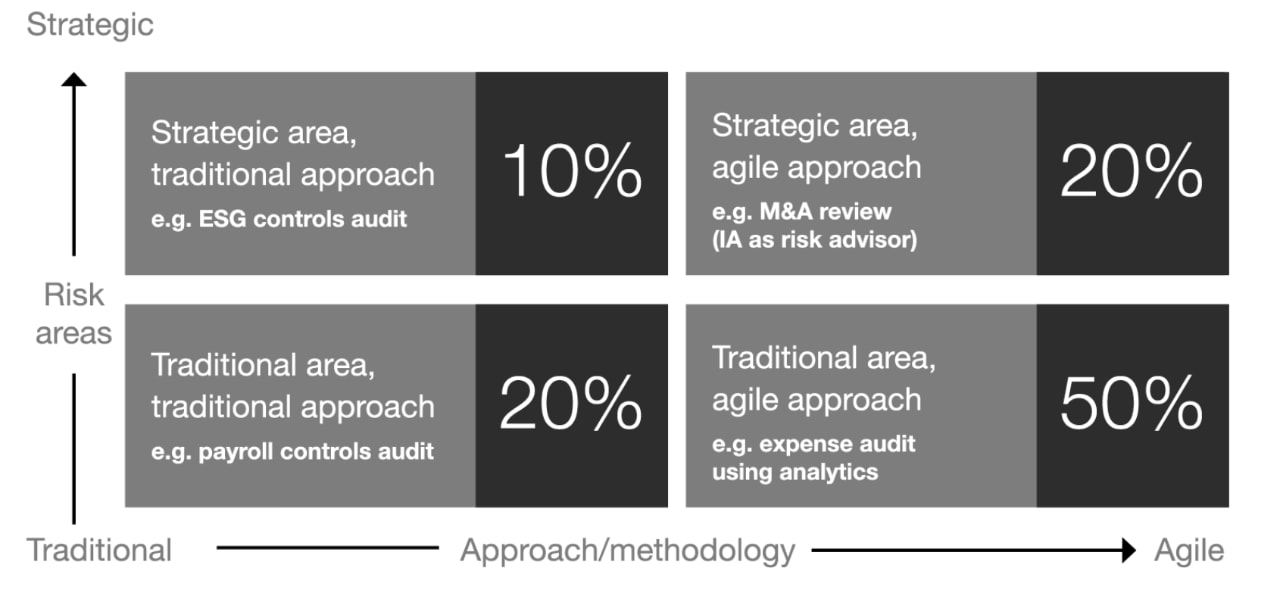
Percentages are illustrative only and each organisation needs to decide the right balance for them.
3. IA can be a unifying force
IA can harness and multiply the expertise of others to benefit everyone
Working alone will always result in blind spots
Most significant corporate failures have resulted from something the organisation either didn’t see coming, or they didn’t understand. Risks are not always easy to see—they can sometimes be too big (e.g. geopolitical, macro-economic, industry-wide) or buried in complex and multi-layered technical areas (e.g. regulatory, cyber, commercial). When they occur, the consequences can sometimes be seen in every part of the organisation, and often externally, which can impact reputation.
IA’s unique vantage point and risk-mindset means that it is able to ‘see through the walls of the organisation’ and shine a light on areas others may not clearly see. It cannot, however, see everything, all of the time. It is unlikely that any one function has the skills, experience, and capacity to cover the diversity of risks organisations face. Traditionally, IA functions have relied on guest auditors or co-sourcing to bring in the required expertise and, whilst this is still necessary to reinforce IA’s capabilities, IA needs to also be confident that nothing is missed at an organisational level. This is particularly relevant to industries that have been impacted by significant disruption to commercial models, complex reform, or new technological advancements, such as the pharmaceutical, energy, and financial service sectors.
The good news
The good news is that our survey showed that organisations have at least five second line functions on average with which to collaborate, and most have strengthened their capabilities and ‘levelled up’ over the last three years.
The strengthening of the second line represents an opportunity for IA to harness these skills and maximise the power of combining different capabilities; however, there is work to do: just over 28% of IA functions show strong alignment with first and second line on key risks and problems.
Business executives recognise that there is room for improvement with 72% believing that IA does not have strong alignment with the other lines on key risks and problems. This gives IA a strong mandate to take the lead in creating a unified view and finding new ways to leverage the different capabilities in the organisation.
The concept of ‘assurance maps’, which provide a consolidated view of how comfort over key risks is being addressed across the organisation, has gained traction in the profession. While the second line challenges and performs a critical role in its oversight of risk, compliance, and internal controls, IA is in a position to provide an independent and objective assessment and elevate issues beyond management to the Audit Committee.
Practically, this can involve a range of different approaches, such as:
- Jointly preparing an assurance map and aligning activity plans
- Ensuring the links between mission statements, charters, and strategies are clear (and it is understood how they fit together in the overall governance structure)
- Authoring risk papers together to brief or update stakeholders
- Aligning risk taxonomies and control libraries, or sharing research and reference materials
- Co-investing in technology, such as eGRC, data analytics, and visualisation tools
- Co-developing or sharing automation and scripts used in assurance activities
- Talent sharing programmes, such as secondments and guest auditors
- Forming communities of interest on specialist or topical matters, such as ESG
Done well, such actions allow IA and others to achieve a ‘multiplier effect’—adding up to better risk coverage, greater efficiency, and more valuable insights. In other words, they become more than the sum of their parts. This can also have the benefit of showcasing to the Audit Committee and Board the value of integrated assurance, and opens the door to better engagement.
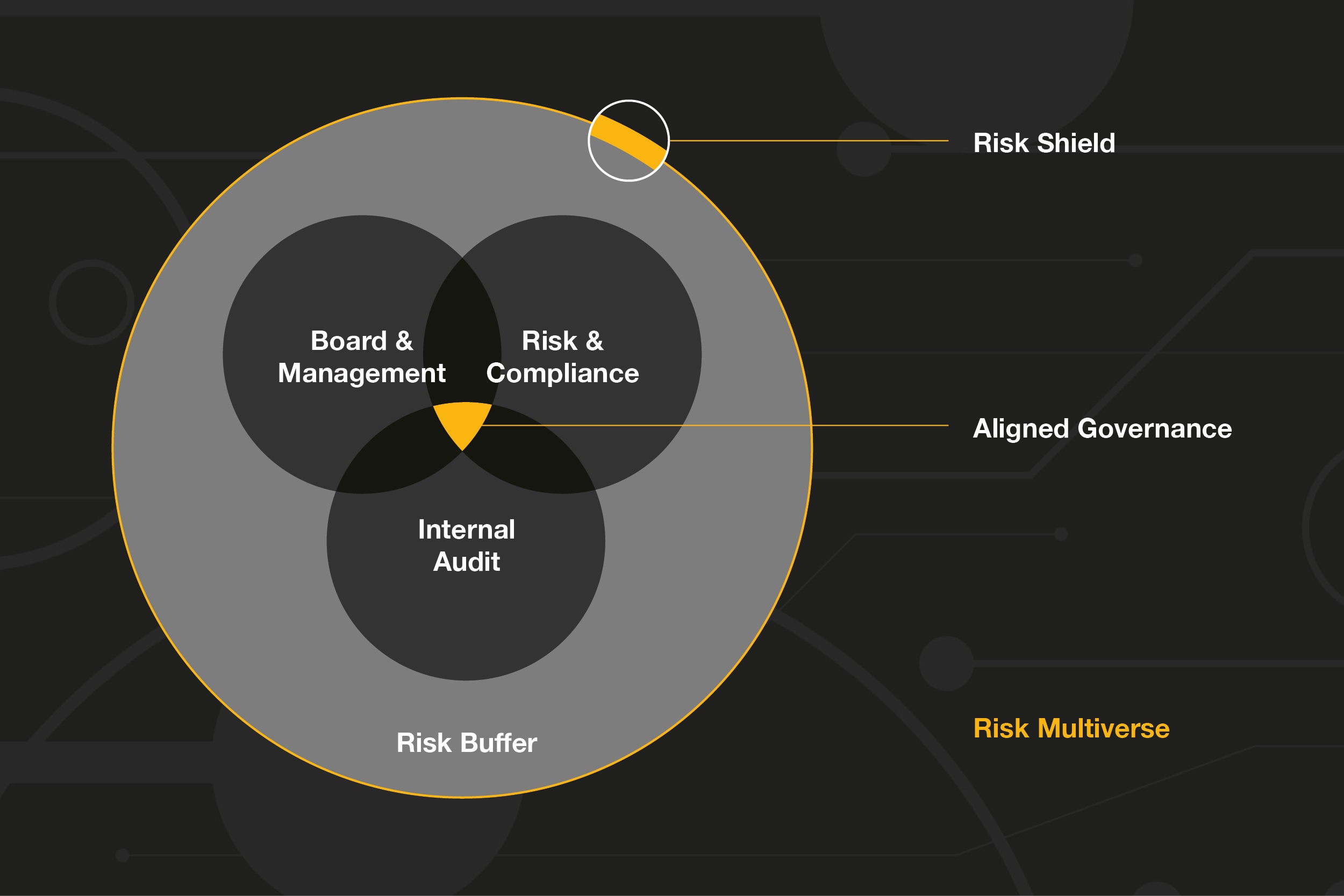
A ‘risk shield’ around the organisation
A shield is only as strong as its weakest part. In today’s world, where risks can come from all directions, an organisation’s foresight and defense needs to be 360-degrees. As organisations assemble different capabilities and embrace new technology, they may also need to look differently at their internal structures, including how the three lines work together to increase agility, break down silos, and remove blind spots to ‘see through walls’.
Whilst it is critical that objectivity remains one of IA’s core superpowers, it should consider where the activities of each line intersect and overlap, how communication flows between them, and what this means for the organisation’s resilience as a whole. This involves being clear on responsibilities, the control and assurance mechanisms that exist, and the new opportunities to collaborate.
Levelling up: Actions to consider
4. IA’s human ‘superpowers’ are more important than ever
IA must develop new tech skills while keeping human capabilities at its core
The human touch
Professional scepticism, a risk and controls mindset, and objectivity are long-standing IA skills and remain the foundation for its future. As the scale and complexity of risks change, IA will need more nuanced human skills to have meaningful and strategic conversations with its stakeholders. Our survey found that Independence and Objectivity (79%) and Risk and Control Mindset (44%) as key strengths of IA.
Technology skills will remain critical, and should continue to evolve, but they must be balanced by the human side of the equation. Important attributes include strengthening strategic thinking as well as creative thinking, agility, flexibility, and empathy. This will also be particularly important as changes from AI and other emerging technology give organisations access to data that they might not have either had access to before or been able to collate manually. If there is no one able to interpret this data, turn it into information, and view it through a risk and assurance lens, it will remain unused in the real world.
Talent sourcing and retention will need more innovative approaches
Just 18% of Singapore executives, compared to 45% globally, are very confident that IA has the talent and skills the function will need in the next three to five years. They rank the lack of IA resources, skills, and expertise to cover key risk areas as the top barrier that could prevent IA from achieving the outcomes the organisation wants.
The stakes are high. Turnover and re-skilling remain challenges; PwC’s Global Workforce Hopes and Fears Survey 2023 – Singapore highlights of 1,000 workers indicates that “The Great Resignation”is far from over in Singapore. In the next 12 months, 37% are extremely or highly likely to ask for a pay raise or promotion while 34% are likely to change employers.
Levelling up: Actions to consider
5. IA can boost its RoI by changing its approach to technology
The window is closing for IA to adopt the next wave of technology innovation
Technology investment is not delivering the desired benefits
In 2019, PwC’s Internal Audit State of the Profession Study focused heavily on IA data and technology, and PwC has subsequently seen a lot of activity in this area; however, the RoI has not been realised. Just over 10% of Singapore’s IA functions, compared to 20% globally, have achieved the desired benefits from their technology and data investments over the last twelve months.
IA’s greatest use of technology and data has been for risk assessment activities, audit planning, and continuous monitoring. Some have made great strides in integrating data into IA processes, and are seeing the benefits. Conversely, nearly a third of IA leaders report they are not using data and technology to a great extent in any area, including scoping or testing activities in individual audits.
There could be multiple reasons why RoI is falling short, but these can include:
- Strategy: The technology is driving the strategy, rather than the strategy driving the technology. This is a common pitfall and requires pausing to reconsider and remap activities to the business and IA strategy, objectives and intended outcomes. In other words, what problem or opportunity is the technology really being used to address, and is this realistic?
- Measurements for success: IA has not defined the right KPIs to measure success. The outcomes might be there, but no one is measuring them.
- Status quo: The technology changes, but people’s way of working remains the same. Resistance to change is common and can stop teams from reaping the full benefits of new technology. The introduction of visualisation software, for example, can optimise audit work and present new insights; however, some IA functions still either don’t present the output, or use it in a traditional report format, which can reduce its impact.
- Siloed: The technology is operated in isolation, not connected to other data sources in the organisation, or accessible and visible to others. For example, IA might have a sophisticated workflow and issue tracking tool, but if audit findings are still manually collated and emailed in spreadsheets to stakeholders, its value is hidden behind a wall.
- Duplication (and confusion): Investment in similar or competing technology is made in different parts of the organisation, resulting in duplication. This can lead to confusion over which should be used, prioritised and invested in.
Speeding up
The advancement of AI is redefining what is possible for organisations, business functions and individuals. IA leaders have discussed the potential value of automation and AI for years, yet only 41% plan to invest in RPA or AI in the next three years.
There could be various reasons for this. It could be fatigue from other technology investments, or it may be that IA leaders just don’t know how or where to get started. There are, however, risks to inaction, including becoming irrelevant as others move forward.
As organisations continue to change and adopt AI, IA needs to evolve in parallel. If IA doesn’t understand AI, how can it understand the many risks arising from it, or provide comfort over them? What would stop the business from trying to forge on ahead without the comfort IA provides or get this directly from generative AI itself? And, if so, what might be the consequences (seen or unseen)?
The time horizon will vary and depend on when, and how, each organisation adopts AI. At some point, budget and resource capacity will constrain IA from covering an expanding risk landscape, and technology will be needed to drive greater efficiency. Moreover, if IA waits too long to recruit knowledgeable talent, those individuals may become hard to find or attract in a more competitive market.
No one knows for sure where AI will lead, but many have an educated view, and IA needs to be at the forefront of that thinking. The resources available to IA functions vary significantly, but there is still an opportunity—or even a necessity—to make forward strides in embedding technology through all that IA does.
A financial services perspective: lots done, but more to do
As historical barriers such as older bespoke and inflexible systems improve, many IA functions are investing more to capitalise on new opportunities: 62% of IA functions have invested in training and upskilling workers on data and technology in last 12 months.
Technology is not the panacea. It can accelerate the availability of information, but human experience and judgement is needed to turn it into trusted insights. Generative AI is driving real opportunities for change, but a machine cannot (yet) identify the difference between right and wrong.
Levelling up: Actions to consider
Read the global report
Seeing through walls to find new horizons
Benchmark yourself against your global peers
Find out more about PwC Singapore’s internal audit services and other insights
Contact us
Francis Wan


