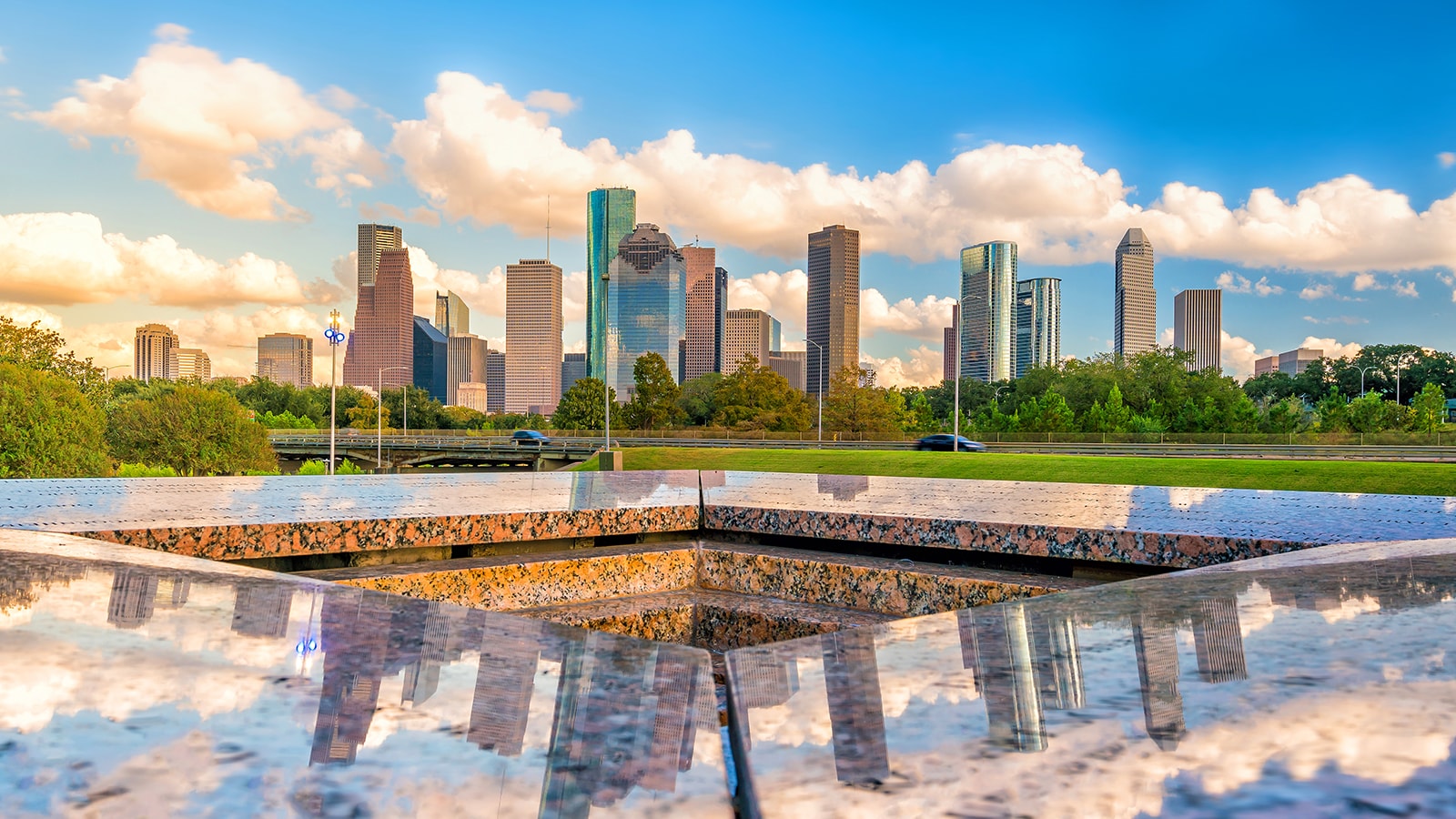
With over 7.5 million residents, the Houston metropolitan area is one of the fastest-growing regions in the nation. This thriving market boasts a diverse array of industries that create thousands of jobs, contributing to a 7.9 percent year-over-year increase in gross metropolitan product (GMP) to $697 billion. Houston GMP is expected to double by 2042.
Billing itself as the energy capital of the world, Houston’s economy today has a surprisingly diverse set of drivers. The Texas Medical Center is one of the largest medical facilities in the world, treating approximately 10 million patients annually. The region also has one of the world’s largest industrial bases, with more than 7,000 manufacturers producing over $75 billion in products each year.
As a prime distribution hub, Houston has 50 percent of the U.S. population within a 1,000-mile radius and is home to the Port of Houston, the leading U.S. port in terms of foreign waterborne tonnage. Houston handles 73 percent of U.S. Gulf Coast container traffic and 97 percent of Texas container traffic. Not only is it the nation’s fifth-ranked container port by total TEUs, it also boasts the highest percentage increase of container volume since 2019.
The Houston metro area is also home to more than 500 space, aviation, and aerospace firms and institutions. Of the 50 largest aerospace manufacturing companies in the United States, 10 have a presence in the Houston region.
Within the Houston office market, building quality and location have become more important than ever. There has been a consistent trend of major companies relocating their headquarters westward to the Energy Corridor. This shift in demand has driven substantial positive net absorption in the Katy Freeway submarket over the past five years. Office vacancy along the Katy Freeway is currently 7.4 percent, compared with 24.3 percent for Houston as a whole.
While the flight-to-quality trend is a national phenomenon in the office market, it is amplified in Houston. The gap between the newest Class A properties and older buildings has widened substantially over the past five years. Vacancy in new buildings since 2015 currently sits at 10.8 percent, roughly in line with the 2019 average. Pre-2015 Houston office buildings have triple the overall vacancy rate at 30.7 percent. This delta between pre- and post-2015 buildings is the largest seen, and is expected to continue widening through the end of 2025.
Given its diverse industry base, fast-growing population, and dominant presence of some of today’s leading economic growth sectors, Houston is well-positioned to further establish itself as a predominant driver of U.S. economic growth.
—CBRE


