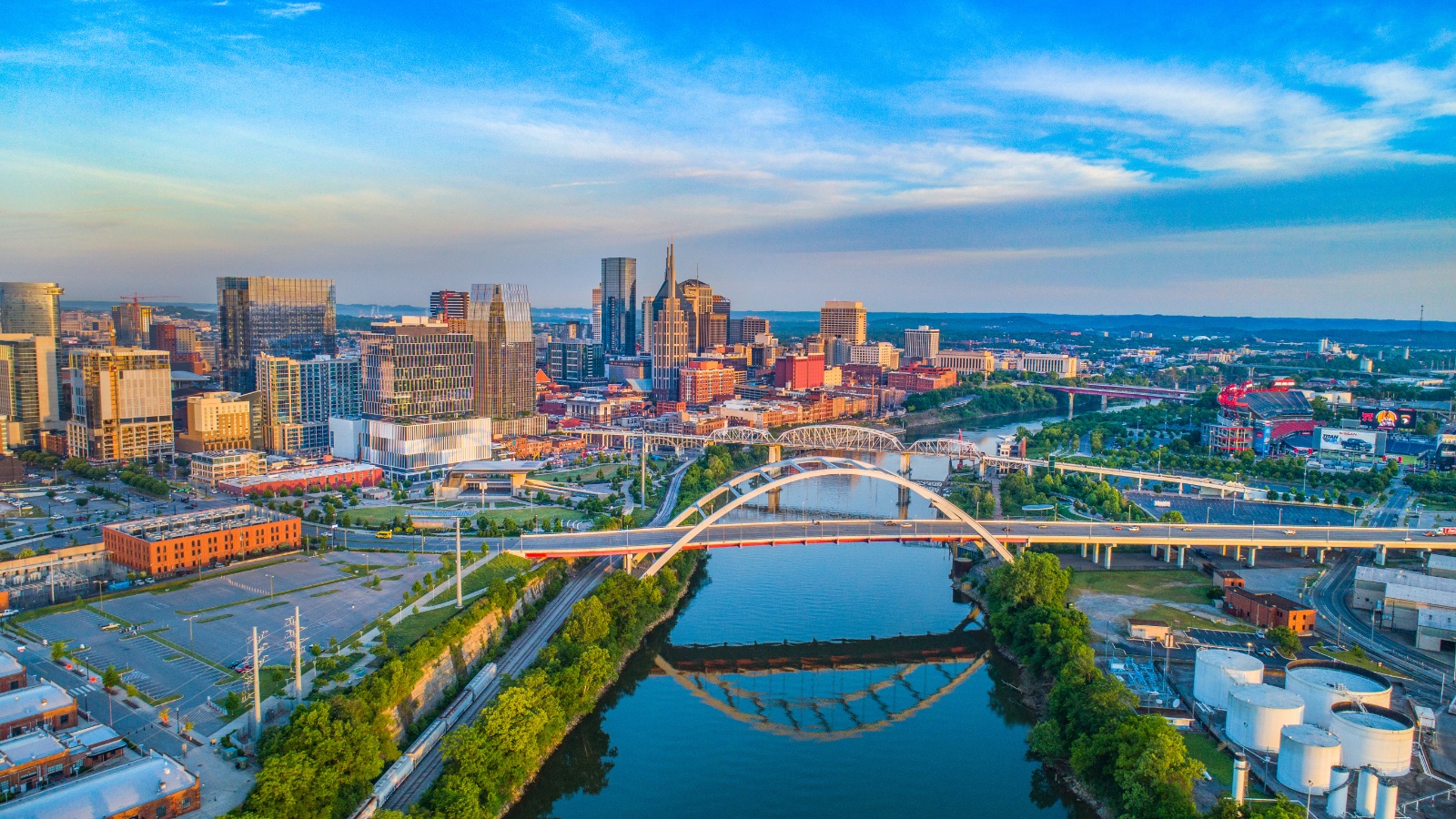
The momentum in Music City has crossed the Cumberland River, as a second urban core emerges on the East Bank. A global enterprise technology company has advanced plans for a massive East Bank/River North campus, submitting final development approvals for what is now envisioned as a roughly 1.3 million-square-foot office campus on more than 80 acres, part of a broader $4.5 billion investment. The project—arguably the largest investment in Nashville in modern history—is expected to bring 8,500 jobs (from its current ~900) and includes offices, hospitality, public space, a pedestrian bridge, and extensive mixed-use development.
The public and private investment tied to the new $2.2 billion Titans stadium, opening next year, alongside the 30-acre Eastpoint Flats development, which kicked off in May 2026, is driving land value, hotel development, multifamily interest, and infrastructure spending throughout the East Bank corridor.
In the Downtown, Nashville Yards has moved beyond a development project and is becoming a fully functioning mixed-use district. During the past year, it has attracted additional corporate users, including major office tenants, and developers have filed plans for another office tower despite a cautious national office development environment. As elsewhere, the market is now favoring new, amenitized space over commodity space.
Overall office vacancy sits at 16.7 percent in 3Q, down from the 17.3 percent peak in early 2025. With nearly 1 million square feet of demand since 2024 and only one small 60,000-square-foot building underway, the market is now clearly signaling inflection and demand growth. Should they materialize, the 1.4 million square feet of planned conversions would pull vacancy to 15.7 percent. Nashville is transitioning from one of the nation’s most active office development markets to one of the most supply-constrained.
Segmentation continues to show greater dispersion in rents: Downtown class A space built after 2007 asks $60.67/square foot versus $38.11/square foot for older stock. A global coffee retailer’s 250,000-square-foot Peabody Union lease, the start of a 2,000-job hub, is another green shoot in a market where leasing volume is at its highest level since 2021 (2.3 million square feet).
Capital targeting Nashville has been flat relative to 2024 and 2025 at an estimated $6.5 billion for all of 2026. Investment sales peaked in 2021 and 2022 at $11.1 billion and $13.9 billion, respectively, however the current run rate represents a historically strong market. A fully leased downtown headquarters sold in May for $255 million, close to $500/square foot and the second-largest office trade in city history. A national real estate investment firm paid $217.8 million for a Gulch Union tower.
The supply-demand push-pull in multifamily housing is finally winding down. Demand relative to stock (3.6 percent) ranks Nashville 4th in the nation as 18,100 units were absorbed in the first nine months of 2026. Vacancy has come in nearly 230 basis points to sub-10 percent (9.8 percent) for the first time in years, paving the way for a broader rent recovery, which remains in its early stages.
Nashville’s 5 percent population growth from 2024–2025 defies the national slowdown in migration, and even as inflation has accelerated throughout the year, “Nash-Vegas”-bound travelers haven’t blinked: a record 17.4 million visitors came to the city, spending a record $11.6 billion. The BNA airport also set a record 26.7 million passengers in fiscal 2026 amid its $3 billion expansion. Nashville’s economy is further buttressed by a secular tailwind: the health care sector, a $72 billion, 372,000-job industry, which anchors the economy. The city may be famous for its music, but its broader story is one of economic diversification and durable growth, suggesting Nashville’s next act could be even larger than its last.
—Cushman & Wakefield


