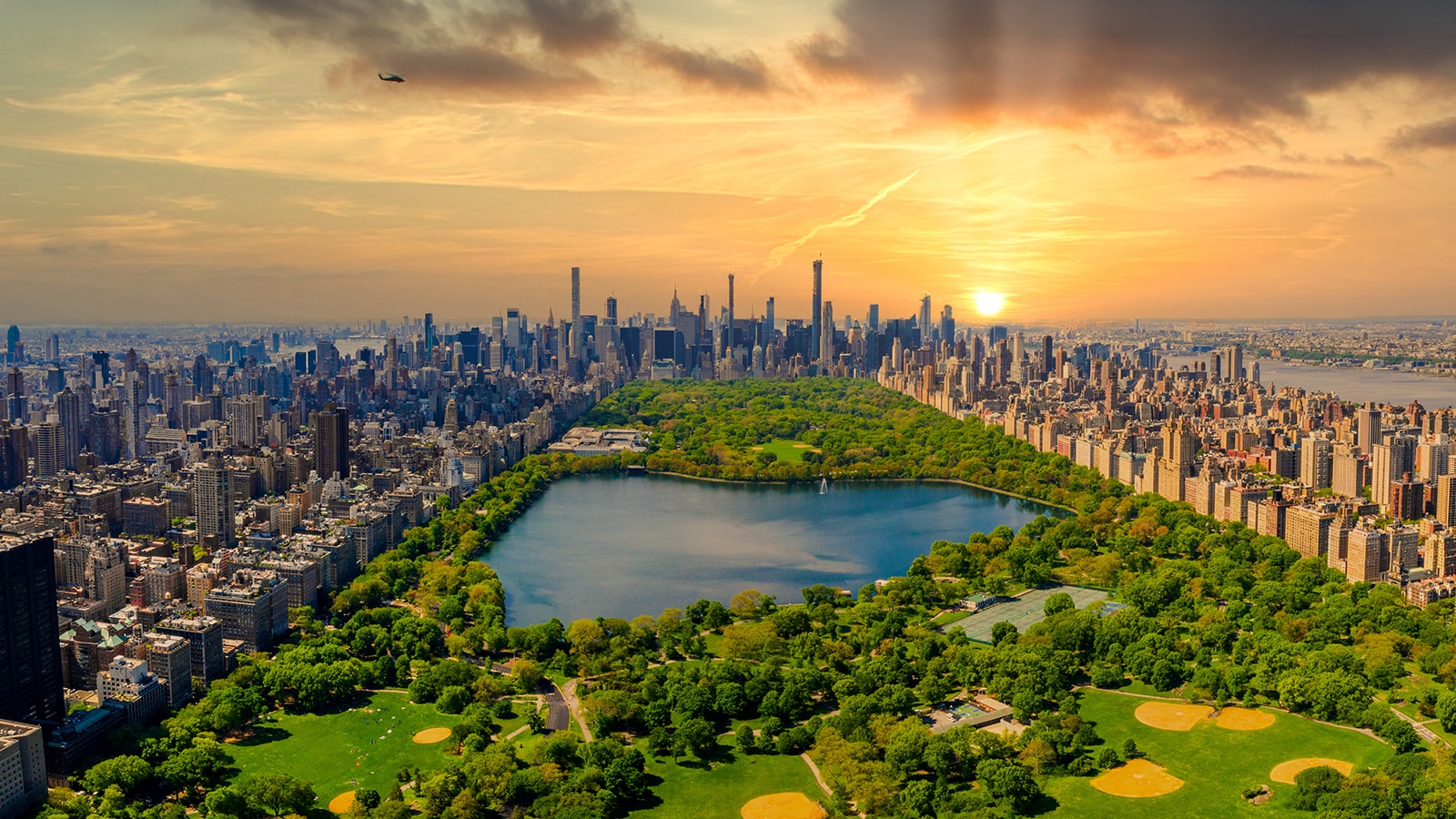
The Big Apple is back, big time. Though office recovery remains an important and increasingly positive story, the more consequential trend is the simultaneous strengthening of tourism, retail, multifamily demand, transit usage, and corporate occupancy that is reinforcing the borough’s position as the country’s premier urban economy. As the third biggest destination for VC funding (overall and for AI/machine learning), Manhattan’s emergent AI ecosystem is only just starting to leave its fingerprints on the commercial property markets.
AI-related office leasing has materially accelerated in the past two years: so far in 2026, AI leasing has totaled 2.8 million square feet, more than all of 2025 combined (950,000 square feet). Unlike the Bay Area where nearly one-third of all demand is from AI, Manhattan’s demand profile is more diversified, reflecting a broader recovery in return-to-office, corporate expansion, and a growing sense of urgency to secure top-quality space. AI leasing as a share of total leasing is only 11.7 percent year-to-date, and within the tenant requirement data, AI remains 10.8 percent of future demand.
Future requirements of 6.5 million square feet were the highest of the post-pandemic era. Large users are also anchoring new buildings as big block vacancies dwindle. A global financial services firm has pre-committed to nearly 2.0 million square feet at Two World Trade, an international law firm 916,000 square feet at 570 Fifth, and an AI firm 465,630 square feet at 330 Hudson. Rents in top tier/new (re)development now exceed $300/square foot, a reflection of a top-tier market whose vacancy is 7.9 percent, the lowest since 2019. Manhattan’s office market is beyond recovery and into a growth cycle. Overall office vacancy fell to 18.6 percent in September, the lowest since 2021, with direct vacant space down 12 straight months and sublease space at its lowest level since April 2020. New leasing is up 4.2 percent to 23.9 million square feet year-to-date (32.6 million square feet with renewals), a pace that could lead to near-record levels of gross demand with the current record-holder being 2019 at 42.5 million square feet.
Moody’s Analytics estimates that the 2023–2025 population growth rate in the New York City MSA was 1.6 percent, lower than the growth rates of other cities but enough to put it in the top spot for nominal population gains (a little over 323,000) over the period. The city’s housing stock is increasingly strained by recovering demographics. Overall, the metro area boasts an incredible supply-side story with recent (relative) delivery levels at all-time highs, but the bulk of the new supply is happening outside Manhattan. Manhattan has delivered only 7,522 units since 2025. Direct-lease average rents hit a record of $5,600 in July (according to CoStar) against citywide rental vacancy of 4.0 percent. Manhattan multifamily investment is nearing $3.0 billion year-to-date, already higher than the annual totals of the last three years and on pace to virtually match 2019’s total of $3.6 billion. Office conversions are scaling too, with about 5.9 million square feet of starts expected in 2026, bringing the cumulative square footage of conversions to 15.8 million square feet in the post-pandemic period.
This sense of resurgence and reinvention is visible on the street. Times Square is hovering around 250,000 daily pedestrians in August, with the summer months outperforming the last few years, while MTA ridership reached its highest annual level since 2019 at 1.9 billion riders, 1.3 billion of which were on New York City Transit, a 7 percent increase year-over-year. Retail availability across Manhattan has fallen to a record-low 10.4 percent, reflecting steady demand from restaurants, luxury retailers, entertainment concepts, and experiential tenants. Fifth Avenue, Madison Avenue, SoHo, and the Upper East Side continue to see tightening availability and rising rents.
Investors are pursuing opportunities in the city that never sleeps. Manhattan is in a league of its own, transacting nearly $33 billion in deals since 2025. Investment volumes have already exceeded $12 billion year-to-date in 2026, an annualized pace of over $16 billion. Office demand remains restrained, although CMBS issuance is rising rapidly. Office volume reached $4.9 billion in the nine months, with class A making up about 81 percent of $25 million-plus trades. An office REIT paid $730 million ($1,174/square foot) for 65 East 55th, and a partnership of institutional investors and a real estate owner-operator paid $1.08 billion for 590 Madison.
None of these buyers could replicate these assets today for anything close to their acquisition basis. Prime Manhattan construction costs remain extraordinarily high, entitlement risk is significant, and new development generally requires major anchor commitments. For investors, acquiring a premier existing building may be the most efficient way to gain exposure to future demand growth.
Beneath the leasing and investment headlines sits one of the largest urban infrastructure buildouts in the country. Projects including the Gateway Tunnel, Penn Station modernization, Port Authority Bus Terminal replacement, Second Avenue Subway expansion, and the combined $27 billion redevelopment of JFK and LaGuardia represent tens of billions of dollars of investment that will reshape accessibility, mobility, and economic capacity across Manhattan for decades to come. The scale of these commitments reinforces an important point: long-term public and private capital continue to be deployed on the assumption that Manhattan’s role as a global commercial center will expand rather than contract.
—Cushman & Wakefield


