Linking ESG to financing and investment activities
EU Sustainable Finance Regulation aims to support EU to achieve three ambitious climate and energy targets by 2030.
Targets - Issue - Solution
- EU Committed to specific environmental targets
- The issue
- The solution
EU Committed to specific environmental targets

40%
Reduce greenhouse gas emissions compared to 1990

32%
At least a 32% share of renewables in final energy consumption

30%
At least 30% energy savings compared with the business-as-usual scenario
The issue
The annual EU investment gap to meet these targets is estimated to be between € 175 to 290 billion.

The solution
The financial sector will be part of the solution and will play a critical role in achieving the EU’s sustainability goals. The purpose of the EU Sustainable Finance Regulation is to finance sustainable growth that will help the EU to achieve the 2030 goals.

What are the objectives of the new regulation:
- Establish a unified EU classification system of sustainable economic activities (‘taxonomy’).
- Improve disclosure requirements on how investors integrate environmental, social and governance (ESG) factors in their risk processes.
- Create a new category of benchmarks which will help investors compare the carbon footprint of their investments.
- Protecting private investors by avoiding risks of green washing.
- Providing the basis for further policy action in the area of sustainable finance, including standards, labels, and any potential changes to prudential rules.

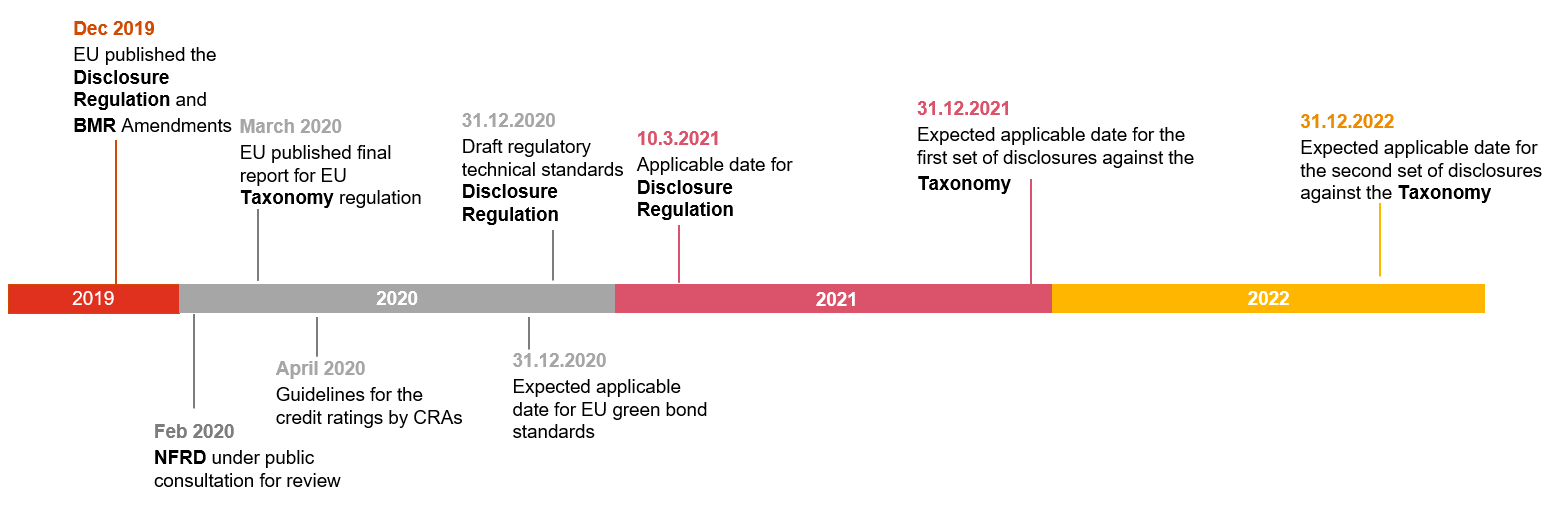
Six key elements of the Sustainable finance regulation:

Standards for green financial products
EU Green Bond Standards and ecolabels for financial products, defining minimum ESG requirements and terms.
Report issuance date: By 31/12/2020

Credit Ratings
Guidelines and disclosure requirements for integrating ESG factors into credit ratings by CRAs
Date of applicability: 01 April 2020

Benchmark Regulation (BMR)
Requires companies that publish financial benchmarks & indexes to disclose how they incorporate ESG factors into their calculations.
Date of applicability: 1/1/2022

Taxonomy Regulation
Index, including minimum thresholds for key ESG KPIs. Environmental threshold for shipping will be CO2 emissions.
Economic activities: Agriculture and forestry, Manufacturing, Electricity, gas, steam and air conditioning supply, Water, sewerage, waste and remediation, Transport, ICT and Buildings.
Date of applicability: 1/1/2022

Non-Financial Reporting Directive (NFRD)
EU law requires large companies to disclose certain information on the way they operate and manage social and environmental challenges.
Public consultation for review launched: 20/2/2020

ESG Disclosure Regulation
Framework defining the minimum content to be disclosed by financial market participants, including web site disclosures.
Date of applicability: 10/3/2021
Six key policy areas of the Sustainable finance regulation
Description – Current Stat |
Applicability Date |
|
|---|---|---|
Taxonomy |
The Taxonomy Regulation is an index, including minimum thresholds for key ESG KPIs. More specifically, this regulation will affect the following economic activities: Agriculture and forestry, Manufacturing, Electricity, gas, steam and air conditioning supply, Water, sewerage, waste and remediation, Transport, ICT and Buildings. The Council adopted the lawyer linguist text on 15 April 2020 (https://data.consilium.europa.eu/doc/document/ST-5639-2020-REV-2/en/pdf). The final vote in the Parliament is anticipated in May 2020 for publication in Official Journal in June 2020. |
1/1/2022 (first set of disclosures 1/1/2023 (second set of disclosures) |
Benchmark Regulation (BMR) |
The Regulation on Climate Benchmarks requires companies that publish financial benchmarks & indexes to disclose how they incorporate ESG factors into their calculations. The Regulation was published in December 2019 (https://eur-lex.europa.eu/legal-content/EN/TXT/?uri=CELEX:32019R2089) and will become binding for benchmark administrators from 30 April 2020. |
1/1/2022 |
ESG Disclosure Regulation |
The Disclosure Regulation constitutes a framework defining the minimum content to be disclosed by financial market participants, including web site disclosures. The Regulation was published in December 2019 (https://eur-lex.europa.eu/eli/reg/2019/2088/oj). Part of Regulation will be amended by the Taxonomy Regulation. |
10/3/2021 |
Non-Financial Reporting Directive (NFRD) |
EU law requires large companies to disclose certain information on the way they operate and manage social and environmental challenges. The Commission is consulting on a revision of the NFRD. The proposal of the renewed legislative act will be announced in December 2020 or in the first months of 2021. |
Proposal for the new regulation: December 2020 |
Standards for green financial products |
EU Green Bond Standards and ecolabels for retail financial products, defining minimum ESG requirements and terms. The technical Expert Group adopted a report in March 2020, suggesting a creation of voluntary EU Green Bond Standard through a legislative procedure. Commission’s Joint Research Centre (JRC) published a draft proposal within the second technical report in December 2019 regarding the ecolabel criteria (https://susproc.jrc.ec.europa.eu/Financial_products/docs/20191220_EU_Ecolabel_FP_Draft_Technical_Report_2-0.pdf). The final criteria will be published by JRC in Q1 2021, which will then be adopted under the EU Ecolabel Regulation. |
Report issuance date: By 31.12. 2020 |
Credit ratings by CRAs |
Guidelines and disclosure requirements for integrating ESG factors into credit ratings by Credit Ratings Agencies (CRAs). In July 2019 ESMA published the guidelines on disclosure requirements (https://www.esma.europa.eu/sites/default/files/library/esma33320_final_report_guidelines_on_disclosure_requirements_applicable_to_credit_rating_agencies.pdf). |
01 April 2020 |