

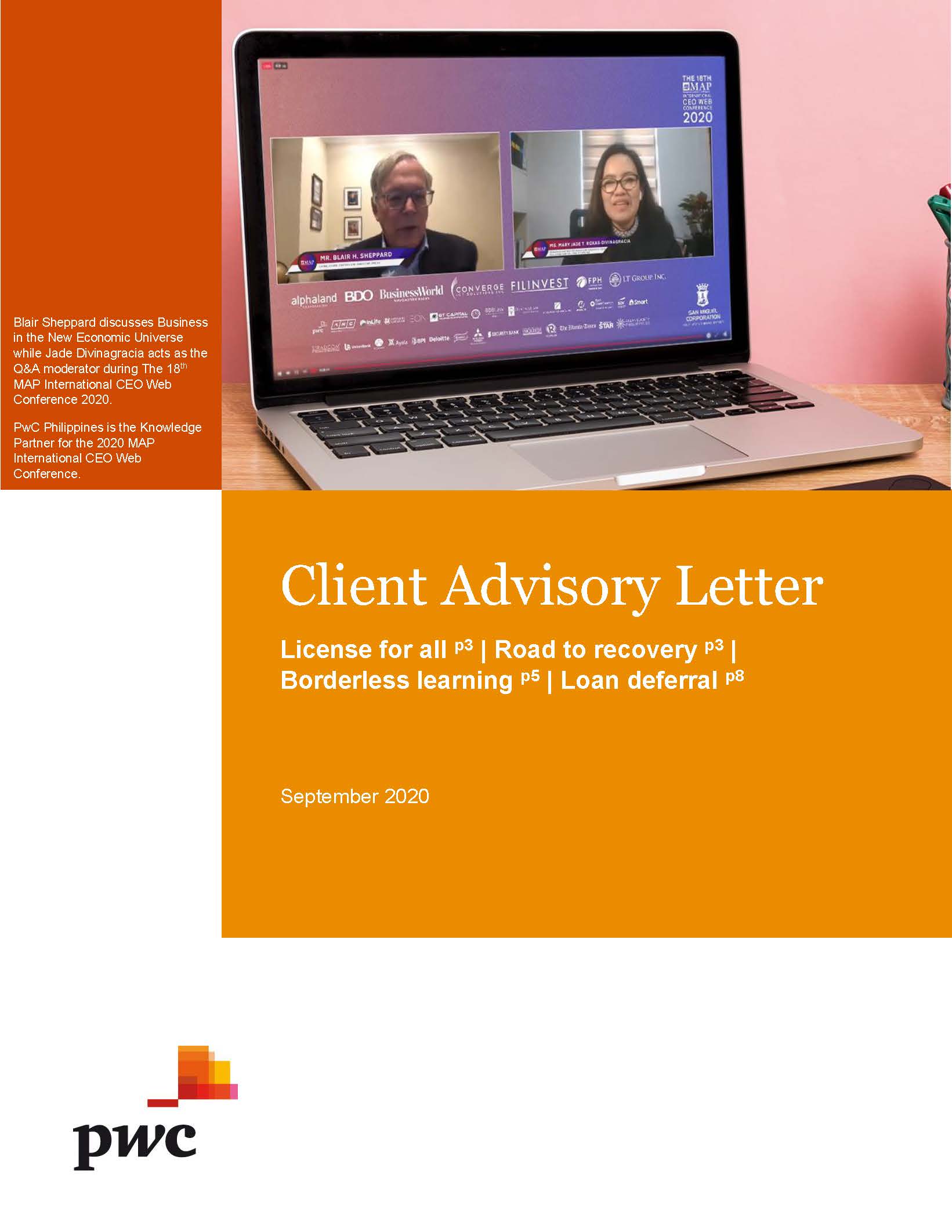
This is a publication about developments in Philippine taxation. The contents usually include latest Republic Acts, Bureau of Internal Revenue issuances, Customs regulations, Court decisions, BSP circulars, SEC circulars, Department of Justice opinions and Executive Orders relevant to Tax practice.
Talk to us
For further discussion on the contents of this issue of the Client Advisory Letter, please contact any of our partners.
Request for copies of text
You may ask for the full text of the Client Advisory Letter by writing our Tax Department, Isla Lipana & Co., 29th Floor, Philamlife Tower, 8767 Paseo de Roxas, 1226 Makati City, Philippines. T: +63 (2) 8845 2728. F: +63 (2) 8845 2806.
Taxes, compliance matters, assessments, and refunds
Open contract
Constitutionality of PCAB nationality restrictions on contractors
For purposes of constructing facilities for waterworks and sewerage system, a company applied with the Philippine Contractors Accreditation Board (PCAB) for the issuance of Regular Licenses to the company’s foreign contractors.
PCAB denied the applications pursuant to Section 3.1(a), Rule 3 of the IRR of the Contractor’s License Law (RA No. 4566), wherein said IRR provision reserved Regular Licenses only for domestic construction firms organized as Filipino sole proprietorships or companies with at least 60% Filipino equity participation. The PCAB further justified that the requirement was consistent with the constitutional mandate limiting the practice of all professions to Filipino citizens.
Consequently, the company sought to declare Section 3.1, Rule 3 of the IRR void. The SC affirmed the decision of the Regional Trial Court ruling in favor of the company and declared the above IRR provision void. The SC’s reasoning is summarized as follows:
- Although the PCAB’s intention was to protect the interests of the Filipino construction industry, the manner of protection raised constitutional issues.
- Section 17 of RA No. 4566 which authorizes PCAB to adopt rules to effect the classification of contractors was not intended to discriminate against foreign contractors as there is no restriction provided by RA No. 4566.
- The PCAB exceeded the confines under RA No. 4566 when it created nationality-based license types under Rule 3, Section 3.1.
- Construction is not a practice of profession. The term “profession” refers to the practice of natural persons of a certain field in which they are trained, certified and licensed. A licensed contractor does not fall within the ambit of the Constitution as a “profession”.
- Contractors are licensed not to engage in the practice of a specific profession but rather to engage in the business of contracting/construction.
- The construction industry is not reserved by the Constitution for Filipinos. Also, RA No. 4566 does not require applicants for contractor’s licenses to have Philippine citizenship. It also does not prescribe a minimum educational requirement. The applicant is only required to have at least two years of experience in the construction industry, and knowledge of Philippine building, safety, health and lien laws, and rudimentary administrative principles of the contracting business.
In addition to Section 3.1, Rule 3, the following IRR provisions were also declared by the SC as void:
- Section 3.1(b) subparagraph (bb), Rule 3 which provides that only a “foreign firm legally owned by the proper Philippine government authority to undertake construction activities in the Philippines” may qualify for a Special License.
- Section 12.7, Rule 12 which provides that an introduction of 30% or more of foreign equity into a construction firm holding a Regular License shall ipso facto invalidate the license.
(G.R. No. 217590, promulgated 10 March 2020)
Road to recovery
Enacting the Bayanihan to Recover as One Act
In view of the state of continuing national emergency and the expiration of the Bayanihan to Heal as One Act (Republic Act No. 11469) last 25 June 2020, the President approved the Bayanihan to Recover as One Act (Republic Act No. 11494) which is effective until 19 December 2020.
The Bayanihan to Recover as One Act provides for the following fiscal provisions:
- Net operating losses suffered in taxable years 2020 and 2021 shall be carried over for the next five (5) consecutive taxable years. Taxable years 2020 and 2021 include corporations with fiscal years ending on or before 30 June 2021 and 30 June 2022, respectively.
- Repeal of percentage tax imposed on sale, barter, or exchange of shares of stock listed and traded through initial public offering (IPO) tax under Section 127(B) of the Tax Code. Given the nature of a repeal, said percentage tax will not be reinstated after 19 December 2020, the expiration date of RA No. 11494.
- Tax exemption on retirement benefits received by officials and employees of private firms, whether individual or corporate, from 5 June 2020 until 31 December 2020. Any re-employment in the same employer within the succeeding 12-month period shall be considered proof of non-retirement which will subject the retirement benefits to tax.
- Liberalization of the grant of incentives for the manufacture or importation of critical or needed healthcare equipment or supplies or essential goods
- Exemption from import duties, and taxes, including donor’s tax, of personal computers, laptops, tablets, or similar equipment appropriate for use in schools, donated for distribution to public schools regardless of level, including state universities and colleges and vocational institutions under TESDA.
- Moving of statutory deadlines and timelines for the filing and submission of any document, the payment of taxes, fees, and other charges required by law.
- No additional DST (including those imposed on debt instruments, on mortgages, pledges and deeds of trust, and on assignments and renewals of certain instruments) on term extensions and credit restructuring, micro-lending including those obtained from pawnshops and extensions thereof granted by covered institutions for loans falling due, or any part thereof, on or before 31 December 2020
- Income tax exemption on the COVID-19 special risk allowance provided by the national government to both public and private health workers directly catering to or in contact with COVID-19 patients
- Tax exemption of compensation paid to public and private health workers who have contracted COVID-19 in the line of duty
- Income tax exemption on active hazard duty pay received by temporary Human Resources for Health (HRH) serving in the front line during the state of national emergency.
Here are some of the non-fiscal provisions:
- Emergency subsidy of PHP5,000 to PHP8,000 to affected low income households in areas under granular lockdown and to households with recently returned OFWs
- Unemployment or involuntary separation assistance of PHP5,000 to PHP8,000 for displaced employees or workers due to COVID-19 including probationary, project, seasonal, contractual and casual employees in certain sectors
- Monthly COVID-19 special risk allowance for all public and private health workers directly catering to or in contact with COVID-19 patients
- Assumption of all medical expenses of public and private health workers exposed to COVID-19 or in case of work-related injury or disease during the state of national emergency
- Implementation of a one-time 60-day grace period for the payment of all existing, current and outstanding loans falling due on or before 31 December 2020 including loans, amortizations, financial lease payments and premium payments, as well as credit card payments without incurring interest on interest, penalties and other charges and thereby extending the maturity of said loans. This applies not only to banks, quasi banks, financing and lending institutions but also to real estate developers, insurance companies and pre-need companies.
- Minimum 30-day grace period on residential and commercial rents of lessees not permitted to work, MSMEs and cooperatives ordered to temporarily cease operations, falling due within the community quarantine (CQ) period. This will be reckoned from the date of lifting of the ECQ or MECQ. There should be no increase in rent during the CQ.
- Non-discrimination against persons confirmed, suspected, probable, exposed or recovered of the COVID-19 virus, returning OFWs, health workers, front liners, other service workers or indigent which result in unjust distinction, exclusion, restriction, physical, psychological harm or suffering, intimidation, harassment, damage to property, public ridicule or humiliation, verbal abuse, arbitrary ejectment from dwelling or unlawful deprivation of liberty
(Republic Act No. 11494, approved 11 September 2020)
Borderless learning
Modernization of higher education and provision of tax exemptions
The CIR circularized the Transnational Higher Education Act (Republic Act No. 11448) which aims to modernize the higher education sector and bring international quality standards and expertise into the Philippines in order to make higher education globally competitive, attract talented students and improve our human resource base.
Higher education refers to any type of education given by higher educational institutions (HEIs) (i.e., universities and colleges, technical and vocational education and training, and specialized institutions that provide undergraduate or graduate degree programs) and usually provides a named degree, diploma, certificate indicating qualifications or skills proficiencies.
Transnational higher education (TNHE) refers to all types and modes of delivery of higher educational study programs, sets of courses of study or educational services. It includes distance education and study-abroad programs. TNHE programs include:
- Academic Franchising;
- Articulation;
- Branch campus;
- International branch campus;
- Joint degree;
- Double degree;
- Online, blended and distance learning;
- Open Distance Learning;
- TNHE Offshore institution; and
- Twinning arrangements.
Foreign higher educational institutions are allowed to provide educational services in the Philippines provided they meet certain standards. Conversely, Philippine HEIs with CHED-recognized programs may be given government authority to offer services offshore.
Transnational higher educational institutions (TNHEIs) may enjoy the following tax exemptions:
- Exemption from taxes and duties of all revenues and assets of nonstock, nonprofit TNHEIs which are used actually, directly and exclusively for educational purposes
- Donor’s tax exemption and deductibility of all grants, bequests, endowments, donations and contributions made to the TNHEI to be used actually, directly and exclusively by the TNHEI
- Real property tax exemption of lands, buildings and improvements used by a TNHEI actually, directly and exclusively for educational purposes
- Entitlement to tax incentives of non-stock, non-profit entities of TNHEIs organized as non-stock, non-profit companies
(Revenue Memorandum Circular No. 99-2020, issued 16 September 2020)
Exclusive uses
When BIR Form No. 0605 may be used to pay excise taxes
The use of BIR Form No. 0605 for excise tax payments is authorized only for the following:
- Payment on export products pursuant to the Product Replenishment Scheme under RR No. 3-2008;
- Payment for excise tax on Non-Essential Services for Excisable Cosmetic Procedures until such time that BIR Form No. 2200-C becomes available for use; and
- Payments for deficiency excise tax.
Accordingly, all other excise tax payments on domestic removals of excisable articles shall use their corresponding excise tax returns (i.e., BIR Form No. 2200 series).
(Revenue Memorandum Circular No. 97-2020, issued 9 September 2020)
Coping mechanism
Requirements for taxpayers adopting temporary measures during the MECQ
In complying with invoicing/receipting requirements, taxpayers located in areas under MECQ (including the National Capital Region, Bulacan, Cavite, Rizal and Laguna from 4 August to 18 August) are allowed to adopt the work-around procedures under RMC No.
47-2020 in order to continue business operations.
Taxpayers who adopt these temporary measures during the MECQ period must comply with RMC No. 47-2020, including the submission of the “Summary of Temporary Receipts/lnvoices lssued” to concerned Revenue District Offices within 90 days from the date of the lifting of MECQ.
(Revenue Memorandum Circular No. 96-2020, issued 7 September 2020)
More in law
Donor’s tax exemption of donations and grants to poverty alleviation programs
The BIR has circularized Republic Act No. 11291, otherwise known as the Magna Carta of the Poor. It provides for the establishment of a system to satisfy the requirements, conditions and opportunities for the enjoyment and realization of the right to adequate food, right to decent work, right to relevant and quality education, right to adequate housing and right to the highest attainable standard of health.
It also provides that government agencies implementing poverty alleviation programs are authorized to accredit partners who may accept donations, aids or grants. In this regard, any donation, contribution and grant made to programs under the National Poverty Reduction Plan shall be exempt from the donor’s tax.
(Revenue Memorandum Circular No. 86-2020, issued 27 August 2020)
Food security
Tax incentives for farmers and fisherfolk enterprises
The BIR has circularized Republic Act No. 11321, otherwise known as the Sagip Saka Act which aims to achieve sustainable modern agriculture and food security by creating and strengthening the Farmers and Fisherfolk Enterprise Development Program. This program shall make use of science-based technologies in the identification and prioritization of agricultural and fishery products covered.
The law provides for the following tax incentives and exemptions:
- Donor’s tax exemption of gifts and donations
- Real property tax exemption of structures, buildings and warehouses utilized for the storage of farm inputs and outputs
- Provision by the Land Bank of the Philippines of preferential rates and special window to accredited farmers and fisherfolk enterprises
- Income tax exemption
(Revenue Memorandum Circular No. 85-2020, issued 27 August 2020)
Latest on regulatory landscape
Refund policy
Guidelines for the refund of duties and taxes by the Bureau of Customs
The Commissioner of Customs issued guidelines on the application, processing, approval and payment of claims for:
- Refunds of overpaid or erroneous payment of duties and taxes;
- Refunds arising from final decisions in protest cases, judicial decisions, special laws and executive issuances; and
- Refunds duly approved and endorsed by the Bureau of Internal Revenue (BIR).
The guidelines provide for the following:
- Grounds for filing a refund
- Refund claims amounting to less than PHP5,000 shall not be accepted
- Refund applications shall be filed within 12 months or 365 days from the date of payment of duties and taxes
- Venue of filing
- Claims shall be processed, paid or granted within 60 days from submission of all mandatory requirements
- If a claim involves only internal revenue taxes such as VAT or excise tax, the claim must be filed with the BIR
- Payment of refunds shall preferentially be in cash
- Tax credit certificates (TCCs) shall not be assignable or transferrable
- BOC procedure and documentary requirements
- Approved claims are subject to the automatic review of the Department of Finance
- Procedure and requirements for utilization and revalidation of TCCs
(Customs Memorandum Order No. 25-2020, dated 24 September 2020)
Penalty situation
Suspending the penalty for non-compliance with reportorial requirements
The Insurance Commissioner suspended the imposition of penalties for non-filings, late filings and failure to comply with required notification and reportorial requirements during the community quarantine period. The suspension only applies to reportorial requirements due on or before 31 December 2020.
For this purpose, IC Circular Letter No. 2020-87 is deemed superseded.
(IC Circular Letter No. 2020-93, dated 22 September 2020)
Gaining access
Violations of the right to inspect or reproduce corporate records
The SEC issued guidelines in the filing, investigation and resolution of complaints for violations of the right to inspect and/or reproduce corporate records. Under the Revised Corporation Code, corporate records shall be open to inspection by any director, trustee, stockholder or member who may also demand copies thereof.
The guidelines provide for the following:
- Acts or omissions which constitute violations of the right to inspect and/or reproduce corporate records
- An aggrieved party may file a Verified Complaint with the Company Registration and Monitoring Department of the SEC if a corporation denies or does not act on a demand for inspection and/or reproduction of records. There is a filing fee of PHP10,130.
- Required contents of a Verified Complaint
- Grounds for outright dismissal
- SEC procedure for investigation and resolution
- The SEC may assist in the criminal prosecution of the violation.
- The provision of Republic Act No. 9285, otherwise known as the Alternative Dispute Resolution Act of 2004, and arbitration agreements in the articles of incorporation or by-laws shall not apply to the resolution or settlement of cases arising from violation of the right to inspect and/or reproduce corporate records.
(SEC Memorandum Circular No. 25-2020, published 11 September 2020)
Loan deferral
Implementing the 60-day grace period under RA No. 11494
Pursuant to the Bayanihan to Recover as One Act which took effect on 15 September 2020, the SEC directed financing companies, lending companies and microfinance NGOs (“Covered Entities”) as follows:
- All Covered Entities are required to implement a one-time 60-day grace period for all loans that are existing, current and outstanding, falling due or any part thereof on or before 31 December 2020.
- The mandatory one-time 60-day grace period shall apply to each loan, whether the borrower has a single loan or multiple loans with the Covered Entity.
- Future payments or amortizations of borrowers shall not be charged or applied interest on interest, penalties, fees, or other charges during the mandatory one-time 60-day grace period.
- Covered Entities are prohibited from requiring clients to waive the application of the provisions of the Bayanihan to Recover As One Act.
- Accrued interest for the one-time 60-day grace period may be paid by the borrower on a staggered basis until 31 December 2020. Nevertheless, this shall not preclude the borrower from paying the accrued interest in full.
(SEC Notice issued 21 September 2020)
Administrator of grace
Implementing rules and clarifications on the mandatory 60-day grace period
All BSP-Supervised Financial Institutions (BSFIs) are directed to immediately comply with Section 4(uu) of the Bayanihan to Recover as One Act which took effect on 15 September 2020. Accordingly, BSFIs shall observe the following:
- Implementation of a one-time 60-day grace period for all loans that are existing, current and outstanding, falling due or any part thereof on or before 31 December 2020;
- The mandatory one-time 60-day grace period shall apply to each loan of individuals and entitles with multiple loans;
- BSFIs shall not charge or apply interest on interest, penalties, fees, or other charges during the mandatory one-time 60-day grace period to future payments or amortizations;
- BSFIs are prohibited from requiring clients to waive the application of the provisions of the Bayanihan to Recover As One Act.
- Accrued interest for the one-time 60-day grace period may be paid by the borrower on a staggered basis until 31 December 2020. Nevertheless, this shall not preclude the borrower from paying the accrued interest in full on the new due date.
The BSP also issued implementing rules and regulations (IRR) of Section 4(uu) and addressed frequently asked questions (FAQs) in order to provide additional guidance and clarification. The IRR and FAQs may be accessed at the BSP website.
(BSP Memorandum Nos. M-2020-74 and M-2020-68, dated 28 and 18 September 2020)
Credit standing
Fixing a ceiling on interest or finance charges for credit card receivables
The Monetary Board approved amendments to the Manual of Regulations for Banks (MORB) and the Manual of Regulations for Non-Bank Financial Institutions (MORNBFI) with respect to the ceiling on interest or finance charges for credit card receivables.
The MORB and MORNBFI amendments are as follows:
- Banks/Credit card issuers shall notify the cardholder at least 90 calendar days before any change in the manner of computing the outstanding balance and fees to be imposed.
- Banks/Credit card issuers shall impose interest or finance charges on credit card transaction not to exceed an annual interest rate of 24%, except credit card installment loans which shall be subject to monthly add-on rate not exceeding 1%.
- In the case of credit card advances, no charge or fee shall be imposed apart from the processing fee capped at PHP200 per transaction.
- Banks/Credit card issuers shall only charge interest or finance charges arising from the non-payment in full or on time of the outstanding balance based on the unpaid amount of the outstanding balance as of statement cut-off date.
- The rate of interest, commissions, premiums, fees and other charges on any loan or forbearance of money, goods or credits shall not be subject to any regulatory ceiling except for interest and finance charges imposed on credit card receivables.
The above amendments will take effect on 3 November 2020 after the publication of BSP Circular No. 1098 in the Official Gazette or newspaper of general circulation.
(BSP Circular No. 1098, dated 24 September 2020)





Follow PwC Philippines


