

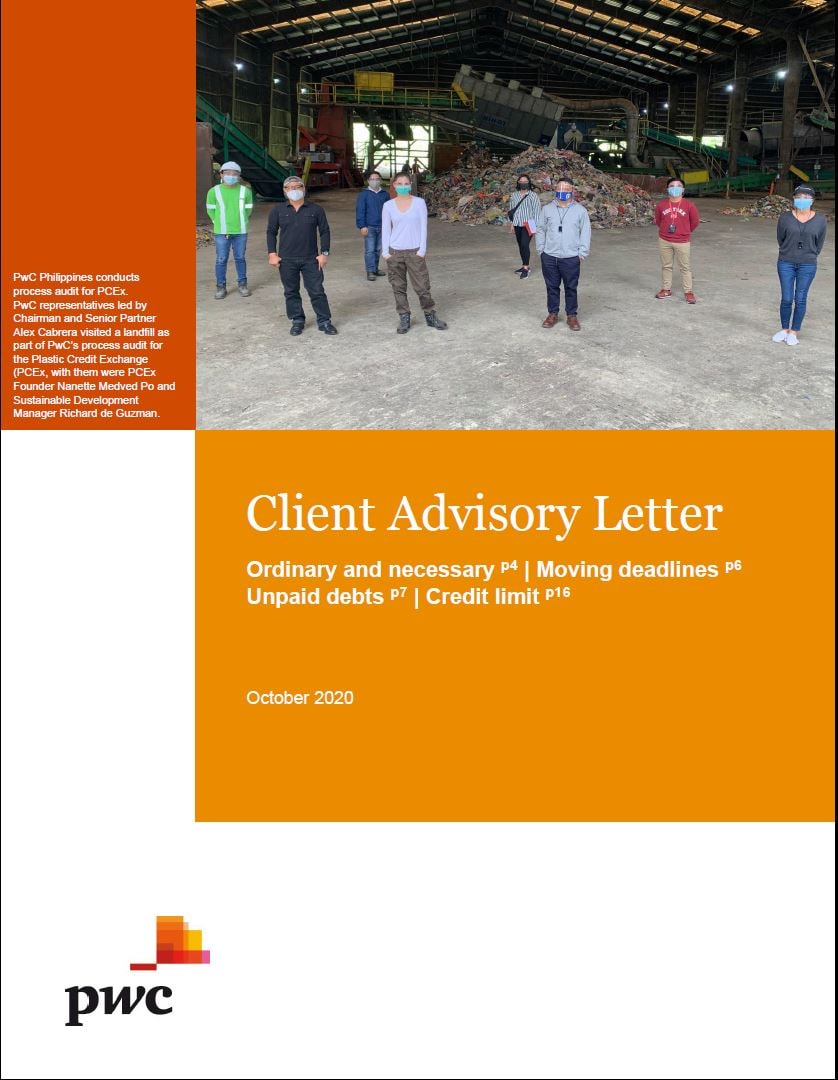
This is a publication about developments in Philippine taxation. The contents usually include latest Republic Acts, Bureau of Internal Revenue issuances, Customs regulations, Court decisions, BSP circulars, SEC circulars, Department of Justice opinions and Executive Orders relevant to Tax practice.
Talk to us
For further discussion on the contents of this issue of the Client Advisory Letter, please contact any of our partners.
Request for copies of text
You may ask for the full text of the Client Advisory Letter by writing our Tax Department, Isla Lipana & Co., 29th Floor, Philamlife Tower, 8767 Paseo de Roxas, 1226 Makati City, Philippines. T: +63 (2) 8845 2728. F: +63 (2) 8845 2806.
Taxes, compliance matters, assessments, and refunds
Hard proof
Manner of proving the existence of prior year’s excess credits
In a claim for refund of excess and unutilized creditable withholding taxes (CWTs) during 2015, the CTA ruled that prior year’s excess credits utilized in 2015 should also be proven. The CTA found that the taxpayer was successfully able to prove so when the following were presented:
Breakdown of prior year’s (i.e., 2014) excess credits;
Detailed movement of excess CWT from 2003 to 2015; and
CWT certificates (BIR Form No. 2307).
(CTA Case No. 9808, promulgated 01 October 2020)
Inconsequential failure
Non-submission of supporting documents within sixty days from filing of protest
The CTA, citing a 2009 Supreme Court decision, affirmed that the mere failure of the taxpayer to submit supporting documents within sixty (60) days after filing a protest (request for reinvestigation) against a Formal Letter of Demand/Final Assessment Notice (FLD/FAN) does not render said FLD/FAN final and unappealable.
(CTA Case No. 9729, promulgated 08 October 2020)
Ordinary and necessary
When an expense is considered ordinary and necessary
In order to be deductible, an expense must be both ordinary and necessary. Under Revenue Regulations No. 9-1983, an ordinary expense is one that is normal usual or customary (in size and character) for the taxpayer’s trade or business while a necessary expense is one that is appropriate and helps develop and maintain the taxpayer’s business.
The Supreme Court[1] laid down the following guiding principles in determining whether an expense is ordinary and necessary:
- An expense is “ordinary” when it pertains to a payment which is normal in relation to the business of the taxpayer and the surrounding circumstances. The term “ordinary” does not require that the payments be habitual or normal. Hence, the payment may be unique or non-recurring.
- An expense will be considered “necessary” when it is appropriate and helpful in the development of a taxpayer’s business.
- The right to a deduction depends in each case on the particular facts and the relationship of the payment to the type of business. The taxpayer’s intention often may be the controlling fact in making the determination.
(CTA Case No. 9729, promulgated 08 October 2020)
[1] G.R. No. L-26911, promulgated 27 January 1981.
Steps to recovery
Implementing tax relief measures under the Bayanihan to Recover as One Act
The BIR issued implementing rules for the following tax exemptions under the Bayanihan to Recover as One Act:
Retirement benefits received by officials and employees of private firms from 5 June 2020 until
31 December 2020, in accordance with a retirement plan duly-registered with the BIRTaxes withheld from retirement benefits given to an employee from 5 June 2020 to 31 December 2020 shall be refunded by the employer to the employee.
If, within the succeeding 12-month period, the retired employee is re-employed by the same employer or by the employer’s affiliate, the retirement benefits will constitute gross income of the employee.
If re-employment occurs in 2020, the retirement benefits should be included in the 2020 annual ITR of the employee who shall no longer be qualified for substituted filing.
If re-employment occurs in 2021, the income taxes due on the retirement benefits should be paid within 30 days from re-employment date or on the deadline for the payment of the second installment of the 2020 income tax, whichever comes later.
COVID-19 Special Risk Allowance paid to health workers directly catering to or in contact with COVID-19 patients for every month of service during the state of national emergency.
Actual Hazard Duty Pay given to temporary Human Resources for Health (complementing or supplementing the current health workforce) serving on the front line during the state of emergency
Compensation of health workers who have contracted COVID-19 in the line of duty or who died while fighting COVID-19 amounting to:
PHP1m in case of death
PHP100,000 in case of severe or critical illness
PHP15,000 in case of mild or moderate sickness
In case of death, the above compensation shall not form part of the gross estate of the decedent subject to estate tax.
Employers or payors are required to:
include the above payments in the Alphabetical List of Employees/Payees submitted annually;
submit a one-time list of recipients to the Revenue District Office/concerned Large Taxpayers office on or before 15 January 2021, which must indicate the names and taxpayer identification numbers of the recipients; the nature of compensation paid, amount and date of payment; and must be attested to by the employer/payor; and
submit within thirty (30) days from the close of all quarters in 2021, a quarterly list of employees who received retirement benefits but are re-employed during the 12-month period.
(Revenue Regulations No. 29-2020, published 17 October 2020)
Critical condition
Tax exemption of critical equipment, supplies and essential goods
The BIR issued the following rules to implement Sections 4(cc) and 18 of the Bayanihan to Recover as One Act regarding the tax exemptions on the importation and manufacture of critical or needed equipment, supplies or essential goods:
Importations of the following goods from 25 June 2020 to 19 December 2020 shall be exempt from VAT, excise tax and other fees:
Personal protective equipment; surgical equipment and supplies; laboratory equipment and its reagents; medical equipment and devices; support and maintenance for laboratory and medical equipment, surgical equipment and supplies; medical supplies, tools and consumables; testing kits; and other supplies and equipment as determined by the DOH and DTI;
Equipment for waste management as approved by the DENR, DOH or other concerned agencies; and
Inputs, raw materials and equipment necessary for the manufacture or production of essential goods enumerated in Section 1.a above.
To qualify for exemption, the taxpayer must present a certification from the DTI to the effect that the equipment and supplies being imported are not locally available or are of insufficient quality and preference.
The importation shall not be subject to the issuance of Authority to Release Imported Goods (ATRIG) under RMO No. 35-2002 and may be released by the BOC without need of the ATRIG.
Donations of the above imported articles to or for the use of the National Government or any non-profit entity created by its agencies, or to any political subdivision of the Government are exempt from donor’s tax and subject to the ordinary rules of deductibility.
The above exemptions are effective starting 25 June 2020. Hence, VAT paid from 25 June 2020 up to 14 September 2020 on qualified importations shall be refunded in accordance with existing procedures for refund of VAT on importations.
Inputs, raw materials and equipment necessary for the manufacture of essential goods of medical grade referred to in Section 1.a above, as determined by the Food and Drug Administration (FDA), shall be VAT-exempt.
To qualify for the exemption, the supplier of inputs, raw materials and equipment must submit a certified true copy of the manufacturer’s License to Operate issued by the FDA and a Sworn Declaration from the manufacturer to the effect that the items shall be used in the manufacture of essential goods.
The sale of finished foods/products in Section 1.a above, whether locally manufactured or imported, shall be subject to VAT.
(Revenue Regulations No. 28-2020, published 17 October 2020)
Moving deadlines
Extending the deadlines of VAT refund claims for the 3rd and 4th quarters of 2018
In line with Section 4(tt) of the Bayanihan to Recover as One Act which allows the moving of statutory deadlines for the filing of documents, the deadlines for filing VAT refund claims covering the following taxable quarters have been extended by the BIR:
Taxable Quarter |
Deadline |
|
Calendar quarter ended |
31 December 2020 |
|
Fiscal quarter ended |
15 January 2021 |
|
Fiscal quarter ended |
31 January 2021 |
|
Calendar quarter ended |
15 February 2021 |
Furthermore, the 90-day processing of VAT refund claims pursuant to Section 112(C) of the Tax Code has been suspended until 19 December 2020.
In areas where the Enhanced Community Quarantine (ECQ) or Modified ECQ (MECQ) is in force after 19 December 2020, the following shall be observed:
If the deadline for the claim falls within the ECQ or MECQ, the filing deadline shall be extended by 30 days from the lifting of the ECQ or MECQ.
The 90-day processing period shall be suspended and shall resume 30 days after the lifting of the ECQ or MECQ.
In cases where the processing BIR office is required to temporarily close in view of COVID-19 cases, the 90-day processing period shall be suspended until the last day of the quarantine period for the affected processing office.
(Revenue Regulations No. 27-2020, published 8 October 2020)
Expected losses
Five-year net operating loss carry-over (NOLCO) and requirements
The BIR issued regulations implementing Section 4(bbbb) of the Bayanihan to Recover as One Act regarding the five-year carry-over of 2020 and 2021 net operating losses. The regulations provide for the following:
Net operating loss means the excess of allowable deductions over the gross income of the business in a taxable year.
Businesses suffering net operating losses for taxable years 2020 and 2021 shall be allowed to carry-over the same as deductions from gross income for the next five (5) consecutive taxable years immediately following the year of loss notwithstanding the expiration of the Bayanihan to Recover Act.
The taxpayer is required to:
Separately show the net operating loss carry-over (NOLCO) in the income tax return (also in the Reconciliation Section thereof); and
Present unused NOLCO in the Notes to the Financial Statements showing, in detail, the taxable year when the net operating loss was incurred and any amount thereof claimed as NOLCO deduction within 5 consecutive years immediately following the year of such loss.
Failure to comply with these requirements shall disqualify the taxpayer from claiming the NOLCO.
(Revenue Regulations No. 25-2020, published 2 October 2020)
Unpaid debts
DST exemption of loan term extensions or restructuring
The BIR issued regulations implementing Section 4(uu) of the Bayanihan to Recover as One Act regarding the documentary stamp tax (DST) exemption of loan term extensions or restructuring.
The regulations provide as follows:
No additional DST, including those under Sections 179, 195 and 198 of the Tax Code, shall be imposed on the following:
all extensions of payments and/or maturity period of all loans including salary, personal, housing, commercial and motor vehicle loans, amortizations, financial lease payments, premium payments and credit card payments falling due or any part thereof on or before
31 December 2020;extensions of maturity periods resulting from the grant of grace periods whether or not such maturity periods originally fall due on or before 31 December 2020; and
credit restructuring and micro-lending including those obtained from pawnshops and extensions thereof made on or before 31 December 2020
Interbank loans and bank borrowing shall be subject to the DST imposed under Sections 179, 195 and 198 of the Tax Code.
(Revenue Regulations No. 24-2020, published 2 October 2020)
Short notice
Replacing the Notice of Informal Conference with the Notice of Discrepancy
The BIR amended Revenue Regulations No 12-1999 by replacing the Notice of Informal Conference with the Notice of Discrepancy. Here are the features of the Notice of Discrepancy:
If a taxpayer is found liable for deficiency taxes in the course of a tax investigation, the taxpayer shall be issued a Notice of Discrepancy (NOD) and invited to a Discussion of Discrepancy within five (5) days from receipt of the NOD in order to present and explain its side and submit supporting documents.
The Discussion of Discrepancy shall not exceed thirty (30) days from receipt of the Notice of Discrepancy. If the taxpayer disagrees with the findings, it must present its explanations and submit supporting documents within said 30-day period.
If, after the Discussion of Discrepancy, the taxpayer is still liable for deficiency taxes, the investigating BIR office shall endorse the case for issuance of a Preliminary Assessment Notice within ten (10) days from the conclusion of the discussion.
Revenue Memorandum Circular No. 102-2020 prescribes the revised format of the Notice of Discrepancy.
If an authorized representative will appear during the Discussion of Discrepancy, he/she should present written proof of authorization.
(Revenue Regulations No. 22-2020, published 17 September 2020 and Revenue Memorandum Circular No. 102-2020, issued 25 September 2020)
IPO tax
Repeal of the percentage tax on share transfers via initial public offering
The BIR issued regulations to implement Section 6 of the Bayanihan to Recover as One Act which repealed the tax under Section 127(B) of the Tax Code on shares of stock sold, bartered, exchanged or disposed through initial public offering (IPO). Hence, such sale, barter, exchange or disposition shares in closely held corporations through IPO shall no longer be subject to the percentage tax imposed by Section 127(B) of the Tax Code.
(Revenue Regulations No. 23-2020, published 2 October 2020)
Voluntary contribution
Launching the Voluntary Assessment and Payment Program for taxable year 2018
The BIR is offering a Voluntary Assessment and Payment Program (VAPP) for taxable year 2018. Here are the VAPP guidelines and subsequent clarifications:
VAPP Benefits
A taxpayer who pays the additional tax under the VAPP and secures a duly issued Certificate of Availment shall not be audited for taxable year 2018.
In case there is already an ongoing tax investigation, the Letter of Authority, Tax Verification Notice, Discrepancy Notice, Notice for Informal Conference, Preliminary Assessment Notice or Final Assessment Notice shall be withdrawn and cancelled.
The payment of the VAPP tax shall not be deemed as an admission that there was fraud in the declaration of taxes and/or there was an intention to pay the tax erroneously.
For purposes of the VAPP, taxable year 2018 covers:
taxable year ending 31 December 2018; and
fiscal years ending on the last day of the months of July 2018 to June 2019.
All taxes are covered including One-Time Transaction (ONETT)-related taxes. Availment should cover all tax types and is not allowed on a piece-meal or per tax-type basis. However, the VAPP can be availed for ONETT-related taxes only.
All taxpayers who erroneously paid taxes or failed to file tax returns/pay taxes during 2018, with or without a tax investigation, may avail of the VAPP except:
Those who have already received Final Assessment Notices that have become final and executory;
Persons under investigation as a result of verified information filed by a Tax Informer;
Those with cases involving tax fraud filed and pending with the Department of Justice or in the courts; and
Those with pending cases involving tax evasion and other criminal offenses.
The period of availment of VAPP benefits is until 31 December 2020. If the VAPP tax is paid before 31 December 2020 but the application is submitted after such date, the VAPP can still be considered as timely availed of.
To avail the VAPP benefits, the following requirements should be submitted:
Duly accomplished Application Form (BIR Form No. 2119);
Payment Form (BIR Form No. 0622) with proof of payment;
Additional submissions
For taxpayers availing the VAPP for income tax, value-added tax (VAT), percentage tax, excise tax and documentary stamp tax (DST) (except ONETT-related DST)
2017 tax returns with proof of payment
2018 tax returns with proof of payment
2018 audited financial statements
Those who failed to file tax returns and/or pay their taxes in 2018 should first file the unfiled tax returns and/or pay the unpaid taxes plus corresponding penalties for late filing and payment
For taxpayers availing the VAPP for final withholding tax (FWT) and creditable withholding tax (CWT) (except ONETT-related CWT)
2018 CWT returns
2018 FWT returns
For taxpayers availing the VAPP for estate tax, donor’s tax, capital gains tax and ONETT-related CWT and DST
ONETT tax returns with documentary requirements for the ONETT
Copy of duly paid BIR Form No. 0605 and proof of payment representing any settlement of previous deficiency tax, with or without an assessment notice, covering taxable year 2018
Determination and computation of VAPP tax
For taxpayers availing the VAPP for all taxes, the VAPP tax with respect to income tax, VAT, percentage tax, excise tax and DST (except ONETT-related DST) ranges from 1% to 5% of gross sales or 5% to 9% of net taxable income, whichever is higher, depending on the percentage increase or decrease of total taxes due from 2017 to 2018.
Minimum VAPP tax amounts have been fixed ranging from PHP100,000 to PHP1m depending on the amount of subscribed capital of stock corporations. For individuals, estates, trusts and other juridical entities, the minimum VAPP tax is PHP75,000.
The VAPP tax with respect to FWT and CWT (except ONETT-related CWT) is equivalent to 5% of total basic withholding tax remittance during 2018.
For taxpayers availing the VAPP for estate tax, donor’s tax, capital gains tax and ONETT-related CWT and DST, the VAPP tax is equivalent to the basic tax due plus 5% thereof.
Gross sales are equivalent to sales net of sales returns, allowances and discounts per annual income tax return.
If the taxpayer is only in its first year of operations, it will be classified under “net increase of more than 30%” for purposes of determining the VAPP tax.
Improperly accumulated earnings tax will be included in computing the percentage increase/decrease.
If ONETT assessment only involves penalties, the VAPP tax shall be 5% of the basic tax paid.
If net VAT due was a negative amount, total taxes due for the year should not be reduced by such negative amount for purposes of computing the percentage increase/decrease.
Any payments for basic deficiency taxes assessed for 2017 shall not be added to taxes due for 2017 for purposes of computing the percentage increase/decrease.
A taxpayer who failed to withhold and remit taxes in 2018 may avail of the VAPP on the condition that the amount not withheld and not remitted is paid.
The VAPP tax may be made in cash or in check provided that the same conforms with BIR requirements. Payment through Tax Remittance Advice is not considered as cash payment.
Procedure
Payment of the VAPP additional tax using Payment Form (BIR Form No. 0622)
Submission of the above requirements to the concerned Large Taxpayers (LT) office or Revenue District Office either personally or through courier
The assigned Revenue Officer has 30 working days to evaluate the application.
The application will be reviewed by the Assistant Chief, LT office/Assistant Revenue District Officer and approved by the Chief, LT office/Revenue District Officer who will sign the BIR Form No. 2119.
The taxpayer will be notified via email in case deficiencies and defects are noted during review, in which case, the taxpayer has ten working days to rectify/comply.
The Certificate for Availment shall be issued within three working days from approval of the application.
If there are deficiencies or defects in the availment, the BIR will notify the taxpayer through the email address provided in BIR Form No. 2119 within fifteen (15) working days from receipt of the application. The taxpayer must rectify the defects and/or remedy/pay the deficiencies within ten (10) working days from receipt of the notification email. Otherwise, the application will be recommended for disapproval.
Despite the issuance of a Certificate of Availment, the availment of the VAPP shall be rendered invalid and a tax investigation shall be triggered in the following instances:
When there is strong evidence or findings of under-declaration of sales, receipts or income or overstatement of deductions by more than 30% based on a written report of the appropriate revenue official stating the facts with supporting documents; and/or
When there is verifiable information that the taxpayer has withheld but failed to remit withholding taxes.
In such case, however, the VAPP tax paid may be applied against any deficiency taxes assessed during the tax investigation.
If a taxpayer with Final Assessment Notice has a VAPP Certificate of Availment, an Authority to Cancel Assessment should be approved and issued.
The internal BIR policies, guidelines and procedure in the processing of VAPP applications are detailed in Revenue Memorandum Order No. 39-2020.
For purposes of the collecting the VAPP tax, the BIR has advised all Authorized Agent Banks to accept BIR Form No. 0622 (VAPP Payment Form) and follow the procedures in Bank Bulletin No. 1-2018.
(Revenue Regulations No. 21-2020, published 5 September 2020 and Revenue Memorandum Circular No. 111-2020, issued 15 October 2020, Revenue Memorandum Order No. 39-2020, issued 26 October 2020 and Bank Bulletin No. 14-2020, dated 11 September 2020)
Bittersweet
Mandatory filing of BIR Form No. 2200-S in the eFPS
The BIR issued guidelines and procedures in filing BIR Form No. 2200-S in the eFPS for excise taxes on sweetened beverages to address the following scenarios:
Scenario 1 - With beginning balance of PHP1m and additional payment of PHP1m for payment on
16 July 2020Scenario 2 - With PHP2m carried forward balance from Scenario 1 and application of Excise Tax Due for Plant A (assumed at PHP450,000) for the same day, 16 July 2020
Scenario 3 - With PHP1.55m carried forward balance from Scenario 2, application of Excise Tax Due for Plant B (assumed at PHP300,000) for the same day, 16 July 2020 and additional tax payment of PHP1m for payment on the same day, 16 July 2020
Scenario 4 - Filed tax return for the immediately preceding day, 15 July 2020
Using the above scenarios, Revenue Memorandum Circular No. 114-2020 provides for detailed steps and procedures on the filings:
for a deposit/advance payment;
for the removal of excisable articles of Plant A;
for the removal of excisable articles of Plant B with deposit/advance payment; and
of tax return for the immediate preceding date or a later date for Plant C removal.
(Revenue Memorandum Circular No. 114-2020, issued 20 October 2020)
Validity date
Taking effect upon publication in the Official Gazette website
The Commissioner of Internal Revenue published the letter dated 18 August 2020 from the Department of Finance clarifying that the complete publication of Republic Act (RA) No. 11467 in the Official Gazette website complies with the publication requirement. Hence, the effectivity date of RA No. 11467 is
23 January 2020, the date of publication in the Official Gazette website.
Accordingly, Revenue Memorandum Circular No. 65-2020 which provided for a 27 January 2020 effectivity date is hereby amended.
(Revenue Memorandum Circular No. 113-2020, issued 19 October 2020)
Interim measures
Clarifications regarding the suspended list of Large Taxpayers
In connection with the postponement of the effectivity of the enlisted and delisted taxpayers of the Large Taxpayers Service (LTS) to 1 January 2021, the BIR clarified as follows:
All transactions of affected taxpayers shall be handled by the Revenue District Offices or concerned offices of the LTS where they are registered prior to 1 July 2020.
All Certificates of Registration issued on or after
1 July 2020 to affected Large Taxpayers shall be valid and may be posted at the principal place of business.Principal and supplementary receipts/invoices printed based on duly approved Authority to Print issued on or after 1 July 2020 shall remain valid.
(Revenue Memorandum Circular No. 112-2020, issued 16 October 2020)
Getting served
Clarifying the proper service of the electronic Letter of Authority
The BIR issued the following clarifications regarding the proper service of the electronic Letter of Authority (eLA):
The eLA shall be served through personal service by delivering a copy of the eLA at the taxpayer’s registered address or known address which is either a place other than the registered address where business activities are conducted or the place of residence.
Personal or substituted service shall be effected by the assigned Revenue Officer or by any BIR employee duly authorized for the purpose.
If personal service is not possible, the eLA shall be served either by substituted service or by mail.
Substituted service can only be resorted to when the party is not present at the registered or known address and shall be done as follows:
By leaving the eLA at the registered address with his clerk or with a person having charge thereof;
If the known address is a place where business activities are conducted, by leaving the eLA with his clerk or with a person having charge thereof;
If the known address is the place of residence, by leaving the eLA with a person of legal age residing therein;
If no person is found in the registered or known address, by bringing a barangay official and two disinterested witnesses to the address to attest to such absence and giving an original copy of the eLA to the barangay official; or
In case of refusal to receive the eLA, by bringing a barangay official and two disinterested witnesses to the address to attest to such refusal and giving an original copy of the eLA to the barangay official.
Service by mail shall be done by sending a copy of the eLA through registered mail, reputable professional courier services, or ordinary mail, if no registry or reputable courier is available.
Personal service shall be complete upon actual delivery of the eLA to the taxpayer or his representative. Service by registered mail is complete upon actual receipt by the taxpayer or after five days from the date of receipt of the first notice of the postmaster, whichever date is earlier. Service by ordinary mail is complete upon the expiration of ten days after mailing.
Service to the appointed or authorized tax agent/practitioner shall be deemed service to the taxpayer.
(Revenue Memorandum Circular No. 110-2020, issued 6 October 2020)
Codes
Modified and new ATCs for excise taxes, the VAPP and Fuel Marking Program
The Commissioner of Internal Revenue has modified/created the following Alphanumeric Tax Codes (ATCs):
Excise taxes in BIR Form No. 2200-M (Excise Tax Return for Mineral Products):
Existing (per ATC Handbook) |
Modified/New |
||
ATC |
Description |
Tax Rate |
Tax Rate |
XM010 |
Coal and Coke Effective: 1 January 2018 1 January 2019 1 January 2020 and onwards |
PHP10.00/MT |
PHP50.00/MT PHP100.00/MT PHP150.00/MT |
XM020 |
Non-metallic minerals and quarry resources |
2% |
4% |
XM030 |
Copper and other metallic minerals |
2% |
4% |
XM040 |
Gold and Chromite |
2% |
4% |
XM050 |
Indigenous Petroleum |
3% |
6% |
2. Voluntary Assessment and Payment Program (VAPP)
New ATC |
Description |
Form No. |
MC341 MC342 MC343 |
On revenue collected through the VAPP: Income Tax, Value-Added Tax, Percentage Tax, Excise Tax, and Documentary Stamp Tax (DST) other than DST on ONETT Final Withholding Taxes and Creditable Withholding Taxes (CWT) other than CWT on ONETT Taxes on ONETT such as Estate Tax, Donor’s Tax, Capital Gains Tax, ONETT-related CWT and DST |
2119 0622 |
3. Fuel Marking Program under Republic Act No. 10963
New ATC |
Description |
Form No. |
NT010 |
Fuel Marking Fee |
0623 |
4. Excise taxes on automobiles and non-essential goods
|
||||||||||||||||||||||||||||||||||||||
(Revenue Memorandum Order No. 37-2020, issued 15 October 2020; Revenue Memorandum Order No. 34-2020, issued 6 October 2020; Revenue Memorandum Order No. 33-2020, issued 6 October 2020; and Revenue Memorandum Order No. 32-2020, issued 6 October 2020)
Medicinal value
Guidelines and procedures in the refund of VAT paid on VAT-exempt drugs
The Commissioner of Internal Revenue prescribed uniform policies, guidelines and procedures in the processing, verification, approval and payment of claims for refund of erroneously paid VAT on imported drugs prescribed for diabetes, high cholesterol and hypertension as implemented by Revenue Regulations No. 18-2020. The policies, guidelines and policies provide for the following:
The claims for refund for erroneously paid VAT cover imported drugs included in the approved DOH-FDA list from 23 January 2020 up to 9 July 2020.
The claim for refund or credit must be filed within two years after the payment of the tax with the Revenue District Office or Large Taxpayers Audi Division where the taxpayer-claimant is registered.
Documentary requirements
Procedure for the processing and verification of claims
(Revenue Memorandum Order No. 36-2020, issued 15 October 2020)
Digital PERA
How overseas Filipinos can secure TINs for purposes of investing in the PERA
The BSP and BIR launched the Digital Personal Equity and Retirement Account (PERA) platform which requires overseas Filipino investors to secure Taxpayer Identification Numbers (TINs) before they can open a bank account and become eligible to invest in the PERA. In this light, overseas Filipinos may apply for TIN/registration through the following:
Manually, through an authorized representative
The BIR Form No. 1904 duly stamped received indicating the TIN issued shall serve as proof of registration.
Via electronic mail (email) at rdo_39css@bir.gov.ph by the overseas Filipino himself/herself
The acknowledgment receipt/reply to the email is sufficient proof of receipt of the application.
Overseas Filipinos shall not be issued any TIN card.
(Revenue Memorandum Circular No. 103-2020, issued 29 September 2020)
Cheap cure
Supplement to the initial list of VAT-exempt drugs
The BIR has published the Food and Drug Administration (FDA) letter dated 28 May 2020 containing the Addendum to the List of VAT-Exempt Drugs for Hypertension, Diabetes and High Cholesterol. This is a supplement to the initial list of VAT-exempt drugs in the FDA letter dated 2 March 2020 and published in Revenue Memorandum Circular No. 62-2020.
Latest on regulatory landscape
Refund policy
Guidelines for the refund of duties and taxes by the Bureau of Customs
The Commissioner of Customs issued guidelines on the application, processing, approval and payment of claims for:
Refunds of overpaid or erroneous payment of duties and taxes;
Refunds arising from final decisions in protest cases, judicial decisions, special laws and executive issuances; and
Refunds duly approved and endorsed by the Bureau of Internal Revenue (BIR).
The guidelines provide for the following:
Grounds for filing a refund
Refund claims amounting to less than PHP5,000 shall not be accepted.
Refund applications shall be filed within 12 months or 365 days from the date of payment of duties and taxes.
Venue of filing
Claims shall be processed, paid or granted within 60 days from submission of all mandatory requirements.
If a claim involves only internal revenue taxes such as VAT or excise tax, the claim must be filed with the BIR.
Payment of refunds shall preferentially be in cash.
Tax credit certificates (TCCs) shall not be assignable or transferrable.
BOC procedure and documentary requirements
Approved claims are subject to the automatic review of the Department of Finance.
Procedure and requirements for utilization and revalidation of TCCs
(Customs Memorandum Order No. 25-2020, dated 24 September 2020)
Tourism revival
Recategorizing travel agencies, tour operators and reservation services
In light of the lifting of the suspension of non-essential travel by Filipinos and the gradual recategorization of industries from Category IV to Category III, travel agencies, tour operators, reservation services and related activities have been recategorized from Category IV to Category III.
Hence, they are allowed to reopen at 50% operational capacity in areas placed under General Community Quarantine (GCQ) and 100% for areas placed under Modified GCQ (MGCQ), subject to the mandatory minimum public health standards and protocols.
The DTI, through the Fair Trade Enforcement Bureau and its Regional or Provincial Offices shall monitor compliance through post-audit. Inspection by concerned government agencies may also be conducted from time to time.
(DTI Memorandum Circular No. 20-53, issued 14 October 2020)
Expanding volume
Increasing the allowable operational capacity of certain businesses or activities
The DTI has issued guidelines to increase in operational capacity of certain business establishments or activities under Categories II and III in areas placed under General Community Quarantine (GCQ). The covered business establishments and activities are listed under Section 1 of DTI Memorandum Circular 20-52 and include mining and quarrying, other financial services, management consultancy, architecture and engineering, film music and TV production, scientific and research development, advertising and market research, computer programming and construction projects.
Business establishments and activities under Section 1 in areas under GCQ shall be allowed to operate at 100% capacity (while still allowing work from home arrangements as far as practicable) except for barbershops and salons which shall be allowed up to 75% subject to strict physical distancing.
The operational capacity for dine-in services of restaurants and fast food establishments shall be allowed at more than 50% operational capacity provided that physical distancing is strictly observed.
The DTI, through the Fair Trade Enforcement Bureau and the Regional an Provincial Offices shall monitor compliance through post-audit. Inspection by concerned government agencies may also be conducted from time to time.
(DTI Memorandum Circular No. 20-52, issued 14 October 2020)
Credit limit
Ceiling on interest or finance charges for credit card receivables
In view of the effectivity of Circular No. 1098 on
3 November 2020, the BSP has issued FAQs to provide additional guidance and clarification which include the following:
Interest or finance charges imposed by a bank/credit card issuer on the unpaid outstanding credit card balance as of 3 November 2020 and periods thereafter should not exceed 2% per month unless revised by the BSP.
Credit card installment loans are credit card availments payable under an installment arrangement. Only credit card installment loans availed on or after 3 November 2020 shall be subject to the 1% ceiling on the monthly add-on rate unless revised by the BSP.
The monthly add-on rate only applies to credit card installment loans and is different from the monthly interest rate or finance charge imposed on unpaid outstanding credit card balance.
Unpaid outstanding credit card balance refers to amounts of the following unpaid transactions as of payment due date:
Purchases made during the previous credit card cycle;
Credit card cash advances;
Monthly installment payments due as of statement cut-off date; and
Interest, finance charges or other fees and charges.
A credit card holder who pays the minimum amount due is still subject to interest or finance charges.
Only the upfront processing fees charged upon availment of credit card cash advances is subject to a cap of PHP200 per transaction.
Legal basis for BSP authority and rationale for its decision to impose an interest rate ceiling on credit card transactions
The ceiling on interest rates, finance charges and fees shall take effect on 3 November 2020.
The interest rate of finance charge ceiling and processing fee cap under BSP Circular No. 1098 are imposed independently and in addition to the relief measures under the Bayanihan to Heal as One Act and Bayanihan to Recover as One Act.
(BSP Memorandum No. M-2020-82, dated 27 October 2020)
Extra pay
Computation and payment of wages for 1, 2 and 30 November 2020
Pursuant to Proclamation No. 845, the following rules for pay on special (non-working) days and regular days shall apply:
Special (non-working) days on 1 and 2 November 2020
If the employee did not work, the “no work, no pay” principle shall apply unless there is a favorable company policy or collective bargaining agreement granting payment on a special day.
For work done during the special day, additional pay shall be 30% of basic wage in the first eight (8) hours of work [(basic wage x 130%) + COLA].
For work done in excess of 8 hours, additional pay shall be 30% of his/her hourly rate on said day [hourly rate of basic wage x 130% x 130% x number of hours worked].
For work done during a special day that also falls on a rest day, additional pay shall be 50% of his/her basic wage on the first 8 hours of work [(basic wage x 150%) + COLA].
For work done in excess of 8 hours under item “d”, additional pay shall be 30% of his/her hourly rate on said day [hourly rate of basic wage x 150% x 130% x number of hours worked].
Regular holiday on 30 November 2020
If the employee did not work, he/she shall be paid 100% of his/her wage for that day.
For work done during the regular holiday, the employee shall be paid 200% of his/her basic wage for that day for the first 8 hours [(basic wage + COLA) x 200%).
For work done in excess of 8 hours, additional pay shall be 30% of his/her hourly rate on said day [hourly rate of basic wage x 200% x 130% x number of hours worked].
For work done during the regular holiday that also falls on a rest day, additional pay shall be 30% of his/her basic wage basic wage of 200% [(basic wage + COLA) x 200%] + [30% x (basic wage x 200%)].
For work done in excess of 8 hours under item “d”, additional pay shall be 30% of his/her hourly rate on said day [hourly rate of basic wage x 200% x 130% x 130% x number of hours worked).
In view of the COVID-19 situation, employers are allowed to defer payment of the holiday pay on November 30, 2020 until such time that the emergency situation has been abated and normal operations are in place.
Establishments that have totally closed or ceased operations during the community quarantine period are exempted from payment of the holiday pay on 30 November 2020 under Labor Advisory No. 29-2020.
(Labor Advisory No. 29-2020, dated 29 October 2020)
Labor protection
Guidelines regarding the 13th month pay obligations of employers
The DOLE issued further guidelines on the payment of the 13th Month Pay by employers to their employees.
Rank-and-file employees in the private sector shall be entitled to 13th month pay provided that they have worked at least one month during the calendar year.
The 13th month pay shall not be less the one-twelfth of the total basic salary earned within a calendar year.
The 13th month pay shall be paid on or before
24 December 2020. No request or application for exemption from or deferment of payment of the
13th month pay shall be accepted or allowed.Employers shall make a report of their compliance with the law to the nearest Regional Office not later than 15 January 2021. Said report shall include, among others, the total number of workers benefitted, amount granted per employee and total amount of benefits granted.
(Labor Advisory No. 28-2020, dated 16 October 2020)
Domestic issues
Recruitment and placement of industry and domestic workers for local employment
The DOLE issued separate rules and regulations governing the recruitment and placement of industry workers and of domestic workers or Kasambahays by private employment agencies for local employment.
A domestic worker or Kasambahay refers to a person engaged in domestic work within an employment relationship whether on a live-in or live-out arrangement. On the other hand, an industry worker refers to a person not engaged in domestic work within an employment relationship or not falling under the enumeration in Republic Act No. 10361.
Both rules and regulations provide for the following:
A private employment agency (PEA) refers to any individual, partnership, corporation or entity licensed by the DOLE to engage in the recruitment and placement of workers for local employment.
An applicant for license to operate a PEA must comply with the following requirements:
Citizenship |
Capital |
|
Sole Proprietorship |
Resident Filipino citizen |
Minimum net worth of PHP1m |
Partnership / Corporation |
At least 75% of the authorized capital stock must be owned and controlled by resident Filipino citizens |
Minimum paid-up capital of PHP1m, 75% of which must be owned by resident Filipino citizens |
The following are disqualified to engage as a PEA:
Those with pending cases with probable cause or convicted of illegal recruitment, trafficking of persons, anti-child labor law violation or crimes involving moral turpitude;
Those whose licenses have been previously revoked or cancelled by the DOLE;
Cooperatives;
Law enforcers and DOLE officials or employees;
Current PEA-licensed sole proprietors; and
Technical-vocational training institutions and other training institutions.
A PEA license shall be valid for three (3) years from the date of issuance.
An agency intending to engage in recruitment and placement for overseas employment must apply for a separate license from the POEA.
An agency engaged in recruitment and placement of both industry workers and domestic workers or Kasambahays need only one license from the Regional Office.
Duties and responsibilities of a PEA licensee
An Authority to Recruit shall be required in case the recruitment activity is conducted outside the principal place of business by any person other the licensee or authorized representative.
Authority to Operate Branch Office
Complaints against employers and PEAs
(DOLE Department Order Nos. 217-2020 and 216-2020, dated 27 and 23 October 2020)
Terms of employment
Amending the rule regarding the suspension of employer-employee relationship
Section 12 of the Omnibus Rules Implementing the Labor Code provides that the employer-employee relationship shall be deemed suspended in case of suspension of business operations for a period exceeding six months. The payment of wages as well as other benefits and privileges during the suspension of employment shall be subject to existing laws, individual or collective bargaining agreement and employer practice or policy.
The DOLE amended said Rule by additionally providing that, in case of declaration of war, pandemic and similar national emergencies, the employer and the employees shall meet in good faith for the purpose of extending the suspension of employment for a period not exceeding six months subject to the following:
The employer is required to report the extension to the DOLE within ten (10) days before the effectivity of the suspension, subject to suspension.
The employees shall not lose employment if they find alternative employment during the extended suspension, except in cases of voluntary resignation.
If retrenchment is necessary before or after the extension of suspension, the retrenched employee shall be entitled to separation pay and shall have priority in re-hiring.
The first 6 months of suspension of employment shall be included in the computation of separation pay.
(DOLE Department Order No. 215-2020, dated 23 October 2020)
Secure communication
Creation and/or designation of email addresses and cellular phone numbers
In order to facilitate and expedite the transmission and receipt of official communications, the SEC promulgated the following requirements and guidelines for the creation and/or designation of official email accounts and cellular phone numbers for transactions with the SEC.
Every corporation, association, partnership and person under the jurisdiction of the SEC is required to submit a valid official email address and valid official cellular phone number within sixty (60) days from the effectivity of SEC Memorandum Circular No. 28-2020. A valid alternate email address and cellular phone number is also required.
For future and pending applications for primary registration with the CRMD, the above information should be either indicated in the registration forms or submitted within thirty (30) days from the issuance of the certificate of registration, license or authority.
A valid email address pertains to an existing email address which identifies an email box with at least one gigabyte of unused memory space at any given time. The official email address may be the official or alternate email address of another person.
A valid cellular phone number pertains to an existing mobile phone number from any telecommunications company legally operating in the Philippines. The official cellular phone number may be the official or alternate cellular phone number of another person.
The email addresses and cellular phone numbers shall be under the control of the corporate secretary, the person charged with the administration and management of a corporation sole, the resident agent of a foreign corporation, the managing partner, the individual, or a duly authorized representative.
Transactions, applications, letters, requests, papers and pleadings under the jurisdiction of or for consideration by the SEC may be processed, submitted or filed online using the official and alternate email address.
The SEC may also send notices, letter-replies, orders, decisions and other documents through said addresses and are deemed to have been received by the corporation, association, partnership or individual on the date sent by the SEC. In this regard, the corporation, partnership, association or individual shall submit an Authorization or Certification of Authorization allowing the SEC to send official communications through the email addresses and cellular phone numbers provided for purposes of complying with the notice requirement of administrative due process.
For every official communication sent through email, the SEC will send to the cellular phone number a One-Time Personal Identification Number or perform a Two-Step Verification which the authorized person will have to input before the email message can be retrieved,
Starting 23 February 2021 onwards, the email addresses and cellular phone number shall be included in the General Information Sheet (GIS) or Notification Update Form (NUF). The GIS or NUF shall be considered incomplete if the corporation fails to include said information.
If an email account cannot be created because the principal office address has no internet access, only the cellular phone numbers shall be required.
In case of replacement of the official email addresses or cellular phone numbers, a Notice to Change must be filed with the SEC within five (5) days from the date of decision to change.
(SEC Memorandum Circular No. 28-2020, dated 27 August 2020)
Conversion process
Changing a regular corporation into a one person corporation and vice-versa
The SEC issued the guidelines for the conversion of an Ordinary Stock Corporation (OSC) into One Person Corporation (OPC) and vice-versa. The guidelines for the OSC to OPC conversion provide for the following:
An OSC may apply for conversion into an OPC if a natural person of legal age, a trust or an estate has acquired all of its outstanding capital stock and the corresponding Certificate Authorizing Registration (CAR) has been issued by the BIR.
The conversion from OSC to OPC shall be processed as an Amendment of the Articles of Incorporation.
The date of issuance of the Certificate of Filing of Amended Articles of Incorporation shall be deemed the date of approval of the conversion.
Upon issuance of the Certificate of Filing of Amended Articles of Incorporation, the AOI and By-Laws of the OSC shall be deemed superseded.
The Certificate of Filing of Amended Articles of Incorporation shall bear and retain the OSC’s SEC Registration Number.
The OPC shall succeed the OSC and shall be legally responsible for the latter’s outstanding liabilities.
On the other hand, the guidelines for the OPC to OSC conversion provide for the following:
An OPC may apply for conversion into an OSC if the shares in the OPC ceases to be held solely by a single stockholder. A notice of Conversion of OPC into an OSC shall be filed within sixty (60) days from the date of issuance of the related CAR in favor of the additional stockholder/s.
The date of issuance of the Certificate of Filing of Amended Articles of Incorporation and of By-laws shall be deemed the date of approval of the conversion.
Upon issuance of the Certificate of Filing of Amended Articles of Incorporation, the AOI of the OPC shall be deemed superseded.
The Certificate of Filing of Amended Articles of Incorporation shall bear and retain the OPC’s SEC Registration Number.
The OSC shall succeed the OPC and shall be legally responsible for the latter’s outstanding liabilities.
(SEC Memorandum Circular No. 27-2020, dated 27 August 2020)
Premium payments
Implementing the grace period under the Bayanihan to Recover as One Act
The Insurance Commissioner issued the following guidelines in the interpretation and application of Section 4(uu) of the Bayanihan to Recover as One Act which directs insurance companies and pre-need companies to implement a one-time sixty (60)-day grace period for premium payments.
The guidelines provide for the following:
Insurance companies and mutual benefit associations (MBAs) providing life insurance policies, and pre-need companies are directed to implement a one-time 60-day grace period for the payment of all life insurance premiums or pre-need installments falling due between the date of effectivity of the Bayanihan to Recover as One Act and 31 December 2020.
The grace period shall be individually/separately applied to each premium or installment falling due, whether the same be payable on a weekly, monthly, quarterly or any other regular payment arrangement. It shall also apply to each life insurance policy or pre-need plan.
The grace period shall be inclusive of any contractual grace period already provided under existing life insurance policies and pre-need plans and shall not be interpreted as requiring a 60-day addition thereto.
Automatic debit/charge arrangements under terms of payment shall be continued. However, an “Opt-Out Offer” shall be communicated to concerned holders advising the latter that if they wish to avail of the 60-day grace period, they should signify their intention in writing and request the termination of the automatic debit/charge arrangement.
Insurance companies, MBAs and pre-need companies shall not charge or apply interest on interest, penalties, fees or other charges during the grace period. They are also prohibited from requiring holders to waiver the application of the provisions of the Bayanihan to Recover as One Act.
The parties to a life insurance policy or pre-need plan may agree on a longer grace period, which agreement shall be in writing.
(IC Circular Letter No. 2020-95, dated 1 October 2020)





Follow PwC Philippines


