

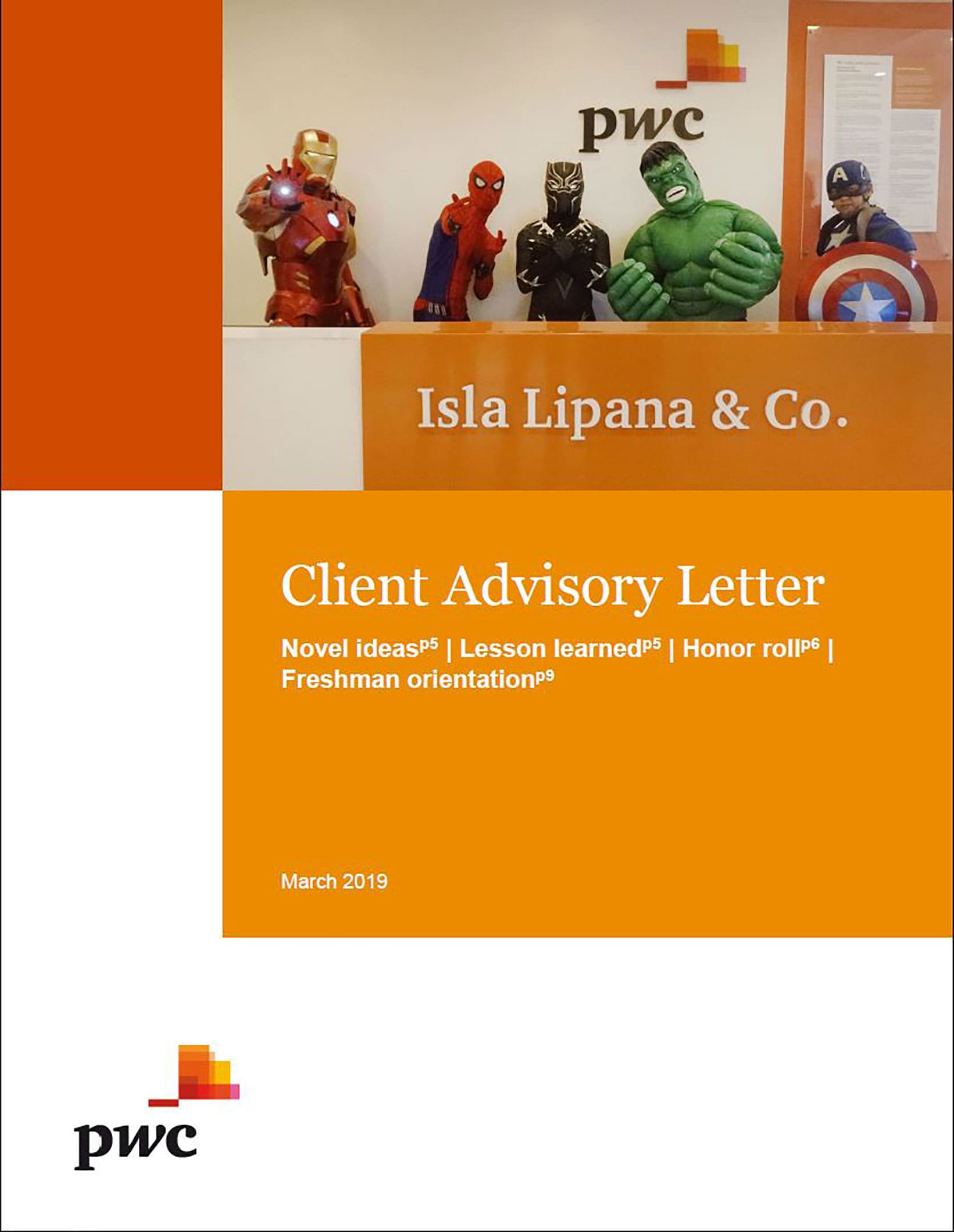
This is a publication about developments in Philippine taxation. The contents usually include latest Republic Acts, Bureau of Internal Revenue issuances, Customs regulations, Court decisions, BSP circulars, SEC circulars, Department of Justice opinions and Executive Orders relevant to Tax practice.
Talk to us
For further discussion on the contents of this issue of the Client Advisory Letter, please contact any of our partners.
Request for copies of text
You may ask for the full text of the Client Advisory Letter by writing our Tax Department, Isla Lipana & Co., 29th Floor, Philamlife Tower, 8767 Paseo de Roxas, 1226 Makati City, Philippines. T: +63 (2) 845 2728. F: +63 (2) 845 2806.
Japan defies demographic destiny by boosting workforce
Japan has continued to grow its workforce despite a shrinking and ageing population
More female and older workers have boosted Japan’s labour market
If Japan’s decline in unemployment rate continues at its average rate of the past eight years, the economy would hit zero unemployment in 2027
Despite a shrinking and ageing population, Japan is continuing to add to its workforce through greater female and older worker employment. PwC’s latest Global Economy Watch explores how Japan is counteracting its challenging demographics and whether this can continue.
Japan’s population is contracting, since its peak at 128 million in 2010, it has declined by 1.3 million people. Additionally, its population is old: 28% are over 65, compared with 18% in the UK and 15% in the US. Yet the number of people working in Japan continues to rise, up by 1.7% in 2018. This growth was not enabled by a reduction in high unemployment; joblessness has been low and falling for years.
Japan’s female employment rate is a key contributor. In 2002, there was a ten percentage point gap between female employment rates in the US and Japan, but Japan has now overtaken the US. A higher proportion of women are also returning to work sooner after having children than they were previously.
Government policy in Japan has aided this, by increasing the number of nursery places and making provision for all 3-5 year olds free by 2021. A law passed in 2015 demands that larger firms set targets for hiring and promoting women. Other legislation caps overtime at 100 hours a month, a move designed to both prevent over-work and generate new roles where demand clearly exists.
The Japanese government is also aiming to push up the retirement age for state workers from 60 to 65 and boost the public pension for those that opt to defer drawing from it. Japan is already leading the world by retaining so many older workers; its rate of around 25% is higher than that in the US (18%) and the UK (10%).
Mike Jakeman, senior economist at PwC, comments:
“Japan’s already strong labour market has found a way to strengthen further despite it’s unfavourable demographics. Former barriers to entry, such as a culture of long office hours, entrenched gender roles and a lack of flexibility have shifted thanks to government intervention. This has enabled parts of the population previously deterred from working, such as women and older people, to participate.
“There’s a reluctance to embrace higher immigration in Japan, but parliament has approved the creation of two new visas, which could see immigration increase.
“But the remarkable performance of Japan’s labour market will require more births and more immigrants to be sustained.”
If Japan’s decline in unemployment rate continues at its average rate of the past eight years, the economy would hit zero unemployment in 2027. It is possible that this date could be deferred if the labour force continued to grow, but the eventual impediment to this will be its shrinking population.
For more information please visit https://www.pwc.com/gx/en/issues/economy/global-economy-watch.html
About PwC
At PwC, our purpose is to build trust in society and solve important problems. We’re a network of firms in 158 countries with over 250,000 people who are committed to delivering quality in assurance, advisory and tax services. Find out more and tell us what matters to you by visiting us at www.pwc.com.
PwC refers to the PwC network and/or one or more of its member firms, each of which is a separate legal entity. Please see www.pwc.com/structure for further details.
© 2019 PwC. All rights reserved
Taxes, compliance matters, assessments, and refunds
Novel idea
Deficiency withholding taxes assessed are still internal revenue taxes
The BIR has the right to assess “internal revenue taxes” within three (3) years after the deadline for filing the return. At the SC level, the BIR argued that the right to assess withholding taxes does not prescribe. This is because they are not “internal revenue taxes” but are, as characterized in an earlier SC decision, mere “penalties” imposed on the withholding agent for failing to remit correct withholding taxes.
The SC did not agree. It explained that the word “penalty” was used in the earlier SC decision to underscore the dynamics in the withholding tax system wherein what is being subjected to the withholding tax is the income of the payee and not the income of the withholding agent. Withholding taxes do not cease being income taxes simply because they are collected and remitted by a withholding agent.
(GR No. 211289, promulgated 14 January 2019)
Lesson learned
Refundable input VAT should be attributable to VAT zero-rated sales
A renewable energy (RE) company had no revenues from 2011 to 2013 because it was still in the stage of developing, constructing and installing its power plant.
The first commercial sale was made in 2014. Later, it filed claims for refund of 2013 unutilized input VAT attributable to VAT zero-rated sales.
In order to be entitled to a refund, the CTA ruled that the RE company should prove, among others, that it was engaged in VAT zero-rated sales and that the subject input VAT was attributable to such VAT zero-rated sales. Since the RE company had no VAT zero-rated sales in 2013 to which the input VAT can be attributed to, the CTA dismissed the refund claims.
(CTA Case Nos. 9119, 9201, 9254 and 9336, promulgated 4 March 2019)
Multiplication table
VAT on undeclared sales inferred from unaccounted purchases
VAT can be imposed only when it is shown that the taxpayer received an amount of money or its equivalent from its sale of goods, property or services and not when there are under-declared purchases. Accordingly, the CTA cancelled a deficiency VAT assessment that was merely based on the amount derived by multiplying the amount of unaccounted purchases by the gross profit rate.
(CTA Case No. 8959, promulgated 11 March 2019)
Fail rate
Use of a benchmark rate in making an assessment has no legal basis
During a tax investigation, the BIR alleged the existence of undeclared sales. These undeclared sales were computed by using a benchmark rate that supposedly pertained to sales of other companies. On this basis, the BIR assessed deficiency VAT.
The CTA cancelled the assessment. It held that the presumption of correctness of the VAT assessment cannot be made to rest on another presumption that the amount of sales of other companies is the same with the sales of the taxpayer.
(CTA Case No. 8959, promulgated 11 March 2019)
Incomplete
Likely source of undeclared income should be identified
In 2007, an individual purchased a luxury car for PHP26m. However, his ITR for the same year indicated that his business had “no operations” or no income. Under these circumstances, he was charged for tax evasion for undeclared income amounting to PHP26m.
The CTA dismissed the case mainly because the prosecution failed to establish the likely source and nature of alleged undeclared income. In criminal cases, it is essential to identify the likely source of unreported or undeclared income of the accused in order to sustain conviction.
(CTA Crim. Case No. O-212, promulgated 26 February 2019)
Pre-req
When the “in lieu of all taxes” provision does not apply
Under RA No. 9511, the NGCP is subject to the 3% franchise tax which is in lieu of all local or national taxes.
The CTA held that the “in lieu of all taxes” clause covers the exemption of the NGCP from the contractor’s tax, a local tax. However, the operation of such clause comes into play only if the 3% franchise tax was paid.
Since there was nothing on record that NGCP paid the 3% franchise tax, the CTA upheld the assessment for contractor’s tax.
(CTA AC No. 181, promulgated 30 January 2019)
Form over substance
Implementing the excise tax on non-essential services
The CIR issued rules and regulations implementing the imposition of excise taxes on non-essential services introduced by the TRAIN Act. Said rules and regulations feature the following:
- Definitions of plastic, cosmetic and reconstructive surgeries, and invasive and non-invasive cosmetic procedures
- Excluded procedures
- Persons liable to pay the excise tax
- Deadline and venue for filing the monthly excise tax return
- Invoicing and accounting requirements
- Penalties
Individual practitioners and juridical entities (e.g., clinics and hospitals) performing invasive cosmetic procedures are required to update their COR to include the tax type ‘Excise Tax on Invasive Cosmetic Procedures’.
On the other hand, those who are performing non-invasive cosmetic procedures are required to execute and submit a Sworn Statement to the effect that they are performing only non-invasive cosmetic procedures.
(Revenue Regulations No. 2-2019, published 21 March 2019)
New form
Prescribing the new BIR Form No. 1701
The BIR issued the newly revised BIR Form No. 1701 January 2018 (ENCS) which is generally required to be used by individuals, estates and trusts in filing their ITR and paying their income tax for 2018 due on or before 15 April 2019.
It may be downloaded from www.bir.gov.ph and is included in the Offline eBIRForms Package v7.4.1 (Package v7.4.1). However, it is not yet available in the eFPS. Therefore, eFPS filers shall file through Package v7.4.1.
Individuals with business/professional income only, who are either using the OSD or availing the 8% income tax rate, shall use BIR Form No. 1701A which is also available in Package v7.4.1.
(Revenue Memorandum Circular Nos. 46-2019, issued 12 April 2019; and 37-2019, issued 18 March 2019)
Honor roll
Supplementing the lists of withholding agents for inclusion and deletion
The BIR issued an additional list of:
- withholding agents who are required to withhold one percent (1%) or two percent (2%) CWT from their income payments to suppliers effective 1 April 2019, and
- withholding agents who are no longer required to withhold the above CWT effective 1 April 2019.
The above additional lists were published at www.bir.gov.ph on 18 March 2019 and supplement the lists earlier published on 8 October 2018.
(Revenue Memorandum Circular No. 36-2019, issued 18 March 2019)
Home schooling
Clarifying the process of issuing DVCs, or issuing/denying TCs
To attain consistency in the understanding of outstanding tax liabilities or Accounts Receivable/Delinquent Accounts (AR/DAs), all BIR processing offices should be guided as follows:
- The definition of AR/DAs in relation to the issuance of Delinquency Verification Certificate (DVC) or Tax Clearance (TC) under RMO No. 11-2014 should be noted.
- Open stop-filer cases and deficiency tax assessments that are timely protested, subject of reconsideration/re-investigation, or pending appeal with the Appellate Division or CTA/SC shall not be considered as AR/DAs, hence, shall not be grounds for non-issuance of a clear DVC or TC.
- The existence of outstanding AR/DAs shall generally be verified through the Accounts Receivable Management System (ARMS). However, if there is an AR/DA record in the manually-maintained Inventory List of AR/DAs, such AR/DA shall first be added or created in the ARMS before issuing the DVC or denying the TC.
(Revenue Memorandum Circular No. 35-2019, issued 14 March 2019)
Dean’s list
Treatment and reporting of input VAT relative to VAT-exempt medicines
Given that the input VAT attributable to VAT-exempt medicines cannot be passed on to the buyer, the following should be strictly observed:
- All manufacturers, wholesalers, distributors and retailers shall be required to have an inventory list as of 31 December 2018 of drugs and medicines which became VAT-exempt beginning 1 January 2019.
- The inventory list shall include drugs and medicines on hand, imported and locally manufactured using the BIR-prescribed format.
- The inventory list shall be filed with the LTS/RDO where the taxpayer is registered on or before
25 April 2019 as an attachment to the Quarterly VAT Return (BIR Form No. 2550Q) for the first quarter of 2019. - Upon sale of VAT-exempt drugs and medicines, the corresponding input VAT shall be closed to cost or expense.
(Revenue Memorandum Circular No. 34-2019, issued 13 March 2019)
Model students
Reminders for candidates, political parties/party list groups and donors
Election candidates, political parties/party list groups and campaign contributors should be mindful of their tax compliance requirements in relation to:
- BIR registration or update of registration
- Payment of annual registration fee
- Registration of books
- Registration and issuance of non-VAT ORs
- Preservation of accounting records
- Tax treatment of campaign expenditures and contributions
- Income tax on unutilized/excess campaign funds
- Submission of Statement of Contributions and Expenditures
(Revenue Memorandum Circular No. 31-2019, issued 7 March 2019)
Giftedness
‘Deemed gift’ provision on transfers for less than adequate and full consideration
Generally, if property (other than real property classified as capital assets) is transferred for less than adequate and full consideration, the amount by which the FMV of the property exceeded the consideration shall be deemed a gift subject to donor’s tax.
A sale, exchange or other transfer of property made in the ordinary course of business is considered as made for adequate and full consideration, and constitutes a transaction which is bona fide, at arm’s length and free from any donative intent.
In this light, the BIR laid down the following rules:
- The exception to the ‘deemed gift’ provision should be strictly but reasonably interpreted, and all doubts should be resolved in favor of the general rule rather than the exception.
- Starting 1 January 2018, when unlisted shares are sold for less than FMV, the excess of the FMV over the selling price shall be treated as a gift subject to donor’s tax, except when they are sold at arm’s length, free from any donative intent.
- The determination of ‘whether the sale of unlisted shares is made at arm’s length’ is a question of fact and not of law. Hence, the taxpayer should be able to prove that the sale involves no irregularity between unrelated and independent parties. This requires the presentation and reception of reasonable and sufficient evidence.
(Revenue Memorandum Circular No. 30-2019, issued 28 February 2019)
Hitting the books
Reminders on bookkeeping requirements
In line with its objective of improving the ease of doing business in the Philippines, taxpayers are reminded of the following bookkeeping rules and requirements:
- All persons required to pay taxes are required to keep bookkeeping records duly authorized by the Secretary of Finance.
- Books of accounts may be maintained in any of the following manner:
- Manual books of accounts
- Loose-leaf books of accounts (with PTU)
- Computerized books of accounts (with PTU)
- Books of accounts must be kept in the place of business at all times and must be preserved intact, unaltered and unmutilated. The keeping of two or more sets of records or books of accounts is prohibited.
- All entries in the manual books of accounts must be handwritten.
- Manual books of accounts must be registered before the deadline for filing the first quarterly ITR or annual ITR, whichever comes earlier.
- Loose-leaf books of accounts, invoices, receipts and other accounting records must be permanently bound and presented for registration within the prescribed period.
- Computerized books of accounts and other electronic accounting records must be submitted and registered within thirty (30) days within the prescribed period.
- Taxpayers whose annual gross sales, earnings, receipts or output exceed PHP3m must have their books of accounts audited by independent CPAs.
- Taxpayers are required to preserve their books of accounts, including subsidiary books and other accounting records, for ten (10) years.
(Revenue Memorandum Circular No. 29-2019, issued 26 February 2019)
Freshman orientation
Allowing new businesses to operate while awaiting their official receipts/invoices
In line with its objective of improving the ease of doing business in the Philippines, the BIR is now allowing new businesses to start business operations while awaiting the printing and delivery of their receipts/invoices. Thus:
- All taxpayers are reminded of the requirements:
- to issue duly registered sale or commercial invoices, or receipts at the point of each sale valued at PHP100 or more; and
- to secure an Authority to Print principal receipts/invoices upon registration with the BIR.
- While awaiting the printing and delivery of receipts/invoices, new business registrants are allowed to secure BIR Printed Receipts/Invoices (BPRs/BPIs) from the New Business Registrant Counter and to use the same but only for a period of fifteen (15) days from date of registration.
- The BPR/BPI serves as principal evidence for the sale of goods, property and/or services and as a supporting document for expenses and input VAT credit.
- Only the BIR is allowed to print and issue BPRs/BPIs.
(Revenue Memorandum Circular No. 28-2019, issued 26 February 2019)
Alternative education
Over-the-counter acceptance of certain tax returns/payments
In light of the intermittent availability, and unavailability of the eFPS, all eFPS taxpayers are instructed to file tax returns manually or use the eBIRForms facility, and to pay their taxes “over-the-counter” with their AABs.
Accordingly, all AABs are advised to accept manually filed and out-of-district returns, and the corresponding tax payments of eFPS taxpayers without penalties if the filing and payment are made on or before the prescribed deadlines.
However, Large Taxpayers under RDOs 116, 125, 126, 121, 123, 124, and 127 are instructed to make “over-the-counter” payments for taxes being paid through the eFPS which deadlines fall from 11 March onwards only with AABs specifically identified in Bank Bulletin No. 2019-06 which may be accessed at www.bir.gov.ph.
(Bank Bulletin Nos. 2019-6 and 2019-5, dated 14 March 2019; and 2019-4, dated 11 March 2019)
Latest on regulatory landscape
Humble origins
Implementing the ASEAN Electronic Certificate of Origin
The BOC issued operational procedures for the implementation of the ASEAN Electronic Certificate of Origin (e-CO). The procedures involve the application, submission and processing of all e-COs pursuant to the Operational Certification Procedure of the ASEAN Trade in Goods Agreement using the TradeNet.gov.ph platform.
(Customs Memorandum Order No. 15-2019, signed 18 March 2019)
Entrance exam
Provisional safeguard duty on imported cement
In order to protect the domestic cement industry and curtail the rising volume of imported cement, the COC imposed a provisional safeguard duty in the form of a cash bond of PHP210/MT on all importations of cement with HS Codes 2523.2990 and 2523.9000.
The imposition shall be for 200 days from the effectivity date of CMO No. 12-2019, which is 22 February 2019 (the date of filing with the UP Law Center).
(Customs Memorandum Order No. 12-2019, signed 21 February 2019)
Course credits
Revised procedure on the utilization of TCCs
The BOC issued revised guidelines and procedures regarding the utilization of TCCs. The said guidelines and procedures pertain to the following:
- Required attachments to a written request to utilize TCC
- Issuance of a Certificate of “no outstanding balance” by the Collection Service and Certificate of Authenticity by the FMO
- Approval by the COC and transmittal of all documents to the District Collector
- Evaluation of completeness by the District Collector
(Customs Memorandum Order No. 10-2019, signed 20 February 2019)
Schedule of payment
Procedures on the issuance and processing of the NPS
The BOC issued revised guidelines and procedures regarding the Verification of Outstanding Balances of VAT TCCs for the issuance and processing of NPS. The said guidelines and procedures pertain to the following:
- Coverage which includes all VAT TCCs issued by the BOC pursuant to Section 112 of the Tax Code and VAT portions of TCCs issued jointly by the BOC and DOF
- Operational provisions
- Options of the holder/transferee upon acquisition of the NPS
- Manner of payment
(Customs Memorandum Order No. 11-2019, signed 20 February 2019)
College manual
Adoption of the TESLite and Revenue Office Tax Exemption Manual
The COC disseminated DOF Order No. 10-2019 which requires the DOF to adopt, starting 1 February 2019, the new tax exemption system called TESLite in processing all tax exemptions.
The COC adopted the Revenue Office Tax Exemption Manual as an official guide on the authority of the respective Revenue Office divisions and special lane, documentary requirements, and procedure for processing tax exemption applications. The COC also disseminated the abolition of the Express Lane.
(Customs Memorandum Circular No. 45-2019, signed 14 February 2019)
Multiple choice
Lane for Express Application Processing for new companies
company registration:
- Lane for Express Application Processing (LEAP)
The LEAP is already available. According to the SEC, one-day processing and approval is possible.
However, its use currently has the following limitations:
- Corporations that do not need to upload additional documentary requirements may utilize the LEAP.
- Only general purpose/non-specialized corporations or those that do not require secondary licenses or prior endorsements from other government agencies are qualified to use the LEAP.
2. Fast Track (Timely Registration Action Kiosk) Lane
- CRS applicants have to encode/upload their applications online.
- Original copies of notarized documents have to be manually submitted to the SEC for checking and processing.
- This is available to corporations that require secondary licenses or prior endorsements from other government agencies.
3. Regular Lane
- All types of corporations may use this lane.
- The entire incorporation process may be completed online from account creation to the payment of registration fees.
- Applicants will only come to the SEC to claim the Certificates of Incorporation.
- However, stable internet connection and a reliable computer is necessary to avoid system slowdown.
(SEC Notice to the Public, posted on 27 February 2019)
Old school
Work-around procedures in the registration of corporations
Due to technical challenges with the on-line CRS, the SEC is implementing the following interventions:
- manual processing of applications and the requirements that should be brought,
- processing of applications on a “First Come, First Served” basis, and
- accommodation of only two hundred (200) applications per day
(SEC Notice to the Public)
Cross registration
ACMF Pass under the ASEAN Capital Market Professional Mobility Framework
The Philippine SEC and the securities regulators of Thailand, Malaysia and Singapore are signatories to the Memorandum of Understanding on the ACMF Pass under the ASEAN Capital Market Professional Mobility Framework.
The ACMF Pass allows the freer movement of licensed professionals in a home country to perform investment advice activities and issue research reports on ASEAN financial products in a host country.
In this light, the SEC issued Guidelines on the Implementation of ACMF Pass under the ASEAN Capital Market Professional Mobility Framework. These Guidelines provide for the following:
- Applicability
- Professionals in the Philippines who are qualified to apply for an ACMF Pass
- Eligibility requirements for professionals from other signatory countries
- Covered ASEAN capital market products
- Scope of activities
- Prohibited activities
- Mode of performance of service
- Conditions for servicing retail and non-retail investors
- Application for, renewal, validity and termination/revocation of ACMF Pass
- Role of attached licensed firm in the host jurisdiction
- Monitoring, supervisory and enforcement mechanism
The Guidelines take effect fifteen (15) days after their publication in a newspaper of general circulation.
(SEC Memorandum Circular N0. 5-2019, dated 26 February 2019)
Double major
Holding companies engaging in financing activities
A financing company must be primarily organized for the purpose of extending credit facilities.
According to the SEC, a holding company cannot engage in financing activities by simply adding or including financing activities in its primary purpose. It opined that the mere addition of financing activities to the primary purpose effectively makes financing activities a secondary purpose which is prohibited under the Finance Company Act and its IRR.
Furthermore, the corporate name of a financing company should contain the term “financing company”, “finance company”, “finance and investment company” or other title descriptive of the operation and activities of a financing company.
(SEC-OGC Opinion No. 19-04, dated 4 March 2019)
Right minus wrong
Deduction of treasury shares from unrestricted retained earnings
The SEC confirmed that a corporation may declare dividends out of unrestricted retained earnings (R/E) without deducting the cost of treasury shares (T/S) arising from the redemption of redeemable preferred shares.
The 1982 Rules Governing Redeemable and Treasury Shares generally provide that T/S costs shall be deducted from R/E Available for Dividend Declaration. However, T/S arising from the redemption of redeemable shares shall not be deducted.
The above general rule and exception are still valid and do not in conflict with the 2008 Guidelines on the Determination of R/E Available for Dividend Declaration which provide for the deduction of T/S costs from R/E Available for Dividend Declaration without qualification as to the type and source of T/S.
(SEC-OGC Opinion No. 19-03, dated 14 February 2019)
Revised curriculum
Enacting the Revised Corporation Code of the Philippines
On 20 February 2019, the President approved the “Revised Corporation Code of the Philippines” (Revised Corporation Code) which repealed the Corporation Code of the Philippines.
The highlights of the Revised Corporation Code include:
- One Person Corporations (OPCs)
- Perpetual existence of corporations
- Removal of the minimum capital stock requirement
- Stricter rules on the use of corporate names
- Participation in the election of directors/trustees through remote communication or in absentia
- Exercise of appraisal right when corporate funds are invested for any purpose other than the primary purpose
- Increase of initial security deposit of foreign corporations which establish branches
The law took effect on 23 February 2019.
(Republic Act No. 11232, published on 23 February 2019)
Thesis defense
Solicitation of public comments on proposed SEC guidelines
The SEC requested all interested parties, market participants and the investing public to submit their views, comments and inputs to the draft SEC Memorandum Circulars containing the following proposed guidelines:
- Guidelines on the Establishment of a One Person Corporation
- Guidelines on the Conversion of an Ordinary Stock Corporation into a One Person Corporation
The views, comments and inputs may be electronically sent to Assistant Director Sampaguita R. Ladrido through srladrido@sec.gov.ph on or before 29 March 2019.
(SEC Notice, dated 15 March 2019)
Graduating class
SEC clarifications on certain provisions of the Revised Corporation Code
In light of the Revised Corporation Code which took effect on 23 February 2019, the SEC clarified the following:
- All financial statements (F/S) covering the period on or before 22 February 2019 should be prepared in accordance with the old Corporation Code of the Philippines.
- All companies required to file audited F/S under the Revised Corporation Code should comply with the required comparative presentation. If the F/S of the preceding year were unaudited, the statements should be prominently marked as “UNAUDITED”.
- Companies should include in the Notes to F/S a discussion on the impact of the Revised Corporation Code to the preparation and submission of F/S.
(SEC Notice, dated 18 March 2019)
Scholarship grant
Mandatory PhilHealth coverage for all PWDs
The “Magna Carta for Persons with Disability” has been amended to provide all PWDs with automatic coverage under the National Health Insurance Program of PhilHealth.
Premium contributions for all PWDs shall be paid by the national government. However, premium contributions of PWDs in the formal economy shall be shared equally by the employers and the national government.
The amendment took effect on 20 March 2019.
(Republic Act No. 11228, published on 5 March 2019)
Forced drop
Approving the Tax Amnesty Act
The President approved the “Tax Amnesty Act” which grants amnesties on estate taxes and on delinquencies. The much-anticipated general tax amnesty in the legislative bill was vetoed.
The estate tax amnesty covers the estate of decedents who died on or before 31 December 2017, and may be availed within two (2) years from the effectivity date of the IRR. The estate amnesty tax is equivalent to 6% of net estate or net undeclared estate at the time of death. If total allowable deductions is higher than the gross estate, a minimum estate amnesty tax of PHP5,000 shall be paid.
On the other hand, the tax amnesty on delinquencies covers all national internal revenue taxes pertaining to the following:
- Delinquencies and assessments which have become final and executory
- Tax cases subject of final and executory court decisions
- Pending criminal cases for tax evasion and other offenses under the Tax Code
- Withholding agents who withheld but did not remit to the BIR
The amnesty tax ranges from 40% to 100% of the basic tax assessed. It may be availed within one (1) year from the effectivity date of the IRR.
The Secretary of Finance, in coordination with the CIR, is mandated to issue the IRR within ninety (90) days from 6 March 2019, the effectivity date of the “Tax Amnesty Act.”
(Republic Act No. 11213, published on 19 February 2019)
Mother goose
105-Day Expanded Maternity Leave Law
The President approved the “105-Day Expanded Maternity Leave Law” which provides better maternity leave (ML) benefits for pregnant female workers. These include:
- 105-day ML with full pay regardless of type of delivery
- If solo parent, additional 15-day ML
- Optional additional 30-day ML without pay
- 60-day ML with full pay for miscarriage or emergency termination of pregnancy
- ML shall be granted in every instance of pregnancy, miscarriage or emergency termination of pregnancy
- ML of up to seven (7) days may be allocated by the mother to the child’s father or alternate caregiver
The law took effect on 10 March 2019.
(Republic Act No. 11210, published on 23 February 2019)
Shifting courses
Approving the Mobile Number Portability Act
The President approved the “Mobile Number Portability Act” which allows a mobile postpaid or prepaid subscriber to retain an existing mobile number when moving from one mobile service provider to another, or when changing the subscription from postpaid to prepaid or vice-versa.
Accordingly, public telecommunications entities are required to:
- provide free mobile number portability to all qualified subscribers
- interconnect with each other’s infrastructure and systems
- unlock the mobile telephone handset upon demand and for free
The NTC, in coordination with concerned government agencies, is required to issue the IRR within ninety (90) days from 8 March 2019, the effectivity date of the “Mobile Number Portability Act.”
(Republic Act No. 11202, published on 21 February 2019)
Social studies
Approving the Social Security Act of 2018
The President approved the “Social Security Act of 2018” which took effect on 5 March 2019. It repeals Republic Act No. 1161.
The new law took effect on 5 March 2019.
(Republic Act No. 11199, published on 19 February 2019)
Great contributions
Issuing new schedules of SSS contributions
Pursuant to the Social Security Act of 2018, the SSC issued new schedules of Social Security Contributions of OFW members, and of employers, employees, self-employed, voluntary members and non-working spouse, as well as OFW members effective for the applicable month of April 2019. The contribution for the Employees Compensation Program is not yet reflected in the schedules.
(SSS Circular Nos. 2019-007 and 2019-005, dated 15 March 2019)
Delinquency
Condonation of penalties on delinquent SSS contributions
Pursuant to Social Security Act of 2018, the SSC issued rules and regulations to implement the Condonation Program for the condonation and non-imposition of penalties on delinquent social security contributions. The rules and regulations provide:
- Who may avail
- Penalties covered
- Six-month period of availment
- Modes of availment
- Installment proposals
(SSS Circular No. 2019-004, dated 15 March 2019)
Virtual classroom
Regulating ATMs with virtual currency transactions
Operators of ATMs that allow the purchase or exchange of virtual currencies (e.g., Bitcoin), or of other devices with similar functionality and capability, are considered Virtual Currency Exchanges, hence, should register with the BSP.
They should also comply with anti-money laundering/terrorist financing laws and regulations, ensure sufficient and appropriate controls and governance framework, and put in place adequate consumer protection and customer support.
(BSP Memorandum No. M-2019-006, dated 14 March 2019)
Teacher discretion
Reduction of penalties imposed on late submission of reportorial requirements
Item No. VII, paragraphs A, B and D of Circular Letter No 2014-15 impose penalties for the delayed submission of reportorial requirements. The Insurance Commissioner has provided guidelines and grounds for the reduction of these penalties.
A written application to reduce penalties should be filed within ten (10) days from the receipt of an order or notice to pay. The penalties may be reduced by up to thirty percent (30%).
(IC Circular Letter No. 2019-07, dated 18 March 2019)



Follow PwC Philippines


