

This is a publication about developments in Philippine taxation. The contents usually include latest Republic Acts, Bureau of Internal Revenue issuances, Customs regulations, Court decisions, BSP circulars, SEC circulars, Department of Justice opinions and Executive Orders relevant to Tax practice.
Talk to us
For further discussion on the contents of this issue of the Client Advisory Letter, please contact any of our partners.
Request for copies of text
You may ask for the full text of the Client Advisory Letter by writing our Tax Department, Isla Lipana & Co., 29th Floor, Philamlife Tower, 8767 Paseo de Roxas, 1226 Makati City, Philippines. T: +63 (2) 845 2728. F: +63 (2) 845 2806.

PwC PH hosts Integrity Initiative FGD with academic leaders
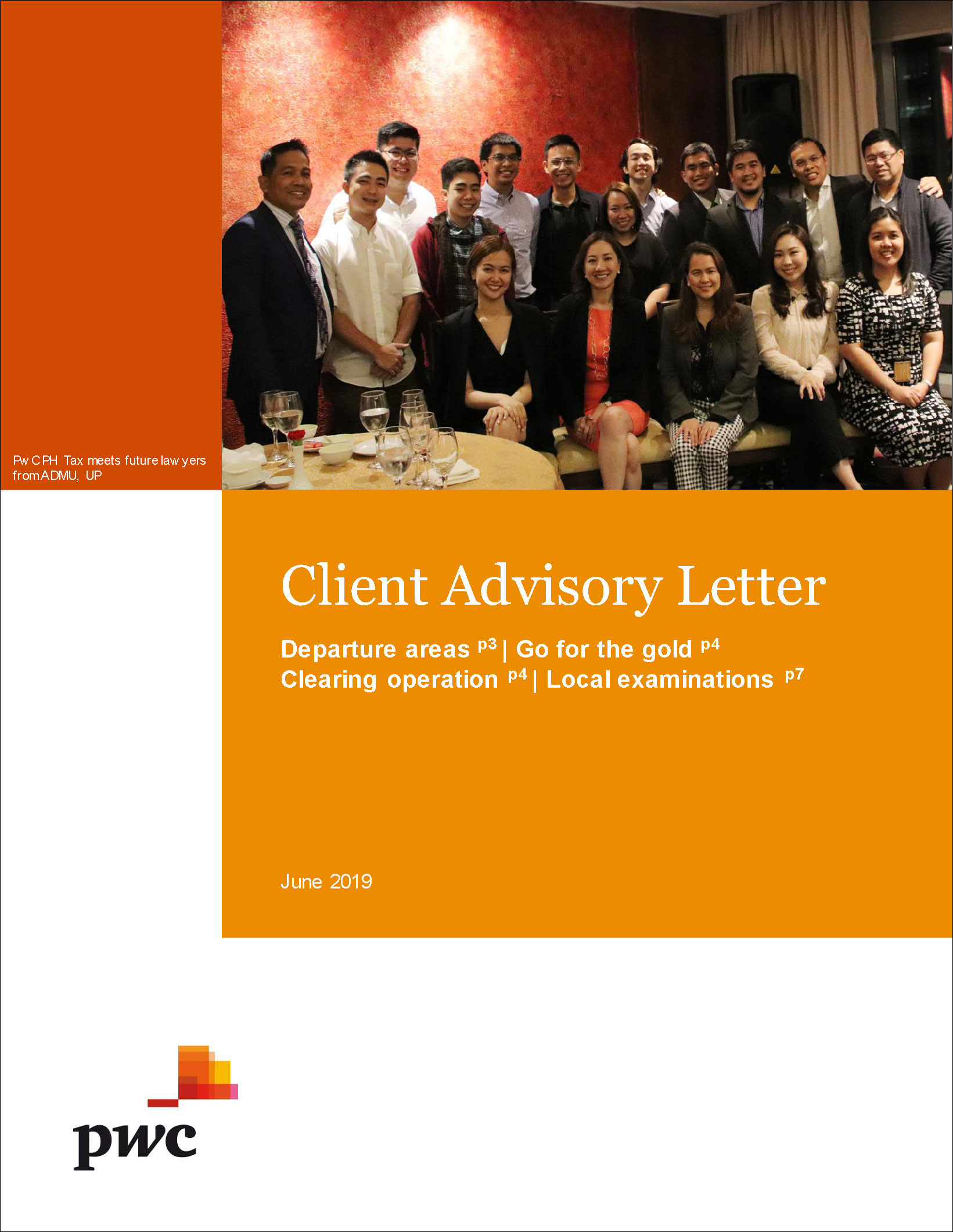
PwC Philippines hosted Integrity Initiative, Inc.'s (II, Inc.) focus group discussion (FGD) with 16 academic leaders on 20 June 2019 at the Tower Club, Philamlife Tower, Makati City.
The FGD, led by PwC Philippines Chairman and Senior Partner, and concurrently II, Inc. Chairman Alex Cabrera, is aimed at supporting II, Inc.'s efforts to establish an Integrity subject for private and public schools.
Educators from major state and private universities shared their insights on revisiting and enhancing the existing Ethics subjects.
II, Inc. is primarily engaged in a long-term private sector-led campaign to promote common ethical and acceptable integrity standards in the business community and among various sectors of society.
Taxes, compliance matters, assessments, and refunds
Internal conflicts
When the CTA has no jurisdiction
If the disputing parties in tax-related cases are both public entities, the cases shall be governed by PD No. 242; wherein the dispute should be administratively settled or adjudicated by the Secretary of Justice, the Solicitor General, or the General Corporate Counsel, as the case may be. Accordingly, the CTA has no jurisdiction over such cases.
(CTA EB No. 1833, promulgated 13 June 2019)
Acceptable loss
Deductibility of input VAT for purposes of computing income taxes
Input VAT pertaining to a claim for refund or issuance of tax credit certificate (TCC) of input VAT attributable to zero-rated sales, which was denied by the Department of Finance, may be deducted from gross income as a loss, not as bad debts expense.
(CTA EB No. 1786, promulgated 13 June 2019)
Expansion project
Amending the definition of ‘top withholding agents’
The definition of ‘top withholding agents’ (TWAs) has been amended to refer to those taxpayers whose gross sales/receipts or gross purchases, or claimed deductible itemized expenses, as the case may be, amounted to PHP12m during the preceding taxable year.
Taxpayers classified as TWAs prior to the effectivity of RR No. 7-2019 shall remain as such until their failure to satisfy the above criterion, and until publication as delisted from the existing list of TWAs.
(Revenue Regulations No. 7-2019, published 14 June 2019)
Departure areas
Amendments to the consolidated IRR on Estate Taxes and Donor’s Taxes
Section 10 of RR No. 12-2018[1] has been amended to include the following:
- Estate taxes may be paid by cash installments within two (2) years from the date of filing of the estate tax return, using the Payment Form (BIR Form No. 0605) or a payment form dedicated for this transaction.
- The bank shall remit the 6% FWT to the BIR using the Monthly Remittance Form of Tax Withheld on the Amount Withdrawn from the Decedent’s Deposit Account (BIR Form No. 0620) within ten (10) days following the month when the 6% FWT was withheld.
- However, if the 6% FWT was withheld during the third month of the quarter, the bank shall remit the same to the BIR using the Quarterly Remittance Return of Tax Withheld on the Amount Withdrawn from Decedent’s Deposit Account (BIR Form No. 0621) on or before the last day of the month following the close of the quarter.
- The bank shall issue the BIR Form No. 2306 as follows:
- Original and duplicate copies to the executor, administrator or any of the legal heirs
- Third copy to be retained by the bank
- The duplicate copy of the BIR Form No. 2306 is required to be submitted by the executor, administrator or legal heir to the concerned Revenue District Office within five (5) days from receipt from the bank.
- The 6% FWT is creditable against the estate tax due, if the amount withdrawn and subject to the 6% FWT was actually included in the gross estate declared in the estate tax return.
(Revenue Regulations No. 8-2019, published 26 June 2019)
[1] Consolidated Regulations on Estate Taxes and Donor’s Taxes
Go for gold
Tax exemptions of the sale of gold to the BSP and to accredited traders
The BIR circularized RA No. 11256 which amends Sections 32(B)(7) and 151 of the Tax Code. Under the amendments, the sale of gold to the BSP by registered small-scale miners and by accredited traders, and the sale of gold by registered small-scale miners to accredited traders for eventual sale to the BSP are exempt from income tax and excise tax.
(Revenue Memorandum Circular No. 61-2019, issued 11 June 2019)
Fund administration
Fuel Marking Program Funds
The BIR circularized DOF-DBM-COA Joint Circular No. 001-2018 entitled "Rules and Regulations Implementing Section 148-A, Subsection (h) Chapter V of the Tax Code on the use of Fuel Marking Program Funds.”
(Revenue Memorandum Circular No. 62-2019, issued 13 June 2019)
Clearing operation
Issuance of Delinquency Verification Certificates for VAT refund/credit claims
In the issuance of Delinquency Verification Certificates (DVCs) for the processing of VAT refund/credit claims within the required ninety (90)-day period, certain BIR offices fail to comply with the correct determination of outstanding liabilities which indicate only a one-month validity instead of six (6) months, or which commit other errors and deviation in policies.
In this light, clarification has been issued regarding the following items:
- Accounts Receivable / Delinquent Account arising from self-assessed tax liability, and final and executory deficiency tax assessment;
- BIR offices allowed to issue DVCs; and
- Official format of DVCs for VAT refund/credit claims.
(Revenue Memorandum Circular No. 64-2019, issued 18 June 2019)
Tightening the noose
Submission of tax incentive report by the CDA to the BIR
The BIR published the full text of Joint Administrative Order No. 1-2019 (Rules and Regulations Implementing Section 3 of RA No. 10963) in relation to Section 5(b) of the Tax Code, regarding the submission by the CDA of a tax incentive report to the BIR.
The Joint Administrative Order provides for the:
- Compliance requirements of registered cooperatives which include the submission of an Annual Tax Incentives Report to the CDA;
- Incentives-monitoring mechanisms; and
- Penalties for non-compliance.
(Revenue Memorandum Circular No. 59-2019, issued 7 June 2019)
Alien registration
Policies and guidelines in the tax registration of foreign nationals
Foreign nationals with the following permits who are planning to work or engage in trade and business in the Philippines are required to secure Taxpayer Identification Numbers (TINs):
- Alien employment permits (AEPs)
- Provisional work permits (PWPs)
- Special temporary permits
- Special work permits (SWPs)
In this relation, RMO No. 28-2019 identifies the appropriate RDO where TIN applications and the corresponding documentary requirements should be filed.
Non-resident aliens not engaged in trade or business in the Philippines, deriving Philippine-source income, are also required to secure TIN for withholding tax purposes. However, the withholding agents shall apply for the TIN of these non-resident aliens respectively.
Employers of foreign nationals with PWPs registered under EO No. 98, but were later issued AEPs or working visas (9g), are required to update their registration information with the RDO where they have been registered. On the other hand, foreign nationals with SWPs registered under EO No. 98, but were later issued working visas (9g), are required to apply for transfer of registration from RDO No. 39 to the appropriate RDO.
Registered foreign nationals may avail of preferential income tax rates under applicable tax treaties and opt to file a tax treaty relief application with the International Tax Affairs Division of the BIR.
(Revenue Memorandum Order No. 28-2019, issued 31 May 2019)
Bank job
Advising all AABs to accept BIR Form No. 0621EA
Further to the implementation of the estate tax amnesty under RA No. 11213, all AABs are advised to accept BIR Form No. 0621EA (Acceptance Payment Form Estate Tax Amnesty), and to follow the procedures in Bank Bulletin No. 2018-01.
(BIR Bank Bulletin No. 2019-12, dated 23 May 2019)
Actions for partition
Splitting of Revenue Regions No. 7 and 8
The CIR prescribed the splitting of Revenue Region (RR) No. 7 – Quezon City and RR No. 8 – Makati City, and redefining of their areas of jurisdiction.
RR No. 7 shall be split as follows:
RR No. 7A – Quezon City |
RR No. 7B – East NCR |
| RDO No. 28 – Novaliches | RDO No. 41 – Mandaluyong City |
| RDO No. 38 – North Quezon City | RDO No. 42 – San Juan City |
| RDO No. 39 – South Quezon City | RDO No. 43 – Pasig City |
| RDO No. 40 – Cubao | RDO No. 45 – Marikina City |
| RDO No. 46 – Cainta-Taytay |
On the other hand, RR No. 8 shall be split as follows:
| RR No. 8A – Makati City | RR No. 8B – South NCR |
| RDO No. 47 – East Makati City | RDO No. 44 – Taguig City-Pateros |
| RDO No. 48 – West Makati City | RDO No. 51 – Pasay City |
| RDO No. 49 – North Makati City | RDO No. 52 – Parañaque City |
| RDO No. 50 – South Makati City | RDO No. 53A – Las Piñas City |
| RDO No. 53B – Muntinlupa City |
The CIR also prescribed the redefinition of cities/municipalities and barangays which compose the jurisdiction of certain RDOs.
(Revenue Administrative Order No. 4-2019, dated 18 June 2019)
Latest on regulatory landscape
Countryside development
Suspending the establishment of Ecozones in Metro Manila
The President directed the DICT, DTI, DoTr, DPWH, TESDA and PEZA to hasten human capital and infrastructure development, provide needed interventions to strengthen ecozones in the countryside, and ensure the development of backward and forward linkages of industries in and around Ecozones.
To complement existing strategies and policies for rural development, the PEZA shall no longer accept, process or evaluate applications for establishment of Ecozones in Metro Manila upon effectivity of AO No. 18 and until such moratorium is lifted.
(Office of the President Administrative Order No. 18 s. 2019, signed 17 June 2019)
Oil dilution
Allowing the PNOC EC to enter into farm-in/farm-out agreements
The President permitted the PNOC Exploration Corporation (PNOC EC) to enter into farm-in/farm-out agreements with respect to petroleum service contracts.
The terms ‘farm-in’ and ‘farm-out’ refer to the practice of allowing third party participation to spread the risks inherent in oil and gas exploration, development and production.
The DOE, in consultation with the Governance Commission for Government-Owned or -Controlled Corporations, shall issue rules and regulations specifying the third-party selection process to be observed by the PNOC EC.
Every farm-in/farm-out agreement takes effect only upon DOE approval after finding that the entire agreement complies with PD No. 87, EO No. 80 and other applicable laws and issuances.
(Executive Order No. 80 s. 2019, signed 28 May 2019)
Investing made easy
Availability of the PSE Electronic Allocation System
The SEC announced that the PSE Electronic Allocation System or PSE EASy is already live and accessible effective 3 June 2019.
The PSE EASy is a web-based application that enables investors to register and subscribe online to the Local Small Investor program of an Initial Public Offering (IPO). It will also make things easier for IPO underwriters and Trading Participants who are provided access to dashboards.
(PSE Memorandum CN No. 2019-29, dated 3 June 2019)
In short time
Amending the policy on the validity period of accreditation of firms
The PSE resolved to limit the validity period of the accreditation of firms for valuation or appraisal purposes to one (1) year. However, existing accreditations shall remain valid until its expiration or revocation by the PSE.
Accredited firms with five (5)-year validity shall still be required to submit to the PSE an annual report (SEC Form AC-AR) including the required information within one hundred five (105) days from fiscal year-end or simultaneous with the submission to the SEC.
(PSE Memorandum CN No. 2019-28, dated 3 June 2019)
What’s in a name
Guidelines and procedures on the use of corporate and partnership names
The SEC adopted guidelines and procedures in the registration of corporate, one person corporate and partnership names in order to keep abreast of business and information technology developments.
The guidelines and procedures provide for the following, among others:
- A corporate name shall contain specific words/abbreviations depending on its type of business.
- A term (in a corporate name) that describes the business of a corporation should refer to its primary purpose.
- Names should be distinguishable from other names registered with the SEC or the DTI, in the case of sole proprietorships.
- A company may have more than one business or trade name.
- A trade name or trademark registered with the Intellectual Property Office may be used as part of a corporate or partnership name of a party other than its owner, if the latter consents.
- Guidelines on the use of the following are provided:
- full name or surname of a living or deceased individual as a corporate or partnership name
- name of an internationally known foreign corporation
- name of a local geographical unit, site or location
- certain words or phrases such as “Finance Company”, “Lending Investor”, “Bank”, “United Nations”, “Bonded” and “ASEAN”
- name of a corporation or partnership that has been dissolved or whose registration was revoked
- corporate or partnership name that was previously used but later amended
- name of an absorbed/constituent corporation in a merger or consolidation
- Special laws regulating the practice of profession shall govern the use of names with respect to related firms, partnerships or associations.
- “Red cross”, “red crescent” or “red crystal” cannot be used without the consent of the Philippine Red Cross.
- The reservation or notice of availability of a name shall not constitute an approval of the use of such name or an application for a change of name.
- The CRMD shall resolve appeals for or oppositions to the approval of corporate and partnership names of new companies, or complaints against proposed new names of existing corporations or partnerships.
- The SEC requires submission of affidavit with unqualified undertaking to change name upon receipt of notice from the SEC.
(SEC Memorandum Circular No. 13-2019, dated 21 June 2019)
Local examinations
When to apply the Grandfather Rule
The Grandfather Rule is a method to determine the percentage of Filipino equity in a corporation engaged in nationalized or partly nationalized activities. It is computed by attributing the nationality of the second or even subsequent tier of ownership to determine the nationality of corporate shareholders. Under this Rule, the Filipino ownership of the investing corporation and the investee corporation are combined to determine the percentage of Filipino ownership.
This Rule is only applicable when the 60-40 Filipino-foreign equity ownership is “in doubt.” Accordingly, if all shareholders of the investing corporation are natural persons, it is no longer necessary to use the Grandfather Rule, or even the Control Test. These tests are used to determine the nationality of a corporation only when the latter has an investing corporation which has corporate stockholders.
(SEC-OGC Opinion No. 19-24, dated 24 June 2019)
Discretionary matter
Foreign corporation operating within Ecozones
The exemption of Ecozone enterprises from nationality requirements depends on the laws governing the Ecozone and the rules issued by its implementing agency.
In the case of the Clark Freeport Zone (CFZ), the Clark Development Corporation (CDC) has the power to authorize a corporation, a business organization formed under foreign law, or a non-Philippine national to do business or engage in an industry inside the zone.
Hence, it is up to the discretion of the CDC to determine whether or not a one hundred percent (100%) foreign-owned corporation may engage in the restaurant business inside the CFZ.
(SEC-OGC Opinion No. 19-21, dated 29 May 2019)
Rent premises
A club may be authorized to lease its real properties
A club may be authorized to contract with third persons for the lease of available spaces and facilities within the club for valuable consideration; although leasing is not specified as the club’s primary purpose.
According to the SEC, the lease of real properties (as may be necessary or incidental to the conduct of the corporate purpose) indicated as a secondary purpose in the Articles of Incorporation of the club may not strictly be construed as a secondary purpose independent or distinct from primary purpose. Because, it is a general power of every corporation allowed under the Revised Corporation Code.
(SEC-OGC Opinion No. 19-22, dated 14 June 2019)
Dividend option
Securing SEC approval for cash or stock dividend declarations is optional
A corporation is not required to seek prior SEC approval or advice to declare cash or stock dividends, provided that the following are complied with:
- For cash dividend declaration
- Board of Directors approval, and
- Sufficient unrestricted retained earnings as of the last fiscal or calendar year
- For stock dividend declaration
- Board of Directors approval,
- Stockholders’ approval representing at least two-thirds (2/3) of the outstanding capital stock,
- Sufficient unissued authorized capital stock, and
- Sufficient unrestricted retained earnings as of the last fiscal or calendar year
Nevertheless, corporations may apply, at their option, for acknowledgement notice of the cash or stock dividend declaration. In such event, corporations must submit SEC-required documentary requirements and pay the required filing fee.
(SEC-OGC Opinion No. 19-23, dated 17 June 2019)
Financial reporting
Adopting the Revised Conceptual Framework
The SEC adopted the Revised Conceptual Framework (the “Framework”) as part of its rules and regulations on financial reporting. The Framework includes:
- a new chapter on measurement;
- guidance on reporting financial performance;
- improved definitions (‘liability’, in particular) and guidance; and
- larifications in important areas, such as roles of stewardship, prudence and measurement uncertainty.
Amendments to references to the Conceptual Framework in the Philippine Financial Reporting Standards are effective for annual periods starting on or after 1 January 2020, with earlier application permitted. These amendments should be applied retrospectively; unless it would be impracticable, or would involve undue cost or effort.
(SEC Memorandum Circular No. 12-2019, dated 28 May 2019)
Sky is the limit
Importation, exportation and trading of rice
The CoC circularized DA-NEDA-DBM Joint Circular No. 01-2019 which contains the implementing rules and regulations of RA No. 11203, liberalizing the importation, exportation and trading of rice, and lifting the quantitative import restriction on rice.
(Customs Memorandum Circular No. 135-2019, dated 22 May 2019)
House rules
Regulating the registration of Customs Brokers with the BOC
The CoC issued rules and regulations governing the registration of Customs Brokers and their representatives transacting with the BOC, which cover the following:
- Requirement to register and obtain a Certificate of Registration (COR)
- Customs Broker who is also an employee of a Customs Broker
- Minimum qualifications of an authorized representative of a Customs Broker
- Responsibilities of the Accounts Management Office
- Procedures and requirements for new applications for registration
- Issuance, form, effect and validity period of COR
- Period and requirements for renewal of registration
- Effects of failure to timely renew registration
- Motion for reconsideration and appeal of disapproved applications
- Duties and responsibilities of Customs Brokers
- Relations with a Customs Broker with cancelled or suspended registration
- Cancellation, delisting and revocation of registration
- General Professional Partnerships of Customs Brokers
(Customs Administrative Order No. 5-2019, dated 28 May 2019)
Stick to the list
Issuance of an official list of prescribed BOC fees and charges
The CoC issued an official list of Bureau of Customs Fees and Charges (the “List”) which may only be imposed and collected by the BOC. Accordingly, all concerned BOC officials and employees are enjoined to strictly comply with the List. Any unauthorized collection or illegal imposition not covered by the List shall be criminally and administratively charged and punished.
(Customs Memorandum Order No. 30-2019, dated 19 June 2019)
Indispensable requirements
Super Green Lane accreditation and clearance procedure
The CoC reiterated and amended the revised Super Green Lane (SGL) accreditation and clearance procedure regarding the processing of SGL importations as follows:
- For shipments requiring clearance from BAI/BPI, the importer is required to submit advance copies of the Bill of Lading to the respective government agencies prior to the issuance of clearances.
- For shipments containing frozen meat, meat products, meat by-products, feed ingredients, feed additives, feed supplements, etc., the importer shall be subject to documentation, tagging and clearance from the VQS office.
- The BAI/BPI shall submit to the BOC an updated monthly list of accredited importers with list of importable commodities.
- A list of updated requirements for BAI/BPI accreditation shall be posted for circularization.
(Customs Memorandum Order No. 29-2019, dated 19 June 2019)
One week’s time
Period of lodgment of goods declaration and payment of duties and taxes
The period to lodge goods declaration has been shortened from fifteen (15) days to seven (7) days from the date of discharge of the last package from the vessel or aircraft. Accordingly, District Collectors are directed to immediately examine the goods (when necessary) after the goods declaration has been lodged, then assess the goods. After which, payment of duties and taxes may be made immediately upon receipt of the assessment.
If the declarant does not have all the information or supporting documents to complete the goods declaration, the lodging of provisional goods declaration may be allowed in accordance with the CMTA.
Considering that certain shipments may be tagged ‘abandoned’ by the updated E2M system, a report of these shipments tagged ‘abandoned’ will be provided by the MISTG to be untagged abandoned by the concerned District Collector. Those not covered by said report shall follow the usual process for lifting of abandonment.
(Customs Memorandum Order No. 27-2019, dated 7 June 2019)
Agency changes
Amending the accrediting government agencies
The CoC amended CMO No. 19-2019 with respect to the accrediting government agencies, thus:
Stakeholders |
Accrediting Agencies |
Requirements to be submitted |
Airlines |
CAB |
Email notification from concerned agency |
Shipping Lines |
MARINA |
Letter indorsement from shipping agent, MARINA Accreditation and valid Permit to Operate |
Importers and Exporters with Freeport Zone Authorities |
PEZA |
BCOR and CPRS notification from concerned agency |
CDC, SBMA, CEZA, ZCSEZA and Authority of the Freeport Area of Bataan |
Email notification from concerned agency |
|
Exporters Registered with Other Investment Promotions Agencies |
BOI |
Email notification and Certificate of Good Standing from concerned agency |
Tourism Infrastructure Enterprises Zone Authority and Export Marketing Bureau |
Email notification from concerned agency |
|
Other Exporters |
Philippine Exporters Confederation, Inc. |
Email notification from concerned agency |
Customs Bonded Warehouse Operators |
License to Operate issued by the BOC and indorsement from the deputy commissioner, AOCG for activation of CPRS profile |
|
Forwarders / Consolidators (NVOCCs) |
DTI-Fair Trade Bureau (Sea Freight) |
Email notification from concerned agency |
CAB (Air Freight) |
(Customs Memorandum Order No. 26-2019, dated 7 June 2019)
Infrastructure development
Guidelines on investments in infrastructure projects under the PDP
The Insurance Commissioner issued ‘Amended Guidelines on Investments in Infrastructure Projects under the Philippine Development Plan (PDP)’ that may be undertaken by an insurance or professional reinsurance company.
The amended guidelines provide for:
- The forms of investment that may be entered into or availed of
- Types of infrastructure projects/activities
- Treatment of investment
- Pre-approval requirements
- Net worth and risk-based capital considerations
(IC Circular Letter No. 2019-19, dated 7 May 2019)
Investment guide
Guidelines for investing in real estate investment trust
Investment in Real Estate Investment Trust (REIT) shall qualify as an admitted asset for insurance companies and Mutual Benefit Associations (MBAs), and as allowable investment for pre-need companies provided that:
- The REIT had prior SEC approval and shall be limited to publicly-listed REITs only;
- The aggregate placement does not exceed ten percent (10%) of Total Admitted Assets for life insurance companies or MBAs, and twenty percent (20%) of Net Worth for non-life insurance or professional reinsurance companies;
- For pre-need companies, the investment shall not exceed fifteen percent (15%) of the total trust fund; and
- This shall be subject to a risk-based capital charge of twenty-five (25%) for both life and non-life insurance companies.
(IC Circular Letter No. 2019-27, dated 21 June 2019)
Trust concerns
Guidelines on investment of trust fund in savings/time deposits and UITFs
The Insurance Commissioner issued the ‘Guidelines on the Investments of the Trust Fund of Pre-Need Companies in Savings/Time Deposits and UITFs’ maintained with and managed by a duly authorized bank.
The guidelines provide for, among others, the following:
- No pre-need company may invest its trust funds in savings/time deposits and UITFs without prior IC approval.
- The IC may validate on the CAMELS ratings disclosed to them by the bank upon submission of certain documents.
- The Investment Division shall be in-charge of the approval of the trust fund investments. The Pre-Need Division shall continue to verify the trust fund of pre-need companies, including the CAMELS ratings of banks.
- Pre-need companies with existing investments in savings/time deposits and UITFs are required to submit the names of the trustee company and the bank where the trust fund was invested, and the amount involved within fifteen (15) days from effectivity of IC Circular Letter No. 2019-29.
(IC Circular Letter No. 2019-29, dated 21 June 2019)
Viral applications
HMO underwriting of applicants with actual, perceived or suspected HIV status
The Insurance Commissioner issued the ‘Guidelines in the HMO Underwriting of Applicants with Actual, Perceived or Suspected HIV Status.’ The guidelines provide for the following:
- Voluntary HIV testing
- Evaluation of compliance with and efficacy of treatment
- Grant of HMO coverage
- Additional underwriting requirements
- Cost of special underwriting requirements
- Modification of plan benefits and terms
- Underwriting decisions
(IC Circular Letter No. 2019-30, dated 21 June 2019)
Ethical agency
Regulating the conduct of business by HMO agents
The Insurance Commissioner issued regulations that shall govern the conduct of business by agents of HMOs. The regulations:
- Define an HMO agent
- Identify the prohibited conduct and activities of HMO agents
- Prescribe rules of conduct and behavior of HMO agents
- Impose penalties following proper notice and hearing
(IC Circular Letter No. 2019-31, dated 25 June 2019)



Follow PwC Philippines


