

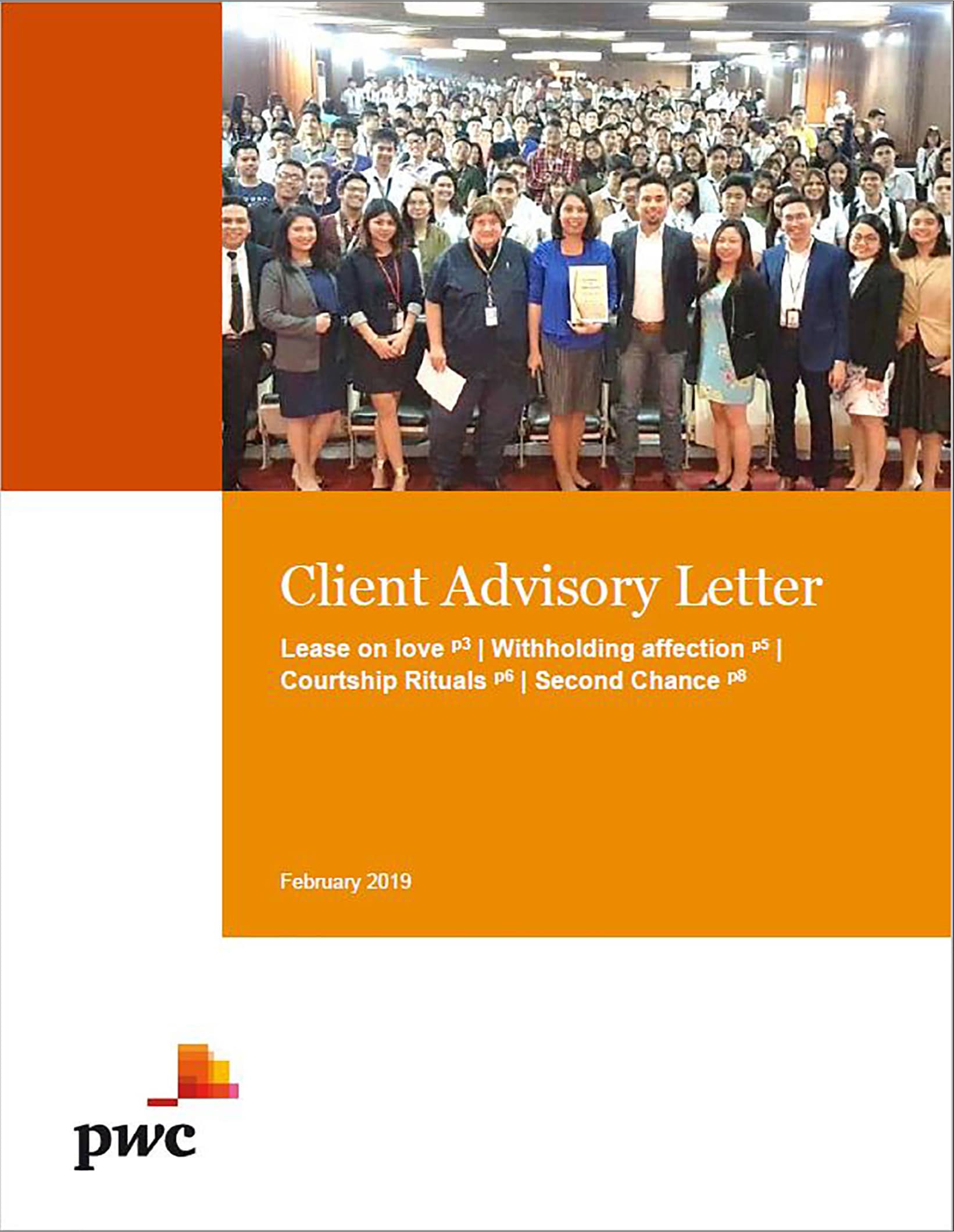
This is a publication about developments in Philippine taxation. The contents usually include latest Republic Acts, Bureau of Internal Revenue issuances, Customs regulations, Court decisions, BSP circulars, SEC circulars, Department of Justice opinions and Executive Orders relevant to Tax practice.
Talk to us
For further discussion on the contents of this issue of the Client Advisory Letter, please contact any of our partners.
Request for copies of text
You may ask for the full text of the Client Advisory Letter by writing our Tax Department, Isla Lipana & Co., 29th Floor, Philamlife Tower, 8767 Paseo de Roxas, 1226 Makati City, Philippines. T: +63 (2) 845 2728. F: +63 (2) 845 2806.
PwC launches new tool to help organisations assess their workforce strategy
February 2019 – As organisations prepare for a future world of work that will look vastly different to today, PwC has launched a new tool allowing them to assess the maturity of their workforce strategy and compare it to others in their region and industry.
Available free of charge on PwC’s website, the tool assesses an organisation’ preparedness in four distinct areas: planning, purpose, talent and technology.
The tool draws on PwC’s research and extensive experience in designing and implementing future workforce strategies.
Bhushan Sethi, Global Leader, People and Organisation, PwC, says:
“Now more than ever, organisations need the right workforce strategy to prepare for the future world of work. It’s critical they get this right. Our new Workforce Strategy Diagnostic tool is designed to help them achieve just that, allowing them to identify which changes they need to make today to ensure they are future proofed for tomorrow.”
Notes to editors
PwC’s Workforce Strategy Diagnostic is available at: www.pwc.com/workforce-strategy-diagnostic
For PwC insights on the future of work, visit www.pwc.com/people.
About PwC
At PwC, our purpose is to build trust in society and solve important problems. We’re a network of firms in 158 countries with over 250,000 people who are committed to delivering quality in assurance, advisory and tax services. Find out more and tell us what matters to you by visiting us at www.pwc.com.
PwC refers to the PwC network and/or one or more of its member firms, each of which is a separate legal entity. Please see www.pwc.com/structure for further details.
© 2019 PwC. All rights reserved
Taxes, compliance matters, assessments, and refunds
Lease on love
DST on financial leases
Citing the Financing Company Act (RA No. 5980), the CTA held that financial leasing is a mode of extending credit and falls within the same category of loans subject to the DST on debt instruments.
However, the DST should be computed on the principal amount of indebtedness which pertains to the cost of the leased property less the guaranty deposit representing the residual value of the property.
(CTA Case No. 8735, promulgated 12 February 2019)
Short-term relationship
Computing DST on advances with terms of less than one year
In computing deficiency DST on short-term advances, the CTA used the general ledger, promissory notes and official receipts to determine the specific number of days each advance was outstanding. However, for advances with no available records to determine the term, the CTA relied on the transaction movements in the GL, i.e., the dates the amount was credited and debited.
(CTA Case No. 8735, promulgated 12 February 2019)
Love knows no bounds
Implication of failure to revalidate the LOA
A revenue officer (RO) has one hundred twenty (120) days from the date of receipt of the LOA by the taxpayer to conduct a tax investigation and to submit the required report of investigation. If the investigation is not completed within the 120-day period, the RO may request the revalidation of the LOA.
The CTA ruled that the failure of the RO to request a revalidation does not nullify the LOA. It will only be a ground for the imposition of disciplinary action and demerit in the performance rating of said RO.
(CTA Case No. 9199, promulgated 8 February 2019)
Cold heart
When a preliminary collection letter constitutes a final decision
The BIR issued a preliminary collection letter (PCL) requesting the taxpayer to settle the tax assessments in the FAN within ten (10) days. The CTA treated said PCL as a final demand letter from the BIR tantamount to a denial of the taxpayer’s request for reconsideration of the FAN.
In other words, the PCL already constitutes the final decision of the BIR on the protest to the FAN. Therefore, the taxpayer had thirty (30) days from receipt of the PCL to appeal to the CTA.
(CTA Case No. 8730, promulgated 17 January 2019)
Love tips
Whether service charges should be subjected to VAT
Service charges collected by hotels, restaurants and other similar establishments that are earmarked and set aside for purposes of distributing the same to the employees should not be subject to VAT.
According to the CTA, gross receipts subject to VAT do not include monies or receipts which do not belong or redound to the benefit of the taxpayer.
(CTA Case No. 9349, promulgated 18 January 2019)
Imperfect match
Utilization of creditable withholding taxes corresponding to prior year’s income
In 2009, the taxpayer utilized creditable withholding taxes (CWT) that correspond to income recognized in 2008. The taxpayer explained that this was due to the fact that its customers-withholding agents only issued the related withholding tax certificates (BIR Form No. 2307) in 2009.
The CTA allowed the late utilization because the CWT was supported withholding tax certificates. It cited Section 2.58.3(B) of RR No. 2-1998 which allows claims for CWT refunds/credits if the income payments were declared as part of gross income and are supported by BIR Form No. 2307 duly issued by the withholding agent.
Note: Section 2.58.3(A) of RR No. 2-1998 provides that the amount of CWT shall be allowed as a tax credit against the income tax liability of the payee in the quarter of the taxable year in which the income was earned or received.
(CTA Case No. 9298, promulgated 21 January 2019)
On my own
Cancellation of unrefuted deficiency tax assessment
In its FDDA, the BIR disallowed excess tax credits carried over to the succeeding year. However, the BIR did not indicate any reason for the disallowance.
Although the taxpayer failed to refute said disallowance, the CTA, on its own, cancelled the disallowance and the corresponding deficiency income tax assessment. The CTA held that the assessment was void because the BIR did not inform the taxpayer of the law and facts on which the assessment was based.
(CTA Case No. 9298, promulgated 21 January 2019)
Admission of feelings
When input VAT carry-over is allowed to be credited against the VAT assessment
In a deficiency VAT assessment, the BIR argued that the CTA Division erred when it deducted input VAT carried over to the succeeding taxable quarters from the deficiency VAT liability without requiring the taxpayer to substantiate such input VAT.
The CTA explained that substantiation was no longer necessary because the BIR already admitted its existence in the Details of Discrepancies attached to the FAN where the input VAT carry-over was disallowed on the assumption that it was credited against output VAT liabilities in the succeeding taxable years.
(CTA EB No. 1743, promulgated 21 January 2019)
A love misplaced
Serving the FAN to the new address
The BIR mailed the FAN to the old address of the taxpayer. The CTA cancelled the deficiency tax assessments in the FAN because there was no proper service thereof.
Although the taxpayer did not file a formal written notice of its change of address, it was found that the BIR was already aware of the taxpayer’s new address prior to the mailing of the FAN. This was evident in the following BIR-issued correspondences which already reflected the taxpayer’s new address:
- Letters of Authority
- Second and Final Request for Presentation of Books of Accounts and Other Relevant Records
- Notice of Informal Conference
In this light, the CTA ruled that the FAN should have been mailed to the new address.
(CTA Case No. 8782, promulgated 21 January 2019)
Proof of love
When proof of actual shipment is not required
The sales of goods by a VAT-registered supplier to a BOI-registered producer whose products are 100% exported are considered export sales subject to the VAT zero-rate. The CTA held that in a claim for refund/credit of input VAT attributable to such VAT zero-rated sales, the supplier-claimant is not required to prove that the BOI-registered producer actually exported or shipped the goods from the Philippines.
(CTA EB No. 1681, promulgated 28 January 2019)
Lucky in love
When prescribed deficiency tax assessments are nevertheless upheld
On 12 January 2015, the taxpayer received the FAN/FLD containing deficiency income tax, VAT, EWT, WTC and FWT assessments for taxable year 2011. The CTA found that the right of the BIR to assess the following taxes already prescribed:
- VAT for the first three (3) quarters
- EWT, WTC and FWT from January to November 2011
However, since the taxpayer was not able to point out which portions of the EWT and WTC assessments pertains to the months of January to November 2011, the entire taxable year’s assessments for EWT and WTC were considered by the CTA.
(CTA Case Nos. 9213 and 9214, promulgated 30 January 2019)
Withholding affection
Amendments to the withholding tax regulations
The BIR amended the following provisions of RR No. 2-1998 (as recently amended by RR No. 11-2018):
- Section 2.57.2(P)(1) – 15% EWT on MERALCO refund arising from the SC decision in GR No 141314 to Phase IV customers as approved by the ERB;
- Section 2.57.2(P)(2) – 10% or 15% EWT on interest paid by MERALCO directly to customers or applied against customer billings;
- Section 2.57.2(Q) – 10% or 15% EWT on interest paid by other electric DUs directly to customers or applied against customer billings; and
- Section 2.57.2(S) –15% EWT on interest income derived from any other debt instruments not within the coverage of deposit substitutes or RR No. 14-2012.
The above amendments are effective beginning 1 January 2019.
(Revenue Regulations No. 1-2019, published 11 February 2019)
Lessons from the heart
Amending the guidelines on the Continuing Professional Development Program
The BIR disseminated PRC Resolution No. 2016-990 which contains the Amendments to the Revised Guidelines on the Continuing Professional Development (CPD) Program. The following provisions were amended:
- Creation and composition of CPD Council
- Operational protocol
- Qualifications for accreditation of CPD providers
- CPD credit units
- Maximum creditable units for self-directed and/or lifelong learning
- Quality assurance review
- Matrix of CPD activities
- Prescribed forms and list of documentary requirements
(Revenue Memorandum Circular No. 20-2019, issued 31 January 2019)
Brand-new feeling
New ITR form for individuals earning purely business or professional income
The BIR issued a new ITR, BIR Form No. 1701A, for individuals earning income purely from business/profession who are subject either to the graduated income tax rates (with OSD as mode of deduction) or to the 8% final income tax.
The new ITR shall be used in filing the annual ITR for 2018 due on 15 April 2019. It may be filed manually by downloading and printing the PDF version from the BIR website, or electronically through the Offline eBIRForms Package v7.3.
It is not yet available in the eFPS. However, eFPS taxpayers are required to use the BIR Form No. 1701A in the Offline eBIRForms Package v7.3. If the 2018 ITR has already been filed using the old BIR Form No. 1701, the eFPS taxpayer should re-file using BIR Form No. 1701A marked as an amended return.
(Revenue Memorandum Circular No. 17-2019, issued 24 January 2019)
Courtship rituals
Work-around procedures for applications for PTUs of sales machines
In light of the temporary unavailability of the eAccReg System, the BIR issued standard work-around procedures to be followed by the RDOs, LTAD, ELTRD, LTDOs regarding the issuance of permit to use CRMs, POS machines, receipting system software and other sales machines (collectively, “sales machines”), and SPMs.
In light of these standard work-around procedures, the procedures under RMO No. 10-2005 are suspended.
(BIR Memorandum OPM-CSS-TSPMD No. 2019-01-13, dated 24 January 2019)
Latest on regulatory landscape
Price of desire
Imposition of review and processing fees under the SBL Program
The PSE announced that it will be charging PHP5,000.00 for services extended to review and process Bilateral or Multilateral Master Securities Lending Agreements under the PSE SBL Program.
The fee will be imposed on a per application basis and took effect on 21 January 2019.
(PSE Memorandum CN – N0. 2019-0003 dated 21 January 2019)
Secret affairs
Issuance of the Post Clearance Audit and Prior Disclosure Program
The BOC issued its Post Clearance Audit and Prior Disclosure Program which deals with the following:
- Audit and examination of records
- Who are required to maintain records
- Purposes of keeping records
- Period and place to keep records
- Records required to be kept
- Post clearance audit
- Prior disclosure program
- Interest on deficiency duties, taxes and other charges
- Remedies of the importer and the BOC
- Administrative and criminal offenses
(Customs Administrative Order No. 1-2019, approved 29 November 2018)
Taking responsibility
Guidelines on BPO activities of insurers and reinsurers
The IC issued guidelines on BPO activities of insurers/reinsurers to balance the interests of protecting the insuring public, and developing and strenghtening the insurance and reinsurance industries.
The guidelines provide for the responsibilities of the insurer/reinsurer, qualifications of BPO providers, limitations on outsourcing and compliance with data privacy laws.
(IC Circular Letter No. 2018-72 dated 28 December 2018)
Thinking of our future
Guidelines on the attachment of sustainability reports to the Annual Reports
The SEC issued the Sustainability Reporting Guidelines for PLCs (“Guidelines”) to help PLCs assess and manage non-financial performance across economic, environmental and social aspects of their organization and to enable PLCs to measure and monitor their contributions towards achieving universal targets of sustainability. The Guidelines may be downloaded from http://www.sec.gov.ph/wpcontent/uploads/2019/02/2019MCNo4-1.pdf.
A reporting template (sustainability report) is required to be submitted together with the Annual Report (SEC Form 17-A). The first sustainability report shall be attached to the 2019 Annual Report to be submitted in 2020. Companies which already have sustainability reports compliant with internationally recognized frameworks and standards will already be considered in compliance.
The Guidelines shall be adopted on a “comply or explain” approach for the first three (3) years of implementation. This means that companies are required to attach the sustainability report to their Annual Reports but can provide explanations for items where they still have no available data on.
The non-attachment of the sustainability report to the Annual Report will be penalized as an Incomplete Annual Report.
(SEC Memorandum Circular No. 4-2019 dated 15 February 2019)
Full disclosure
Issuance of new GIS requiring disclosure of beneficial ownership information
The SEC issued a new GIS form which includes beneficial ownership information. It can be downloaded from the SEC website using the link http://www.sec.gov.ph/reportorial-requirements/corporations-with-primary-licenses-2/.
Starting 1 March 2019, the SEC will accept only the new GIS form. However, submission of the new GIS form containing the Beneficial Ownership Disclosure page was deferred to 30 June 2019.
(SEC Notice and Office of the Commission Secretary dated 28 February 2019)
Changes of heart
Amendments to the 2017 IPP
The BOI amended the “General Policies and Specific Guidelines to implement the 2017 IPP” with respect to the following provisions:
- Geographical Consideration in Industry Development Policy
- Locational Restriction in NCR
- Corporate Social Responsibility
- Definition of ‘Consumer Durables’, ‘New Project’ and ‘Start of Commercial Operations’
- Preferred Activities
- All Qualified Manufacturing Activities Including Agro-Processing
- Strategic Services
- Healthcare Services including Drug Rehabilitation Centers
- Infrastructure and Logistics Including LGU-PPPs
- Publication or Printing of Books/Textbooks
(BOI Memorandum Circular No. 2018-09 dated 19 November 2018)
Second chance
Extending the deadline for submission of alphabetical list of employees/payees
The BIR extended the deadline from 31 January 2019 to 15 February 2019 for the submission of 2018 alphabetical lists of employees or payees from whom taxes were withheld. The extension was due to the delay in the availability of the enhanced Data Entry and Validation Module.
(Tax Advisory issued by the CIR dated 21 January 2019)
Kiss marks
Marking of imported goods or their containers
The BOC issued guidelines for the marking of imported goods or their containers to indicate country of origin. The guidelines provide for the following:
- Manner of marking
- Fines for and other implications of failure to mark
- Goods exempted from marking requirements
(Customs Administrative Order No. 2-2019, approved 29 January 2019)
Responsible adults
Responsibilities of independent accountants and auditors
The SEC amended Rule 5.8.2 of the IRR of the Investment Company Act regarding the responsibilities of independent accountants and auditors in the performance of their financial audit function.
The amendments take effect fifteen (15) days after their publication in a newspaper of general circulation and will be applicable beginning with 2018 audit engagements.
(SEC Memorandum Circular N0. 2-2019 dated 7 February 2019)



Follow PwC Philippines


